
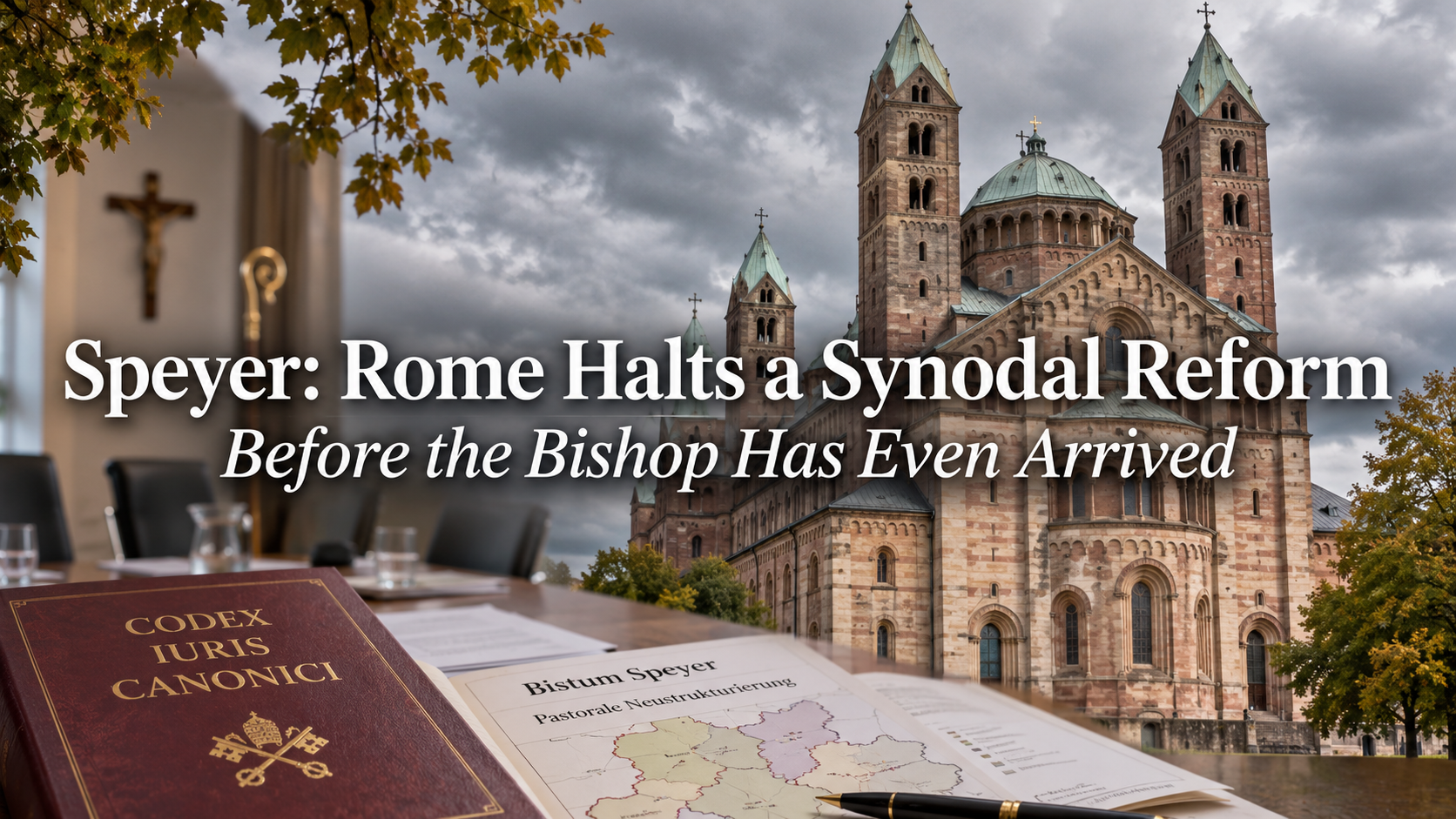
The Apostolic Nuncio has suspended a German diocese’s plan to replace seventy parishes with nine, provoking complaints that Rome has disregarded two years of consultation. Yet the dispute exposes a more fundamental difficulty in contemporary ecclesiastical government: the growing assumption that participation in a consultation confers authority over decisions which belong to a bishop.
More than 3,500 submissions, five working groups and two years of consultation have brought the Diocese of Speyer to an unexpected halt. On 11 November, the Apostolic Nunciature in Germany directed the diocese to suspend its ambitious parish restructuring programme until a new bishop takes office. Diocesan Administrator Markus Magin has accepted the instruction, although with considerable reluctance, complaining that the interruption undermines the principles of synodality which the programme was intended to embody. He fears that the work undertaken since 2024 may be delayed by years, leaving an already diminished diocese unable to address its mounting financial and pastoral difficulties.¹
The intervention concerns a scheme entitled Ein Segen sollt ihr sein (You Shall Be a Blessing), under which Speyer’s seventy existing parishes would be replaced by nine much larger territorial entities. The boundaries would broadly follow those of the existing deaneries, with local communities continuing to provide centres for religious activity while the new parishes assumed responsibility for administration and pastoral coordination. The diocese has approximately 423,000 Catholics, although the number continues to decline, and its leaders argue that diminishing resources and fewer priests make the existing arrangements unsustainable.²
In June 2026, the diocesan assembly unanimously approved the principal proposals. Bishop Karl-Heinz Wiesemann welcomed the agreement, describing the proposed restructuring as a considerable undertaking requiring courage. The assembly called for an implementation plan to be prepared by 31 October, and Wiesemann subsequently adopted its recommendations, declaring them binding as the basis for the diocese’s continuing work. His resignation, accepted by Pope Leo XIV on 19 August for reasons of health, consequently left an extensive programme already under way but without the diocesan bishop whose authority would be required to implement its most consequential decisions.³
This distinction is important, because the programme had progressed considerably beyond an initial consultation. Its proposed leadership arrangements would establish a three-person professional executive in each new parish, comprising a priest, a pastoral officer and an administrative director, with additional participation by volunteers. A parish synodal council would share responsibility for leadership, while a separate administrative council would oversee financial affairs. The leading priest and pastoral officer would ordinarily be appointed for periods of up to six years, renewable once. These are substantial alterations to the organisation of parish life, including the relationship between those who exercise pastoral care by virtue of sacred orders and those appointed to administrative or consultative responsibilities.²
The question of how far the programme might proceed during an episcopal vacancy was already being tested before the nuncio intervened. On 29 October, the diocesan newspaper Der Pilger reported that members of the former diocesan assembly had been invited to meet again on 31 October, notwithstanding the expiry of the assembly’s formal mandate following Wiesemann’s resignation. Magin had asked them to continue advising him informally. Among the matters scheduled for consideration were an implementation timetable and criteria for establishing the new local communities. The former assembly had possessed fifty-eight voting members and exercised the functions of the diocesan pastoral council. It was now being invited to continue discussions concerning decisions of considerable consequence, although its former canonical status had ceased.⁴
There is no inherent impropriety in seeking advice from former members of a dissolved council. Their knowledge and experience do not disappear when the office of the diocesan bishop falls vacant. Nevertheless, the continued development of an agreed programme, particularly one involving the suppression of sixty-one parishes, raises questions which cannot be settled by describing the meetings as informal. Preparing options for an incoming bishop is one thing. Advancing a timetable for implementing a programme already declared binding by his predecessor may be another.
Archbishop Hubertus van Megen, the Apostolic Nuncio, evidently considered that distinction sufficiently serious to require intervention. According to the account published by the diocese, his correspondence raised canonically founded concerns that further work could create expectations, initiate changes and establish personal commitments capable of restricting the incoming bishop’s freedom. The nuncio also recalled that the erection, suppression and substantial alteration of parishes belong to the diocesan bishop, and that the presbyteral and diocesan pastoral councils cease upon the vacancy of the see. His stated concern was to protect the freedom and responsibility of the next bishop in making decisions of such magnitude.⁵
The principle is established in canon 428 of the 1983 Code of Canon Law: Sede vacante, nihil innovetur. Nothing is to be altered while the episcopal see is vacant. The same provision prohibits those governing the diocese temporarily from undertaking anything prejudicial to the diocese or to episcopal rights. Canon 427 confers extensive powers upon a diocesan administrator, but expressly excludes matters reserved by their nature or by law. The intention is to ensure continuity of ecclesiastical government without allowing temporary administration to determine questions properly belonging to the successor.⁶
There is nothing particularly novel about this principle. It appeared in canon 436 of the 1917 Code and reflects the older canonical understanding that the rights of episcopal office must be preserved during an interregnum. The Church has accumulated considerable experience of the difficulties which arise when those administering a vacant see attempt to bind a successor. The provision is therefore concerned with preserving the constitutional order of ecclesiastical government, rather than merely preventing administrative inconvenience.
Canon 515 §2 reserves the erection, suppression and substantial alteration of parishes to the diocesan bishop, who must first consult the presbyteral council. Canon 501 §2 provides that this council ceases when the see becomes vacant, its functions passing to the college of consultors. The diocesan pastoral council likewise ceases under canon 513 §2. These provisions establish that the mechanisms for consultation are themselves subject to the constitutional circumstances in which they operate. They cannot simply be prolonged in their former capacity because their members believe the work unfinished.⁷
Magin’s argument deserves consideration on its actual terms. He maintains that the programme could have continued through preparatory work, with every substantial or legally binding decision reserved to the incoming bishop. He also relies upon Wiesemann’s express instruction that the reform should proceed. The latter fact should not be overlooked: the programme was undertaken with episcopal approval, and its continuation was not simply an initiative devised by an administrator after the vacancy arose. Yet the endorsement of a reform programme is distinct from the individual canonical acts required to bring its proposals into legal effect. A predecessor’s general direction cannot extinguish the proper authority of his successor over decisions still awaiting implementation.
Nor does an incoming bishop exercise his authority in genuine freedom merely because his signature remains formally necessary. After two years of consultation, unanimous votes and considerable organisational preparation, expectations will inevitably have formed. Priests, pastoral employees and lay representatives may have committed themselves to a particular outcome. The suggestion that the next bishop should simply receive the completed plans and decide whether to approve them is less straightforward than it appears. Any substantial departure from those plans could be represented as a rejection of the work and goodwill of thousands of Catholics, notwithstanding his canonical responsibility to examine the proposals independently.
This difficulty would exist even if every participant acted with complete sincerity. Institutional expectations acquire their own momentum, particularly when the public has repeatedly been assured that a reform represents the agreed future of the organisation. The next Bishop of Speyer should be able to consider the evidence collected during the consultation without being placed in the position of having to justify himself for declining to endorse conclusions reached before his appointment.
There is a further canonical difficulty which deserves considerably more attention than the immediate disagreement over synodality. In July 2020, the Congregation for the Clergy published its instruction The Pastoral Conversion of the Parish Community in the Service of the Evangelising Mission of the Church. The document expressly requires specific written decrees for the suppression of individual parishes and rejects the use of a single general administrative act to accomplish a comprehensive diocesan reorganisation. It further explains that where parishes are suppressed through absorption into others, general diocesan financial difficulties or an overall shortage of priests do not, of themselves, constitute sufficient grounds. The reasons must be properly connected with the circumstances of the particular parishes concerned.⁸
Speyer’s proposed reduction from seventy parishes to nine requires examination against those provisions. The magnitude of the undertaking does not establish its illegitimacy, and there may well be individual parishes whose circumstances justify amalgamation. The diocese’s financial and demographic problems are sufficiently serious to require attention. But neither those difficulties nor the unanimous approval of a general proposal relieve the competent bishop of his obligation to examine each suppression according to law.
The juridical status of a parish is not an administrative convenience which may be discarded merely because larger units promise economies of scale. Canon 515 §3 recognises the juridical personality of a legitimately erected parish. The 2020 instruction also requires proper provision for ecclesiastical property and safeguards concerning the continued availability of churches for worship. Such matters cannot be settled satisfactorily by assurances that the former parishes will survive under the less definite designation of local communities.
A local community may retain its name, buildings and established customs while nevertheless losing the canonical arrangements which formerly secured its pastoral life. The ordinary faithful are likely to judge the consequences according to rather more immediate considerations: whether a priest remains available, whether Mass continues to be offered regularly, whether confession can be obtained without considerable difficulty and whether the sick may receive the sacraments when they need them. These are matters which must enter into the bishop’s judgement before administrative savings are treated as pastoral achievements.
The proposed leadership model introduces a related ecclesiological question. Catholic law permits extensive lay participation in parish administration and pastoral cooperation, and such assistance may be indispensable where priests are few. Canon 519 nevertheless identifies the parish priest as the proper pastor of the community entrusted to him, exercising the functions of teaching, sanctifying and governing under the diocesan bishop. Canon 536 provides that the parish pastoral council possesses a consultative vote. The 2020 instruction similarly insists upon preserving the proper responsibilities of the priest where pastoral care is shared with persons who have not received priestly ordination.⁹
Speyer’s intention that a parish synodal council should share leadership responsibility therefore demands careful examination. Much depends upon the precise powers proposed for the council and the relationship of its decisions to the authority of the priest. It cannot be presumed from the terminology alone that universal law has been contravened, but neither can such questions be dismissed as merely technical. A body whose authority is consultative cannot acquire governing powers simply by being given a new name. Likewise, the proposed limitation of leading priests to successive six-year appointments must be considered in relation to canon 522, which establishes the principle of stability in the office of parish priest and permits fixed terms under specified canonical conditions.⁹
The difficulties consequently extend beyond the suspension of a programme. They concern the understanding of ecclesiastical authority upon which the programme has been constructed. Modern synodal language frequently speaks of participation, shared responsibility and common discernment, while leaving insufficiently defined the point at which consultation ends and governing authority begins. The distinction is essential to Catholic ecclesiology. The lay faithful have their proper apostolate and recognised rights within the Church, including the right to make their needs and opinions known to their pastors. Their baptismal dignity does not confer the episcopal office upon an assembly, nor does the contribution of clergy and laity collectively transform a consultative body into the canonical governor of a diocese.
The Second Vatican Council reaffirmed in Lumen gentium §27 that diocesan bishops exercise proper, ordinary and immediate authority in the particular Churches entrusted to them, subject to the supreme authority of the Church. The bishop governs personally in Christ’s name. His responsibility includes consultation, prudence and attention to the faithful, but it remains his responsibility. The nature of episcopal office cannot be revised through the administrative machinery of a diocesan programme, however popular that programme may become.¹⁰
This makes Magin’s appeal to synodality particularly revealing. He has criticised the nuncio’s failure to consult diocesan representatives before directing the suspension, arguing that the intervention contradicts the understanding of synodality advanced during the 2023–24 Synod of Bishops. Yet the purpose of the intervention, as the nuncio reportedly explained, is to preserve the authority of the bishop who has not yet arrived. The complaint effectively assumes that those already engaged in the programme possess a claim to continue directing its development which the future bishop’s rights must somehow accommodate.
Consultation certainly benefits from openness, and Rome might have explained its intentions more fully to those concerned. The distinction between permissible preparatory work and steps capable of prejudicing a successor is one which deserves clear explanation. Nevertheless, the canonical authority of the Apostolic See does not depend upon the agreement of the diocesan bodies whose activities it is regulating. Synodality cannot reasonably be invoked to require consultation before every exercise of hierarchical authority, particularly when the question concerns the preservation of that authority itself.
Behind the procedural controversy lies the much greater problem of the condition of Catholic life in Germany. Speyer’s difficulties are by no means exceptional. Declining Mass attendance, falling membership, fewer priests and the financial consequences of these developments have encouraged numerous dioceses to consolidate parishes and establish larger administrative units. The assumption underlying much of this work is that the Church must organise herself around the resources she now possesses, rather than those upon which her older parochial arrangements were founded.
There is an unavoidable practical logic in this, although the pastoral consequences deserve closer scrutiny. A diocese which continually reduces its local sacramental provision in response to declining participation may find that the resulting arrangements make participation more difficult still. Administrative centralisation cannot supply what is lacking in religious conviction, priestly vocations or the transmission of the Faith. Nor does a larger parish necessarily constitute a more vigorous Christian community. The measures by which a restructuring is considered successful must therefore extend beyond the balancing of accounts and the efficient deployment of personnel.
The Church’s supreme law remains the salvation of souls. A bishop considering the future of his parishes must attend to their finances and property, but his principal responsibilities concern the preservation and propagation of the Catholic Faith and the sanctification of the people entrusted to him. Any proposed reform which makes the Church’s sacramental life less accessible requires particularly serious justification. The scale of a parish and the professional sophistication of its administration are secondary considerations when compared with the actual care of souls.
The Apostolic Nunciature has not condemned Speyer’s proposed restructuring, nor has it determined that the nine-parish model can never be implemented. Its direction concerns the continuation of the reform during the vacancy of the episcopal see. The consultations already completed, including the substantial body of material contributed by clergy and laity, remain available to the incoming bishop. He will be able to examine them, commission further work where necessary and decide which proposals may properly be adopted.¹
What the present administration cannot demand is that his freedom should be measured by his willingness to endorse the outcome already preferred by his predecessor’s advisers. The next Bishop of Speyer must be permitted to ask whether the proposed arrangements satisfy the requirements of canon law, preserve the proper office of the parish priest and genuinely provide for the pastoral needs of the faithful. He may conclude that some changes are necessary and others undesirable. He may even regard much of the existing scheme as suitable for implementation. Those are judgements belonging to the authority and responsibilities of his office.
The diocesan leaders who have expressed disappointment at the nuncio’s instruction have invested considerable effort in their programme, and the practical problems which prompted it remain unresolved. Their work need not be wasted. But if synodality is to possess any coherent meaning within Catholic ecclesiology, those participating in it must recognise the distinction between contributing to the government of the Church and possessing the authority to govern her.
Speyer has spent two years consulting about the future of its parishes. The bishop who will have to answer for that future has yet to take office. His right to decide should have been among the first considerations of the consultation, rather than becoming an objection raised by Rome at its conclusion.
FOOTNOTES
- Diocese of Speyer, ‘Stopp für die Strukturreform „Ein Segen sollt ihr sein“’, 11 November 2026, reproduced in Speyer-Kurier
- Vatican News, ‘Künftig nur noch neun Pfarreien im Bistum Speyer’, 15 June 2026
- Archdiocese of Paderborn, ‘Papst nimmt Rücktrittsgesuch von Speyers Bischof Dr. Karl-Heinz Wiesemann an’, 19 August 2026
- Der Pilger, ‘Pfarreistrukturreform-Beratungen gehen weiter’, 29 October 2026
- Katholisch.de, ‘Nuntius stoppt Pfarreireformprozess im Bistum Speyer’, 11 November 2026
- Code of Canon Law (1983), Canons 427–428
- Code of Canon Law (1983), Canons 501, 513 and 515
- Congregation for the Clergy, ‘The Pastoral Conversion of the Parish Community in the Service of the Evangelising Mission of the Church’, 20 July 2020, §§47–51
- Code of Canon Law (1983), Canons 519, 522 and 536
- Second Vatican Council, Lumen gentium, 21 November 1964, §27





Leave a Reply