
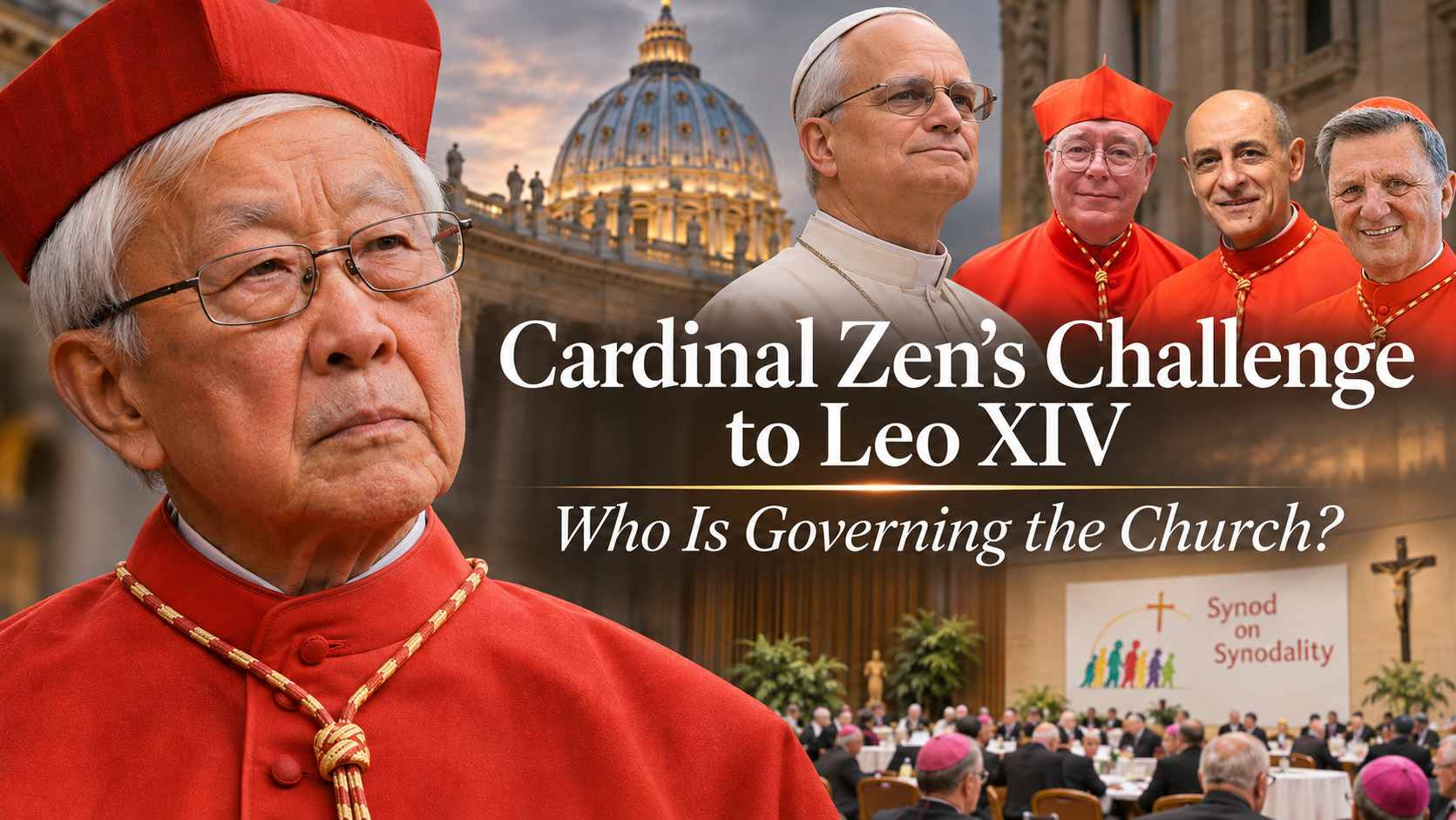
The Bishop Emeritus of Hong Kong has called upon Pope Leo XIV to end the Synod on Synodality and replace three of its most influential figures. His intervention raises a question Rome has yet to answer satisfactorily: how has a process of consultation acquired such influence over ecclesiastical government, and who is responsible when its recommendations threaten the integrity of Catholic doctrine?
Cardinal Joseph Zen has suggested that Pope Leo XIV should give Cardinals Mario Grech and Jean-Claude Hollerich a long holiday. His recommendation concerning Cardinal Víctor Manuel Fernández is rather less charitable towards the latter’s employment prospects: the Prefect of the Dicastery for the Doctrine of the Faith should be replaced. At 94, the Bishop Emeritus of Hong Kong has earned a certain liberty of expression, although his latest intervention is considerably more serious than the prospect of three eminent churchmen finding themselves with unexpected leisure. He wants the Synod on Synodality brought to an end, and his reasons concern the very constitution of the Catholic Church.¹
Writing on the feast of St Charles Borromeo, 4 November, Zen begins with the Council of Trent and the work required to implement its decrees. The sixteenth-century Church was confronting Protestant heresy, widespread deficiencies in clerical formation and abuses which could no longer be excused or ignored. Trent provided authoritative doctrinal judgements and disciplinary reforms. Their practical implementation depended upon bishops prepared to exercise their office, and few did so more thoroughly than Charles Borromeo, Archbishop of Milan.
The comparison with the Second Vatican Council is deliberate. Zen considers that its proper reception has been frustrated by those who claim to be continuing its reforms while promoting ideas which cannot be reconciled with Catholic Tradition. He praises the efforts of Paul VI, John Paul II and Benedict XVI to secure a faithful implementation, particularly through the work associated with Cardinal Joseph Ratzinger and the publication of the Catechism of the Catholic Church. His judgement upon Francis is considerably harsher. Although acknowledging the late Pope’s concern for the poor and vulnerable, Zen argues that his pastoral priorities permitted compassion to become an excuse for compromising doctrine.
He goes further, accusing Francis of having destroyed achievements of his predecessors, particularly by transforming the Synod of Bishops into an exercise in general consultation whose relationship with the Church’s apostolic constitution has become increasingly uncertain.
This is where Zen’s argument becomes especially interesting, because his complaint concerns the very nature of a synod.
Paul VI established the Synod of Bishops in September 1965 through Apostolica Sollicitudo, providing a permanent institution through which bishops from throughout the world could assist the Roman Pontiff in governing the universal Church. Its membership, constitution and procedures were subsequently developed, but its distinctly episcopal character remained fundamental to its purpose.²
Francis substantially altered the institution’s operation. The Synod on Synodality involved extensive consultation of the faithful, continental assemblies, expert facilitation and voting participation by members who were not bishops. Such developments were presented as expressions of the Church’s vocation to listen and discern together.
Zen believes that something essential has been lost in the process. The Pope’s knowledge of the faithful should ordinarily be mediated through the bishops, whose pastoral responsibility involves knowing their people, teaching them the faith and bringing their concerns to the Successor of Peter.
He recalls Francis’s familiar observation about shepherds knowing the smell of their sheep, then points out that a Pope in Rome cannot acquire this knowledge directly from every Catholic throughout the world. Bishops, however, are responsible for particular flocks and possess a pastoral relationship with them. Their office involves more than representing the opinions of those entrusted to their care. They must teach, correct, sanctify and govern according to the faith received from the Apostles.
The point is grounded in Catholic ecclesiology. Bishops are successors of the Apostles, entrusted by divine institution with responsibilities which cannot be transferred to a consultative assembly. Other members of the faithful possess genuine rights of consultation and participation, but these do not confer episcopal office or the authority proper to it.
A Pope may consult whomever he wishes. There is considerable wisdom in listening to the experience of lay Catholics, religious, priests and those whose difficulties are insufficiently understood by ecclesiastical authorities. Their participation, however, does not alter the source of episcopal authority, nor can consultation become an independent means of determining the content of revealed doctrine.
Strictly speaking, Zen’s claim that Francis abolished the Synod of Bishops is inaccurate if understood juridically. The institution remains in existence, and the Holy See continues to regulate its authority and membership. What Zen describes is a transformation of its practical character. An institution founded principally to assist the Pope through the counsel of bishops has become the principal vehicle for a wider programme intended to reshape the Church’s habitual exercise of government.
That distinction identifies precisely what requires examination.
Nor is this the first occasion on which Zen has challenged the manner in which synodal methods affect episcopal responsibility. During Leo XIV’s Extraordinary Consistory in June, he criticised procedures which he considered excessively controlled, objecting to the organisation of discussion in ways that prevented bishops from exercising genuine theological judgement.
Nuntiatoria examined that intervention in When Process Replaces Judgment: Cardinal Zen’s Warning, the Synodal Consistory, and the Crisis Rome Refuses to Confront, published on 26 June. The central question was whether the arrangement of conversations had begun to substitute for the exercise of government. Zen objected to an ecclesiastical procedure in which participants were invited to speak, their contributions were mediated through organised discussion and the resulting summaries were presented as expressions of communal discernment.³
The present intervention develops that objection. Zen alleges that the synodal process was managed to advance objectives which its assemblies were unwilling to endorse. He identifies women’s ordination, clerical celibacy, the Church’s hierarchical constitution and proposals associated with contemporary sexual morality. His accusation of deliberate manipulation is serious and remains his judgement; the establishment of study groups does not itself prove that the proceedings were secretly controlled. It is nevertheless a matter of record that Francis transferred several disputed questions to specially constituted groups, whose work continued beyond the conclusion of the synodal assemblies.
These groups have permitted the synodal method to operate after the assembly itself dispersed. The General Secretariat of the Synod acquired a continuing responsibility for implementation, while expert bodies examined questions whose theological and disciplinary implications extend considerably beyond the organisation of another meeting.
Nuntiatoria has already traced this development. In September’s A Name on the Letterhead: Grech, Farrell and the Synodalisation of Amoris Laetitia, we examined reporting that Cardinal Grech’s Secretariat had acquired considerable practical influence over preparations for the October gathering on Amoris Laetitia, formally entrusted to Cardinal Kevin Farrell’s Dicastery for the Laity, Family and Life.⁴ The allegations concerning the division of preparatory work could not independently be established, although the Vatican’s published arrangements confirmed that Grech’s office had been assigned an organisational and methodological role.
The significance was never the possibility of rivalry between two Curial departments. Vatican offices have occasionally disagreed about their responsibilities, and it would be surprising if the present administration had discovered a permanent cure for that particular ailment. The concern was the increasing capacity of the Synod Secretariat to influence the framing, discussion and eventual reception of questions extending beyond the original synodal assemblies.
Nor can responsibility for that development be placed exclusively upon Grech. Leo XIV himself authorised the continuation of the synodal method and its application to the reception of Amoris Laetitia. The cardinals operate under papal mandates. The Pope cannot be separated from the programme carried out in his name.
Zen’s immediate objection has been sharpened by the publication, on 5 May 2026, of the final report of Study Group 9, concerning theological criteria and synodal methodologies for addressing emerging doctrinal, pastoral and ethical questions.⁵
The report proposes a significant change in approach. Rather than beginning principally with the identification and correction of doctrinal or ethical problems, it recommends attending to the experiences of those involved, recognising elements of goodness and allowing these encounters to contribute to theological discernment. Its authors explicitly describe this as a paradigm shift.
The choice of language matters because its implications depend upon the authority accorded to experience.
There is nothing unorthodox about recognising that theologians and pastors must understand the circumstances of the people to whom they minister. Catholic moral theology has always distinguished the objective character of an act from the subjective responsibility of the person performing it. Circumstances may affect culpability, reveal pastoral needs and require considerable prudence in applying established principles.
The difficulty arises when experience begins to supply the criterion by which those principles are reconsidered. A person’s sincerity cannot establish the moral goodness of an act, nor does evidence of affection within a relationship determine whether its sexual expression accords with the natural and divine law.
Study Group 9 illustrates why this distinction matters. Among its published supporting materials are testimonies from Catholics describing same-sex relationships, their personal experiences of faith and their encounters with ecclesiastical authority. Zen objects particularly to material which he interprets as portraying homosexual sexual conduct as a gift from God. His language is severe, and he asks how such an idea could appear in a publication issued under the authority of the Holy See.
The report itself does not formally promulgate that proposition as Catholic doctrine. Its authors expressly decline to offer definitive pronouncements, instead proposing further questions and pathways for discernment. Nevertheless, their methodology gives considerable importance to the experiences presented and encourages local communities to recognise goodness through the process of listening.
The theological problem is consequently more substantial than the inclusion of a disputed testimony. If experience becomes an important starting point for reconsidering moral questions, what prevents the conclusions from contradicting principles which the Church has already authoritatively taught?
The report contains language which makes the concern reasonable. Its account of the principle of pastorality proposes that the starting point should be the recognition of goodness within concrete experiences rather than the correction of situations considered doctrinally or ethically problematic. Authority is described principally in terms of listening, facilitating discernment and accompanying the search for consensus.
Such methods may assist pastoral understanding. Yet they cannot determine the moral character of conduct independently of the revealed and natural law. Where a practice contradicts Catholic doctrine, recognition of whatever good may be present in the lives of those involved cannot transform that practice into something morally permissible.
The Church’s teaching does not become provisional whenever a sufficiently compelling personal narrative is presented.
Zen connects this development with Fiducia Supplicans, the declaration issued by Cardinal Fernández’s Dicastery in December 2023. The document permitted certain spontaneous, non-liturgical blessings of couples in irregular situations, including same-sex couples, while insisting that these must neither validate the unions nor resemble marriage rites.⁶
Its reception demonstrated how difficult that distinction could become in practice. Several episcopal conferences, especially in Africa, resisted implementation, arguing that the circumstances and public meaning of such blessings would communicate approval of relationships which Catholic doctrine cannot recognise as marriages.
The controversy did not depend upon denying that sinners may receive blessings. It concerned the meaning of blessing two persons together when their relationship was the very circumstance distinguishing their request from an ordinary individual blessing.
That theological problem has never been satisfactorily resolved simply by insisting that the declaration does not change doctrine. A document may affirm the permanence of doctrine while introducing pastoral practices whose public meaning appears to contradict it. The difficulty then becomes one of credibility, particularly when those charged with explaining the distinction cannot secure a consistent understanding of its practical application.
The same pattern appeared after Amoris Laetitia. Some episcopal conferences interpreted its eighth chapter as permitting sacramental access in circumstances which earlier magisterial teaching had excluded, while others maintained the previous discipline. Francis subsequently approved the interpretation of the bishops of the Buenos Aires pastoral region, which allowed sacramental access in certain cases where continence was not maintained. The criteria and the Pope’s approving letter were published in the Acta Apostolicae Sedis, accompanied by a rescript identifying the documents as authentic Magisterium.⁷
Whatever theological judgement is reached concerning that development, it establishes that the controversy was never merely the product of misunderstanding. Differing sacramental practices had arisen from competing interpretations, and Rome eventually endorsed one of them.
Zen fears that the continuing implementation of synodality will multiply such divergences. His warning about the Anglican Communion is particularly revealing. He believes the decentralised application of synodal recommendations risks producing doctrinal differences between national Churches whose institutional association conceals an increasingly uncertain common faith.
The comparison has limits. The Catholic Church possesses a universal primacy and a magisterial constitution which the Anglican Communion does not share. Episcopal conferences cannot independently redefine Catholic doctrine, and legitimate differences of discipline should not be confused with disagreements concerning revealed truth.
Yet that is precisely why the comparison deserves consideration. The Catholic Church already possesses authoritative means of resolving such disputes. If they remain unresolved while contradictory pastoral practices become established, the problem concerns the willingness to exercise authority already possessed.
There is another significant fact which deserves attention. On 25 November 2024, Francis issued a note accompanying the Final Document of the Synod’s Sixteenth Ordinary General Assembly. He expressly declared that the document would form part of the ordinary Magisterium of the Successor of Peter, while explaining that its provisions were not strictly normative and would require implementation according to particular circumstances.⁸
This is important because it establishes a distinction sometimes obscured in discussions of synodality. The final document did not acquire magisterial authority simply because its participants had achieved consensus or because a synodal procedure had been followed. Its authority came through the express approval of the Roman Pontiff, under the provisions of Episcopalis Communio.
The Pope possesses the authority to approve such a document, and the exercise of his ordinary Magisterium demands the response appropriate to its doctrinal content and authoritative character. Yet incorporation into the ordinary Magisterium does not render every prudential proposal, methodological recommendation or administrative arrangement an irreformable teaching.
It follows that the study groups occupy a different position. Their reports are preparatory and advisory documents, without an independent authority to determine doctrine. The theological assumptions underlying their recommendations must therefore be examined according to the Church’s existing doctrinal principles before any subsequent papal decision.
The distinction becomes particularly important when a report proposes to reconsider the methods by which theological and moral questions are judged. A methodology cannot confer authority upon itself, however frequently its conclusions invoke the Holy Spirit.
Zen’s criticism of Cardinal Fernández belongs within this larger problem.
Upon appointing Fernández Prefect of the Dicastery for the Doctrine of the Faith in July 2023, Francis issued an unusual letter setting out his expectations. He criticised earlier methods of doctrinal investigation and encouraged the new Prefect to promote theological understanding and constructive engagement with contemporary questions.⁹
Zen regards this as a departure from the Dicastery’s historic responsibility for defending Catholic doctrine. Francis’s letter, however, expressly retained the obligation to safeguard the faith, a responsibility also established in the apostolic constitution Praedicate Evangelium. The controversy concerns emphasis and execution rather than the formal abolition of doctrinal oversight.
Nevertheless, the appointment letter is revealing because it expresses assumptions underlying much of Francis’s ecclesiastical programme. Theological development is encouraged through dialogue, contextual understanding and an approach less concerned with identifying errors. These priorities are not inherently contrary to Catholic doctrine. Everything depends upon whether they remain subordinate to the Church’s obligation to preserve what has been revealed.
The difficulty becomes apparent whenever theological innovation and pastoral experimentation encounter teachings which the Church has already authoritatively maintained.
Nuntiatoria’s recent examination of the dispute between Fernández’s Dicastery and the Society of St Pius X has raised a related question about the consistent exercise of doctrinal and canonical authority. The SSPX’s episcopal consecrations without papal mandate present serious questions of ecclesiastical discipline and communion. The Holy See possesses both the right and responsibility to address them, just as it possesses the duty to correct doctrinal error wherever it occurs.
Yet canonical regularity and fidelity to Catholic doctrine must be distinguished. The possession of legitimate ecclesiastical office cannot make an erroneous theological proposition orthodox, any more than a defence of orthodox doctrine can authorise disobedience to legitimate ecclesiastical government. The Church must preserve both, and her credibility suffers when one appears to receive considerably more attention than the other.
This leads to the larger historical problem Nuntiatoria has identified in its examination of post-conciliar official theology.
Theological propositions need not be formally defined to acquire considerable institutional power. They may become established through seminary formation, episcopal policies, educational materials, administrative appointments and the habitual language of official Church documents. Over time, clergy and faithful may encounter them as the normal interpretation of Catholic teaching, although their precise magisterial standing remains uncertain.
The distinction between an authoritative teaching and an influential theological opinion is particularly important in a Church whose fidelity depends upon receiving and transmitting a deposit of faith entrusted to her by Christ.
The synodal process adds a further institutional mechanism through which such opinions may acquire practical influence. Working groups gather testimony, theologians formulate recommendations, administrators develop implementation procedures, and episcopal conferences incorporate the results into local programmes. Formal doctrine may remain unchanged throughout, while the assumptions governing its pastoral application are gradually altered.
No conspiracy need be presumed to recognise the danger. Indeed, the process may be more difficult to correct precisely because its participants are persuaded that they are doing what the Church now expects of them. Once a particular theological method becomes embedded within ecclesiastical administration, disagreement may be interpreted as resistance to the process itself rather than examined for its doctrinal merits.
Consultation properly assists those who possess authority to exercise it wisely. It cannot relieve them of responsibility for the judgements which follow.
The Church has never understood doctrinal development as the discovery that yesterday’s definitive teaching has become today’s negotiable proposition. St Vincent of Lérins distinguished genuine growth in understanding from alteration of meaning, while the First Vatican Council reaffirmed that sacred dogmas must retain the sense once declared by the Church. This principle does not prohibit theological investigation. It establishes the conditions under which such investigation remains Catholic.¹⁰
Nor does the appeal to the Holy Spirit settle every dispute. The Church enjoys divine assistance in the fulfilment of her mission, and the gates of hell shall not prevail against her. That promise does not guarantee the prudence of every ecclesiastical administrator, the orthodoxy of every published theological opinion or the suitability of every programme proposed in the name of reform.
It certainly does not confer infallibility upon a study group.
Zen’s experience of ecclesiastical government has been shaped by the struggle to preserve the Church’s freedom and integrity under political pressure. In China, he has consistently opposed efforts to subordinate ecclesiastical authority to structures whose legitimacy derives from the state rather than the apostolic constitution of the Church.
He now fears a different kind of displacement: the increasing influence of ecclesiastical machinery which, although operating under papal authority, risks diminishing the direct responsibility of bishops for preserving and transmitting the faith.
The comparison should not be pressed beyond its proper limits. Vatican study groups are not instruments of the Chinese Communist Party, and their members have been appointed through legitimate ecclesiastical procedures. Zen’s understanding of apostolic authority nevertheless explains why he regards the matter as something considerably more serious than a disagreement about pastoral methodology.
His concluding appeal is directed towards Leo XIV because the present Pope possesses the responsibility to determine what becomes of the institutions inherited from Francis. Grech, Hollerich and Fernández are not independent authorities conducting an ecclesiastical programme beyond papal control. Their responsibilities derive from appointments and mandates which the Roman Pontiff can modify or withdraw.
Leo has already permitted the synodal process to continue. Indeed, by authorising its further implementation, he has increasingly made it a policy of his own pontificate. He cannot indefinitely treat its future as a question belonging to his predecessor.
The controversy has now moved beyond the relative merits of particular proposals. It concerns how the Church is governed when those proposals generate serious disagreement over matters of faith and morals. Who determines whether a study group’s theological premises are compatible with Catholic doctrine? Who decides when consultation has produced sufficient information for an authoritative judgement? Who takes responsibility when episcopal conferences adopt practices which appear difficult to reconcile with one another?
These are responsibilities belonging to the pastors of the Church, and ultimately to the Roman Pontiff where the universal Church is concerned. They cannot be discharged by permanent recourse to the General Secretariat of the Synod.
Zen’s choice of St Charles Borromeo is consequently more illuminating than the controversy over the three cardinals might initially suggest. Borromeo understood that the Council of Trent required faithful implementation by those charged with the care of souls. His reforms addressed concrete failures in clerical formation, ecclesiastical discipline and pastoral government because the doctrinal principles guiding them were sufficiently clear to be enforced.
What Zen sees in the present Church is an extraordinary proliferation of mechanisms for discussing reform, accompanied by an increasing reluctance to determine where legitimate pastoral development ends and contradiction of received doctrine begins.
His proposed remedy may be abrupt, and removing three cardinals would hardly resolve problems which have developed over decades. Yet his argument cannot be dismissed as a disagreement between elderly traditionalists and enthusiastic reformers. It concerns the relationship between divine revelation, apostolic authority and the exercise of ecclesiastical government.
Leo XIV possesses the authority to determine the future of the synodal programme. He must also ensure that the structures operating under his authority remain faithful to the purposes for which ecclesiastical authority exists.
Whatever he decides concerning the three cardinals, that responsibility remains. The succession of Peter exists to confirm the brethren in the faith. Consultation may assist that responsibility, sometimes considerably. It cannot indefinitely postpone its exercise.
- Cardinal Joseph Zen, While Remembering St Charles Borromeo, English text, 6 November 2026; 懷念聖嘉祿・鮑榮茂有感, Chinese-language version, 8 November 2026; Michael Haynes, Cardinal Zen calls for Leo to remove three leading Cardinals, The Catholic Herald, 9 November 2026.
- Pope Paul VI, Apostolica Sollicitudo, 15 September 1965; Pope Francis, Episcopalis Communio, 15 September 2018.
- Nuntiatoria, When Process Replaces Judgment: Cardinal Zen’s Warning, the Synodal Consistory, and the Crisis Rome Refuses to Confront, 26 June 2026; The Cardinals Find Their Voice: Leo XIV’s Second Consistory and the Return of Judgement, 28 August 2026.
- Nuntiatoria, A Name on the Letterhead: Grech, Farrell and the Synodalisation of Amoris Laetitia, 6 September 2026.
- General Secretariat of the Synod, Theological Criteria and Synodal Methodologies for Shared Discernment of Emerging Doctrinal, Pastoral, and Ethical Issues, Study Group 9, 5 May 2026; The Selection of Bishops and the Handling of Emerging Doctrinal, Pastoral and Ethical Questions, 5 May 2026.
- Dicastery for the Doctrine of the Faith, Fiducia Supplicans, 18 December 2023.
- Pope Francis, Amoris Laetitia, 19 March 2016, §§300–305; Acta Apostolicae Sedis, 108 (2016), pp. 1071–1074, containing the Buenos Aires pastoral criteria and the papal letter, with the rescript of 5 June 2017.
- Pope Francis, Note to Accompany the Final Document of the Sixteenth Ordinary General Assembly of the Synod of Bishops, dated 24 November and published 25 November 2024; Episcopalis Communio, Article 18.
- Pope Francis, Letter to the New Prefect of the Dicastery for the Doctrine of the Faith, 1 July 2023.
- St Vincent of Lérins, Commonitorium, XXIII; First Vatican Council, Dei Filius, Chapter IV, 24 April 1870.





Leave a Reply