
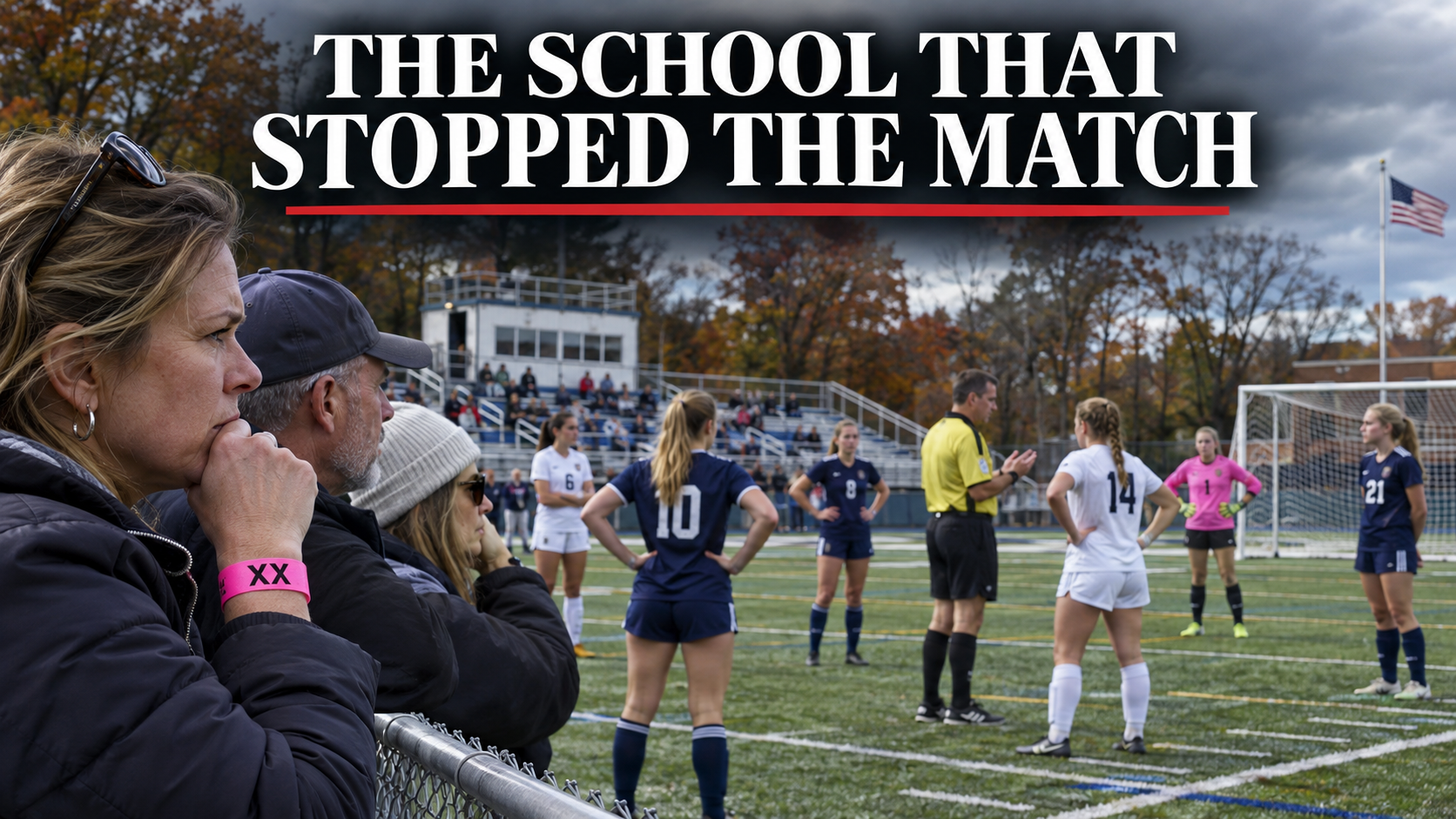
New Hampshire school officials interrupted a girls’ football match to suppress a silent protest against a male pupil’s participation. Two years later, a federal judgment has established that the parents’ constitutional rights were violated. The case exposes the consequences when educational authorities come to regard disagreement about biological sex as a form of harassment.
On 17 September 2024, three spectators at a girls’ football match in New Hampshire put on pink wristbands bearing the letters ‘XX’. They were protesting against the participation of a biologically male pupil on the visiting Plymouth Regional High School girls’ team. They waited until half-time, made no attempt to confront the pupil, and neither shouted nor interrupted the game. School officials nevertheless demanded that the wristbands be removed. A police officer became involved, the referee eventually stopped play, and both teams were sent to their benches. The match resumed approximately fifteen minutes later, once the remaining protester had complied with the demand to remove his wristband.¹
There is something faintly ridiculous about an administration interrupting a sporting fixture to protect it from people who were not interrupting it. The consequences, however, were serious. Kyle Fellers and Anthony Foote subsequently received orders excluding them from school property and sporting events. For Fellers, whose daughter was completing her final year at Bow High School, that meant missing approximately half her remaining football matches. Whatever the outcome of subsequent litigation, those occasions were gone.
On 5 November 2026, United States District Judge Steven J. McAuliffe entered a stipulated declaratory judgment in Fellers v. Kelley, establishing that Bow School District had violated the plaintiffs’ First Amendment rights. The judgment specifically protects their freedom to wear pink ‘XX’ wristbands silently at district sporting events, including beside the pitch, in spectator areas and in car parks. It binds the district and its Board of Education, irrespective of subsequent changes to school policies. The settlement accompanying the judgment provides $275,000 towards legal fees and costs, bringing more than two years of litigation to an end.²
The four plaintiffs were Fellers, Anthony and Nicole Foote, and Eldon Rash, a grandfather. Nicole Foote attended the match but did not wear a wristband; her claim concerned the possibility of being sanctioned for doing so at future events. The others had intended their protest to express solidarity with female athletes, and their concern that admitting males to girls’ sporting competitions compromised both fairness and safety.
The background to the confrontation was more complicated than the wristbands themselves. Before the match, school officials had received reports that some parents were contemplating demonstrations which might involve heckling or intimidating the visiting pupil. Fellers had also used offensive language in correspondence with school administrators about transgender participation in sport. Superintendent Marcy Kelley and Athletic Director Michael Desilets consequently discussed the possibility of harassment, and police attendance was arranged in advance. Those concerns were real enough in the minds of the officials involved. The difficulty was that the conduct they anticipated never materialised.³
Superintendent Kelley regarded the ‘XX’ symbol as exclusionary, while Principal Matt Fisk described it as hateful and anti-transgender. The school maintained that preventing its display was necessary to protect the visiting pupil. In April 2025, Judge McAuliffe initially accepted the district’s position sufficiently to refuse the parents’ application for preliminary relief.
The parents appealed, and on 26 August 2026 the United States Court of Appeals for the First Circuit overturned that decision. The appellate judges found no evidence that any player had even noticed the wristbands. There had been no chanting, threatening gestures or confrontation. Although the earlier correspondence and reports gave administrators grounds for concern, the actual protest consisted of a silent expression of opinion. The only demonstrated disruption occurred when school officials intervened.
The court concluded that the protest had “fell short of harassment and disruption”, and that the parents had established a likelihood of success in their claim that the restrictions constituted viewpoint discrimination. It was particularly significant that administrators had characterised the wristbands as hateful because of the opinion they expressed. The evidence suggested that the district had sanctioned the parents precisely because it disapproved of their message.⁴
The legal reasoning deserves some precision. The First Circuit did not settle the general question of which constitutional standard governs the speech of adult spectators at school sporting events. The parties had argued from two related but distinct bodies of First Amendment law: the principles governing expression in a limited public forum, and the greater discretion afforded to school authorities under Tinker v. Des Moines Independent Community School District (1969). The majority considered that its conclusion would be the same under either approach, without finally deciding which should govern.
Judge Lara Montecalvo Rikelman, concurring in the judgment, questioned whether the majority had adequately explained that position. She agreed that the district court’s viewpoint-discrimination analysis was erroneous, but considered the relationship between the two constitutional tests more complicated than the majority acknowledged. Her separate opinion leaves an important question for future litigation, especially where schools seek to regulate adults rather than pupils. None of this alters the judgment entered against Bow School District. It does, however, prevent the case being misrepresented as establishing an unrestricted right to protest on every part of school property, whatever the circumstances.⁵
The case is also inseparable from the dispute concerning female sporting categories. In July 2024, New Hampshire enacted legislation restricting girls’ school sports to female pupils. Two transgender-identifying pupils challenged the legislation, obtaining preliminary protection which allowed them to continue competing while their case proceeded. One was a member of the visiting Plymouth team. The injunction was in force when Bow played Plymouth, and school administrators were obliged to comply with it. Their duty to permit the visiting pupil to compete did not require them to suppress every expression of disagreement with that arrangement.
On 30 June 2026, the United States Supreme Court delivered its judgment in West Virginia v. B.P.J., together with the related Idaho case, Little v. Hecox. By a majority, the Court upheld the constitutional permissibility of legislation reserving female sporting competitions for biological females. Justice Brett Kavanaugh’s opinion examined the physical differences between the sexes which had historically justified separate sporting categories, as well as the purpose of Title IX in securing equal athletic opportunities for women and girls. The Court found that Title IX does not require schools to admit biological males identifying as female to women’s and girls’ competitions.⁶
That decision materially affected the New Hampshire proceedings. On 8 July 2026, the two pupils challenging the state’s sporting legislation voluntarily dismissed their lawsuit. The First Circuit subsequently referred expressly to the Supreme Court’s reasoning when rejecting Bow School District’s attempt to justify suppressing the wristbands by reference to its duties under Title IX.
The parents had been expressing an opinion which federal law itself now recognised as consistent with the legitimate organisation of female sport. That did not make every possible method of protest permissible, nor would it excuse personal harassment of a pupil. It made the district’s assertion that the silent display of an ‘XX’ symbol was inherently discriminatory particularly difficult to sustain.
There is a significant distinction between the settlement agreement and the subsequent judgment. The agreement contains a conventional provision in which Bow School District denies liability or wrongdoing. It expressly states, however, that this denial does not extend to matters established in the stipulated declaratory judgment. That judgment declares that the district violated the plaintiffs’ First Amendment rights when it prevented them from wearing the wristbands at the September 2024 match. The court has therefore entered an enforceable finding against the district, notwithstanding the general language of the financial settlement.⁷
The district’s risk pool, Primex, will pay $225,000 to the Institute for Free Speech and $50,000 to the local law firm Lehmann Major List PLLC. Each of the four plaintiffs will receive $17.91, commemorating 1791, the year in which the First Amendment was ratified. The substantial payment represents legal fees and costs rather than personal damages. The practical result is that considerable resources have been expended defending restrictions which the district has now accepted should not have been imposed.
School officials undoubtedly possess authority to protect pupils against genuine harassment. The obligation is particularly important where children may be exposed to hostility over personal characteristics or circumstances. Yet the exercise of that authority must proceed from evidence and an assessment of actual conduct. An institution cannot simply declare an opinion objectionable, identify its expression as a threat to somebody’s wellbeing, and thereby dispense with the ordinary limits upon its own powers. Safeguarding requires judgement. It becomes an instrument of censorship when the supposed harm consists chiefly in encountering a view which administrators consider unacceptable.
That difficulty is familiar in Britain, where Nuntiatoria has repeatedly examined the growing tension between parental rights, school safeguarding and policies founded upon gender identity. The question is particularly acute when educational authorities expect families to accept arrangements concerning sex-separated facilities or personal identity which contradict their understanding of biological reality.
The recent proceedings involving Dorothy Stringer School in Brighton provide a relevant example. A father and daughter brought a High Court challenge after the girl discovered that a biologically male pupil had been using the girls’ changing facilities under the school’s previous case-by-case policy. Her father had repeatedly raised safeguarding concerns, while the girl described how the arrangement affected her privacy and her willingness to change comfortably. She also feared being labelled transphobic if she objected.
The family withdrew the proceedings this week after the school confirmed changes to its arrangements and provided assurances concerning single-sex facilities. Their solicitors, Conrathe Gardner LLP, maintain that the legal challenge was responsible for securing those protections. Brighton and Hove City Council disputes that account, insisting that the changes followed revised government safeguarding guidance and that the proceedings were unnecessary. Good Law Project, which supported the school’s defence, has presented the withdrawal as a vindication of its position.¹⁰
The competing explanations do not dispose of the underlying safeguarding concerns. The previous policy had permitted access to opposite-sex facilities on a case-by-case basis, the family objected, legal proceedings followed, and the arrangements have now changed. Whether the litigation was the decisive cause is disputed. The question of why a schoolgirl’s expressed concerns about privacy failed to resolve the matter before legal proceedings were commenced remains worthy of examination.
The New Hampshire dispute concerned expression at a sporting event rather than access to changing facilities, and the two legal systems cannot be treated as interchangeable. Nevertheless, both cases illustrate how difficult it can become for parents to secure a proper hearing when their objections concern policies which educational institutions have already adopted as expressions of inclusion or safeguarding.
Catholic teaching offers a more settled account of the relationship between parental authority and education. In Divini Illius Magistri (1929), Pope Pius XI explained that the family possesses from the Creator a duty and corresponding right to educate its children which precedes the authority of the State. Education involves the whole person, and the responsibilities of public institutions must be understood in relation to those of the family, civil society and the Church. The encyclical does not deny the State’s legitimate responsibilities. It rejects the idea that the State possesses an original and unlimited authority over children and their formation.⁸
That teaching has particular relevance wherever schools attempt to prescribe what parents may believe or express concerning matters of moral anthropology. A public school may regulate conduct, enforce reasonable rules and protect children against abuse. Its educational responsibilities do not confer upon it competence to determine that an objectively recognisable biological distinction is morally impermissible to acknowledge.
The Catholic understanding of sexual difference is likewise neither obscure nor dependent upon contemporary political controversies. Man and woman are created as bodily and spiritual persons, and the distinction between the sexes belongs to human nature. In Dignitas Infinita (2024), the Dicastery for the Doctrine of the Faith reaffirmed that the human person must be understood in the unity of body and soul, criticising theories which separate personal identity from biological sex. Paragraph 59 recalls the teaching that biological sex and the social expression of sex may be distinguished, but cannot be separated.⁹
The same declaration insists upon the dignity owed to every person and condemns unjust discrimination and aggression. There is no doctrinal difficulty in maintaining both principles. The dignity of a pupil experiencing distress concerning sexual identity is inherent and must be respected. That dignity does not depend upon others accepting a claim that biological sex can be displaced by personal identification. Nor does charity require parents to abandon concern for the privacy, safety and sporting opportunities of their daughters.
Indeed, the confusion begins when disagreement about a proposition is treated as an attack upon the person asserting it. Once an institution adopts that assumption, its responsibilities for safeguarding can become entangled with the defence of a particular ideology. Parents who question the policy may then find themselves regarded as the problem which requires management, rather than as persons exercising legitimate responsibilities towards their children.
The Bow proceedings provide a documented example of where that reasoning can lead. Administrators anticipated trouble because they knew some parents strongly opposed the participation of a male pupil in girls’ sport. They interpreted a silent symbol as hostile, prohibited its display and involved the police. The referee suspended play because the officials insisted upon the removal of a wristband. The disruption they claimed to be preventing was produced by their own intervention.
The subsequent settlement and judgment have established the constitutional wrong. They have also exposed the practical cost of an institutional culture in which the protection of pupils is too readily confused with protecting educational policy from criticism.
Fellers has received a legal vindication, although he will never recover the matches he missed during his daughter’s final school season. The district has undertaken to respect his right to peaceful expression and has accepted a substantial liability for legal costs. Its original decision remains difficult to justify. A school entrusted with teaching young people how to conduct themselves amidst disagreement should have been capable of tolerating three spectators wearing pink wristbands.
- United States Court of Appeals for the First Circuit, Fellers v. Kelley, 26 August 2026.
- United States District Court for the District of New Hampshire, Stipulated Declaratory Judgment and Order of Dismissal, 5 November 2026.
- United States Court of Appeals, Fellers v. Kelley, factual background and testimony, 26 August 2026.
- United States Court of Appeals, Fellers v. Kelley, majority opinion on viewpoint discrimination and harassment, 26 August 2026.
- United States Court of Appeals, Fellers v. Kelley, concurring opinion of Judge Lara Montecalvo Rikelman, 26 August 2026.
- Supreme Court of the United States, West Virginia v. B.P.J. and Little v. Hecox, 30 June 2026.
- Bow School District, Settlement Agreement and Release of All Claims, 5 November 2026; United States District Court, Stipulated Declaratory Judgment, 5 November 2026.
- Pope Pius XI, Divini Illius Magistri, 31 December 1929.
- Dicastery for the Doctrine of the Faith, Dignitas Infinita, 8 April 2024, §§55–59.
- Brighton and Hove News, School Changes Changing Room Policy after Legal Challenge, 12 November 2026; Good Law Project, Legal Challenge against School’s Inclusive Approach Withdrawn, 11 November 2026.








Leave a Reply