
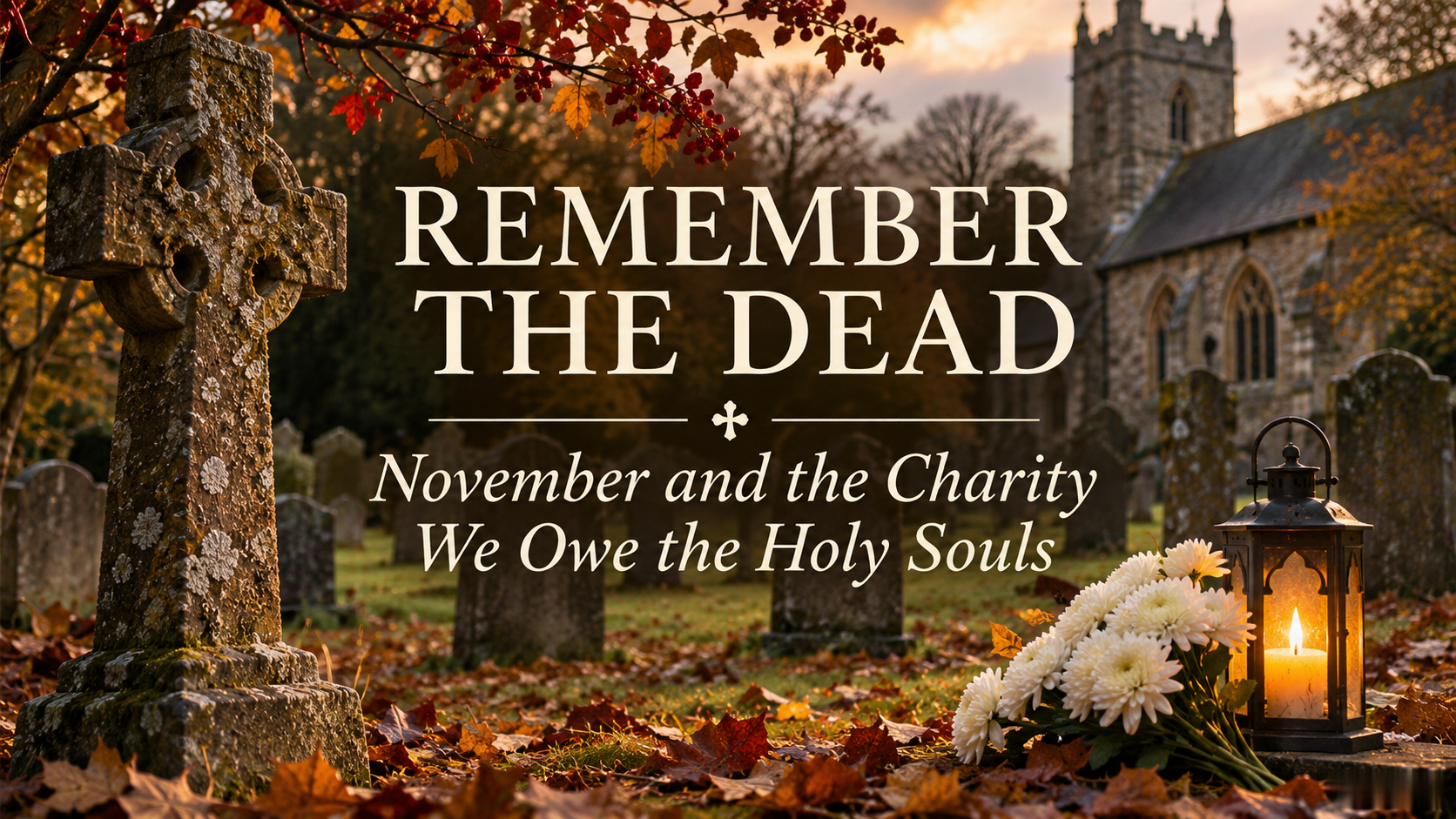
November belongs particularly to the faithful departed, whose souls the Church commends to Almighty God through the Holy Sacrifice of the Mass, indulgences, prayer and works of mercy. The old Catholic customs of remembering anniversaries, visiting graves, maintaining Chantry Books and praying for the dead within the family deserve more than affectionate recollection. They deserve to be practised. Nuntiatoria encourages the faithful throughout November to recover these observances and to make provision for those whose names might otherwise be forgotten.
Among the more revealing changes in Catholic domestic life is the disappearance of the dead from ordinary family prayers. Their photographs may remain upon the mantelpiece, their possessions are sometimes carefully preserved, and their anniversaries remembered with affection. Yet the practice of having Masses offered for them, of reciting the De Profundis or adding their names to the evening Rosary, has become less familiar than it once was. Our grandparents generally understood that death altered the manner in which we fulfilled our obligations towards those we loved; it did not bring those obligations to an end. The departed continued to belong to the family’s spiritual concerns, and children learned from an early age that prayer could assist somebody whom they could no longer see.
November was formerly an especially visible expression of this Catholic understanding. The solemnity of All Saints, followed by the Commemoration of All the Faithful Departed, placed before the faithful the great company of the blessed and those souls still undergoing purification. Black vestments, the solemn Dies irae, the prayers of the Requiem Mass and the familiar petition for eternal rest impressed upon successive generations the reality of death, judgement and the mercy of God. There was comfort in these observances, certainly, but it was the comfort of Christian hope, supported by the Sacrifice of Christ and the prayers of His Church. No attempt was made to disguise the seriousness of death or to suppose that affection alone could obtain what the departed might still require.¹
Our contemporary habits are rather different. Considerable attention is given to the arrangements surrounding death, often with admirable care for the wishes of the deceased and the feelings of those who mourn. Memorial gatherings, photographs, music and personal recollections may provide genuine consolation. Yet it is possible to arrange an occasion at which almost everything is said about the departed except a prayer for the salvation of his soul. The expression “celebration of life” has become so customary that even Christian funerals sometimes appear reluctant to acknowledge the principal reason for the Church’s presence: to commend the deceased to Almighty God and implore His mercy.
Catholics should be especially cautious of the increasingly common assurance that a deceased relative is already in Heaven. It may be kindly intended, particularly when offered to somebody overwhelmed by grief, but kindness does not confer knowledge of the particular judgement. Except where God has made the heavenly glory of a person known, the eternal condition of an individual soul remains beyond our ordinary knowledge. We may hope, and should hope, in the mercy of God. We ought also to pray. The two dispositions have always belonged together in Catholic teaching, whereas the presumption that prayer is unnecessary deprives the deceased of the very assistance which the Church has traditionally urged upon the living.
The doctrinal foundation is familiar, although its implications are sometimes insufficiently appreciated. In the Second Book of Machabees, Judas arranges an offering for the fallen, and Sacred Scripture declares it “a holy and wholesome thought to pray for the dead, that they may be loosed from sins” (12:46). The Council of Trent, in its twenty-fifth session of December 1563, reaffirmed the existence of Purgatory and the assistance afforded to the souls detained there by the suffrages of the faithful, above all through the Sacrifice of the Altar. The Council also directed bishops to ensure that Masses, prayers, almsgiving and other customary suffrages were faithfully performed. It was sufficiently concerned about the subject to warn against speculative curiosities and abuses involving money. The Church’s responsibility was to teach the doctrine clearly and see that the faithful actually practised it.²
Purgatory is the purification of those who have died in the grace and friendship of Almighty God but are not yet perfectly prepared for the Beatific Vision. Their salvation is assured. They have passed beyond the possibility of final rejection of God, although the consequences of forgiven sin and whatever remains imperfect must be removed before their entrance into heavenly glory. The departed undergoing this purification can no longer acquire merit or undertake works of satisfaction as we can during our earthly lives. They remain, nevertheless, within the Communion of Saints and may be assisted by the prayers and suffrages of the faithful.
This teaching ought to make the month of November particularly dear to Catholics. While we remain alive, opportunities for repentance, penance, charitable works and sacramental grace are continually offered to us. Our departed brethren no longer possess those opportunities in the same manner. We may assist them by offering to God the merits of Christ’s redeeming sacrifice, by prayer, by almsgiving and by the indulgenced works which the Church has appointed for their benefit. That possibility should awaken gratitude for the means of grace entrusted to the Church and a charitable concern for those who may still await their full enjoyment of God.
The Holy Sacrifice of the Mass
The principal observance of November should be the offering of Masses for the dead. The Church has never regarded the Eucharistic Sacrifice as merely one devotion among several. Calvary is made sacramentally present upon the altar; the same Christ who offered Himself for mankind continues to plead the merits of His saving Passion. When a priest celebrates Mass for the repose of a particular soul, he applies the special ministerial fruit of that celebration according to the intention for which it is offered. The infinite worth of Christ’s sacrifice is beyond calculation, although the actual reception of its fruits belongs to the wisdom and mercy of God.
Families should therefore arrange Mass intentions for their deceased relatives and friends, especially on anniversaries of death. Those who have never requested such an intention may simply approach a priest and ask that Mass be offered for the repose of a named soul. A customary offering may accompany the request, but the offering is intended for the support of the priest and his ministry. It does not purchase the Mass or determine the spiritual value of the sacrifice. Nobody should be prevented by poverty from requesting prayers for the departed.
Among the traditional arrangements deserving renewed attention are Gregorian Masses, a series of thirty Masses celebrated on thirty consecutive days for one deceased person. The custom is associated with Pope St Gregory the Great and his account of the monk Justus in the Dialogues. Ecclesiastical authority has recognised the practice as a pious custom, although no Catholic should imagine that a fixed number of celebrations compels Almighty God to release a particular soul from Purgatory. The series requires appropriate arrangements with a priest or religious community able to undertake the obligation. It may be especially fitting following a recent death, or for a deceased parent, spouse or benefactor whose memory a family wishes to honour through an extended act of intercession.³
Nuntiatoria has already examined the traditional three Masses of All Souls’ Day and the historical provisions associated with Pope Benedict XV’s apostolic constitution Incruentum altaris sacrificium of 10 August 1915. The circumstances of the Great War gave particular urgency to the Pope’s concern for the immense number of the dead, many of whom had perished without the customary suffrages of their families. The privilege allowing priests to celebrate three Masses on All Souls’ Day remains a striking testimony to the Church’s solicitude for the departed. It also illustrates something easily overlooked in discussions of traditional liturgy: the prescribed rites are instruments of the Church’s charity towards souls, and their careful observance serves a purpose far greater than ceremonial correctness.⁴
Catholics who cannot attend Mass in person should nevertheless endeavour to unite their prayers to the Holy Sacrifice. A live broadcast of the traditional Mass, such as that provided through Old Roman TV, enables the housebound, elderly and geographically isolated to follow the liturgy as it is being celebrated, to make a spiritual communion where appropriate, and to join their intentions to the priest’s offering. Watching remotely does not constitute sacramental attendance at Mass, nor does it replace the obligation of physical attendance where that obligation applies. It can, however, provide a valuable opportunity for prayerful participation when attendance is impossible. The faithful should be encouraged to make use of such provision rather than suppose that distance must deprive them of every connection with the Church’s daily sacrifice.
Our remembrance ought also to extend beyond those whose company we enjoyed. We may have relatives with whom relations were strained, friends from whom we became estranged, or acquaintances whose conduct caused considerable suffering. Christian charity does not require the pretence that their actions were otherwise than they were, but it certainly permits us to seek their eternal good. A Mass offered for somebody who wronged us may constitute one of the most generous acts of forgiveness we shall ever perform. Death has a way of settling disputes which the living should perhaps have settled much earlier.
Nor should Catholics suppose that private intercession must cease at the visible boundaries of ecclesiastical communion. Traditional canonical discipline permits private Masses for deceased non-Catholics, while maintaining distinctions concerning public funeral rites and liturgical commemoration. The historical position, reflected in commentary upon Canon 809 of the 1917 Code, requires particular care where the deceased was unbaptised; it should not be confused with an unrestricted right to public Requiem observances. The Catholic doctrine of salvation and the necessity of the Church remain intact, as does our duty to entrust the departed to divine judgement with humility. Nuntiatoria has recently considered the particular pastoral difficulties surrounding those who died outside visible Catholic communion, including circumstances in which families have been left uncertain whether they may pray for a deceased loved one. Such families should receive sound theological guidance and the compassionate assistance of their priests.⁵
Visiting the graves of the departed
The traditional November visit to a cemetery combines prayer with an acknowledgement of the Christian dignity of the human body. Catholic burial proceeds from the belief that the body belongs to the person whom God created and redeemed, and that it will be raised at the Last Judgement. To tend the grave of a parent or friend, to place flowers there, and to kneel in prayer for the departed are acts of respect towards somebody whose earthly remains await the resurrection.
England’s old churchyards make this duty particularly intelligible. Beneath the yews and among the weathered stones are the remains of generations who once considered themselves indispensable to the affairs of their families, parishes and neighbourhoods. Some names remain legible; others have disappeared beneath lichen and the passage of time. Many graves have nobody left to visit them. Yet the souls of those buried there are neither beyond God’s providence nor necessarily beyond the benefit of Christian intercession.
Catholics should visit the graves of their relatives where practicable, but there is no reason to confine their prayers to family burial plots. A visit to the local cemetery offers an opportunity to pray for all who rest there, including those whose names are unknown and those who have nobody surviving to remember them. The old Catholic practice of making the Sign of the Cross when passing a cemetery deserves restoration. It takes only a moment to offer the familiar petition for eternal rest.
November also provides particular opportunities for indulgenced prayer. Under the Enchiridion Indulgentiarum, fourth edition, a plenary indulgence applicable only to the souls in Purgatory may be obtained on each day from 1 to 8 November through a devout visit to a cemetery accompanied by prayer for the departed, even if the prayer is made silently. On All Souls’ Day, a plenary indulgence may likewise be obtained through a devout visit to a church or oratory, with the recitation of the Our Father and Creed; the prescribed day may be transferred in the circumstances authorised by the competent Ordinary. The ordinary conditions for a plenary indulgence include sacramental Confession, Holy Communion, prayer for the intentions of the Supreme Pontiff, and complete detachment from sin, including venial sin. Partial indulgences are also attached to certain prayers and cemetery visits outside the principal November period.⁶
These are the provisions of the current Roman handbook. Earlier editions and the traditional discipline contain their own grants and prescriptions, which should be consulted where applicable rather than carelessly treating the different historical regulations as interchangeable. A priest responsible for a traditional mission or oratory should be able to explain the relevant provisions to the faithful.
The indulgence itself is frequently misunderstood. When the guilt of sin has been forgiven, temporal punishment may nevertheless remain. Through the authority entrusted to the Church, an indulgence remits this temporal punishment by application of the treasury of Christ’s merits and those of His saints. When an indulgence is offered for a soul in Purgatory, it is applied by way of suffrage, according to God’s mercy. No indulgence is earned by payment, no prescribed prayer operates mechanically, and no individual can compel its particular effect. The conditions of grace and detachment from sin are themselves a reminder that indulgences belong to the spiritual life of conversion and charity.
The prayers of the Catholic household
The recovery of November observances should begin in the family home, where the regular remembrance of the departed can become part of the ordinary rhythm of prayer. Nuntiatoria’s recent Domestic Church series has already provided practical guidance for All Saints, All Souls and the opening days of November, including prayers, cemetery customs and activities suitable for children. The present appeal is intended to carry that observance through the remainder of the month and, where possible, throughout the year.⁷
The De Profundis, Psalm 129 according to the Vulgate and Douay-Rheims numbering, deserves a special place in these devotions. Its opening cry, “Out of the depths I have cried to thee, O Lord,” belongs to the Church’s ancient treasury of penitential prayer. Recited for the departed, it commends them to the mercy of God while reminding the living of their own dependence upon that same mercy. Nuntiatoria’s recent examination of the psalm traced its place in the traditional rites surrounding death and burial, together with its wider liturgical and devotional use. Families unfamiliar with the text would do well to learn it, in Latin or English, and to recite it regularly during November.⁸
The shorter prayer Requiem aeternam dona eis, Domine, et lux perpetua luceat eis ought to become familiar even to the youngest children. It may be added to the evening Rosary, said after grace at meals, or offered whenever the death of a relative or friend is remembered. Parents can explain that Catholics continue to pray for those they love because death does not extinguish the bonds of Christian charity. The lesson need not be burdened with speculative descriptions of Purgatory. Children readily understand the meaning of helping somebody through prayer, and it is better that they should acquire the habit early than discover the doctrine as an unfamiliar abstraction much later in life.
An ordinary notebook can become a family Book of Remembrance. The names of deceased parents, grandparents, godparents, friends and benefactors may be entered together with the dates of their deaths, so that their anniversaries are not overlooked. It would be especially appropriate to include departed priests who administered the sacraments, religious who taught the Faith, and those whose kindness or sacrifices made possible the Catholic upbringing of later generations. An elderly relative may be able to supply names and stories which would otherwise disappear from the family’s knowledge. Such conversations are worth having while there is still somebody to answer our questions.
The custom also carries a practical consequence. A name entered in a family book should lead to prayer; it should not become a decorative exercise in ancestry. Where an anniversary approaches, the family might arrange a Mass intention, visit the grave, or recite the Rosary for the deceased. A household which preserves these customs passes on something more valuable than a collection of photographs. It teaches its children that gratitude and charity impose obligations which survive death.
The Guild of Holy Souls
Within the Old Roman Apostolate, the Guild of Holy Souls provides an organised means of sustaining this work. Approved on 21 November 2022 by the Titular Archbishop of Selsey, it encourages regular suffrages for the departed, monthly Requiem Masses, the maintenance of Chantry Books and practical assistance towards traditional Catholic burial where resources permit. Its work is especially relevant to missions and scattered communities whose faithful may lack the support of an established parish structure.⁹
Those wishing to have departed relatives remembered should enquire through their local Old Roman mission or oratory about the Guild and the submission of names. A name entered in a Chantry Book is remembered according to the Guild’s arrangements, although this should not be confused with requesting a separate Mass for one particular intention. Both practices are commendable, and the distinction should be explained when requests are received.
The Guild also offers a means of remembering deceased persons whose families have become estranged from Catholic practice, or who leave nobody familiar with the traditional duty of arranging Masses and prayers. The names of departed benefactors, clergy, religious and faithful who laboured for the apostolate deserve continued remembrance. There are priests whose former congregations have disappeared, missionaries buried far from their native countries, and Catholics whose work for the Faith was undertaken without public recognition. Their absence from ordinary conversation should not entail their absence from our prayers.
The practical assistance towards Catholic burial associated with the Guild merits attention. To bury the dead is a corporal work of mercy, and to pray for them a spiritual work of mercy. Both may require considerable effort. A family confronting bereavement may need guidance concerning the funeral rites, contact with a priest, arrangements for burial and the continuing obligation of suffrages. The Church’s concern for the departed ought to be evident in the assistance offered to those who remain.
A duty of charity beyond November
The faithful should also consider those whose grief has become largely invisible. A widow who has ceased to receive invitations, an elderly man visiting his wife’s grave, parents who have lost a child, or a family separated by distance from the burial place of a loved one may find November particularly difficult. A visit, an invitation to share a meal, assistance with reaching a cemetery, or the offer of a Mass intention can mean considerably more than another general expression of sympathy.
Priests have a particular responsibility to make these observances possible. Requiem Masses should be available where the rubrics permit, the doctrine of Purgatory should be taught without embarrassment, and the faithful should understand both the value of Mass intentions and the conditions governing indulgences. Traditional Catholics possess in their inherited liturgy a remarkably rich provision for the dead. The Officium Defunctorum, the Requiem Mass, the absolution at the catafalque where prescribed, and the prayers of the Roman Ritual give solemn and intelligible expression to doctrines which might otherwise be neglected. Their pastoral usefulness should not be underestimated.
The temptation, particularly after the opening days of November, is to suppose that the month’s principal observance has been completed. Yet the commemoration of All Souls is intended to encourage a continuing habit of intercession. The customary anniversaries of death, monthly Requiems and household prayers provide for remembrance long after the special indulgenced days have passed. November should restore the pattern of Catholic charity which the remainder of the year will sustain.
Our recent spiritual conference, Memento Mori, considered the Christian art of dying well and the exercise of free will in preparation for eternity. The connection with prayer for the departed is intimate. Our earthly lives are the time in which grace invites our cooperation, repentance remains possible, and acts of charity may be offered both for ourselves and for others. We cannot know the circumstances in which our own death will occur, but we can attend to those duties which are presently within our power. Making provision for Masses after death, instructing our families concerning the Church’s rites, and practising the remembrance of the departed ourselves are sensible expressions of the same Christian responsibility.¹⁰
It is worth recalling that many of the older Catholic observances survived precisely because ordinary people persevered in them. The mother who remembered her parents in the family Rosary, the priest who maintained a list of deceased benefactors, and the widow who arranged an annual Requiem were preserving the Church’s doctrine through practical fidelity. There was little occasion to write elaborate explanations of the Communion of Saints in households where its obligations were regularly fulfilled.
November 2026 affords an opportunity to recover that inheritance. Catholics who have not yet arranged a Mass for their departed relatives should consider doing so. Those able to visit a cemetery should pray there, remembering especially the forgotten dead. Families might begin a Book of Remembrance and place the De Profundis among their regular prayers. The faithful associated with Old Roman missions should support the Guild of Holy Souls and encourage others to participate in its work. Such observances need not be expensive or elaborate. Their importance lies in their fidelity to the Church’s teaching and the charity with which they are undertaken.
One day the responsibility will pass to another generation. Our own names will be spoken in prayers for the departed, our anniversaries will appear in somebody else’s calendar, and the Masses which we now request for our parents may be requested for us. Whether those who survive us will understand these obligations depends in some measure upon what we have taught them.
For the present, there are souls to be remembered, Masses to be offered and prayers to be said. November gives us an occasion to attend to them.
Requiem aeternam dona eis, Domine, et lux perpetua luceat eis. Requiescant in pace. Amen.
- Missale Romanum, Commemoratio Omnium Fidelium Defunctorum, three Mass formularies; Dom Prosper Guéranger, The Liturgical Year, vol. XV, All Souls’ Day.
- Douay-Rheims Bible, 2 Machabees 12:38–46; Council of Trent, Session XXV, Decree Concerning Purgatory, 3–4 December 1563.
- St Gregory the Great, Dialogues, Book IV, chapter 57; J. B. O’Connell, The Celebration of Mass, section on Gregorian Masses.
- Benedict XV, Incruentum altaris sacrificium, 10 August 1915; Nuntiatoria, Requiem Aeternam: The Church That Will Not Forget Her Dead, 30 October 2026.
- Matthew Ramstein, A Manual of Canon Law, commentary on Canon 809; Sacred Congregation for the Doctrine of the Faith, Decree Regarding Public Celebration of Mass in the Catholic Church for Other Christians Who Have Died, 11 June 1976; Nuntiatoria, The Dead We Dare Not Judge, 30 October 2026.
- Apostolic Penitentiary, Enchiridion Indulgentiarum, fourth edition, 1999, concession 29 and general norms; Catechism of the Catholic Church, §§1471–1479.
- Nuntiatoria, The Domestic Church: 1–8 November 2026, 30 October 2026; The Domestic Church: 25 October–2 November 2026, 23 October 2026.
- Rituale Romanum, Exsequiarum Ordo; Nuntiatoria, De Profundis: The Prayer That Will Not Leave the Dead Behind, 1 November 2026.
- Old Roman Apostolate, Guild of Holy Souls, 21 November 2022; Nuntiatoria, The Domestic Church: 1–8 November 2026, 30 October 2026.
- Archbishop ✠Jerome Lloyd, Memento Mori: Learning to Live in the Light of Eternity, Nuntiatoria, 3 November 2026.



Leave a Reply