
The Communion of Saints, the Holy Souls, Free Will, and the Christian Art of Dying Well
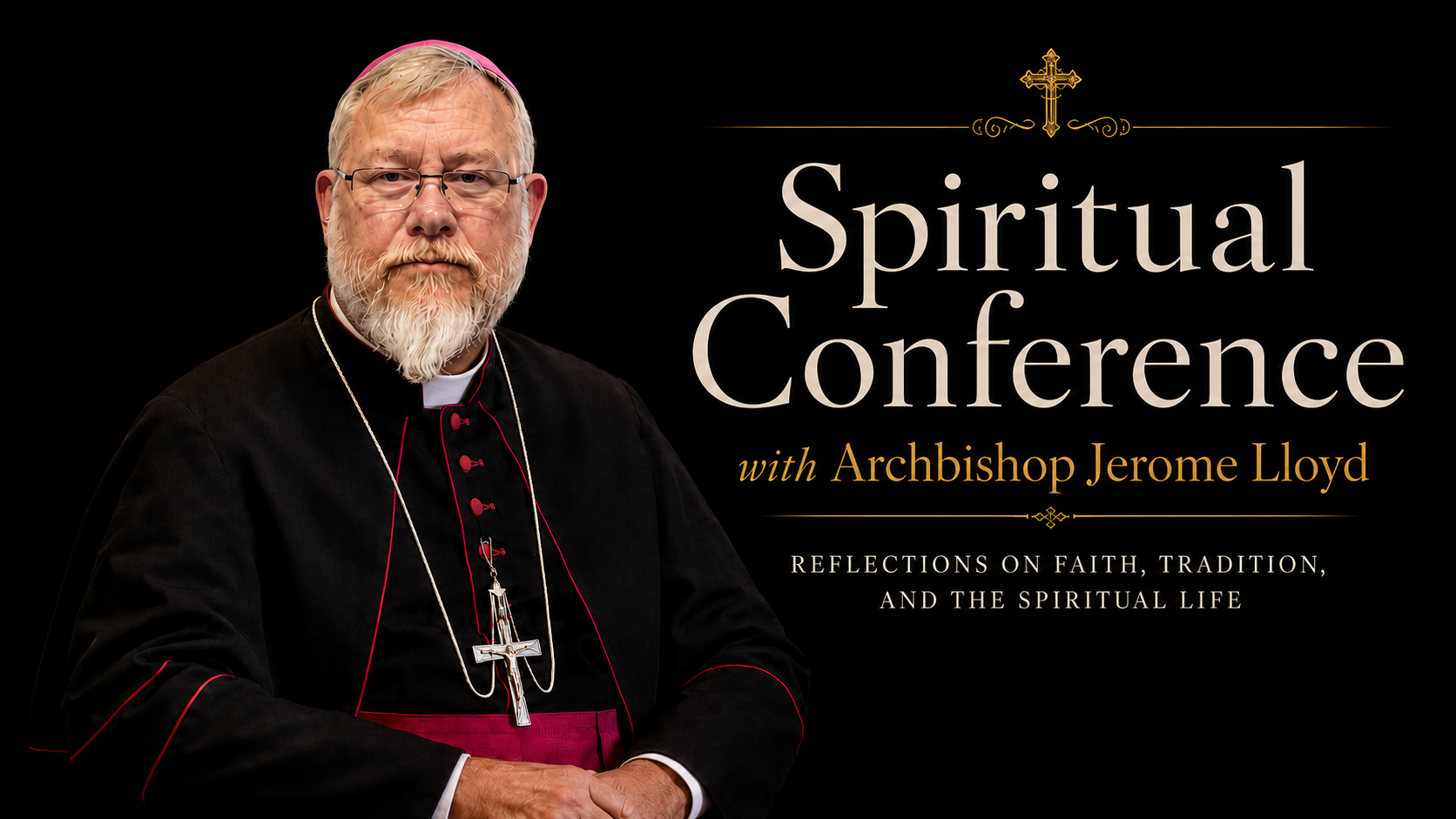
HE ✠Jerome Lloyd, Titular Archbishop of Selsey and Primus of the Old Roman Apostolate
A pastoral meditation for the Octave of All Saints and the month of the Holy Souls, exploring how remembering death helps us to live more faithfully. Drawing upon the traditional Roman liturgy, the Four Last Things, the Communion of Saints and the purpose of free will, the conference considers how the choices we make each day, supported by divine grace, prepare us for eternity. The saints reveal the fulfilment of true freedom: the joyful and perfect choice of God.
Beloved in Christ,
There is something rather curious about growing older. When we are children, a year seems an enormous stretch of time. Christmas takes forever to arrive, the summer holidays seem almost endless, and forty or fifty sounds impossibly old. Then one day we find ourselves looking at a photograph taken twenty or thirty years ago, remembering the occasion perfectly well, and wondering how so much time could have passed. We meet somebody we have not seen for years and are startled by how they have aged, before realising that they are probably thinking much the same about us. We remember a conversation with someone who has since died, and for a moment it hardly seems possible that they are gone. Their voice is still familiar; we remember their expressions, their habits, perhaps even the things that used to irritate us. Time passes almost unnoticed while we are busy living, and only when we look back do we realise how quickly it has gone.
November brings these thoughts particularly close. All Saints places before us the countless souls who have reached Heaven; All Souls reminds us of those who have died in God’s friendship and still need our prayers. We hear the solemn words of the Requiem Mass, the pleading of the De Profundis, and the Dies Iræ with its unmistakable reminder that each of us must stand before God. And naturally we think of our own departed: parents, grandparents, relatives, friends, priests and benefactors. Some have been gone for many years; others are so recently departed that their absence still takes us by surprise. There may be an empty chair at the table, a birthday we no longer know quite how to mark, or a telephone number we have never brought ourselves to delete. These are ordinary things, but anyone who has lost someone dear understands how much love can be contained in them.
Yet I wonder how often, during November, we remember that one day somebody else will be praying for us. Our own name will be entered among the departed. Someone may request a Mass, visit our grave or remember us when the names of the dead are read aloud. Our belongings will be sorted through; some will be treasured, some given away, and things we considered terribly important will simply disappear. Work that seemed impossible to do without us will be carried on by someone else. The world will continue. That is not a cheerful prospect if we look at it merely from an earthly point of view, but it is a useful and deeply Christian one. The Church does not ask us to remember death so that we may become gloomy or frightened. She asks us to remember it so that we may learn to live properly. Memento mori: remember that you must die.
The Scripture puts it rather more directly: “In all thy works remember thy last end, and thou shalt never sin.” We are not asked to spend our days imagining funerals or worrying about precisely when death will come. We are asked to recover a sense of proportion. Think of the things which have troubled you this past week. Perhaps somebody spoke unkindly, failed to thank you, or disagreed with you about something important. Perhaps an argument has been replaying in your mind, or you have worried over something which may never happen. We all know how easily a small irritation can occupy an entire afternoon. But suppose you knew that you had only a week left to live. Would that remark still deserve so much attention? Would winning the argument seem quite so necessary? I suspect we would become much more interested in the people we love, the wrongs we have yet to put right, and whether we are at peace with God. If those things would matter in our final week, why do we so often postpone them now?
We are very good at telling ourselves that there will be a better time. We shall pray more when work becomes less demanding. We shall make a good confession when we feel more prepared. We shall make peace with a relative once circumstances improve. Yet we somehow find time to watch television, follow the news, or spend an evening looking at things on our telephones which we can scarcely remember the following morning. I am not suggesting that recreation is wrong, or that every waking moment must be filled with religious exercises. We all need rest. But there is something worth examining when the things that matter least always find room in our lives, while the things that matter most are continually pushed into tomorrow.
Our Lord tells us of a prosperous man whose harvest was so plentiful that he decided to build larger barns and store up enough to enjoy many comfortable years. He congratulated himself on the future he had secured. But God said to him, “Thou fool, this night do they require thy soul of thee.” The man’s error was not that he worked hard or made provision; a father who provides for his children is doing his duty. His error was to think that he owned the years ahead of him. He had prepared for everything except the one thing he could not avoid. We should not imagine this parable is only about the wealthy. We can be poor and still become excessively attached to comfort, reputation or our own plans. The question is not simply how much we possess, but what occupies our hearts.
For those of us who cherish the traditional Catholic faith, November offers a particularly rich inheritance upon which to draw. The ancient Roman liturgy speaks of death, judgement, mercy and eternal life with a clarity which much of the modern world has lost. Its prayers do not conceal the seriousness of sin, nor do they leave the faithful without hope. In the solemn beauty of the Requiem Mass, in the Dies Iræ, and in the Church’s constant intercession for the departed, we encounter centuries of Catholic wisdom concerning the purpose of life and our preparation for eternity. Many Catholics have made considerable sacrifices to preserve their attachment to this sacred inheritance, sometimes travelling long distances to attend Mass or persevering despite misunderstanding and discouragement. Their fidelity has helped ensure that these treasures remain available to future generations. There is something particularly fitting, therefore, in allowing the traditional prayers of November to shape our spiritual lives. The Church has already given us the wisdom of the saints, the prayers of her liturgy, and the sacramental means by which we may prepare ourselves for Heaven. Our task is to receive that inheritance gratefully, practise it faithfully, and hand it on intact.
That is why the Four Last Things — death, judgement, Heaven and Hell — belong in ordinary Catholic preaching. Our Lord spoke plainly about judgement because our choices have consequences. At death comes the particular judgement, when the soul stands before Jesus Christ. We shall no longer be able to hide behind appearances or explanations. He knows our sins and what we neglected to do; but He also knows our struggles, our prayers and the sacrifices nobody else noticed. Think of someone caring for an elderly parent, exhausted after another difficult night; or a mother quietly persevering through years of worry; or a person living alone who remains faithful to prayer despite discouragement. These things may never make an impression upon the world. They are known perfectly to God.
We must take judgement seriously. Mortal sin is real, and the possibility of eternal loss is real. But the Judge is the same Lord who died for us upon Calvary. He has given us His commandments, His Church and His sacraments, particularly confession, where the repentant sinner encounters His mercy. In the Dies Iræ, amid the solemn account of judgement, the soul prays: Recordare, Jesu pie, quod sum causa tuæ viæ: ne me perdas illa die. Remember, merciful Jesus, that I am the reason for Thy coming: do not lose me on that day. The soul does not claim to have earned Heaven; it appeals to the Redeemer who came to save sinners. We should have that confidence without falling into presumption. God’s mercy is not an excuse to postpone repentance. It is a reason to repent today.
I wonder how many people have avoided confession for years because of embarrassment. They are afraid of what the priest may think, ashamed of confessing the same sin again, or uncertain how to begin after a long absence. If this applies to anyone listening, remember that the confessional exists precisely because we are sinners in need of grace. The priest is not there to be astonished by human weakness, but to exercise the ministry of reconciliation entrusted to the Church by Christ. A good confession requires honesty, sorrow and a sincere purpose of amendment; it does not require us to have overcome every temptation before we enter. There can be enormous relief in ceasing to make excuses and placing the truth before God. What a pity it would be to carry a burden for years when the remedy was available all along.
The same remembrance of death should change the way we deal with one another. There are families in which people have not spoken for years, and sometimes the original quarrel has become almost less important than the habit of remaining estranged. Of course some wrongs are serious, and forgiveness does not mean pretending that nothing happened or restoring trust where it would be unsafe. But we are not free to nurse hatred or desire revenge. One day either we or the person with whom we have quarrelled will die. It is better to make whatever peace justice and prudence permit while there is still time. And we should not postpone gratitude either. We often suppose that those closest to us know that we love them, but it costs very little to tell them, to thank them, or to spend an unhurried hour in their company. Many a bereaved person would gladly exchange a possession for one more ordinary conversation. Remembering death ought to make us more loving, not less interested in life.
Indeed, one of its greatest benefits is that it can free us from the exhausting idea that we must win every argument, answer every criticism and accomplish everything we once planned. We cannot control every circumstance or satisfy every expectation. Some disappointments must be borne, and some burdens entrusted to Providence. We are responsible for our duties, our choices and the charity with which we meet the people God places before us. That is quite enough to occupy a lifetime. We need not be famous, admired or indispensable. We need to be faithful. And fidelity begins not in some imagined future when everything is easier, but in the very ordinary circumstances of today.
It is sometimes said that one should live each day as though it were the last. I understand what is meant, but the phrase can be misleading. If we truly knew we had only twenty-four hours left, we might abandon legitimate duties which God still requires of us. A parent cannot cease caring for children because eternity is important; a worker cannot simply refuse honest obligations because this world passes. The Christian way of living in the light of death is not to become dramatic about every decision. It is to perform today’s duties with greater care. We can make the bed, prepare a meal, answer a difficult letter or visit an elderly neighbour with a different spirit when we remember that these may be opportunities God has placed in our hands. Much of what we shall answer for at judgement lies precisely there: in the patience we showed, the truth we spoke, and the love we offered when nobody was applauding.
Let us turn now to those for whom we pray during this month. Most of us have particular faces in mind when we hear the words “faithful departed”. Sometimes grief makes itself felt at unexpected moments. We hear a familiar song, pass a certain street, prepare a meal someone used to enjoy, and suddenly remember them with extraordinary clarity. Perhaps we even find ourselves smiling at a habit which once irritated us. Our Lord Himself wept at the grave of Lazarus. He knew that He would raise His friend from the dead, yet He wept. Christians need not pretend that bereavement does not hurt. We were made for love and companionship, and the absence of someone dear can be terribly painful. Faith does not remove that pain. It gives us a reason for hope and a way to continue loving when earthly companionship has ended.
The Communion of Saints means that death does not destroy the unity of Christ’s Church. The blessed in Heaven intercede for us; the Holy Souls in Purgatory await the full vision of God; and we, still making our pilgrimage on earth, can assist them through prayer and sacrifice. We belong to one supernatural family. In ordinary life, death seems to end our ability to help somebody. We can no longer visit, cook a meal, run an errand or sit beside them in illness. Yet the Church tells us that our charity need not end. We can have Mass offered for the departed, pray the De Profundis, offer a Rosary, perform an act of penance, or obtain an indulgence for them under the conditions prescribed by the Church. These are not merely gestures which comfort those who remain. They are works of charity directed towards the souls for whom we pray.
This helps us understand why the Catholic funeral is something more than a celebration of someone’s life. It is natural to remember a person’s kindness, humour, achievements and the happiness they brought us. There is a place for affectionate recollection. But the Church’s first concern is the eternal welfare of the departed. We do not gather simply to say that someone was a good person and must therefore be in Heaven. We offer the Sacrifice of Christ and implore God’s mercy. The departed do not chiefly need our admiration; they need our prayers. Nor should we presume to know another person’s final judgement. We may have known someone as devout and conscientious, but we do not see the whole soul. Equally, when someone has lived badly or died in distress, we cannot know all that passed between that person and God in the final moments. Our duty is to pray and entrust the departed to His justice and mercy.
Purgatory is sometimes spoken of as though God were reluctant to welcome people into Heaven. That is not what the Church teaches. Those who die in sanctifying grace are saved, but some still require purification from the effects of sin and the satisfaction of temporal punishment. We know from experience that forgiveness and the healing of our character are not always the same thing. A person may confess anger sincerely and yet struggle for years to become patient. We may truly repent of pride and still discover how deeply we crave praise or resent correction. These habits can persist even when guilt has been forgiven. Purgatory is the final purification of souls who belong to God and whose salvation is certain, but who are not yet ready for the unveiled vision of His holiness. We need not pretend to know all the circumstances of that purification. What matters is that the Holy Souls can benefit from the suffrages of the Church, especially the Holy Sacrifice of the Mass.
There is particular consolation in this for those who carry regrets about someone who has died. Perhaps the death was sudden and there was no opportunity for a final conversation. Perhaps we were impatient during an illness, or failed to visit as often as we might have done. We cannot return and change those moments; we can repent of our own failings, and we can pray for the person now. The Mass, the Rosary, the De Profundis and the small sacrifices we offer are real acts of love after death. That is one reason the Guild of Holy Souls matters within our Apostolate. Through its Chantry Books, prayers and Requiem Masses, we seek to maintain a duty which the wider culture increasingly forgets. A name entered for remembrance is not merely a record of someone who once lived. It belongs to a soul whom we commend to the mercy of Christ.
And what of the departed who have nobody left to remember them? Most of us can name our grandparents and perhaps our great-grandparents, but beyond that our family memory soon becomes uncertain. Those earlier generations were as real to themselves as we are now. They worked, worried, laughed, loved and suffered; they believed that the years ahead of them were their own. Now even their names may be unknown to their descendants. Who prays for them? The Church’s charity reaches beyond the circle of those we personally knew. When we pray for all the faithful departed, we include those long forgotten, the lonely, the unremarked, the people whose graves have disappeared and whose stories were never written down. God forgets none of them, and we may still perform a genuine act of charity for souls whose earthly lives are completely unknown to us.
The De Profundis gives voice to this charity with extraordinary simplicity. “Out of the depths I have cried to thee, O Lord: Lord, hear my voice.” The psalmist knows his need of forgiveness: “If thou, O Lord, wilt mark iniquities: Lord, who shall stand it?” But he does not remain in fear. “Because with the Lord there is mercy: and with him plentiful redemption.” That is the true spirit of November. The traditional Requiem prayers do not pretend that sin is unimportant or that judgement is a formality. Neither do they abandon the dead to despair. They ask for rest, mercy and everlasting light on the strength of Christ’s redeeming Sacrifice. They teach us how to grieve as Catholics: without denying sorrow, without presuming to know what God alone knows, and without ceasing to pray.
All Saints, meanwhile, reminds us what these prayers are directed towards. Heaven is not simply a place where our difficulties cease. It is the vision and enjoyment of God Himself, the fulfilment of the purpose for which we were created. During this Octave of All Saints, there is something particularly worth considering about the men and women whom the Church places before us for our encouragement and imitation. They knew disappointment, temptation, uncertainty and fatigue, just as we do. Some were scholars, missionaries or martyrs; others were parents, labourers, widows or people who attracted very little notice. Their circumstances were extraordinarily different, but they shared something fundamental: they learnt, with the assistance of divine grace, to choose what was right. They did not become holy by waiting for circumstances in which holiness would be easier. They became holy through a succession of choices, sometimes heroic and sometimes almost unnoticed, by which they preferred the will of God to their own inclinations. Holiness is not reserved for a particular temperament, intelligence, occupation or state of life. We are all called to it, and God gives us the grace necessary to respond.
We have reflected before upon the purpose of free will, and I think it is especially important to recall it during this Octave. We are not free simply so that we may do whatever we please. We are free so that we may choose the good. That distinction matters enormously, because the modern world has come to regard freedom almost entirely as the absence of restraint, as though the ability to choose something were sufficient to make that choice worthwhile. But anyone who has struggled with a bad habit knows that this cannot be true. A person who cannot resist his appetites is not particularly free, however many opportunities he has to indulge them. Someone governed by anger, resentment or vanity is allowing his passions to govern him rather than directing them according to reason. Our intellect is given to us to recognise what is true and good, and our will enables us to choose it. Conscience does not invent what is right or wrong according to our preferences; it obliges us to seek and apply the moral law established by God. The commandments are not arbitrary restrictions upon freedom, but safeguards which help us use it properly.
This is precisely where the saints have so much to teach us. Their holiness was not the absence of temptation, but their willingness, sustained by grace, to choose God despite temptation. The martyr who refused to deny Christ, the mother who persevered in her responsibilities, the religious who remained faithful to a difficult vocation, and the ordinary Catholic who quietly resisted a habitual sin were all exercising the same fundamental freedom: the freedom to choose what is right. Every day we make choices which gradually shape the kind of people we become. We may choose patience or irritation, generosity or selfishness, forgiveness or resentment, prayer or neglect. Sometimes the choice is difficult, and sometimes we fall despite sincerely intending to do better. But failure need not be final. Through repentance, confession and renewed cooperation with grace, we can begin again. Virtue grows through its repeated exercise, just as vice becomes more deeply rooted when we repeatedly surrender to it. The person who practises patience becomes more patient; the person who learns to resist an unreasonable appetite becomes more capable of governing himself; the person who habitually chooses charity is gradually formed in charity.
Of course, we do not save ourselves by the unaided strength of our wills. Without divine grace we cannot attain the supernatural end for which we were created. It is a matter of cooperating freely with the grace which God so generously provides. Here we discover the wonderful connection between All Saints and the remembrance of death: the saints have reached the final fulfilment of human freedom because their wills are now perfectly united to God’s. They do not become less free in Heaven because they can no longer sin. They are perfectly free because they love the Supreme Good without hesitation, disorder or division. What we seek imperfectly here below, they now possess in its fullness. Every good choice we make in this life, every temptation resisted and every duty faithfully fulfilled through grace, is therefore part of our preparation for that perfect liberty which awaits us in eternity. The freedom God gives us is not merely the ability to choose between alternatives; it is a gift through which we may learn to love Him, until at last our wills rest completely and joyfully in His.
We must not romanticise suffering. Caring for someone who is seriously ill can be exhausting. Loneliness can be painful, and some burdens cannot be made lighter by a few encouraging words. Nor is every trial a punishment for some particular sin. The Cross of Christ should teach us how profoundly God can bring good from suffering without making suffering itself something we are obliged to enjoy. We should seek legitimate help, accept the kindness of others, and fulfil our responsibilities as well as our strength allows. Sometimes a person who feels they have accomplished very little has actually shown remarkable fidelity simply by persevering. God sees the hidden cost of such perseverance, just as He sees the small kindnesses which pass unnoticed by everyone else.
The old spiritual writers spoke of the ars moriendi, the art of dying well. We naturally hope for a peaceful death, surrounded by those we love, with the opportunity to receive confession, Holy Viaticum and Extreme Unction. We should pray for those blessings and make every effort to obtain the sacraments for the sick. Yet we must never suppose that someone who dies suddenly, alone or in distress has therefore died badly. God knows the soul, and we must be careful not to place needless burdens upon grieving families. The essential preparation for death is to live in the grace and friendship of God now. We do not know what clarity of mind or outward assistance will be available to us in our final hours. We do know that today we can pray, confess our sins, fulfil our duties, forgive an injury and cooperate with grace. A good death is prepared for by a faithful life.
I would recommend one very simple habit: before going to sleep, spend a few moments examining the day. Thank God for His gifts; ask where you have failed in charity, truthfulness or duty; make an act of contrition and resolve to begin again. This need not become an anxious inspection of every passing thought. It should be an honest, peaceful conversation with God. Keep close to confession and the Holy Mass. Pray for final perseverance, commend yourself to Our Lady and Saint Joseph, the patron of a happy death, and try to make some small act of charity each day. These are ordinary ways of allowing grace to shape us. And remembering death should also make us grateful for life: for a familiar voice, a shared meal, a moment of beauty, the companionship of a friend, or the chance to help somebody in need. These things are gifts, and gifts should lead us back to the Giver.
There is one question I should like to leave with you. If you learned this evening that your life was drawing to its close, what would you most regret leaving undone? Perhaps there is a confession you have postponed, an apology you owe, someone you need to forgive, or a duty you have neglected. Perhaps you would wish you had spent less time worrying about the opinions of strangers and more time with the people entrusted to your care. Perhaps you would discover that the most valuable things you had done were not those which brought you praise, but the sacrifices made quietly out of love. Think of one thing which you know needs attention, and begin to address it this week. We cannot change yesterday, and we have no promise of tomorrow. We have the opportunity God gives us today. And that is precisely where free will becomes so important: we are not powerless spectators of our own lives, condemned simply to repeat yesterday’s mistakes. With the grace of God, we can choose differently. We can choose to forgive, to repent, to pray, to fulfil our duties, and to love more generously. Every such choice is a step towards the holiness to which God calls us.
During November, then, let us remember the dead with more than affection. Let us pray for them, seek Masses for them, and remember especially those for whom no one now prays. And as we do so, let us remember our own last end, not in fear of living, but so that we may live with greater charity and purpose. The saints whose glory we celebrate during this Octave have already reached the fulfilment of that purpose. Their lives assure us that holiness is possible, that grace is sufficient, and that our daily choices matter. One day our work will pass to others, our possessions will be dispersed, and our names will be among those commended to God’s mercy. What will matter then is not whether we were admired or considered successful, but whether we have sought to love and serve Him faithfully. May Our Blessed Lady pray for us now and at the hour of our death; may Saint Joseph obtain for us the grace of final perseverance; and may the souls of all the faithful departed, through the mercy of God, rest in peace. Requiem æternam dona eis, Domine: et lux perpetua luceat eis. Amen.




Leave a Reply