
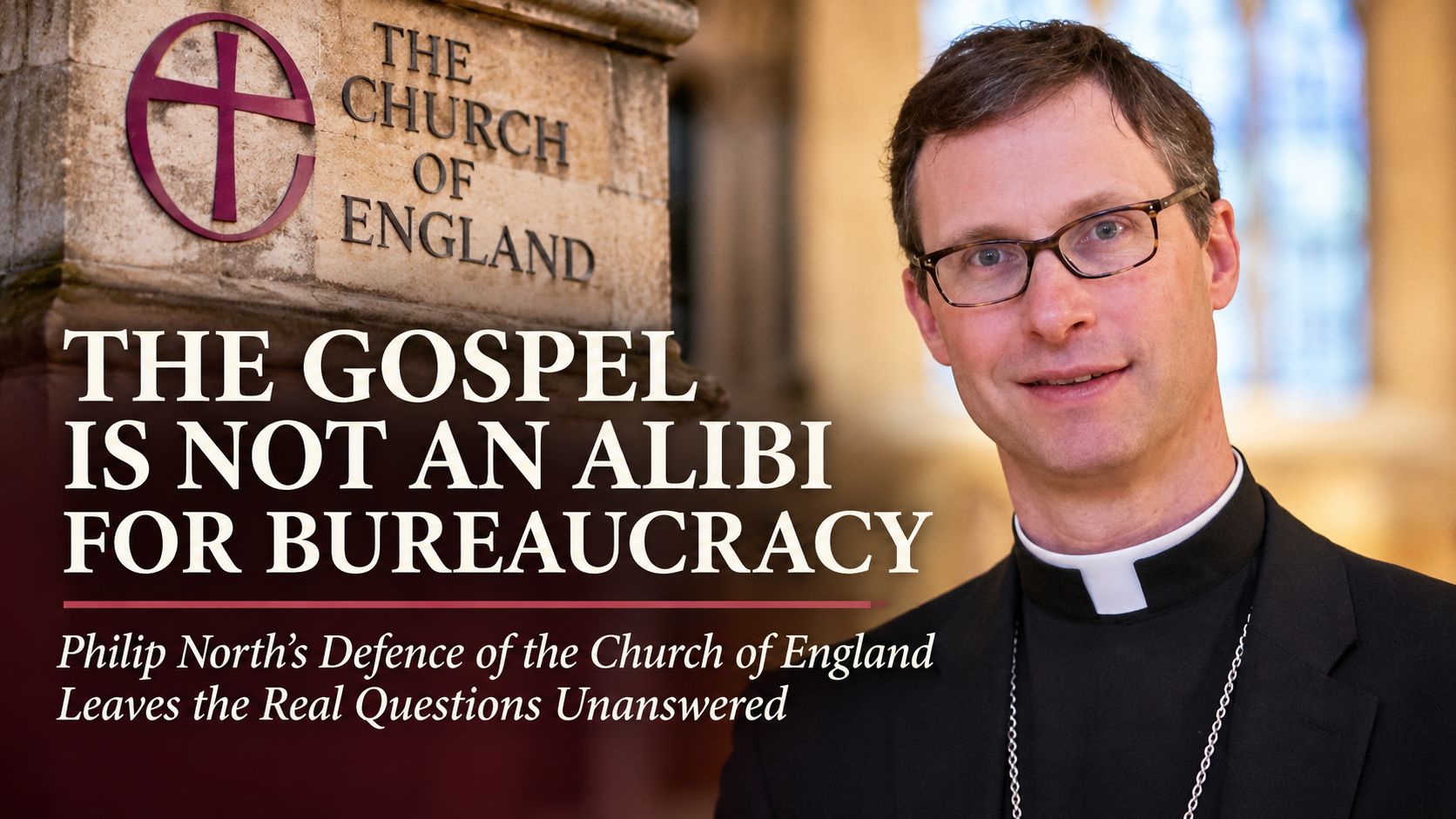
Philip North’s Defence of the Church of England Leaves the Real Questions Unanswered
Bishop Philip North argues that the Church of England cannot spend its way out of decline and must recover confidence in the Gospel. He is right about the need for spiritual renewal. But his response to a devastating report on diocesan expenditure raises an uncomfortable question: why does an institution with fewer clergy, fewer worshippers and extraordinary technological advantages need an expanding administrative establishment? The Gospel deserves better than to become a defence of the machinery supposedly serving it.
There is something rather extraordinary about a bishop responding to a report on ecclesiastical waste by insisting that the Church must preach Jesus Christ. Of course it must. That is precisely why people are asking what has happened to the money, the clergy and the parishes. Nobody commissioned the Church of England to become an administrative corporation with religious activities attached. Its reason for existence is Christianity. The question is whether its increasingly expensive structures are helping to sustain that Christianity or consuming resources which might otherwise be devoted to its proclamation.
In an article published in the Church Times on 30 October, the Bishop of Blackburn, Philip North, takes issue with Professors John Craven and Robin Gill over their report, Wasted Money in a Diminishing Church. He accepts that diocesan finances are under serious pressure but disputes both the authors’ analysis and their proposed remedies. Most importantly, he accuses them of treating the Church as an organisation rather than the Body of Christ. He concludes that financial difficulties cannot be resolved financially and urges the Church to concentrate instead upon converting the nation.¹
North’s appeal to the Gospel is welcome. His apparent reluctance to examine the institutional arrangements through which that Gospel is supposedly being advanced is considerably less convincing. Spiritual renewal and financial reform are not alternatives. A bishop who wishes his parishes to flourish ought to be particularly interested in discovering whether their resources are being spent elsewhere unnecessarily.
Nuntiatoria examined the Craven–Gill report in our editorial of 23 October, The Church of England Is Running Out of Church. We considered not simply its financial findings but the historical transformation of Anglican episcopal government, the multiplication of administrative responsibilities, and the implications for Catholic dioceses confronting comparable difficulties. That examination was subsequently developed in What the Rain Exposed at Southwell, which considered the financial crisis surrounding Southwell Minster and the increasingly uncomfortable relationship between national ecclesiastical resources and local religious responsibilities. North’s intervention therefore deserves to be considered against evidence and questions already established, rather than treated as the beginning of an entirely new discussion.²
The figures remain serious. According to Gill and Craven, diocesan employees increased from approximately 1,300 in 2005 to 2,300 in 2025, while the number of stipendiary clergy fell by around one-third and average attendance by roughly forty per cent. Inflation-adjusted parish-share receipts declined by about twenty per cent. Meanwhile, expenditure upon bishops and archbishops’ ministry reached approximately £53 million in 2025. That last sum covers episcopal establishments and associated responsibilities, not simply personal remuneration, but it nevertheless represents a substantial charge upon the Church’s resources. The authors’ concern is that the machinery surrounding ordinary ministry has expanded while the ministry itself has contracted.³
These figures alone do not establish that diocesan administration caused the decline. The Anglican commentator Ian Paul has examined the report’s appendix and calculated that the correlation between growth in diocesan staffing and changes in attendance across dioceses is effectively zero. Some dioceses increased staffing substantially while experiencing comparatively smaller reductions in churchgoing; others kept administrative growth modest and nevertheless suffered severe losses. His criticism is important. It prevents the legitimate complaint about expenditure from becoming an unsupported claim that every additional administrator produces fewer worshippers. But it does not settle the question of whether all those posts are necessary. Spending can be unjustified without being the principal cause of religious decline.⁴
North’s first substantial objection concerns the proposal to transfer greater financial and administrative responsibility to deaneries. He argues that area deans are pastors rather than professional managers, that deaneries are too small to undertake certain strategic functions, and that providing hundreds of deaneries with the necessary support might simply replicate the existing bureaucracy on an even larger scale. He has a point. The report proposes that deaneries should exercise considerable control over clergy deployment, budgets, property and employment arrangements. Such responsibilities demand expertise. An arrangement which abolishes administrative duplication in forty dioceses only to reproduce it across approximately 660 deaneries would hardly be an improvement.
But why should this argument settle the wider question? The report does not simply advocate relocating administration. It proposes reducing the number of mainland dioceses from forty to approximately thirty by 2032, achieving economies of scale, moving suitable services to national provision and restoring a greater measure of local responsibility. Its recommendations require careful costing, and some may ultimately prove impracticable. Nevertheless, their underlying principle remains sound: decisions should be made at the level best equipped to undertake them, and administrative arrangements should be justified by the work they actually accomplish. North demonstrates possible defects in the deanery model without establishing that the present diocesan model is satisfactory.⁵
There is an obvious alternative to both extremes. Functions requiring specialist expertise can be shared nationally or regionally, while decisions about local pastoral provision remain closer to the communities affected. Clergy pensions need not be calculated independently in every parish. Nor should each diocese necessarily require its own complete apparatus for performing identical administrative tasks. Safeguarding, payroll, property advice and professional compliance may require central expertise without requiring the preservation of every existing layer of management. This is not revolutionary thinking. It is ordinary organisational prudence.
More importantly, North never adequately confronts the historical comparison at the heart of our earlier editorial. Nineteenth-century bishops administered immense dioceses with an administrative capacity that would appear primitive by modern standards. Their correspondence travelled by post, their journeys depended upon horses and railways, and their records were maintained without computers, electronic databases, instant communication or video conferences. They possessed clerical and legal assistance, certainly, but nothing resembling the modern administrative establishment. Yet many governed far greater numbers of clergy and worshippers than their successors.
Consider John Bird Sumner, Bishop of Chester between 1828 and 1848. His enormous diocese included territories subsequently assigned to Manchester, Liverpool and Blackburn. During twelve years of his episcopate, 170 additional churches were opened to meet the needs of expanding industrial communities. Gill and Craven estimate that the funds raised for church-building and endowment during his tenure amounted to approximately £100 million in contemporary purchasing-power terms. Sumner’s achievements cannot be transplanted uncritically into the twenty-first century, and Victorian ecclesiastical arrangements had serious deficiencies of their own. Nevertheless, they demonstrate what an episcopal establishment could accomplish when extending pastoral provision commanded its attention.⁶
The contrast becomes more embarrassing when modern technology is considered. A contemporary bishop can communicate with every incumbent in his diocese almost instantly. Financial information can be assembled and examined electronically. Administrative processes can be standardised. Routine correspondence, scheduling and reporting can be completed with a fraction of the labour once required. Yet the modern Church employs substantially more administrators to oversee a dramatically reduced pastoral constituency. It is reasonable to ask why. If contemporary regulations account for some of the increase, which particular responsibilities account for the remainder? What activities have become simpler? What have dioceses ceased doing because technology has made the work unnecessary? North offers no comprehensive answer.
Instead, he points to Blackburn, where he says central costs represent six per cent of the overall diocesan budget, compared with ten to twelve per cent in the charity sector. This sounds reassuring until one asks what is being compared. Are central expenditure and administrative expenditure classified consistently? Are clergy housing, episcopal offices, professional support and programme management included on the same basis? Are the other charities comparable in their activities, their property responsibilities and their employment arrangements? A percentage without a clear definition of its denominator tells us very little about whether a particular expenditure is necessary. Even a modest administrative percentage can conceal waste, just as a high percentage can reflect genuinely indispensable services.
North is on firmer ground when he identifies inequalities in historic endowments. Some dioceses possess significant inherited resources, while others depend heavily upon parish contributions. His complaint that parishes in less wealthy dioceses may face much greater demands is not trivial. It raises serious questions of distributive justice. But here again his criticism does not destroy the professors’ argument. Their report explicitly proposes allocating substantial historic resources according to local deprivation, thereby reducing the burden upon poorer communities. One may dispute the proposed mechanism without pretending that the underlying concern has been overlooked. The proper question is how resources can be distributed more fairly while preserving accountability and encouraging local generosity.⁷
Safeguarding deserves particular care. North correctly observes that diocesan safeguarding teams perform essential work, and that increasing referrals may reflect greater vigilance within parishes. No serious reform should weaken protection for children or vulnerable adults, discourage reporting, or abandon the professional expertise required to investigate allegations properly. The Church of England’s record makes any such suggestion indefensible. Yet Gill and Craven do not advocate dispensing with safeguarding. They question whether the organisation of safeguarding across numerous diocesan administrations is the most efficient or effective arrangement, especially when information-sharing failures have themselves contributed to institutional harm. They identify approximately 220 people employed within diocesan safeguarding teams, equivalent to between 150 and 200 full-time posts, alongside national personnel. Their challenge is directed towards organisational effectiveness, duplication and transparency, not the legitimacy of safeguarding itself.⁸
There is an important distinction between maintaining necessary safeguards and defending every existing arrangement by invoking safeguarding. The former is a duty; the latter is an argument requiring evidence. The Church’s history of serious failures should make its leaders especially determined to establish which arrangements work, which do not, and whether professional responsibilities are being discharged consistently. Simply maintaining a department is no guarantee that the people it exists to protect are safe.
North’s defence of national investment is also rather revealing. The Diocese of Blackburn was awarded a substantial programme of funding in 2024, with £25.5 million envisaged over nine years, including £12 million in the first phase and further funding agreed in principle subject to evaluation. The programme includes thirty parish-based children’s and youth workers, eighteen lay pioneers, support for clergy development, work in disadvantaged communities and an expanded diocesan renewal programme. It also funds central personnel responsible for administration, management and reporting. This is a mixed programme containing activities which may genuinely strengthen parish life alongside the organisational machinery necessary to administer them.⁹
It would be unreasonable to dismiss the entire initiative as bureaucratic extravagance. North can point to serious missionary intentions and reported growth in participating parishes. Indeed, his diocese has made considerable claims for its work in developing new congregations and supporting parish renewal. Those achievements deserve examination and, where independently demonstrated, recognition. But they make accountability more important, not less. How much of the funding reaches ordinary parish ministry? How much supports permanent administration? What proportion of the resulting activity would have occurred without the grants? Are the new appointments sustainable when the funding ends? How many people who encounter a funded initiative become committed members of a worshipping congregation? These questions should be answered publicly and consistently.
There is also an obvious difficulty in North’s assertion that financial problems cannot have financial solutions. His own diocese’s mission programme depends upon a substantial financial allocation. He regards that expenditure as a means of making evangelisation possible. Why, then, should the redirection of money towards parish clergy and ordinary worship be dismissed as merely financial thinking? If £25.5 million can help Blackburn pursue renewal, the distribution of ecclesiastical resources plainly matters to the Church’s spiritual mission. Money cannot produce faith, but its absence can prevent a priest from being appointed, a church from remaining open, or a missionary initiative from proceeding.
The most peculiar criticism in North’s article is his appeal to a word search. He complains that the report scarcely mentions Jesus, that the Holy Spirit is absent, and that evangelism receives no explicit treatment. He even suggests that the only occurrence of Jesus refers to Jesus College, Cambridge. This last assertion is incorrect. On page 31, the report discusses research into children’s religious beliefs and reproduces the phrase “Jesus helps me”. More importantly, its introduction explicitly states that the authors share the Church’s ambition to bring the Gospel throughout the country. Their purpose in examining money is to improve the conditions under which that mission can be undertaken.¹⁰
The report may legitimately be criticised for failing to develop a sufficiently substantial theology of evangelisation. Its discussion of contemporary religious experience relies heavily upon sociological analysis, and it does not fully investigate the doctrinal and cultural causes of declining Christian belief. Those are genuine limitations. Nevertheless, a study of ecclesiastical finance is entitled to examine finance. A bishop would hardly expect a report on clergy pensions to become a treatise on the Holy Trinity before its recommendations could be considered. The absence of particular religious vocabulary cannot substitute for examining financial evidence.
Indeed, North’s own argument comes uncomfortably close to the managerialism he condemns. Having criticised Gill and Craven for approaching the Church as an organisation, he proceeds to defend the location of administrative responsibilities, staffing arrangements, diocesan expenditure, charity-sector benchmarks and centrally funded programmes. He is entirely entitled to do so. Bishops must govern institutions as well as preach the Gospel. But he cannot reasonably object to organisational analysis while relying upon organisational arguments to defend the present system.
There is a further problem with his description of Anglican attendance. North insists that the Church of England is not diminishing because Sunday attendance has increased for five consecutive years. The official figures confirm those annual rises, and the development is welcome. But the starting point matters. Average weekly attendance in 2021 was approximately 605,000, following the severe disruption of the pandemic. By 2025, preliminary returns suggested a recovery to 707,000. That remains substantially below the approximately 854,000 recorded in 2019, a deficit of about seventeen per cent. The Church of England itself acknowledges that participation remains below pre-pandemic levels.¹¹
North is therefore describing a genuine recovery from an exceptionally depressed position, not demonstrating that the Church has reversed its long-term decline. Those distinctions are not pedantic. A diocese which loses a third of its congregation and subsequently recovers a fraction of that loss has reason to welcome the improvement. It does not thereby cease to face a serious demographic problem. The figures should encourage those engaged in successful pastoral work without becoming a convenient means of avoiding the much longer history of contraction.
His invocation of historic buildings, social provision and voluntary service is similarly understandable but insufficient. The Church of England makes an immense contribution to the life of the nation. Its churches are among England’s most important architectural and historical treasures. Its schools, charities and volunteers provide services which deserve public recognition. Yet these achievements cannot themselves demonstrate religious vitality. A church can maintain a successful community project without creating a worshipping congregation. It can preserve a medieval building without handing on the Christian faith. It can employ a substantial workforce while becoming progressively less important to the religious life of the people it serves.
Southwell Minster illustrates the problem from another direction. As we reported on 30 October, its Chapter faces severe financial difficulties alongside a repair backlog exceeding £20 million, with the possibility of closure during 2027 raised publicly. The circumstances include serious deficiencies in financial administration and the immense cost of maintaining a medieval building. No straightforward transfer from the Church Commissioners’ investment endowment would resolve every difficulty, and the Commissioners’ statutory responsibilities cannot simply be ignored. Nevertheless, the predicament exposes a striking contrast between the financial capacity of the national establishment and the vulnerability of institutions directly responsible for sustaining its worship and inheritance.¹²
There is a painful irony in a Church possessing increasingly sophisticated administrative resources while struggling to maintain the buildings and clergy through which ordinary Christianity has been expressed for generations. A ministry which exists principally upon paper, in committee reports and strategic plans, is no substitute for a priest known to his congregation, a church open for worship, the Scriptures taught, and the Christian faith communicated from one generation to the next.
North is correct that the deeper crisis is spiritual. But spiritual decline cannot become an explanation which absolves ecclesiastical leaders from examining their own decisions. The Church’s difficulties did not arise solely because diocesan offices grew. Secularisation, demographic change, weakening religious formation, cultural indifference and disputed doctrine have all contributed. Yet those circumstances make the responsible use of resources more urgent. A Church encountering growing resistance to Christianity should be especially determined to ensure that the resources entrusted to it support its proclamation.
The New Testament offers no encouragement for imagining that sound administration is somehow beneath the dignity of Christian mission. Our Lord Himself speaks of the prudence of a builder who first calculates whether he possesses the means to finish his tower (Luke 14:28). The Apostles, confronted by practical difficulties in the distribution of assistance to widows, established an appropriate arrangement so that they could continue to devote themselves to prayer and the ministry of the word (Acts 6:1–4). St Paul organised collections for needy Christians and instructed the faithful concerning their administration (1 Corinthians 16:1–4). None imagined that temporal arrangements could replace grace. Neither did they suppose that invoking the Gospel removed the obligation to administer resources responsibly.
The lesson is simple. Administration is legitimate insofar as it assists the Church to fulfil her religious obligations. It becomes burdensome when its own preservation dictates the distribution of resources, the organisation of ministry or the priorities of ecclesiastical government. That danger is not eliminated by giving departments religious names, describing expenditure as investment, or announcing a programme of renewal. The substance of the work must justify the arrangements supporting it.
There is also a theological question which North does not seriously address. He rightly calls for renewed evangelisation, but evangelisation requires a recognisable and coherent account of Christianity. The Church of England remains divided over fundamental questions of doctrine, ecclesiastical authority, marriage, moral teaching and the interpretation of Scripture. These disagreements are not minor differences about presentation. They concern the content of what is being proclaimed. A national institution cannot reasonably expect greater religious commitment merely by becoming more enthusiastic about inviting people into an ecclesiastical community whose own leaders disagree about significant elements of its teaching.
This is not to deny that many Anglican clergy proclaim Christ with conviction, or that their congregations exercise genuine Christian charity. North’s own emphasis upon conversion deserves recognition. But the institution’s theological disagreements inevitably bear upon its capacity to communicate a consistent message. A church which has become uncertain about what Christianity requires cannot solve that problem by employing more evangelists, reorganising deaneries or increasing programme funding. The character of its preaching, worship and doctrine must also be examined.
Catholics should recognise the uncomfortable parallels. As our earlier editorial observed, the Catholic hierarchy in England and Wales faces its own decline in clergy and sacramental practice, while increasingly elaborate administrative processes, diocesan restructuring and synodal programmes command substantial attention. The Catholic understanding of episcopal authority and sacramental ministry differs fundamentally from Anglican ecclesiology, but that distinction intensifies rather than diminishes the responsibility of Catholic bishops. Their principal duties concern the preservation of revealed doctrine, the sanctification of souls and the provision of the sacraments. Committees, consultations and professional services may assist those obligations; they cannot replace them.¹³
An organisation may become very accomplished at describing renewal without producing it. A strategy may be ambitious, properly presented and generously funded, yet fail to strengthen the religious life of an ordinary parish. Conversely, a relatively modest church with a faithful priest, sound teaching, reverent worship and committed families may exercise an influence far beyond its financial means. That does not mean money is irrelevant. It means that the purpose for which money is spent is decisive.
North is consequently right to resist any suggestion that the Church can engineer Christian faith through institutional reorganisation. Gill and Craven themselves acknowledge that financial restructuring cannot automatically reverse the historical decline of religious practice. But North makes the opposite mistake when he appears to treat the appeal to evangelisation as a sufficient answer to questions about the present disposition of resources. Both positions are inadequate. A smaller bureaucracy will not preach the Gospel by itself. Neither will an expanding bureaucracy become necessary simply because its defenders proclaim their commitment to evangelisation.
The responsibility of the bishops is to ensure that the institution serves the mission, not to defend the institution by invoking the mission. That requires a willingness to examine diocesan boundaries, senior appointments, professional staffing, strategic expenditure, endowments and the actual condition of parish ministry. It also requires the courage to acknowledge that some existing arrangements may have become unnecessary, some investments may have failed, and some resources may be better employed elsewhere.
There is nothing unchristian about asking such questions. It would be much more troubling if those entrusted with the Church’s resources declined to answer them.
Philip North has identified the right ultimate priority but has not demonstrated that the present arrangements serve it. His article may encourage those who are tired of pessimistic accounts of Anglican decline, and some of his practical objections deserve careful consideration. But confidence in the Gospel cannot be measured by the optimism of institutional statements. It must be reflected in the faithfulness of Christian teaching, the availability of pastoral ministry, the vitality of worship and the responsible stewardship of the means entrusted to the Church.
The Church of England does not need to choose between preaching Christ and reforming its finances. It needs to do both, precisely because they are connected. Nor should those who identify financial failings be accused of overlooking Christianity when their complaint is that too much of the Church’s money has been diverted from the work of the Church.
If the Gospel really is the priority, then everything maintained in its name must be prepared to justify its existence by reference to that priority. Including the bishops’ offices.
¹ Philip North, “Money Alone Will Not Solve C of E’s Woes”, Church Times, 30 October 2026.
² Nuntiatoria, “The Church of England Is Running Out of Church”, 23 October 2026; “What the Rain Exposed at Southwell”, 30 October 2026.
³ Robin Gill and John Craven, Wasted Money in a Diminishing Church: A Report on the Church of England, Centre for Anglican History and Theology, 2026, pp. 43–47, 63–66 and appendix.
⁴ Ian Paul, “Is Wasted Money the Problem with the Church of England?”, Psephizo, 27 October 2026.
⁵ Gill and Craven, Wasted Money in a Diminishing Church, pp. 60–66.
⁶ Nuntiatoria, “The Church of England Is Running Out of Church”, 23 October 2026; Gill and Craven, Wasted Money in a Diminishing Church, historical chapters and pp. 63–64.
⁷ Philip North, “Money Alone Will Not Solve C of E’s Woes”, 30 October 2026; Gill and Craven, Wasted Money in a Diminishing Church, pp. 60–63.
⁸ Gill and Craven, Wasted Money in a Diminishing Church, pp. 48–49.
⁹ Church of England, “More than £60 Million Awarded to Three Dioceses for Long-Term Programmes of Transformation”, 13 June 2024; Diocese of Blackburn, “Diocesan Investment Programme”, updated 30 July 2025; Church of England, “Diocesan Investment Programme”.
¹⁰ Gill and Craven, Wasted Money in a Diminishing Church, pp. 5, 31, 47 and 54–56.
¹¹ Church of England, “Church Attendance Grows for Fifth Year in a Row”, 13 May 2026; “Church Attendance Rises for Second Year Running”, 10 November 2023.
¹² Nuntiatoria, “What the Rain Exposed at Southwell”, 30 October 2026.
¹³ Nuntiatoria, “The Church of England Is Running Out of Church”, 23 October 2026.







Leave a Reply