
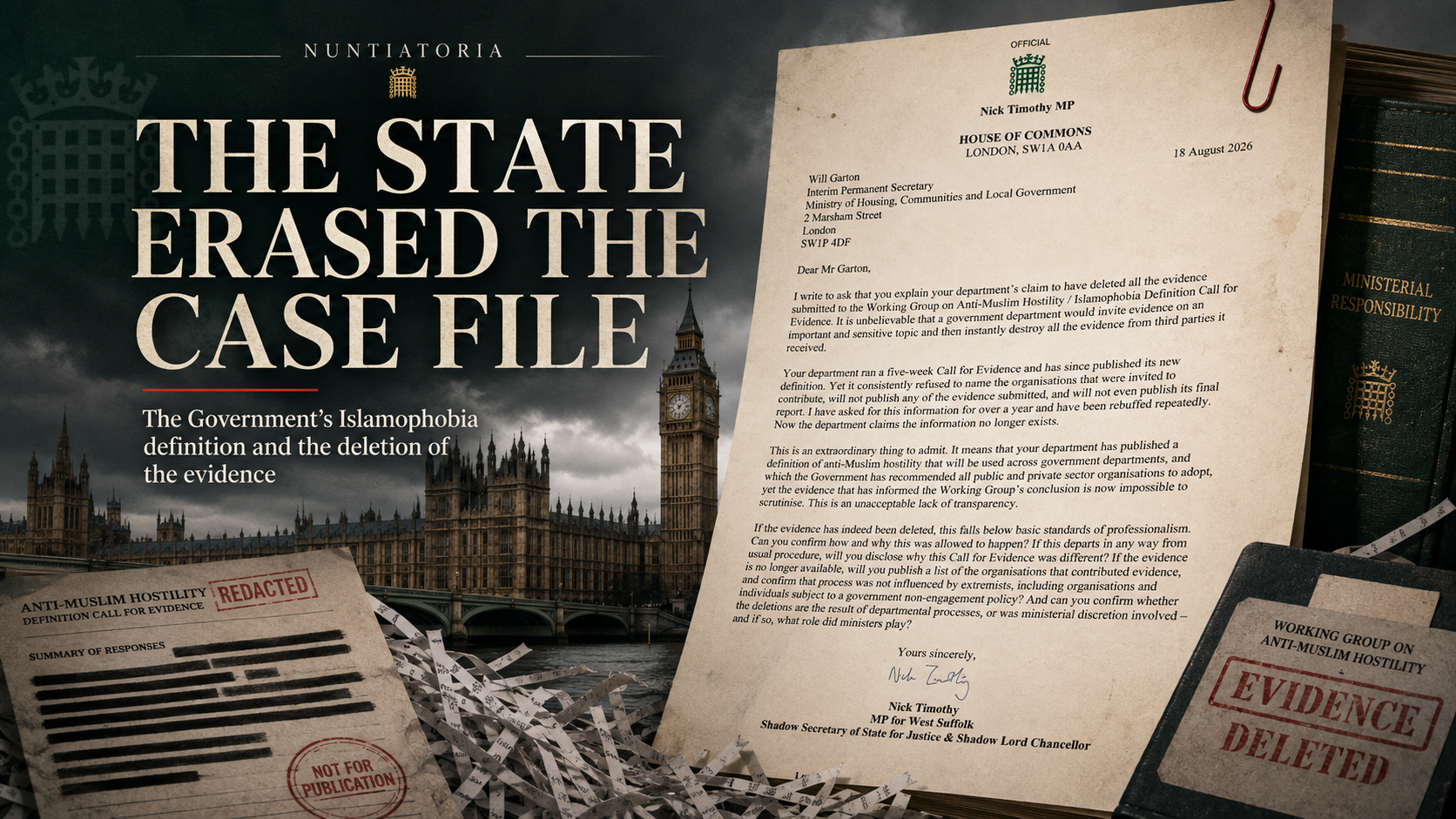
The State Erased the Case File: Blasphemy Law by Stealth
Nuntiatoria warned before the Government adopted its definition of “anti-Muslim hostility” that supposedly non-statutory language could acquire coercive force once absorbed into the administrative machinery of the State. Subsequent controversies in policing, prosecution and public debate demonstrated why that warning mattered. Now an even more fundamental question has arisen. The Government says that a substantial evidence-gathering exercise formed the basis of its definition, yet the department responsible has apparently deleted the submissions gathered in that exercise. Britain is consequently being encouraged to accept an official definition capable of influencing institutional treatment of lawful speech while the evidential record behind it has been placed beyond public scrutiny.

When the Government published its definition of “anti-Muslim hostility” on 9 March 2026, the Ministry of Housing, Communities and Local Government was explicit about its provenance. The independent Working Group, it said, had undertaken a “significant evidence gathering exercise”, including a Call for Evidence, which informed its private advice and “forms the basis of the definition” subsequently adopted by Government.¹ Those are important words because they establish that the definition was not presented merely as the opinion of five appointed advisers. The Government itself invoked an evidential process as the foundation upon which the resulting policy rested. That makes the latest disclosure particularly serious: according to information obtained under the Freedom of Information Act and reported by the Free Speech Union, the Department has deleted the responses submitted to that Call for Evidence.²
Nick Timothy MP, Shadow Secretary of State for Justice and Shadow Lord Chancellor, has therefore written to Will Garton, the Department’s Interim Permanent Secretary, asking how and why the material was deleted, whether its destruction followed normal departmental procedure, whether ministerial discretion played any part, whether a list of contributing organisations survives, and whether bodies subject to the Government’s own non-engagement policies were among those whose evidence informed the process.³ The difficulty is not complicated. The Government says that evidence gathered through this exercise formed the basis of its definition, while the Government department responsible apparently can no longer produce that evidence. Whatever one thinks of the definition itself, that is a serious question of public administration and democratic accountability.
Readers of Nuntiatoria will recognise that this development does not arise in isolation. For more than a year we have followed the gradual re-emergence of questions Britain thought it had settled when Parliament abolished the common-law offences of blasphemy and blasphemous libel in 2008. In July 2025, when Timothy introduced his Freedom of Expression (Religion or Belief System) Bill, Nuntiatoria defended the basic proposition that criticism, contradiction, satire and proselytism concerning religion must remain protected, and that whatever liberty applies to criticism of Christianity must apply equally to criticism of Islam.⁴ In November, reporting the Employment Tribunal judgment protecting reasoned “Islam-critical” beliefs, we emphasised the legal and moral distinction between criticism of Islamic doctrines and hostility towards Muslim persons.⁵ In December, before ministers had finalised the definition now in force, Nuntiatoria warned specifically that the danger of a definition of “anti-Muslim hostility” did not depend upon Parliament creating a new criminal offence. A non-statutory definition could nevertheless acquire practical consequences through public-sector guidance, employment procedures, professional regulation, safeguarding structures and institutional compliance.⁶
That earlier warning deserves particular attention now because it identified the central problem before the present controversy arose. The Government’s definition is expressly non-statutory. Its published guidance says that it creates no new criminal offence, does not override existing law and should not prevent criticism of Islam, critical examination of Islamic history or practice, ridicule or insult of religion, or expression which adherents may regard as disrespectful or scandalous.¹ Those safeguards should be acknowledged rather than caricatured. Parliament has not enacted a statute criminalising criticism of Islam, and it would be inaccurate to pretend otherwise. The concern is instead that language need not be statutory before it begins changing institutional behaviour.
The Government plainly intends the definition to be used. Ministers say that it will inform the development and revision of policy, and organisations across the public, private and third sectors are encouraged to adopt it in ways appropriate to their own circumstances.¹ The distinction between a criminal prohibition and an administrative category therefore matters less than ministers sometimes suggest. An employer does not require an Act of Parliament before opening a disciplinary investigation; a university does not require a criminal offence before commencing misconduct proceedings; a professional body does not need a conviction before deciding that a member has breached a code of conduct; and a police force does not require statutory blasphemy provisions before recording lawful speech under some non-criminal category. A definition can remain formally voluntary while becoming practically significant through the institutions which adopt it.
The South Wales Police controversy illustrated the point. Guidance associated with the developing concept of anti-Muslim hostility reportedly required officers to consider whether discussion of Islam had gone beyond what was regarded as “legitimate” discussion. After the Free Speech Union threatened judicial review and political criticism followed, the force paused the guidance.⁷ The important constitutional question was not whether the police intended to prosecute theological disagreement as blasphemy; it was why a police force should be placed in the position of determining what constitutes legitimate discussion of a religion in the first place. That is precisely the kind of administrative consequence Nuntiatoria had warned about when ministers were still describing the proposed definition as merely non-statutory.
In February we returned to the same question through the Coskun case, examining what we described as the possibility of a return of blasphemy “by prosecutorial means”.⁸ The argument was not that Britain had secretly restored the abolished offences under another name. It was that legal and administrative systems can reproduce some of the practical effects of blasphemy protection without formally restoring the old law. In March, when Timothy himself became the subject of accusations arising from comments about public Islamic prayer in Trafalgar Square, Nuntiatoria again considered the way in which accusations of hostility can become substitutes for answering arguments.⁹ That controversy demonstrated the danger of allowing the boundary between criticism of religious practice and hostility towards religious persons to become politically elastic.
The distinction must nevertheless remain clear. Muslims in Britain are entitled to the same protection of their persons, property and civil rights as every other citizen. A Muslim assaulted because he is Muslim, a mosque vandalised because it is a mosque, or a woman abused because she wears Islamic dress should receive the protection of the law without hesitation. Genuine intimidation, criminal harassment and discrimination should be addressed as such. Nothing in the defence of freedom of expression requires indifference to prejudice or violence. The point is that protecting Muslims from wrongdoing is not the same thing as protecting Islam from criticism. Civil rights belong to persons; religious propositions must remain open to contradiction.
Christian experience makes the importance of that distinction especially evident. Christianity enjoys no administrative immunity from ridicule in modern Britain, nor should it. Christ may be mocked, Our Lady insulted, Scripture derided and the doctrines of the Church described as irrational, oppressive or hateful. Catholic teaching concerning marriage, sexuality, abortion or the moral law is routinely subjected not simply to disagreement but to deliberate caricature. Christians may regard much of that treatment as contemptuous, offensive or intellectually dishonest, yet the remedy in a free society cannot be a governmental definition requiring institutions to determine where criticism of Christianity ceases to be “legitimate”. The freedom which permits attacks upon Christianity is the same freedom which enables Christians to proclaim that other religious claims are false.
Equality therefore requires reciprocity. A Muslim must be free to reject the Trinity, just as a Christian must be free to reject Muhammad’s prophetic claims. An atheist must be free to ridicule both faiths. A former Muslim must remain free to criticise Islam without being treated as hostile towards Muslim people. Historians must be free to examine Islamic history critically; journalists must be free to investigate Islamist political movements; politicians must be able to discuss questions involving integration, extremism, religious schooling, women’s rights and the relationship between religious law and secular government. These freedoms do not depend upon every contribution being wise or courteous. Freedom of expression exists precisely because controversial questions cannot be left to administrative bodies to determine according to an official standard of acceptable opinion.
This was also why the Employment Tribunal judgment previously examined by Nuntiatoria was important. The tribunal recognised that a reasoned philosophical position critical of traditional Islamic doctrines could itself qualify for protection under equality law.⁵ The significance of that decision lay in its insistence that criticism of ideas is not equivalent to hostility towards adherents. The Government now says that its own definition rests upon essentially the same distinction. If so, transparency about the process by which the definition was produced ought to strengthen rather than endanger confidence in it.
Instead, questions concerning the Working Group’s composition and evidence have persisted from the beginning. Angela Rayner, during her previous tenure as Communities Secretary, established the Working Group in 2025. Its members were Dominic Grieve KC, Professor Javed Khan, Baroness Shaista Gohir, Akeela Ahmed and Asha Affi.¹⁰ The Free Speech Union subsequently published an investigation alleging connections between members of the group and organisations or campaigning networks involved in the longstanding campaign for an official Islamophobia definition, including associations involving MEND and the Muslim Council of Britain.¹¹ Those allegations should be handled carefully: association does not itself establish extremism, misconduct or improper influence, and support for an Islamophobia definition does not disqualify anyone from participating in public policy. What the allegations unquestionably did, however, was increase the importance of transparency concerning the evidence received and the manner in which competing arguments were assessed.
Parliament attempted to obtain precisely that information. Sir James Cleverly asked whether MEND, CAGE, the Muslim Association of Britain or the Muslim Council of Britain had given evidence to the Working Group. The Department replied that its Call for Evidence had been open to anyone, that the Department itself did not engage with the named organisations, and that the Working Group had not met them.¹² That answer did not establish whether any of those bodies had made written submissions. When Cleverly separately asked which organisations had responded to the Call for Evidence, the Government said that it did not routinely publish details of individual respondents.¹³ Lord Jackson of Peterborough subsequently asked directly whether organisations subject to non-engagement had submitted written evidence and received substantially the same response.¹⁴
That sequence gives the reported deletion of the consultation material its real significance. While the submissions existed, the Government’s position was that it possessed the information but would not disclose the identities of individual respondents. If the original responses have now been deleted, the possibility arises that information which Parliament repeatedly sought may no longer be recoverable from the evidential record at all. The distinction between refusing scrutiny and becoming incapable of facilitating scrutiny is considerable.
It is unnecessary to speculate about conspiracy in order to recognise the seriousness of the situation. Perhaps no organisation subject to a non-engagement policy contributed. Perhaps some did but their evidence was rejected. Perhaps the Working Group received a genuinely broad and balanced range of submissions. Perhaps free-speech organisations, former Muslims, Christians, Jews, Hindus, Sikhs, academics and counter-extremism specialists were extensively represented. Perhaps the final safeguards protecting criticism of Islam were strengthened precisely because the Working Group received powerful evidence about the dangers of overreach. All of those possibilities remain open. The problem is that the original evidence could have helped establish which of them was true.
There may also be an entirely administrative explanation for the deletion. Government departments operate records-management and retention policies; consultation responses may contain personal information; raw submissions may be processed into summaries and subsequently disposed of according to established procedures. If that is what occurred, MHCLG should have little difficulty explaining it. The relevant retention policy can be published, the date and authority for deletion identified, and surviving summaries, analyses, minutes or correspondence disclosed subject to proper privacy protections. The Working Group can be asked whether it retained copies. The Department can state whether ministers knew that the evidence would be destroyed and whether organisational respondents can still be identified from other records. Timothy’s letter asks substantially these questions, and they deserve substantive answers rather than formulaic assurances.
Angela Rayner’s return to the same department gives the matter an additional political dimension. She established the Working Group during her earlier tenure and has now returned as Secretary of State for Housing, Communities and Local Government.¹⁵ There is presently no evidence that she ordered, authorised or knew about the deletion of consultation material, and it would be irresponsible to imply otherwise. She nevertheless now holds the office capable of ensuring that the Department explains what occurred. The process initiated under her previous stewardship has returned to her ministerial responsibility, and the appropriate response is not defensiveness but disclosure.
The wider lesson concerns a method of government increasingly familiar in modern Britain. Significant social regulation can occur without primary legislation. Guidance, definitions, frameworks, professional standards, safeguarding policies and institutional toolkits may each be described as advisory or non-statutory, but once government recommends them, regulators notice them, public bodies incorporate them and employers train staff around them. Their practical influence can therefore become much greater than their formal legal status suggests. The constitutional question for the citizen is increasingly not merely whether particular speech is unlawful, but whether expressing it will cause an official record to be created, an investigation to begin or some professional consequence to follow.
That is why the evidential integrity of this definition matters beyond the immediate argument about Islamophobia. The Government is encouraging institutions across Britain to use a concept concerned with one of the most contentious subjects in public life. The definition deliberately reaches some conduct which is not criminal because its stated purpose extends beyond the criminal law. Such a policy therefore requires especially careful scrutiny of its intellectual foundations, the competing evidence considered and the safeguards intended to prevent legitimate criticism of religion from being transformed into an accusation against the speaker.
Nuntiatoria has consistently argued that Muslim citizens must be protected from genuine hatred without constructing an exceptional protection for Islamic ideas. Our reporting on Timothy’s free-speech legislation, the tribunal recognition of Islam-critical beliefs, the development of the Government’s definition, the Coskun litigation and the subsequent political controversies has followed the same principle throughout: equal citizenship requires equal protection for people and equal freedom to dispute beliefs.⁴ ⁵ ⁶ ⁸ ⁹ The latest disclosure does not prove that the Government intended otherwise, but it makes independent scrutiny of how the definition was produced more necessary than ever.
The Government should therefore publish the Working Group’s final report, explain its methodology, identify organisational respondents wherever legally possible, disclose surviving summaries and analyses, state whether organisations subject to its non-engagement policy submitted evidence, and explain precisely what happened to the original responses. If their deletion followed an ordinary records-management rule, the Government should identify that rule. If copies survive elsewhere, they should be preserved. If ministers played no part in the decision, that too should be made clear. None of these steps presupposes misconduct; they are the ordinary requirements of accountability when a Government invokes evidence as the foundation of a policy and then discovers that the evidence itself is unavailable.
Britain abolished its blasphemy offences because religious peace does not require religious propositions to be insulated from criticism. The Government insists that it has not restored them and that its definition protects Muslim citizens rather than Islam itself. Those assurances deserve to be judged according to the evidence and the practical operation of the policy. Yet that judgment becomes considerably harder when the evidential record behind the definition has apparently disappeared. A government is entitled to make controversial policy and to defend conclusions with which citizens disagree. What it cannot reasonably ask is that the public accept an evidence-based definition while being denied the evidence by which its basis might be examined. The State is entitled to make its case; it is not entitled to erase the case file.
¹ Ministry of Housing, Communities and Local Government, A Definition of Anti-Muslim Hostility, 9 March 2026.
² Free Speech Union, Max Thompson, Government department deletes all responses to consultation for the official Islamophobia definition, 10 August 2026.
³ Nick Timothy MP, letter to Will Garton, Interim Permanent Secretary, Ministry of Housing, Communities and Local Government, 18 August 2026.
⁴ Nuntiatoria, Reclaiming the Right to Speak Truth: A Catholic Defence of Nick Timothy’s Free Speech Bill, 27 July 2025.
⁵ Nuntiatoria, The Shield of Reasoned Critique: Tribunal Recognises Protection for “Islam-Critical” Beliefs, 8 November 2025.
⁶ Nuntiatoria, Ministers finalising a definition of “anti-Muslim hostility”: non-statutory wording, statutory consequences, 16 December 2025.
⁷ Free Speech Union, South Wales Police shelve Islamic blasphemy law after FSU legal threat, 10 June 2026.
⁸ Nuntiatoria, England’s Free Speech Test: the Coskun Case and the Return of Blasphemy by Prosecutorial Means, 13 February 2026.
⁹ Nuntiatoria, The Politics of Accusation: Public Religion, Nick Timothy, and the Closure of Debate, 20 March 2026.
¹⁰ Ministry of Housing, Communities and Local Government, Working Group on Anti-Muslim Hatred/Islamophobia Definition.
¹¹ Free Speech Union, David Rose, Anti-Free Speech Hostility: The Islamist Links of the Government’s Working Group on Islamophobia, 1 March 2026.
¹² UK Parliament, Written Questions 124756 and 124793, answered 20 April 2026.
¹³ UK Parliament, Written Question 127149, answered 21 April 2026.
¹⁴ UK Parliament, House of Lords Written Question HL1546, answered 14 July 2026.
¹⁵ Prime Minister’s Office, Ministerial Appointments: July 2026, 20 July 2026.
related articles


Latest articles
- Today’s Mass: October 09 St Dennis, Bishop with Rusticus & Eleutherius, MartyrsGregory of Tours states that Denis was bishop of the Parisii and was martyred by being beheaded by a sword. The earliest document giving an account of his life and martyrdom, the “Passio SS. Dionysii Rustici et Eleutherii” dates from c. 600, is mistakenly attributed to the poet Venantius Fortunatus, and is legendary.
- Today’s Mass: October 08 St Bridget of SwedenSaint Bridget of Sweden, born around 1302, was a noblewoman renowned for her piety and prophetic revelations. After marrying Prince Ulpho and raising eight children, she led a life of austerity and charity, founding the Order of the Holy Saviour. She died in Rome in 1373 and was canonised in 1391.
- Today’s Mass: October 07 Pope St Mark, ConfessorSt Mark’s brief pontificate teaches that God measures fidelity, not duration or worldly achievement. Christ alone possesses the everlasting priesthood; His servants are stewards of what they have received. With the commemorated martyrs, St Mark reminds us to persevere faithfully, so that when the Lord comes, He finds us “so doing.”
- Omnia autem probate: quod bonum est tenete ~ Prove all things; hold fast that which is good: Spiritual Conference for Nuntiatoria CXXVIThe conference reflects on St Paul’s assertion to “prove all things” in relation to self-judgement and the Church. It explores themes of synodality, ecumenism, and the importance of discernment, emphasising the need for humility in understanding truth and the challenge of maintaining genuine holiness in the midst of contemporary ecclesiastical crises.
- FROM PERMISSION TO PRESUMPTION: Fort Worth and the Chalice Vatican II never made the NormBishop Michael Olson has implemented strict limitations on the distribution of Communion under both species in the Diocese of Fort Worth, prompting a discussion on the historical evolution of liturgical practices following Vatican II. This decision aims to reaffirm the doctrine of the Eucharist, emphasising that Christ is fully present under either species, while addressing misconceptions surrounding modern practices.




Leave a Reply