
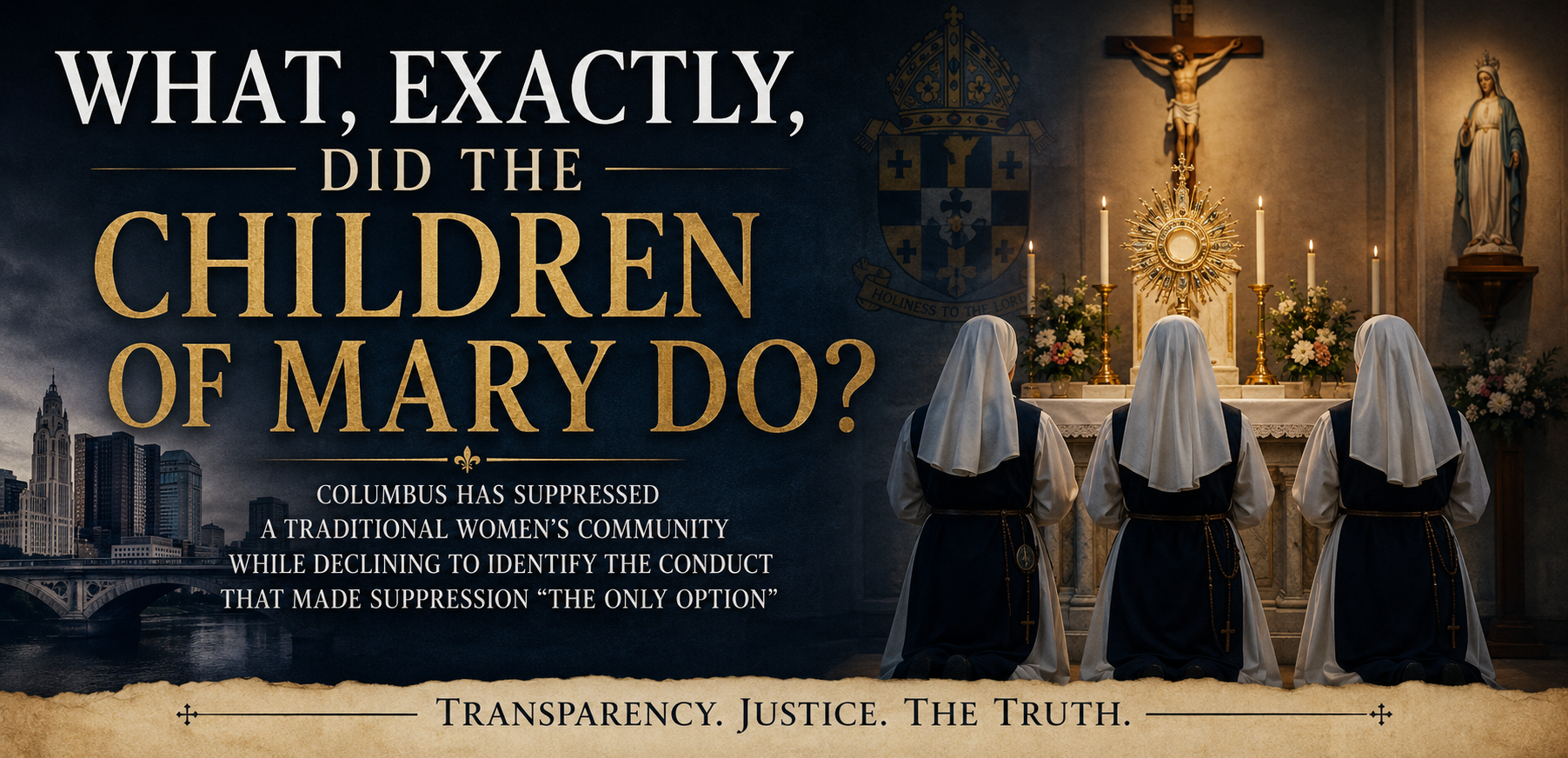
What, Exactly, Did the Children of Mary Do? Columbus has suppressed a traditional women’s community while declining to identify the conduct that made suppression “the only option”
A Catholic community centred upon Eucharistic adoration, Marian devotion, religious habit, prayer for priests and recognisably traditional formation will cease to exist in October. The Bishop of Columbus alleges persistent formation problems and even “abuses”, but has publicly identified neither the offending practice nor the defective teaching. A source close to members of the Children of Mary tells Nuntiatoria that the underlying difficulty was their traditional approach to formation and catechesis. That claim remains testimony rather than independently established fact. Yet everything that can be independently established makes the unanswered question more, not less, urgent: what exactly did these Sisters do that required their community to be extinguished?

There are circumstances in which a bishop not only may but must intervene in a religious community. Authority can be abused; obedience can be distorted into control; spiritual direction can intrude upon government, and government can trespass upon conscience. The distinction between the internal and external forum exists for very serious reasons, and no attachment to traditional Catholicism should ever be invoked to excuse genuine coercion or spiritual abuse. If members of the Children of Mary suffered such treatment, they deserve justice, protection and the truth. But precisely because abuse is a grave word, it cannot responsibly be used as an ecclesiastical fog within which the actual conduct alleged simply disappears.
On 10 August 2026, ✠Earl Fernandes, Bishop of Columbus, announced the suppression of the Children of Mary, a public association of the faithful whose community life had begun in 2002. The Sisters themselves say that their common life will end in October. The Bishop acknowledges their work in fostering devotion to the Blessed Sacrament, devotion to Our Lady and prayer for priests, but says that during recent years “formation issues and even abuses” had been brought to his attention, involving the evangelical counsels and the distinction between the internal and external forum.¹ Those are extremely serious allegations. Yet the statement does not explain what actually happened. No example of an alleged abuse is given; no practice is identified; no offending provision of the Constitutions is quoted; no catechetical proposition is corrected; no teaching is condemned. We are not told what any Sister was allegedly required to do, disclose, believe or accept, nor whether the problem concerned the foundress, the present superior, previous superiors, confessors, spiritual directors or the structure of formation itself. We are not told whether every member was affected, whether several were affected, or whether the allegations arose from isolated cases. Neither are we told which reforms were required, which were implemented, which failed, or why they failed.
The Sisters’ own statement is scarcely more revealing. They acknowledge “unintended formational issues” associated with being a relatively new community and accept the suppression in “faith, humility, and filial obedience”.² That obedience is admirable, but it is not an explanation. Suppression is not a minor administrative adjustment. A community disappears; women who have ordered their lives around its charism are dispersed; a recognised apostolate ends; property, governance and future vocations are affected; and women who believed themselves called to spend their lives as Children of Mary must now determine whether that vocation can be lived elsewhere at all. According to the Bishop himself, some may now have to discern another community “or in the world”.¹ One would therefore expect the grave cause for such a measure to be capable of being stated with reasonable precision.
Canon law itself treats suppression accordingly. Canon 320 provides for the suppression of public associations for grave causes and requires that the moderator and other senior officials first be heard. Canon 318, meanwhile, provides another formidable instrument for serious difficulties: in special circumstances and for grave reasons, competent ecclesiastical authority may appoint a trustee or commissioner to govern an association temporarily in its name.³ This does not mean that suppression was canonically unavailable, nor can outsiders know from the Bishop’s public letter whether less drastic remedies had genuinely been exhausted. It does mean, however, that his assertion that suppression was “the only option” requires explanation.
That becomes particularly important because Rome did not, according to either published statement, itself suppress the Children of Mary. The question before the Dicastery for Institutes of Consecrated Life and Societies of Apostolic Life concerned their desired progression from a public association into an institute of diocesan right. Since Pope Francis amended Canon 579 in 2020, a diocesan bishop may validly erect such an institute only after receiving the written permission of the Apostolic See.⁴ The Dicastery’s refusal therefore prevented the Children of Mary from making that juridical transition. It did not of itself cause their existing public association automatically to disappear. The Sisters say plainly that after the Dicastery’s conclusion was communicated, ✠Fernandes decided to suppress the association, while the Bishop himself says that, because erection as an institute would not be possible, he determined that suppression was “the only option”.¹ ² The distinction is central: Rome would not permit the association to become a diocesan religious institute; the Bishop of Columbus then determined that the association itself should cease to exist. Why the first necessarily required the second remains unexplained.
Then there is the chronology, which is perhaps the most troubling part of the entire affair. On 3 May 2026, barely three months before the announcement of suppression, three Children of Mary — Sisters Cecilia Grace, Imelda Joy and MaryAnne Regina — made perpetual vows at Emmanuel Convent. ✠Fernandes himself celebrated the Mass. The diocesan newspaper reported that he called the three women forward and questioned them before they proceeded to their profession. Around fifteen clergy were present, together with seminarians and members of the faithful.⁵ This was no private ceremony occurring beyond diocesan knowledge; the Bishop of Columbus was standing in the chapel and publicly receiving their lifelong professions. Nor was May an isolated occasion. On 21 November 2024, ✠Fernandes had presided when Sister Maria Caritas made perpetual vows, two Sisters renewed their profession and another made first profession, and in November 2023 he had likewise presided at a profession ceremony for the community.⁶ ⁷
The difficulty is obvious. ✠Fernandes now says that the problems concerned formational issues in communal life “from its inception”, that these problems persisted despite attempts at reform, and that concerns had been reaching him “over the past few years”.¹ If the problems were known over several years, why were women being admitted to perpetual commitment in May 2026? This is not a rhetorical trap but a serious pastoral question. A woman making perpetual vows is not signing up for an experimental programme. She is surrendering the ordinary expectation of another life. The symbolism used at the May ceremony made precisely that point: the Sisters lay prostrate beneath a funeral pall signifying death to the world before rising to profess lifelong vows.⁵ If the Bishop already believed that the community’s formation might be fundamentally defective, why permit those professions to proceed? If he did not yet believe that, what changed between 3 May and 10 August? If Rome’s concerns had already reached an advanced stage, why were three women permitted to bind their futures to an association whose very viability was in serious doubt? And if some decisive new evidence emerged after May, why does the August statement not identify even its general nature?
The questions become harder still because ✠Fernandes was not an episcopal stranger encountering the Children of Mary for the first time. Before becoming Bishop of Columbus, he had been their regular confessor in Cincinnati. In 2022, the diocesan newspaper reported a Sister explaining that then-Father Fernandes visited them approximately every month to hear confessions, while ✠Fernandes himself said at the time: “I know the Sisters of the Children of Mary very well.”⁸ The community subsequently transferred into the Diocese of Columbus in 2022. Its own history records that it had been erected as a public association of the faithful by ✠Dennis Schnurr in the Archdiocese of Cincinnati in 2016, with its Constitutions approved, before making that transfer.⁹ Thus the present Bishop knew the community before his episcopate, knew members through one of the most intimate sacramental ministries a priest exercises, received them into his diocesan orbit, presided repeatedly over professions, and was still celebrating perpetual vows for three of its Sisters in May. That history does not prove his decision wrong, but it makes an intelligible explanation indispensable.
It is here that information supplied to Nuntiatoria becomes significant. A source close to members of the suppressed community tells us that the real dispute concerned what was regarded as the Children of Mary’s excessively traditional approach to formation and catechesis. We emphasise the evidentiary status of that statement deliberately. Nuntiatoria has not obtained the Dicastery’s dossier, the Bishop’s correspondence, visitation reports or testimony from those who complained. We therefore do not present “they were suppressed for being too traditional” as established fact. But neither is this allegation floating without context, for the traditional character of the Children of Mary is independently verifiable and longstanding.
A traditional vocations directory was describing them as a “young and very traditional group of sisters” a decade ago.¹⁰ Their own present material describes a life structured around nocturnal Eucharistic adoration, daily Mass, sacred silence, the Rosary, chanting the Divine Office, fasting, spiritual reading and common religious discipline.¹¹ Their website contains a course based upon the catechetical work of Fr John Hardon SJ.¹² Their spirituality explicitly includes consecration to the Immaculate Heart of Mary, prayer for priests, Eucharistic reparation and two additional vows directed towards priestly holiness and love of Our Lord in the Blessed Sacrament.¹³ The diocesan newspaper has itself documented Catholics encountering the Traditional Latin Mass at the Children of Mary chapel.¹⁴ None of this establishes that traditionalism caused the suppression, but it demonstrates beyond reasonable dispute that traditional Catholic identity was not something retrospectively projected upon the community after controversy arose. It was visible, longstanding and known to ecclesiastical authority. That is why the anonymous source’s account cannot responsibly be transformed into a fact, but neither can it responsibly be ignored.
There is also an important conceptual distinction which should not be lost in the controversy. Traditional religious formation can be demanding without being abusive. Silence is not abuse. Asceticism is not abuse. A serious habit is not abuse. Fasting is not abuse. Teaching obedience is not abuse. Teaching chastity and poverty is not abuse. Frequent Confession, Eucharistic adoration, Marian consecration, strong catechesis and a disciplined common life are not abuse. Equally, every one of these good things can be distorted by bad government. Obedience can become domination; asceticism can become arbitrary punishment; spiritual direction can become manipulation; and a superior can misuse information belonging to conscience. A community can possess entirely orthodox theology and still govern its members badly. That is precisely why specificity matters. If the Children of Mary crossed that line, the Diocese should say where the line was crossed. What does not suffice is to place the words abuse, formation and internal forum next to a community, dissolve it, and leave everybody else to imagine the rest.
Indeed, episcopal concern for reputation cuts both ways. Canon 220 protects the right of the faithful not to have their good reputation illegitimately harmed.³ To associate a community publicly with “abuses” while declining to identify their character inevitably leaves every member under a cloud. Were the Sisters victims, participants or witnesses? Were particular superiors responsible? Was the issue structural, doctrinal, disciplinary or merely imprudent? The statement leaves the public unable to distinguish among radically different possibilities. That ambiguity is unfair to everyone involved, including ✠Fernandes himself. If the evidence is serious, greater precision would strengthen his action. If members were mistreated, clarity would vindicate them. If the dispute concerned something entirely unrelated to traditional Catholic formation, an explicit statement would immediately weaken the account now circulating among those close to the community.
The Diocese could answer these questions without violating anybody’s confidentiality. It could say whether the alleged abuses principally concerned violations of conscience; whether members were required or pressured to disclose internal-forum matters to superiors; whether spiritual directors improperly communicated information to those responsible for governance; whether particular exercises of obedience were judged excessive; whether disputed catechetical materials contained doctrinal errors; whether the problem concerned the substance of formation, its method, or the conduct of particular individuals; and, crucially, when the Diocese concluded that the defects were sufficiently serious to make suppression necessary. None of this requires naming a complainant. It requires only an intelligible account of the institutional reason for destroying an institution.
There is a wider ecclesial question here too, and Catholics would be naïve to pretend otherwise. Across the Western Church, communities of religious women have disappeared for decades through ageing, declining vocations and the abandonment of common works. Their extinction is generally treated as sad but unremarkable. Meanwhile, communities which attract young women to visible, disciplined and traditionally recognisable religious life frequently encounter an intensity of ecclesiastical scrutiny which Catholics cannot fail to notice. That observation does not prove persecution in Columbus, but it explains why opacity inevitably breeds suspicion. The Church cannot reasonably complain that traditional Catholics construct persecution narratives while simultaneously making severe interventions against traditional communities and refusing to explain in concrete terms what those communities have done wrong. Transparency is the obvious antidote.
The Children of Mary, for their part, have not declared war upon their Bishop. Their response is almost painfully obedient. They express gratitude, accept the decision, ask for prayer and entrust themselves to Providence.² Whatever else may eventually be discovered, there is no public spectacle here of defiance against ecclesiastical authority. Their restraint deserves to be met with something better than institutional vagueness. Perhaps ✠Fernandes possesses evidence which, if known, would make suppression entirely comprehensible. If so, Nuntiatoria would report it. Perhaps women suffered real violations of conscience. If so, their suffering must never be minimised because the community is traditional. Perhaps the Dicastery discovered defects so deeply embedded that no commissioner, revised Constitutions or change of superiors could realistically remedy them. All of that is possible. But possibility is not explanation.
What we know is that the Children of Mary were a canonically recognised public association; their traditional character was longstanding and publicly visible; ✠Fernandes knew them intimately before becoming their bishop; he presided repeatedly over their professions; three Sisters made perpetual vows in his presence on 3 May 2026; Rome subsequently refused the association permission to advance to the status of an institute of diocesan right; and ✠Fernandes then determined that suppression of the existing association was “the only option”.¹ What we do not know is the very thing upon which the justice and proportionality of the decision ultimately depends: what did they actually do?
A source close to the community says their offence, in substance, was being too traditional in formation and catechesis. The Diocese says there were formation problems and abuses. Those are profoundly different accounts, and the published evidence does not presently permit Nuntiatoria responsibly to declare either explanation proven. But the burden of clarification does not fall principally upon dispersed Sisters or anonymous sources. It falls upon the authority which has publicly invoked abuse and exercised the most drastic remedy available.
If the Children of Mary taught something contrary to the Catholic Faith, the faithful should be told what it was. If their superiors violated consciences, the prohibited practice should be described. If obedience became coercion, the manner in which that occurred should be explained. If traditional catechesis had nothing whatever to do with the decision, the Diocese can say so plainly. And if suppression truly was “the only option”, then the other options, and the reasons for rejecting them, should be made intelligible.
Until that happens, the question will persist not because traditional Catholics are determined to manufacture a conspiracy, but because the Diocese of Columbus has created an informational vacuum at precisely the point where transparency matters most. The scandal is not that a bishop exercised authority. The scandal is that an entire Catholic community can be extinguished under the public shadow of the word abuse while the faithful are still unable to say what the alleged abuse actually was.
What, exactly, did the Children of Mary do? Columbus owes them — and the Church — an answer.
¹ ✠Earl K. Fernandes, Bishop of Columbus, “Letter to the Faithful Regarding the Suppression of the Children of Mary”, 10 August 2026.
² Children of Mary, “Dear Friends and Family”, 10 August 2026.
³ Code of Canon Law, cann. 220, 318 and 320.
⁴ Francis, Authenticum charismatis, 1 November 2020; amended can. 579.
⁵ The Catholic Times, “Children of Mary sisters profess final vows”, 7 May 2026.
⁶ The Catholic Times, “Four Children of Mary sisters profess vows”, 2 December 2024.
⁷ The Catholic Times, “Sister professes vows, another receives new name at ceremony”, 30 November 2023.
⁸ The Catholic Times, “Bishop was active in parish restructuring in Archdiocese of Cincinnati”, 31 May 2022.
⁹ Children of Mary, “Our History”.
¹⁰ Call of Heaven: Traditional Catholic Vocations for Women, “Children of Mary (Newark, Ohio)”, 20 March 2016.
¹¹ Children of Mary, “A Day in the Life”.
¹² Children of Mary, “Videos — Talks on John Hardon’s Catholic Catechism Course”.
¹³ Children of Mary, “Our Charism”; Council of Major Superiors of Women Religious, “Children of Mary”.
¹⁴ The Catholic Times, report documenting parishioners’ encounter with the Traditional Latin Mass at the Children of Mary chapel.
RELATED ARTiCLES


LATEST ARTICLES
- Today’s Mass: October 07 Pope St Mark, ConfessorSt Mark’s brief pontificate teaches that God measures fidelity, not duration or worldly achievement. Christ alone possesses the everlasting priesthood; His servants are stewards of what they have received. With the commemorated martyrs, St Mark reminds us to persevere faithfully, so that when the Lord comes, He finds us “so doing.”
- Omnia autem probate: quod bonum est tenete ~ Prove all things; hold fast that which is good: Spiritual Conference for Nuntiatoria CXXVIThe conference reflects on St Paul’s assertion to “prove all things” in relation to self-judgement and the Church. It explores themes of synodality, ecumenism, and the importance of discernment, emphasising the need for humility in understanding truth and the challenge of maintaining genuine holiness in the midst of contemporary ecclesiastical crises.
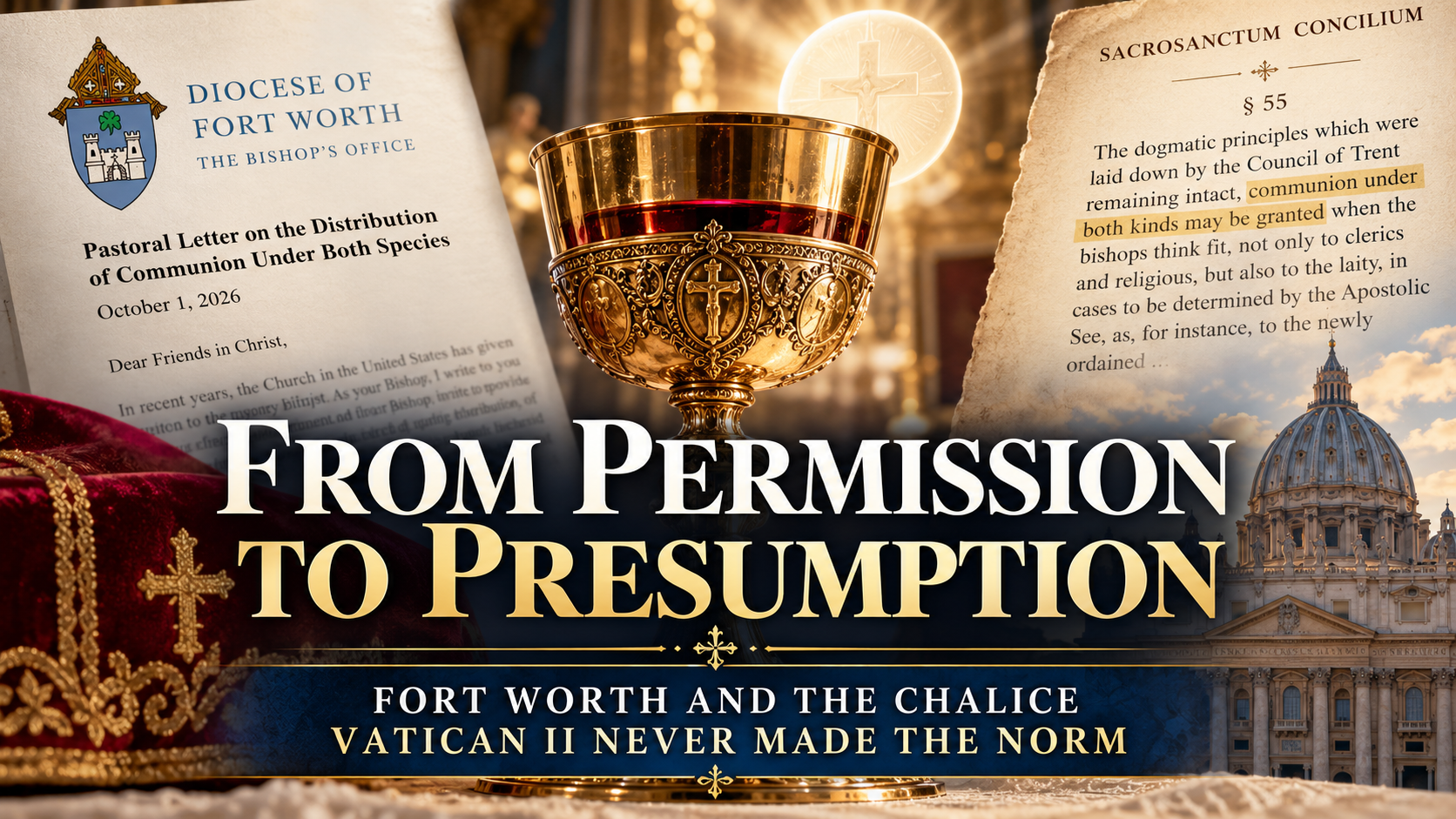
- FROM PERMISSION TO PRESUMPTION: Fort Worth and the Chalice Vatican II never made the NormBishop Michael Olson has implemented strict limitations on the distribution of Communion under both species in the Diocese of Fort Worth, prompting a discussion on the historical evolution of liturgical practices following Vatican II. This decision aims to reaffirm the doctrine of the Eucharist, emphasising that Christ is fully present under either species, while addressing misconceptions surrounding modern practices.
- AUGSBURG 2030: Can Rome commemorate a Confession it once confuted?Pope Leo XIV aims to revitalise the ecumenical spirit of the Augsburg Confession for its 2030 anniversary. However, historical responses from Rome highlight significant doctrinal differences between Catholics and Lutherans. True reconciliation must acknowledge these unresolved issues, as merely celebrating commonality risks glossing over critical theological distinctions that led to the Reformation.
- Today’s homily: St BrunoThe text reflects on Saint Bruno’s journey towards a life of solitude, prayer, and contemplation, emphasising the importance of genuine pursuit of God amidst distractions. It highlights that true spiritual growth requires silence and self-examination, urging believers to reclaim quiet moments for reflection, repentance, and devotion in daily life.
CURRENT EDITION


DAILY MASS ONLINE
One of the earliest online apostolates dedicated to the Traditional Latin Mass, Old Roman TV began broadcasting the Holy Sacrifice on the Feast of the Assumption, 15 August 2008. During the COVID-19 pandemic, additional programming — devotions, catechesis, and conferences — was added to support the faithful in prayer and formation.
Support the daily Holy Mass on Old Roman TV by offering a Mass intention — for loved ones, thanksgiving, or the repose of souls. Your intention helps sustain the sacred liturgy and brings grace to those you remember before God’s altar.
SUPPORT THE DAILY MASS ONLINE
Likely the world’s longest-running daily online broadcast of the
Traditional Latin Mass, streaming faithfully since the
Feast of the Assumption 2008.

This apostolate cannot continue without immediate help
Please support us with a contribution toward
chapel rent, sacristy supplies, operating costs, and web-hosting.
Our essential monthly costs reach £1,000.
MASS INTENTIONS
If your offering is for a Mass Intention, kindly complete the form below in full so we may correctly match it to your donation. For anniversary intentions — birthdays, wedding anniversaries, anniversaries of death — please be sure to include the relevant date.


Today’s Mass Propers
- Today’s Mass: October 07 Pope St Mark, Confessor
 St Mark’s brief pontificate teaches that God measures fidelity, not duration or worldly achievement. Christ alone possesses the everlasting priesthood; His servants are stewards of what they have received. With the commemorated martyrs, St Mark reminds us to persevere faithfully, so that when the Lord comes, He finds us “so doing.”


Leave a Reply