
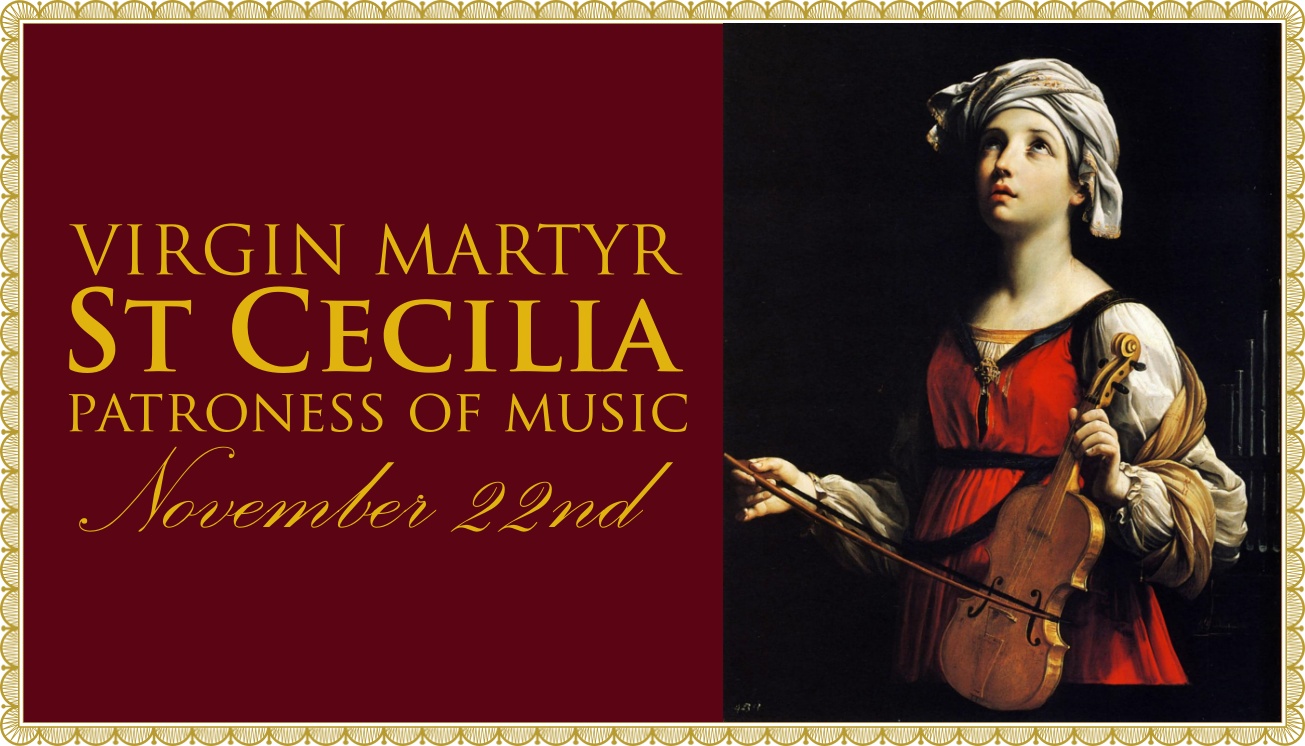
St Cecilia / Sunday Before Advent
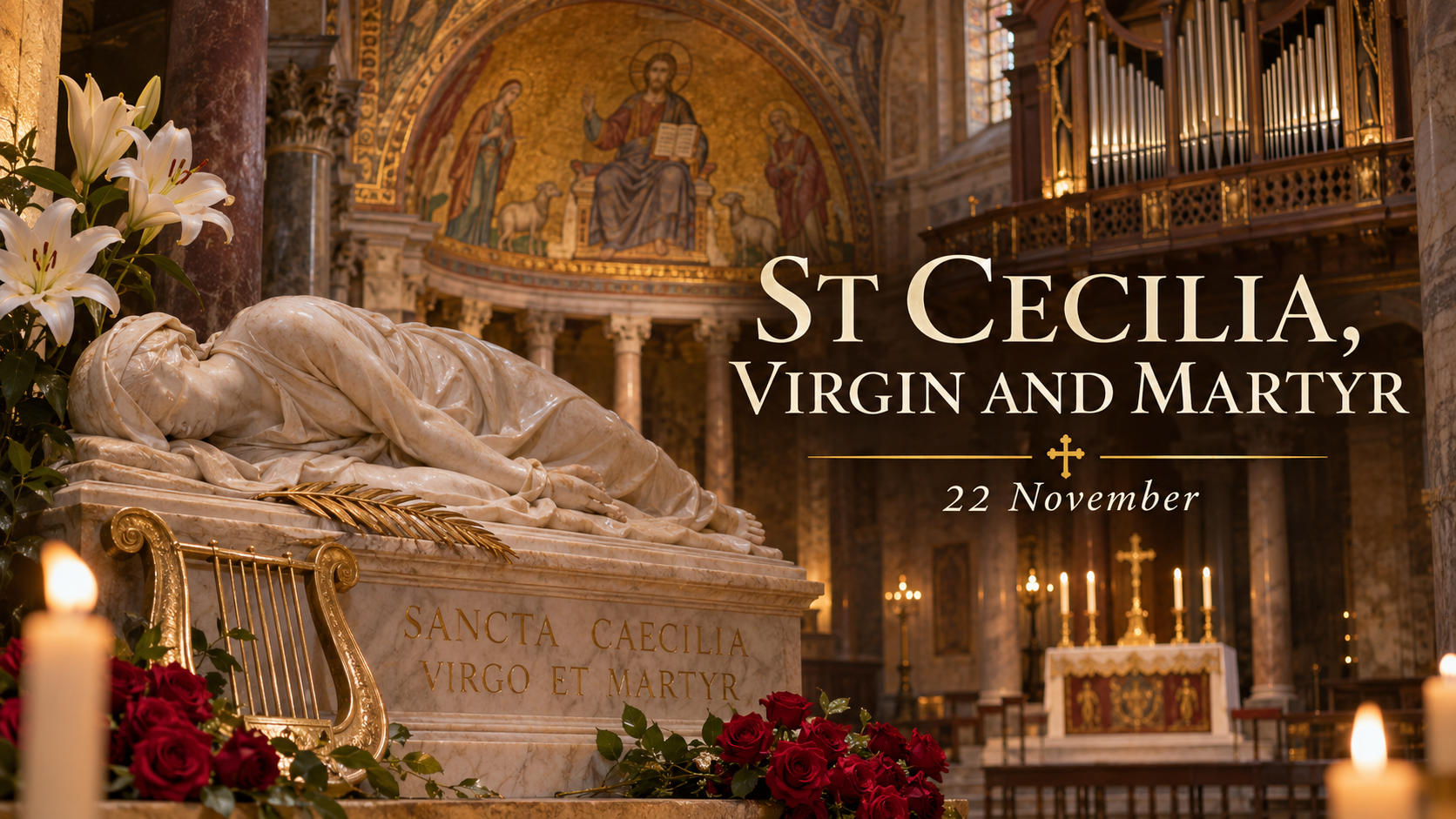
Today we celebrate the feast of St Cecilia, as well as commemorating the Sunday before Advent.
The life of St Cecilia follows a pattern similar to many other Christian virgins who became martyrs, such as St Agnes, St Agatha and St Lucy. They were Christian virgins pressurised into marrying pagan husbands, and suffered persecution and martyrdom because they would not consent to losing their virginity and compromising their faith. Whereas for most of the male early martyrs it was their refusal to acknowledge the cult of the Emperor that led to their martyrdom, for most of the female early martyrs the conflict came due to forced marriages to pagan husbands. This exposed them to persecution and martyrdom. It shows the difficulty of living as a Christian in a pagan society. Those who refused to compromise with the false standards of the world and the idolatry of the pagan Roman Empire suffered persecution and death because of it. And yet the paradox is that the reason why we still remember them to this day is because they were prepared to lose their lives rather than compromise what they believed to be right. As Tertullian put it, “The blood of the martyrs is the seed of the Church.”
In today’s Gospel from St Matthew we hear the parable of the wise and foolish virgins. There were ten virgins who took lamps to meet the bridegroom. Five were foolish and five were wise. The foolish, having taken their lamps, did not take oil with them, but the wise took oil in their vessels with the lamps. At midnight the cry was made, “Behold, the bridegroom cometh, go ye forth to meet him.” The foolish asked the wise to give them some of their oil, for their lamps were gone out. The wise answered that, in case there was not enough for both of them, they should buy some for themselves. While they had gone to buy oil the bridegroom came and the wise virgins went in with him to the marriage and the door was shut. When the foolish virgins arrived they asked to be let in, but the bridegroom would not do so for he did not know them. They were not prepared for the arrival of the bridegroom and were caught unawares.
In the parable the wise virgins awaiting the arrival of the bridegroom are the faithful who are ready for the Second Coming of Christ and the Last Judgement. The foolish virgins are those who are unprepared. None of us know when the Second Coming of Christ will occur and so we must be careful that we are not caught unawares. This is especially important to remember at the present time on this Sunday before Advent, the season when we look forward especially not only to the first coming of Christ in great humility at Christmas, but also to his second and final coming in glorious majesty to judge the living and the dead.
The Gospel for the Sunday before Advent (which we are commemorating today) is also from St Matthew and reminds us that Jesus forecast that in the world his followers would meet with tribulation as he himself did. He forecast not only death for himself, but also persecution for his disciples and death for some of them, and the ruin of the Jewish nation and the Temple in Jerusalem. After the manner of the Hebrew prophets before him, he moved straight on from the impending historical crisis to the final judgement, when the Son of Man would finally come in great power and glory to judge the living and the dead and God’s kingdom would finally come and his will be done on earth as it is in heaven.
“When you see the abomination of desolation which was spoken of by Daniel the prophet standing in the holy place.” The Seleucid Emperor Antiochus Epiphanes had attempted to suppress Judaism and desecrated the Temple at Jerusalem by setting up the worship of Zeus in the Temple. This was a clear example of the setting up of the abomination of desolation in the holy place. It was through the revolt of the Maccabees that the crisis was averted and the Temple purified from idolatry and rededicated to God. Similar fears arose again in the earliest days of the Church when the Emperor Caligula tried to set up a statue of himself in the Temple in Jerusalem. This crisis was only averted by his death, but it served as a powerful reminder to the first Christians of the tendency of the pagan State to set itself up in place of God. Indeed, this was precisely what it did for a few hundred years until the Emperor Constantine accepted Christianity. The martyrs such as St Cecilia were those who refused to compromise with the pagan deification of the civil power.
But surely we might say, that was then and it is different now. On the contrary, what is happening now, though the persecution is less overt than then, has many affinities with it. Secular governments throughout the world are arrogating to themselves more and more power and have taken away from people the responsibility for making their own decisions and placed them in the hands of the Government. We might say that this is not being done with an explicitly anti-Christian intention and that it is necessary for the State to have more power to help address the many problems our society now faces. However, the danger is that it is creating a totalitarian society which is in effect the old paganism in a new technological guise. As in the time of St Cecilia those who do not acknowledge the totalitarian State are seen as subversive elements in society who should have no place in the public sphere. They are seen as selfish for questioning the absolute power of the totalitarian State, just as the early Christians were seen as a threat to the wellbeing of society. We must pray that we remain faithful in the face of this new form of persecution and must seek to follow the example of the early martyrs who refused to compromise with paganism.
Let us make our own the words of today’s Collect:
Stir up the wills of thy faithful people, we beseech thee, O Lord; that they more earnestly seeking the fruit of good works, may receive more abundantly the gifts of thy loving kindness, through Jesus Christ thy Son our Lord, who livest and reignest with thee in the unity of the Holy Ghost, ever one God world without end. Amen.
by the Revd Dr Robert Wilson PhD (Cantab), Old Roman Apostolate UK





Leave a Reply