
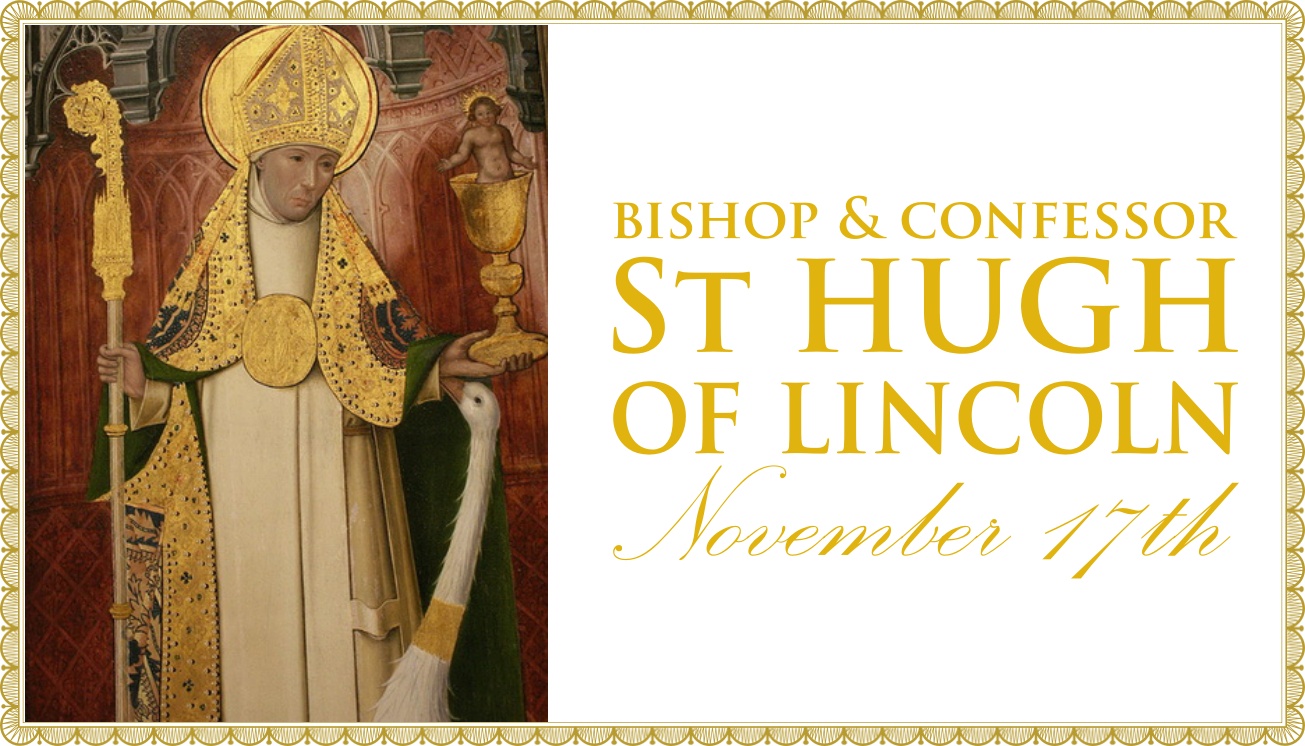
St. Hugh of Lincoln
Today we celebrate the feast of St. Hugh of Lincoln. He was born at Avalon in south eastern France in around 1140. His mother died when he was around eight years old and his father sent him to be educated by a community of Augustinian canons. His father himself later retired to the community. At the age of fifteen St. Hugh made his profession as an Augustinian and was later ordained deacon at the age of nineteen.
Though the Augustinians took upon themselves the evangelical counsels of poverty, chastity and obedience they still lived in the world ministering to those in need. By contrast, St. Hugh increasingly came to desire a more contemplative existence in an enclosed monastery. This he found in the Grande Chartreuse, the mother house of the Carthusian order that had been founded by St. Bruno.
The Carthusians sought to combine the distinctive vocations of both hermits (those who lived alone) and monks (those who lived in community). Carthusian monks spent most of the time living as hermits in individual cells, but also shared some activities together as part of a religious community. St. Hugh discerned that his vocation lay with the Carthusians rather than the Augustinians. In 1163 he left the Augustinians and became a Carthusian monk at the Grande Chartreuse.
He now devoted himself to a life of prayer and contemplation. He was ordained priest to further this vocation and eventually became procurator, with responsibility for all the temporal affairs of the monastery. It seemed virtually certain that he would spend the rest of life in such an enclosed environment.
In fact, history took a very different course. At this time the King of England, Henry II, also ruled half of France. He had recently been involved in a bitter conflict with St. Thomas a Becket, the Archbishop of Canterbury, that had led to Becket’s murder in his own cathedral. Henry had been forced to perform public penance, part of which involved the foundation of three monasteries in England.
One of these was a Carthusian house at Witham in Somerset. It had been established in 1178 but the monks sent from the Grande Chartreuse faced great difficulties. The first prior was unsuccessful and the second died soon afterwards so Henry, hearing of St. Hugh’s good reputation sent for him to be the third prior.
St. Hugh was not enthusiastic about this new role, which he viewed as a distraction from the life of prayer and contemplation. The Bishop of Bath and Wells and the Bishop of Grenoble eventually compelled him to accept it. St. Hugh arrived at Witham in 1179. Gradually the difficulties involved in establishing the community were overcome. It again seemed that St. Hugh would spend the rest of his life as prior of Witham.
History again took another course. In 1186 Henry summoned a council of bishops and barons at Eynsham. One of the matters under consideration was the filling of vacant bishoprics, notably Lincoln. St. Hugh was nominated and was consecrated bishop in September, 1186.
At that time Lincoln was the largest diocese in England. It even included Oxford, a university town many miles to the south. St. Hugh proved a model pastoral bishop and set to work in reforming his unwieldy diocese. He raised the standard of education at the cathedral school and set about the task of rebuilding the cathedral itself. He was even able to maintain on good terms with the king, an exceptionally aggressive personality. He did this by speaking the truth in love, tempering firmness of principle with mercy in his dealings with others. He died on 16 November, 1200.
It is not surprising that St. Hugh was venerated as one of the most loved saints in medieval England and there is much that can be learnt from his life and witness today. Perhaps the most important is the need to speak truth to power, but also to temper justice with mercy. The Hebrew prophets spoke the truth, whether they will hear or whether they will forbear. They were passionate about social injustice and delivered harsh criticisms of those in positions of power who abused their authority for their own advantage.
At the same time they could sometimes be accused of an imperfect apprehension of the spirit of love and a lack of charity towards others. The same could also be said of many prophetic figures in the history of the Church who spoke truth to power. They were often more feared than loved because they could sometimes be excessively harsh and unbending in their dealings.
At the opposite extreme many in our own day tend towards excessive lenience. Under the guise of being charitable and merciful towards others, they neglect the cause of truth and justice and prefer to tend a blind eye to social injustices and abuses, both within and outside the Church.
How might a correct balance between the principles of justice and mercy be achieved? We find this in the life and ministry of Jesus, who himself taught and embodied in his own life, death and resurrection the kindness and severity of God. He spoke truth to power and, like the prophets of old, spoke in scathing terms of those who abused their power.
The times were evil, he told his hearers, and their lives were in need of radical amendment. There would be terrible judgment upon the nation that had rejected him and vindication for himself and his followers.
At the same time, he also embodied that most excellent gift of charity, the divine charity that suffereth long and is kind, that vaunteth not itself, in seeking and saving the lost, in turning the other cheek and going the second mile, in taking evil upon himself and somehow subsuming it into good. In his life justice and mercy were finally combined and the forces of evil that seem to rule this present age were finally defeated.
The strength of great saints like St. Hugh of Lincoln is that they too were able to embody something, however imperfectly, of that same spirit. St. Hugh had clear principles and was not afraid to criticise those in positions of power who abused them, even when that person was the king who had promoted him first to be the prior of a monastery and then to a bishopric.
At the same time, he spoke the truth in love and was not harsh, but rather merciful, in his dealings with others. Then, as now, this was easier said than done. The world then, as it is now, is filled with violence and it is easy to become disheartened about how little we can accomplish.
St. Hugh did not despair at the problems that he faced, but rather embraced them as part of his vocation. He would have much preferred a quiet life of prayer and contemplation, but accepted the roles, first of prior of Witham and then as bishop of Lincoln, that had been entrusted to him, and by the grace of God, he persevered in times of great adversity.
Let us pray that we will too, by the grace of God, follow the example of the life and witness of St. Hugh of Lincoln today, and find the correct balance between the principles of justice and mercy in addressing the problems and challenges that we face in our own time and place.
by the Revd Dr Robert Wilson PhD (Cantab), Old Roman Apostolate UK





Leave a Reply