

Faithful in the Things Entrusted to Us
MASS Gaudeamus
EPISTLE Ecclesiasticus (Sirach) 50:1, 4–11
GOSPEL St Matthew 25:14–23
HOMILIST Mt Revd Jerome Lloyd OSJV

In the Name of the Father, and of the Son, and of the Holy Ghost. Amen.
My dear brethren,
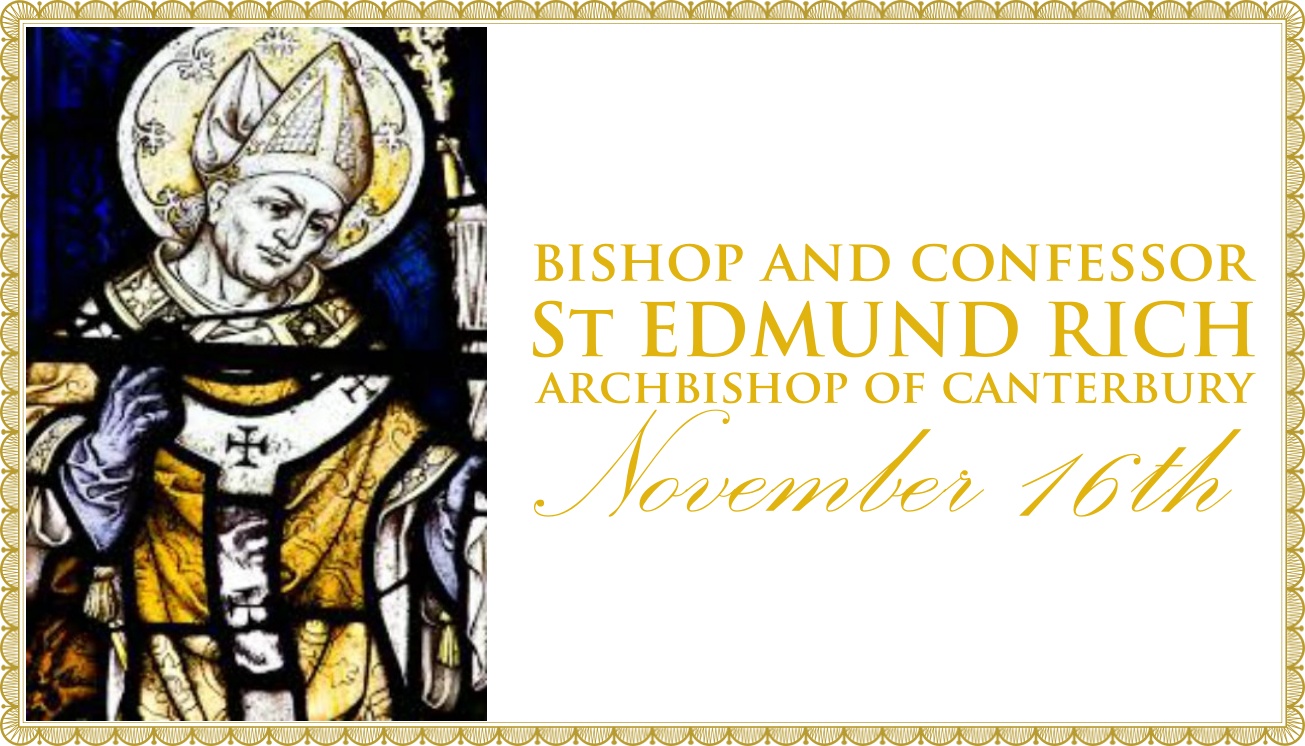
There is something rather sobering about the Gospel appointed for today’s feast of St Edmund Rich. Our Lord describes a master who entrusts his possessions to his servants and then, after a considerable absence, returns to demand an account. The servants have not been told how long they will have, nor what difficulties they may encounter. They are expected to employ what has been entrusted to them. And when the reckoning comes, the question is whether they have been faithful.
We are inclined to measure our lives rather differently. We consider what we have accomplished, whether our efforts have been appreciated, and particularly whether things have turned out as we intended. Yet anyone who has lived for any considerable time knows how rarely circumstances oblige us in this respect. We may do everything that prudence and conscience require, and still encounter disappointment, misunderstanding, even failure. What then becomes of our fidelity?
The life of St Edmund provides a remarkable answer.
Born at Abingdon towards the end of the twelfth century, Edmund was formed in the Faith principally through his mother, Mabel. His was a household where prayer, sacrifice and the commandments were understood as serious obligations. This may seem unremarkable until we consider how easily Catholic parents can become preoccupied with securing every worldly advantage for their children while leaving their eternal welfare to chance. There is little point in preparing a child for every conceivable career if he has not been prepared to become a saint.
Edmund was intellectually gifted, studying and teaching at Oxford and Paris before devoting himself to theology. His learning was accompanied by a profound spiritual life. The traditional accounts of his youth relate his particular devotion to the Blessed Virgin, to whom he consecrated his chastity. Here was a man whose gifts might have secured him worldly distinction, but who understood that their proper employment must ultimately be determined by God.
In 1234 he became Archbishop of Canterbury, entering upon difficulties which would occupy much of his remaining life.
King Henry III interfered in ecclesiastical affairs, particularly appointments and revenues, while Edmund defended the Church’s freedom to govern herself according to her own laws. Disputes involving religious communities and the intervention of the papal legate, Cardinal Otto, further complicated his position. Edmund struggled to discharge his episcopal responsibilities while encountering opposition from authorities whose cooperation he might reasonably have expected.
We ought to appreciate his predicament. Edmund had not sought an opportunity to make himself troublesome. He was attempting to fulfil the duties imposed by his episcopal consecration. His responsibility was to Christ, whose flock he had been appointed to shepherd, and that responsibility could not be set aside because obedience to conscience proved inconvenient to others.
There is a distinction here which Catholics must understand. The authority of the Church comes from God, and the faithful owe genuine obedience to those lawfully appointed to govern them. Yet ecclesiastical authority remains subject to divine law, the deposit of Faith and the purpose for which it was instituted. A bishop does not cease to possess authority because he makes an imprudent decision; neither does his office transform every decision into an expression of the divine will.
St Edmund understood this without becoming disloyal to the Church. He appealed to Rome, sought justice through established channels and continued defending what his office required. His difficulties did not drive him to abandon ecclesiastical communion or construct a religion more agreeable to his own judgement. He remained a Catholic bishop, even when the conduct of other Catholics made the fulfilment of his vocation painfully difficult.
Some eight centuries later, we should scarcely be astonished that ecclesiastical government can still present difficulties. The Church’s history contains many occasions when holiness has been found among those obliged to suffer the consequences of other men’s mistakes. Yet fidelity cannot be reduced to the successful resolution of disputes. We must do what is right because it is right, and leave to Providence what may come of it.
This brings us back to the Gospel.
The servants receive different amounts according to their capacity. One receives five talents, another two, and a third one. Our Lord makes no suggestion that they have been treated unjustly. Their master knows what each can undertake. What matters is what they do with the responsibilities placed in their hands.
And this is where the parable becomes rather uncomfortable, because it concerns every one of us.
We have each received something from God for which an account must eventually be rendered. Our Catholic Faith, the sacraments, opportunities to practise charity, the duties of our state of life, the circumstances in which Providence has placed us: all these belong to the Master. They have been entrusted to our care for a time.
A parent may spend years struggling to bring up children in the Faith, only to discover that some have abandoned its practice. A priest may labour faithfully among a congregation which never becomes numerous. Someone may spend much of his life caring for an elderly relative, with little opportunity for worldly accomplishments. Are these lives failures? Certainly not, provided their duties have been undertaken faithfully and with charity. God does not demand that we accomplish what lies beyond our power. He demands that we cooperate with the grace He supplies.
Of course, we must not confuse fidelity with obstinacy. It is possible to become so attached to one’s plans that every obstacle is interpreted as persecution and every disappointment as evidence of another’s wickedness. Prudence requires us to examine our motives, seek sound counsel and distinguish what God commands from what we happen to prefer. Edmund’s perseverance was rooted in prayer and the obligations of his office.
The lesson is equally important when our efforts appear fruitless. We cannot compel another person’s conversion. We cannot guarantee that our children will embrace everything we have taught them. We cannot, by our own efforts, restore the Catholic life of a nation. But we can pray, teach, offer sacrifice, receive the sacraments worthily and fulfil the duties which belong to us.
And we must begin with our own souls. There is little use lamenting the disappearance of Catholic practice from society if we have allowed it to disappear from our homes. The family Rosary, Sunday Mass, frequent confession, the observance of fasts and feasts, the teaching of the catechism: these are ordinary means by which grace bears fruit. What they require is perseverance.
Edmund eventually withdrew to France, dying in 1240 after years of struggle. He had not achieved everything for which he laboured. Many difficulties afflicting the English Church remained unresolved. Yet the Church remembers him as a saint, while the disputes which consumed so much of his earthly life have become matters for historians.
At the altar today, we are reminded that our own reckoning approaches. Whatever our past failures, God’s mercy permits us to begin again through repentance and grace. We need not possess five talents to enter heaven. We must faithfully employ those we have received.
For when the Master returns, He will not ask whether the world applauded our efforts, whether our plans succeeded, or whether life was agreeable. He will judge whether we loved Him, obeyed His commandments and remained faithful to the duties He entrusted to us.
May St Edmund obtain for us that perseverance, so that when our own reckoning comes, we too may hear: “Well done, good and faithful servant … Enter thou into the joy of thy lord.”
In the Name of the Father, and of the Son, and of the Holy Ghost. Amen.




Leave a Reply