

St Martin I of Rome: The Price of Fidelity
MASS Státuit ei Dóminus
EPISTLE James 1:12-18
GOSPEL St Luke 14:26-33
HOMILIST Mt Revd Jerome Lloyd OSJV

In the Name of the Father, and of the Son, and of the Holy Ghost. Amen.
My dear brethren,
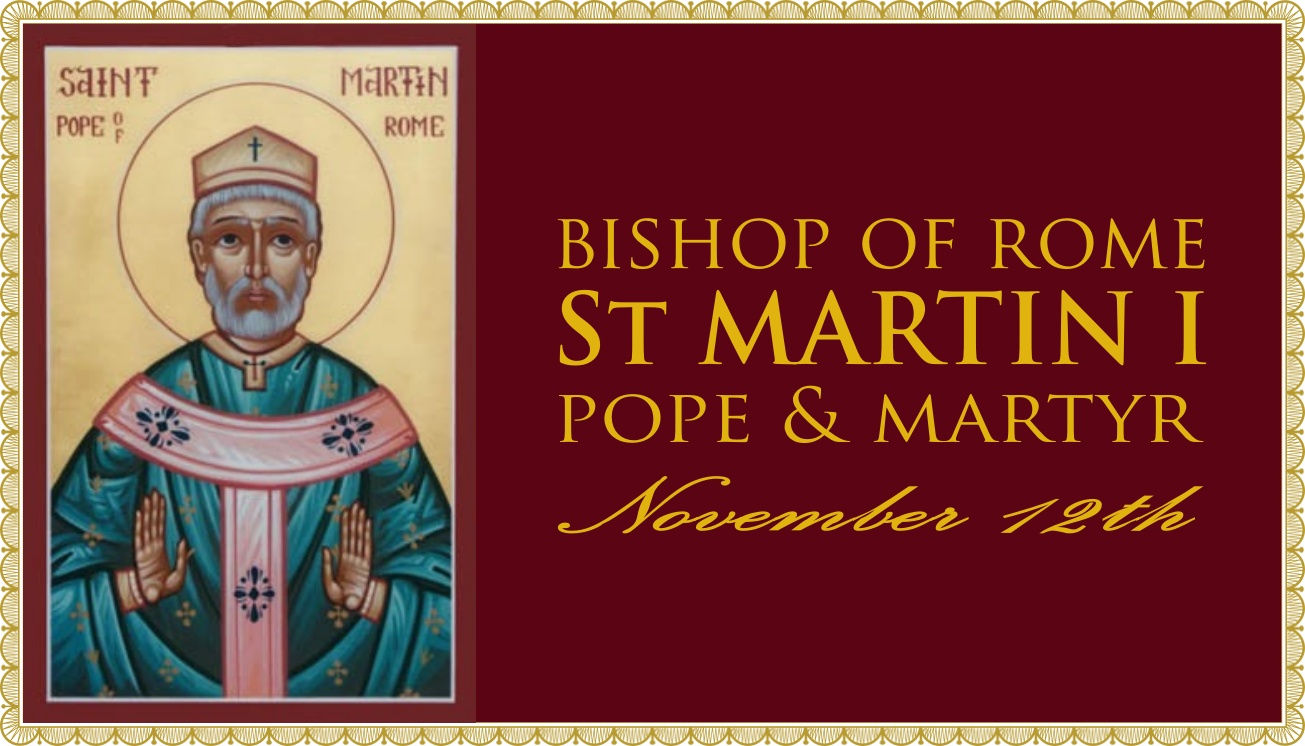
Yesterday we celebrated St Martin of Tours, the soldier who became a monk and bishop, and whose holiness helped establish the Christian Faith throughout much of Gaul. Today we celebrate another Martin, whose circumstances were rather different. St Martin I was Pope during the seventh century, and had the distinction, if one may call it that, of being arrested, imprisoned and exiled by a Christian emperor for defending the Catholic Faith. It is a curious thing that the successor of St Peter should have been persecuted by a ruler who professed the very religion which the Pope was bound to defend. Yet the history of the Church contains a number of such curiosities, usually arising when those entrusted with authority forget the purpose for which it was given.
Martin became Pope in 649, when the Eastern Roman Empire was troubled by religious and political divisions. The controversy concerned the Monothelite heresy, which taught that Our Lord Jesus Christ possessed only one will. The emperors hoped that this formula might reconcile opposing theological parties and restore unity to an empire already threatened by enemies beyond its borders.
We might wonder why anyone should suffer imprisonment over what appears to be a rather technical theological question. Surely there were more pressing matters to occupy the emperor and the Pope?
But consider what was actually being proposed. The Catholic Faith teaches that Our Lord is one divine Person possessing two complete natures, divine and human. Having assumed a true human nature, He also possessed a true human will, perfectly obedient to His divine will. When He prayed in Gethsemane, “Not my will, but thine be done,” He manifested the genuine human obedience through which He freely accepted His Passion.
This concerns the very heart of our redemption. Adam had disobeyed God through the misuse of his human will. Christ, the new Adam, redeemed mankind through the perfect obedience of His human will. To deny that will was to obscure the reality of the humanity He assumed for our salvation.
The Emperor Constans II, however, wanted the controversy ended. In 648, he issued a decree known as the Typos, forbidding further discussion of whether Christ possessed one or two wills and operations. It was an imperial attempt to settle a theological dispute by requiring everyone to stop discussing it. The emperor evidently believed that silence would produce peace.
Unfortunately, truth does not cease to matter merely because its discussion has become inconvenient.
Martin had previously represented the Apostolic See in Constantinople. He knew the political circumstances and the probable consequences of opposing the emperor. Nevertheless, in October 649, he assembled 105 bishops at the Lateran, where the Catholic doctrine was affirmed and the imperial decree condemned.
Here we encounter something particularly relevant to today’s Gospel. Our Lord speaks of the man intending to build a tower, who must first calculate whether he possesses the means to finish it. He also describes a king considering whether his army can withstand a greater force advancing against him.
Both examples concern the necessity of understanding what one has undertaken. Our Lord is speaking about discipleship and the sacrifices which fidelity to Him may demand. A man who proposes to follow Christ must understand that this commitment extends beyond those occasions when following Him is agreeable.
Martin had counted the cost. He was no inexperienced cleric, unaware of the emperor’s power or the dangers of opposing him. He knew that he might lose his liberty, be separated from Rome and subjected to whatever indignities imperial officials might devise. Nevertheless, his responsibility was clear. The Faith entrusted to him was neither his to alter nor the emperor’s to regulate according to political convenience.
In June 653, imperial officers entered the Lateran Basilica to arrest him. Martin was already seriously ill. Rather than permit bloodshed in his defence, he submitted to his captors. He was taken to Constantinople, imprisoned, publicly humiliated and tried upon political charges. Eventually he was banished to Cherson, in the Crimea, where poverty, illness and neglect brought him to his death in 655.
There is something particularly affecting about his final months. He had defended the doctrine of Christ and endured the consequences. Yet he died far from Rome, deprived of comfort and largely abandoned by those who might have been expected to assist him. There was no triumphant return, no public vindication, no earthly reward for his courage.
St James tells us in today’s Epistle: “Blessed is the man that endureth temptation: for when he is tried, he shall receive the crown of life, which the Lord hath promised to them that love him.”
Notice that St James speaks of endurance. The Christian life is seldom decided by one magnificent act of courage. More commonly, it requires perseverance through difficulties which continue long after our first enthusiasm has faded. There is a considerable difference between declaring oneself willing to suffer for the Faith and remaining faithful when suffering has actually arrived.
Martin’s courage in condemning heresy was remarkable. His perseverance in exile, when there was little left for him to do except suffer patiently and commend himself to God, was perhaps more remarkable still.
St James also makes an important distinction. God permits trials through which our fidelity may be strengthened, but He never tempts us to evil. The enticement to sin arises from our disordered desires, which seek their satisfaction apart from God’s law. Martin’s circumstances presented many opportunities for fear, discouragement and resentment. His perseverance required that he should continue to choose God even when obedience brought no apparent relief.
There is another difficult expression in today’s Gospel. Our Lord tells the multitude that whoever comes to Him without hating father, mother, wife, children, brethren, sisters and even his own life cannot be His disciple.
He is certainly not commanding us to despise our families. Such an interpretation would contradict His own commandments concerning charity and the honour due to parents. The expression conveys the absolute priority which our love for Christ must possess. Even our dearest and most legitimate human attachments must yield where they conflict with our duty towards God.
Martin was required to surrender nearly everything which ordinarily gives a man security: his home, his position, his companions and eventually his life. His willingness to do so arose from the conviction that Christ was worth more than anything he might lose.
And here his example becomes relevant to ourselves. We may never be required to stand before an emperor or suffer exile for the Faith, but we shall certainly encounter occasions when fidelity to Christ requires us to sacrifice something we would prefer to keep. Sometimes it may be the approval of others or a comfortable arrangement. More frequently it is the daily struggle to overcome pride, impatience, resentment or our reluctance to forgive.
We can admire the courage of martyrs whilst remaining surprisingly reluctant to surrender our own comparatively modest attachments.
The same Christ whose human obedience Martin defended now asks us to conform our wills to His. We cannot claim to value the truth of the Incarnation whilst disregarding the purpose for which the Son of God became man: that we might be reconciled to the Father and brought to eternal life.
Our concern for the condition of the Church must therefore always be directed towards the salvation of souls. Where doctrine is obscured or the faithful are confused, we have good reason to be concerned. Martin’s example certainly does not commend indifference. But the defence of the Faith belongs together with living that Faith: prayer, confession, the worthy reception of Holy Communion, instructing our children, encouraging those who have fallen away and helping others discover Christ.
The doctrine which Martin defended was solemnly vindicated at the Third Council of Constantinople in 680–681, twenty-five years after his death. He had not lived to witness that confirmation. His duty had been to remain faithful in the circumstances Providence permitted.
And in a few moments, upon this altar, we shall encounter the same divine Redeemer for whose truth Martin suffered. The Holy Sacrifice makes present that perfect offering of obedience through which our salvation was accomplished. Here we receive the grace by which our own imperfect wills may be strengthened and brought into conformity with His.
Let us ask St Martin for his courage, but also for his patience and perseverance. To begin well is a grace; to remain faithful until the end requires our continued cooperation with grace.
St James promises the crown of life to those who endure because they love God. Martin died a prisoner, far from the city in which he had once occupied the chair of St Peter. The emperor could deprive him of Rome, of liberty and of human consolation. He could not deprive him of Christ.
May we likewise persevere in the Faith, whatever circumstances God permits, and be found worthy, through His mercy, of that same eternal crown.
In the Name of the Father, and of the Son, and of the Holy Ghost. Amen.
Homilies Archive

Mass Propers


DAILY MASS ONLINE
One of the earliest online apostolates dedicated to the Traditional Latin Mass, Old Roman TV began broadcasting the Holy Sacrifice on the Feast of the Assumption, 15 August 2008. During the COVID-19 pandemic, additional programming — devotions, catechesis, and conferences — was added to support the faithful in prayer and formation.
Support the daily Holy Mass on Old Roman TV by offering a Mass intention — for loved ones, thanksgiving, or the repose of souls. Your intention helps sustain the sacred liturgy and brings grace to those you remember before God’s altar.
SUPPORT THE DAILY MASS ONLINE
Likely the world’s longest-running daily online broadcast of the
Traditional Latin Mass, streaming faithfully since the
Feast of the Assumption 2008.

This apostolate cannot continue without immediate help
Please support us with a contribution toward
chapel rent, sacristy supplies, operating costs, and web-hosting.
Our essential monthly costs reach £1,000.




Leave a Reply