

The Vine, the Sword, and the Crown: The Cost of Apostolic Fidelity
MASS Intret in conspectu tuo
LESSON 1 Corinthians 4:9-14
GOSPEL St John 15:1-7
HOMILIST Mt Revd Jerome Lloyd OSJV

In the Name of the Father, and of the Son, and of the Holy Ghost. Amen.
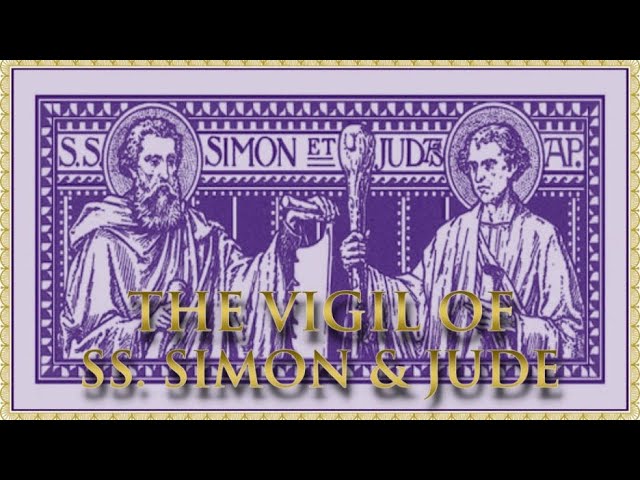
The Church places upon our lips today the cry of a people whose sanctuary has been violated and whose faithful have been slaughtered. “Let the sighing of the prisoners come before thee, O Lord,” we hear in the Introit, followed by the terrible petition, “Revenge the blood of thy saints, which hath been shed.” These words, taken from Psalm 78, introduce the Vigil of Saints Simon and Jude. We have come to prepare for the feast of two Apostles, and the Church begins by reminding us what their vocation demanded. They were sent to preach salvation to the world, knowing that the world might answer by putting them to death.
Simon and Jude belong to that company of Apostles about whom Scripture tells us comparatively little. Simon bears the title of Zealot, indicating an ardour which Christ would direct towards the service of His Kingdom. Jude, also called Thaddeus, is remembered for a question he addressed to Our Lord at the Last Supper. After Pentecost, the two disappear from the detailed narrative of the New Testament. Ancient traditions associate their missionary labours with the East, particularly Persia, where they are believed to have suffered martyrdom. The circumstances cannot be reconstructed with certainty, but the Church has honoured their apostolic witness for centuries, joining their names in a common feast on 28 October.
Their relative obscurity is worth considering. These men belonged to the Twelve upon whom Christ established the foundations of His Church. Yet we know almost nothing of their preaching, their converts, their daily sacrifices, or the circumstances in which they died. How much must have been accomplished which no earthly record has preserved! The work of God cannot be measured simply by what history remembers. We may spend our lives seeking recognition for things of little consequence while overlooking the immense supernatural value of duties faithfully performed and sacrifices known to God alone.
In today’s Epistle, St Paul describes the apostolic condition with an almost shocking frankness. “We are made a spectacle to the world, and to angels, and to men.” He speaks of hunger, thirst, poverty, homelessness, persecution and public contempt. The Corinthians had begun to imagine themselves already rich in spiritual accomplishment, and Paul reminds them of the price being paid by those who brought them the Gospel. The Apostles were entrusted with divine authority, yet they possessed none of the worldly security commonly associated with power. Their office was glorious because of the One who had instituted it, not because it protected them from humiliation.
Notice especially Paul’s account of their conduct: “We are reviled, and we bless: we are persecuted, and we suffer it.” He could have described his injuries at much greater length. Instead, he tells us how the Apostles responded. Their endurance was governed by charity. They refused to allow the malice of others to determine the character of their own souls. That is a demanding lesson for Christians who find themselves opposed, misrepresented, or treated unjustly. We may have every reason to defend the truth and resist wrongdoing; we have no permission to cultivate hatred. Indeed, the manner of our resistance often reveals whether we are acting from supernatural conviction or wounded pride.
Simon, the Zealot, provides a particularly fitting patron for this examination. Zeal is necessary to the Christian life. A man who is indifferent to divine truth, to the salvation of souls, or to the honour due to God has scarcely understood his religion. Yet zeal requires discipline. It must be obedient to truth, animated by charity, and purified of the desire to triumph over other people. Christ did not extinguish Simon’s ardour when He called him. He gave it a higher object and a holier purpose. The zealot became an Apostle, spending himself for the conversion of those whom he had been sent to serve.
St Jude brings us still closer to today’s Gospel. At the Last Supper he asked Our Lord: “Lord, how is it, that thou wilt manifest thyself to us, and not to the world?” Christ answered by speaking of love and obedience: “If any one love me, he will keep my word.” The Father and the Son, He promised, would come and make their abode with such a soul. Jude had asked about the manifestation of the Messiah; Our Lord revealed the mystery of divine indwelling. It is this same mystery which He explains in today’s Gospel through the image of the Vine and its branches.
“I am the true vine,” says Christ, “and my Father is the husbandman.” He then declares, “Abide in me, and I in you.” These words concern the very source of supernatural life. The branch cannot nourish itself, however vigorous its outward appearance. It receives life from the vine or it withers. St Augustine insists upon the absolute character of Our Lord’s teaching. Christ did not say that without Him we could accomplish very little. He said, “Without me you can do nothing.” Whatever merely natural good a person may accomplish, the fruit that belongs to eternal life requires divine grace.
This explains why the Church’s sacramental life is indispensable. Baptism grafts us into Christ; sanctifying grace establishes us in His friendship; the Holy Eucharist nourishes our union with Him. Mortal sin destroys that life of grace within the soul, and the Sacrament of Penance restores the repentant sinner to friendship with God. We cannot substitute religious enthusiasm, theological knowledge, or attachment to ecclesiastical customs for that supernatural life. All these things have their proper place, but they must serve the end for which Christ established His Church: the sanctification and salvation of souls.
There is also the matter of pruning. “Every one that beareth fruit, he will purge it, that it may bring forth more fruit.” Anyone who has tended a vine knows that pruning can appear destructive. Branches which have grown vigorously must be cut back so that the plant may become more fruitful. Something similar occurs in the spiritual life. God permits trials which expose our attachments and teach us dependence upon Him. An ambition is disappointed, an injustice must be endured, a cherished expectation comes to nothing. None of these experiences is pleasant, and suffering does not automatically make anyone holy. Its spiritual value depends upon the grace with which it is received and the response we make.
For many of us, the most necessary pruning will be found in ordinary life. The sharp word withheld during an argument, the apology offered when pride demands silence, the difficult person treated with patience, the neglected prayer resumed, the confession made after months of delay: these are opportunities for grace to bear fruit. We should not imagine that fidelity will necessarily present itself in some dramatic confrontation. The man who cannot govern his temper at home is poorly prepared to endure persecution for the Gospel.
This has particular importance when we consider the present condition of the Church. Catholics who recognise the injuries inflicted upon her doctrine, discipline, and sacred worship have serious responsibilities. The apostolic inheritance must be preserved, and error must be resisted. Yet fidelity to tradition demands more than the defence of inherited forms. The traditional Mass should form traditional Catholic souls: reverent towards God, obedient to His commandments, attentive to the poor, faithful in their duties, and serious about their eternal salvation. We cannot hope to restore Catholic life while neglecting its foundations in our own homes and hearts.
The brief Epistle traditionally attributed to St Jude speaks directly to this responsibility. He exhorts Christians to “contend earnestly for the faith once delivered to the saints.” The deposit of faith is something received, guarded, and transmitted, never reconstructed according to the fashions of an age. But Jude also commands the faithful to pray in the Holy Ghost, preserve themselves in the love of God, and show mercy towards those in spiritual danger. He understood that the defence of doctrine and the salvation of souls belong together. We betray his example if the struggle for truth leaves us embittered, prayerless, or indifferent to those whom Christ desires to save.
Nor may we overlook Our Lord’s warning about the branch that refuses to remain in Him. It withers, is gathered up, and is cast into the fire. These are solemn words, spoken by the same Saviour who gave His life for sinners. The possibility of eternal loss is real. Our final destiny cannot be secured by belonging outwardly to the Church while deliberately refusing the demands of grace. Christ calls us to perseverance: to remain in His friendship, to repent when we fall, and to order our lives towards the eternity for which we were created.
We understand, then, why so many Christians invoke St Jude in desperate circumstances. His patronage reminds us that no human predicament lies beyond the power of divine mercy. Yet Our Lord’s promise in the Gospel, “You shall ask whatever you will, and it shall be done unto you,” must be understood in the light of His command that we abide in Him and that His words abide in us. Christian prayer seeks the will of God. Sometimes Providence grants the deliverance we desire; sometimes grace enables us to endure what cannot presently be changed. In either case, the faithful soul is sustained by the One who has promised never to abandon those who trust in Him.
As we approach the altar, the Secret of this Vigil asks that the merits of the Apostles may commend our offering to God, acknowledging how our own guilty conscience hinders its acceptability. The Church makes us examine ourselves before celebrating the mysteries through which Christ communicates His life. And in the Postcommunion she prays that the Sacrament received in this present life may obtain for us life eternal. Here is the purpose of the apostolic mission, the meaning of the martyrs’ sacrifice, and the fulfilment of the Gospel’s promise.
Tomorrow we shall honour Simon and Jude in the glory of their heavenly birthday. Tonight we ask for the grace by which they reached it. May their intercession obtain for us the courage to defend the faith without compromise, the humility to recognise our need of conversion, and the charity which makes our witness worthy of Christ. Their names have endured because they belonged to Him. Let our lives, whether publicly noticed or quietly spent in His service, bear the same testimony. “Abide in me,” says the Lord. Upon that command rests our fruitfulness in this world and our hope of everlasting life.
In the Name of the Father, and of the Son, and of the Holy Ghost. Amen.
Homilies Archive

Mass Propers


DAILY MASS ONLINE
One of the earliest online apostolates dedicated to the Traditional Latin Mass, Old Roman TV began broadcasting the Holy Sacrifice on the Feast of the Assumption, 15 August 2008. During the COVID-19 pandemic, additional programming — devotions, catechesis, and conferences — was added to support the faithful in prayer and formation.
Support the daily Holy Mass on Old Roman TV by offering a Mass intention — for loved ones, thanksgiving, or the repose of souls. Your intention helps sustain the sacred liturgy and brings grace to those you remember before God’s altar.
SUPPORT THE DAILY MASS ONLINE
Likely the world’s longest-running daily online broadcast of the
Traditional Latin Mass, streaming faithfully since the
Feast of the Assumption 2008.

This apostolate cannot continue without immediate help
Please support us with a contribution toward
chapel rent, sacristy supplies, operating costs, and web-hosting.
Our essential monthly costs reach £1,000.




Leave a Reply