
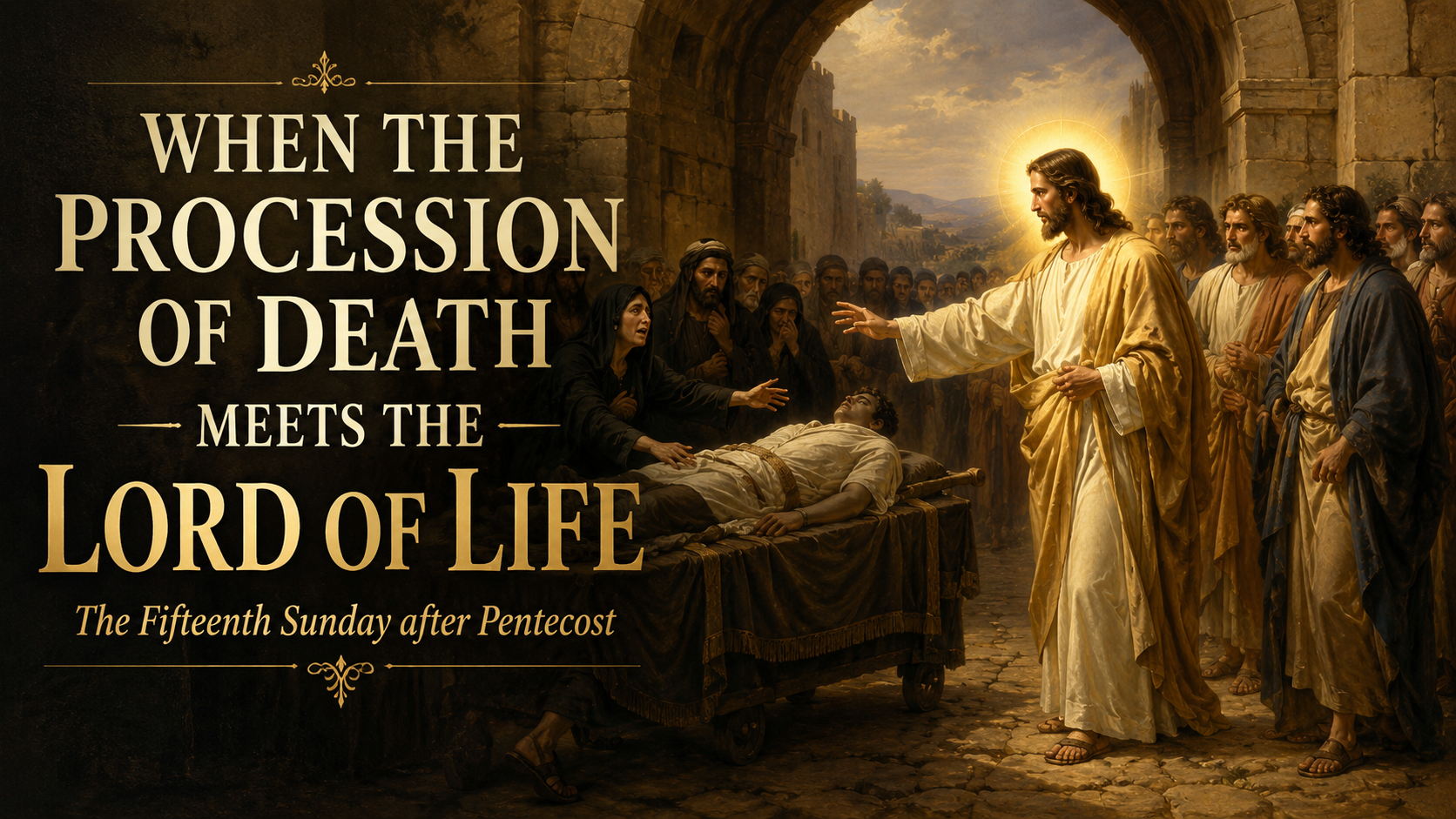
The Fifteenth Sunday after Pentecost: the widow of Naim, the resurrection of the sinner, and the life that comes only from Christ
The Fifteenth Sunday after Pentecost is one of those Sundays on which the ancient Roman liturgy seems almost to construct a theological treatise before our eyes. Its subject is life: not merely biological life, nor vague spiritual vitality, but the supernatural life of grace which comes from God, is sustained by God, can be lost through mortal sin, and can be restored only by the power of Christ. The Introit cries for preservation; the Collect confesses that without God the Church cannot remain safe; the Epistle commands those who live by the Spirit actually to walk according to the Spirit; the Gospel shows a corpse being carried towards the grave until Christ stops the procession; the Secret asks that the divine mysteries guard us against the assaults of the devil; the Communion identifies the Flesh of Christ as the Bread given “for the life of the world”; and the Postcommunion asks that this heavenly Gift should take possession of mind and body. The Mass is not a miscellaneous collection of texts. It is one sustained proclamation: **Jesus Christ is the life of the Christian soul.**¹
The Introit begins with the supplication of Psalm 85: Inclina, Domine, aurem tuam ad me, et exaudi me — “Incline Thy ear, O Lord, unto me, and hear me.” The Christian approaches God neither as one possessing life independently nor as one negotiating between equals. He cries: salvum fac servum tuum — “save Thy servant.” Immediately afterwards the Collect makes the same doctrine ecclesial: Ecclesiam tuam, Domine, miseratio continuata mundet et muniat — may the Lord’s continuing mercy cleanse and defend His Church; and, “because without Thee she cannot remain safe,” may she always be governed by His gift.¹
Christian life begins here, in dependence. Grace is not divine assistance added decoratively to an otherwise self-sufficient human project. Without God, neither the individual Christian nor the Church considered in her human members can preserve supernatural life by their own strength. The prayer is therefore already preparing us for Naim. The widow cannot restore her son. The mourners cannot restore him. The bearers cannot restore him. The dead man certainly cannot restore himself. Life must come from Another.
The Epistle then tells us what that life looks like when it has been received: “If we live in the Spirit, let us also walk in the Spirit.” St Paul immediately opposes supernatural life to vainglory, provocation, envy, harshness and self-deception. A man may have escaped obvious sins of the flesh and yet discover that pride has merely changed its clothing. Indeed, spiritual vanity is particularly dangerous because it can feed upon apparently religious achievements. Mortification can become an occasion of self-admiration; doctrinal knowledge can become an occasion of contempt; zeal can become a means of enjoying one’s superiority over those who have fallen.
Dom Prosper Guéranger dwells precisely upon this danger. The Church, he observes, resumes the Epistle exactly where she left St Paul on the preceding Sunday. The flesh may have been subdued, but the work of perfection is not therefore complete. Vainglory can insinuate itself even into humility and penance. The truly spiritual man is therefore recognised not by his consciousness of being better than his neighbour but by what St Paul immediately requires of him when that neighbour falls: “instruct such a one in the spirit of meekness: considering thyself, lest thou also be tempted.”¹
St John Chrysostom catches the precision of the Apostle’s command. Paul does not say that the fallen Christian is to be crushed or merely judged; his object is restoration. And he does not simply prescribe meek behaviour as a matter of etiquette. He speaks of a spirit of meekness: correction performed without vanity, resentment or private satisfaction belongs to the supernatural character of the spiritual man. The corrector must therefore look first at himself, remembering that he too remains vulnerable to temptation.²
St Thomas Aquinas reaches the same conclusion with characteristic exactness. Having spoken so much about sin, the Apostle must prevent those presently free from a particular fault from becoming savage towards those who have fallen into it. Hence the command to the “spiritual” to restore the sinner in spiritu lenitatis. The Holy Ghost, St Thomas says, produces a certain sweetness and gentleness in man. Severity towards another must be tempered by the recollection of one’s own fragility, because nothing so effectively restrains harsh judgment as the knowledge that one may oneself be tempted. The “law of Christ” fulfilled by bearing another’s burdens is charity.³
That does not turn correction into indulgence. The object is precisely to restore the fallen man. Charity cannot mean leaving him where the fall has placed him. Nor does meekness abolish truth. The Apostle can speak in the same passage of corruption being reaped by the man who sows in the flesh and eternal life being reaped by the man who sows in the Spirit. Christian mercy is not the denial of spiritual death. It is the desire that the dead should live again.
And then the liturgy takes us to the gate of Naim.
Two processions meet there.
One procession is entering the city. At its head is Jesus Christ, accompanied by His disciples and “a great multitude.” The other is leaving it. At its head is a corpse, followed by a widowed mother and another great multitude. One procession accompanies Life; the other accompanies death. One is travelling with Christ; the other is travelling towards the grave.
They meet at the gate.
The scene could hardly be more perfectly constructed as an icon of fallen humanity. Death is moving with the solemn appearance of inevitability. The funeral has already begun. The corpse is already on the bier. The bearers know their destination. The mourners can grieve, but none can reverse the direction of travel.
Then Christ stands in the road.
St Cyril of Alexandria notices something easily overlooked. In the miracle immediately preceding this one, the centurion sought Christ’s intervention. At Naim no petition is recorded. The widow does not approach Him; the dead man obviously cannot. Christ comes, as the patristic tradition puts it, “self-invited.” Divine mercy takes the initiative. He sees the widow, is moved with compassion towards her, and says: Noli flere — “Weep not.”⁴
But Christ does not merely sympathise with what cannot be changed. His compassion has power over the cause of the tears.
He approaches and touches the bier.
St Cyril insists upon the Christological importance of that touch. The Flesh which touches the bier is the Flesh personally united to the divine Word. It is therefore life-giving. The sacred Humanity of Christ is not an external instrument belonging to some absent divine power: it is the Humanity of the Word made flesh. Where Christ touches death, Life Himself has made contact with it.⁴
St Gregory of Nyssa sees in the sequence of Our Lord’s miracles a divine pedagogy. The centurion’s servant was gravely ill; now the widow’s son is unmistakably dead and already being carried to burial. Christ leads faith from the lesser to the greater manifestation of His power. The Gospel is preparing the mind for the final Christian claim which infinitely exceeds the temporary resuscitation of one young man: the resurrection of the dead.⁴
There is therefore a crucial difference between Christ and the prophets who had raised the dead before Him. Elias stretched himself upon the widow’s son and prayed. Eliseus prayed over the Shunammite’s child. Christ says simply: Adolescens, tibi dico, surge — “Young man, I say to thee, arise.” Cornelius a Lapide draws the Christological conclusion without hesitation. The prophets asked life from God; Christ commands as “Lord of life and death.”⁵
The corpse obeys.
“He that was dead sat up, and began to speak.”
The voice which called the universe from nothing addresses a dead man as though death constituted no obstacle to being heard.
But the Fathers refuse to leave the young man merely as a fortunate inhabitant of first-century Galilee. The Gospel records history; within that history the Church discovers a mystery.
St Augustine famously considers the three persons whom the Gospels expressly show Christ restoring to bodily life: the daughter of Jairus, the widow’s son at Naim, and Lazarus. He reads them as three degrees in the manifestation and entrenchment of sin. Jairus’s daughter lies dead inside the house: sin is still interior, conceived within the heart and not yet carried publicly into action. The young man of Naim has passed beyond the gate: what was within has issued outward into conduct. Lazarus has reached the tomb and lain there: sin has hardened into habit.⁶
Yet Christ raises all three.
The allegory therefore teaches something much more important than a taxonomy of sinners. It destroys despair. The sin secretly consented to, the sin openly committed, the vice repeatedly chosen until it has acquired the strength of habit: none lies outside the sovereignty of Christ. There are degrees in the sinner’s bondage; there are no degrees in Christ’s ability to command the dead to rise.
This is one of the places at which Catholic doctrine preserves us from two opposite and equally ruinous errors. The first denies the gravity of sin until resurrection becomes unnecessary. The second exaggerates the sinner’s hopelessness until resurrection seems impossible. The first tells the corpse that he is not really dead. The second tells him that he can never live again.
Christ does neither.
He says: Arise.
St Ambrose, St Bede and the other Fathers gathered by St Thomas in the Catena Aurea deepen the ecclesial meaning of the scene. The widow is not only an afflicted woman but an image of Mother Church grieving over children who have lost supernatural life. The young man carried outside the gate signifies the sinner whose inward disorder has passed into outward act. The gate itself can be understood through the bodily senses, by which what was hidden within becomes manifest in word and deed. And the bier upon which the dead man lies acquires, in St Ambrose, an extraordinary significance: it is wood. Before Christ touches it, wood carries a corpse towards burial; touched by Him, it becomes associated with restoration to life. Ambrose sees the sign of that other Wood by which death itself would be overcome — the Cross.⁷
Blessed Ildefonso Schuster develops the image with particular spiritual force. Commenting upon this same Gospel when the Roman liturgy reads it during Lent, he identifies the widowed mother with the Church, whose prayers and tears seek the conversion of sinners. The bearers of the bier represent the senses and passions which can agitate and confuse a soul until a man bearing the name of being alive is in fact spiritually dead. The first action of grace is to make those bearers stop.⁸
That is a profound observation.
Grace does not always begin with an explosion of religious emotion. Sometimes it begins with interruption.
The procession stops.
The passion which seemed irresistible pauses. The habit which dictated the next act meets resistance. The noise which prevented self-knowledge falls silent. A man who has spent years moving towards the grave suddenly sees where he is being carried.
That moment is already mercy.
Before conversion there is often the grace of recognising that conversion is necessary. Before confession, the grace of ceasing to excuse what must be confessed. Before amendment, the grace of recognising the chain as a chain. Schuster recalls the terrible words of the Apocalypse: Nomen habes quod vivas, et mortuus es — “Thou hast the name of being alive: and thou art dead.”⁸ There are few spiritual conditions more dangerous than being dead while maintaining the reputation — perhaps even the self-image — of being alive.
This makes the widow all the more important.
The Church does not cease to be mother because one of her children has made himself spiritually dead. She mourns precisely because she knows what has been lost. St Ambrose insists that Mother Church weeps for those whom she longs to recover; St Bede explicitly sees in the miracle a repudiation of Novatian rigorism, which denied adequate hope of restoration to grave sinners after baptism. The tears of the Church do not trivialise the offence. They testify simultaneously to the reality of death and to hope in the power of Christ.⁷
Cornelius a Lapide immediately thinks of St Monica. Augustine himself had once been such a son. His mother could not argue him into sanctifying grace. She could not compel his conversion. She could only remain beside the bier, so to speak, with tears and prayer. Yet the son whom she mourned as spiritually lost was eventually restored not merely to ordinary Christian life but given back to Mother Church as priest, bishop and Doctor.⁵
Dom Guéranger makes the symbolism even more striking by locating this Sunday within the Church’s liturgical year. This is not the first time she has proclaimed the Gospel of Naim. It appeared already on the Thursday of the fourth week of Lent. Then, the Church was the mourning mother preparing by prayer, fasting and the Passion of Christ for the resurrection of sinners at Easter. The penitents were restored; the children once dead were brought again to the Paschal table. But Pentecost is now long past. Easter absolution did not abolish human freedom. Some who rose have fallen again.
And so the widow is weeping again.⁹
Here the traditional Roman liturgy reveals a realism almost painfully opposed to sentimental Christianity. Conversion is real, but perseverance is not automatic. Baptism can be betrayed. Absolution can be followed by relapse. Holy Communion does not make subsequent mortal sin impossible. The Christian cannot live upon the memory of a conversion twenty years ago while walking away from Christ today.
Mother Church therefore resumes her place beside the bier.
Guéranger’s treatment is particularly moving because he refuses to separate maternal tenderness from doctrinal seriousness. The Church knows mortal sin to be death; precisely for that reason she refuses to regard the dead sinner with indifference. She remembers that he was born at the font. She remembers the promises of his baptism. She weeps over his fall and continues to pray for his resurrection. And Guéranger immediately turns this into an obligation for those who remain standing: Christians must share the anguish of their Mother and labour humbly for the restoration of their fallen brethren.⁹
Now the Epistle and Gospel reveal their complete unity.
“If a man be overtaken in any fault,” says St Paul, restore him in meekness.
At Naim, the Church is shown doing precisely that in figure.
She does not tell the dead that death is another kind of life. She does not abandon the dead because death is real. She mourns, prays, accompanies and waits for Christ.
That distinction matters. Catholic charity is neither moral indifferentism nor pharisaical contempt. To deny that mortal sin kills is not mercy. To delight in the condemnation of the sinner is not orthodoxy. The first abandons truth; the second abandons charity. Mother Church does neither because Christ does neither. She calls sin death because she wants the sinner alive.
There is therefore a warning in this Sunday particularly for the man who thinks of himself as a faithful Catholic.
St Paul’s admonition is addressed not first to the fallen but to “you who are spiritual.”
Considerans teipsum.
Consider thyself.
It is possible to defend Catholic truth and become vain about doing so. It is possible to denounce doctrinal confusion while becoming blind to one’s own spiritual pride. It is possible to correct another man’s genuine error principally for the pleasure of defeating him. It is possible to identify the procession of death accurately while secretly enjoying the spectacle.
The Apostle permits none of this.
Those who live in the Spirit must walk in the Spirit. The proof of supernatural life is not merely recognising evil in somebody else. It includes bearing burdens, persevering in good, refusing vainglory, correcting with charity and remembering that we ourselves stand only by grace.
The Offertory now acquires a remarkable appropriateness: Exspectans exspectavi Dominum, et respexit me: et exaudivit deprecationem meam — “With expectation I have waited for the Lord, and He was attentive to me: and He heard my prayer.” Then comes the consequence: immisit in os meum canticum novum — “He put a new canticle into my mouth.”¹
At Naim, the dead man sits up and begins to speak.
Life produces a voice.
The restored sinner can praise again. The mother whose tears have been answered receives a living son. The Church whose child was silent in death hears once more the language of faith.
But the Mass is not finished with the danger. The Secret asks that the divine mysteries should guard us and “always defend us against the assaults of the devil.”¹ Restoration is not the end of spiritual warfare. The resurrected sinner must still persevere. The man who has risen from the bier must not climb back upon it. Grace has enemies; supernatural life must be guarded.
And then the Roman liturgy gives us its deepest synthesis.
After hearing Christ say in the Gospel, “Young man, I say to thee, arise,” the faithful approach the altar while the Communion sings:
Panis, quem ego dedero, caro mea est pro sæculi vita.
“The bread that I will give is My Flesh for the life of the world.”
Guéranger explicitly places the two mysteries together. Christ’s word recalled the widow’s son from death; Christ’s Flesh is now given as the life of the world.⁹ The Lord who restores life does not leave the restored soul to sustain itself. He feeds with Himself the life which He has given.
This is not merely an elegant liturgical correspondence. It reaches the heart of the Catholic spiritual life. Grace is not a possession received once and thereafter held independently of its Giver. The Christian lives from Christ. At the altar, the same Jesus who stood before the bier at Naim comes sacramentally beneath the appearances of bread and wine. The Life which commanded the corpse to rise becomes Food for those whom He has raised.
Fr Gabriel of St Mary Magdalen therefore identifies the dominant thought of this Sunday’s Mass in the simplest possible terms: Jesus is our life. By His grace we remain steadfast in good in the Collect; by grace we live in the Spirit in the Epistle; by grace we rise from sin in the Gospel; and by feeding upon His Flesh we nourish His supernatural life within us at Communion.¹⁰
This also gives the Gospel a mystical application extending beyond spectacular conversions from notorious mortal sin. The Christian life contains innumerable lesser resurrections. We must rise from tepidity, negligence, resentment, vanity, deliberate venial sin, spiritual laziness and repeated infidelities before they prepare the way for something worse. A serious interior life does not consist in reaching a point at which one no longer needs conversion. It consists partly in becoming more ready to hear Christ when He says again: Surge.
The Postcommunion completes everything:
Mentes nostras et corpora possideat… doni cælestis operatio.
May the operation of the heavenly Gift possess our minds and bodies.
The word is astonishingly strong.
The Church does not ask merely that the Eucharist console us, accompany us, encourage us or occupy one respectable corner of life labelled “religion.” She asks that the Gift possess us. Mind and body, intellect and appetite, thought and action, private intention and public conduct: all are to come beneath the government of grace, so that, as the prayer continues, not our own sensus but the effect of the heavenly Gift should continually take precedence within us.¹
This is what the resurrection at Naim looks like when translated into Christian existence.
Christ does not restore the dead man so that he may continue lying upon the bier.
He raises him.
The whole Mass therefore takes place, spiritually, at the gate of Naim. Every Christian knows something of those two processions. There is the movement with Christ towards life; and there is the terrible possibility of allowing sin, passion, pride or habit to carry the soul in the opposite direction.
Sometimes the bearers are obvious: mortal sin, impurity, hatred, unbelief, repeated consent to vice.
Sometimes they wear more respectable clothing: vanity, spiritual pride, resentment, complacency, the desire to be admired for one’s fidelity, the secret pleasure of standing in judgment over the failures of others.
But the decisive fact is not how many bearers there are.
Nor how long they have been carrying us.
Nor how near the grave appears.
The decisive fact is that Christ stands in the road.
And Mother Church still follows her children.
She does not tell the dead that death is merely another form of life. She does not tell the widow that her tears are unnecessary. She does not tell the mourners that they must accept the direction in which the procession is travelling.
She cries to God.
She preaches.
She admonishes.
She does penance.
She offers the Holy Sacrifice.
She absolves the contrite sinner.
She feeds the restored with the Flesh of Christ.
And she waits for the moment when the Lord touches the bier and everything carrying the soul away from Him is commanded to stop.
That is the hope of the Fifteenth Sunday after Pentecost, but it is a demanding hope. Christ’s Noli flere — “Weep not” — is followed by Surge — “Arise.” His mercy does not consist in calling death life. His mercy conquers death.
The man who hears Him cannot remain comfortably upon the bier.
He must rise.
He must speak.
He must return to his mother.
He must walk in the Spirit.
He must sow for eternity.
He must receive the Bread of Life.
And he must allow the heavenly Gift to take possession of him.
At Naim, death was travelling out of the city when Life Himself came towards it.
Death had the corpse.
Death had the bier.
Death had the bearers.
Death had the mourners.
Death had the grave waiting at the end of the road.
Christ needed only a word.
“Young man, I say to thee, arise.”
¹ Missale Romanum, Dominica XV post Pentecosten, Introit, Collect, Epistle (Gal. V, 25–26; VI, 1–10), Gospel (Luc. VII, 11–16), Offertory, Secret, Communion and Postcommunion; Dom Prosper Guéranger, The Liturgical Year, Time after Pentecost, “The Fifteenth Sunday after Pentecost.”
² St John Chrysostom, Commentary on the Epistle to the Galatians, Homily VI, on Galatians VI, 1.
³ St Thomas Aquinas, Super Epistolam B. Pauli ad Galatas lectura, cap. VI, lect. 1; cf. cap. V–VI on life according to the Spirit and sowing unto eternal life.
⁴ St Thomas Aquinas, Catena Aurea in Lucam, cap. VII, 11–17, collecting St Cyril of Alexandria, St Gregory of Nyssa, Titus of Bostra and the other Fathers.
⁵ Cornelius a Lapide, Commentaria in Scripturam Sacram, Commentary on Luke VII, 11–16.
⁶ St Augustine, Sermon 98 (Sermon XLVIII on the New Testament in the NPNF numbering), especially §§3–5, on the three dead persons raised by Christ.
⁷ St Ambrose, St Bede and the patristic commentators in St Thomas Aquinas, Catena Aurea in Lucam, cap. VII, 11–17; cf. St Ambrose, Expositio Evangelii secundum Lucam, V.
⁸ Blessed Ildefonso Schuster, O.S.B., The Sacramentary (Liber Sacramentorum), vol. II, Thursday after the Fourth Sunday of Lent, commentary on Luke VII, 11–16.
⁹ Dom Prosper Guéranger, O.S.B., The Liturgical Year, Time after Pentecost, “The Fifteenth Sunday after Pentecost.”
¹⁰ Fr Gabriel of St Mary Magdalen, O.C.D., Divine Intimacy, Meditation 294, “Jesus Our Life: Fifteenth Sunday after Pentecost.”




Leave a Reply