
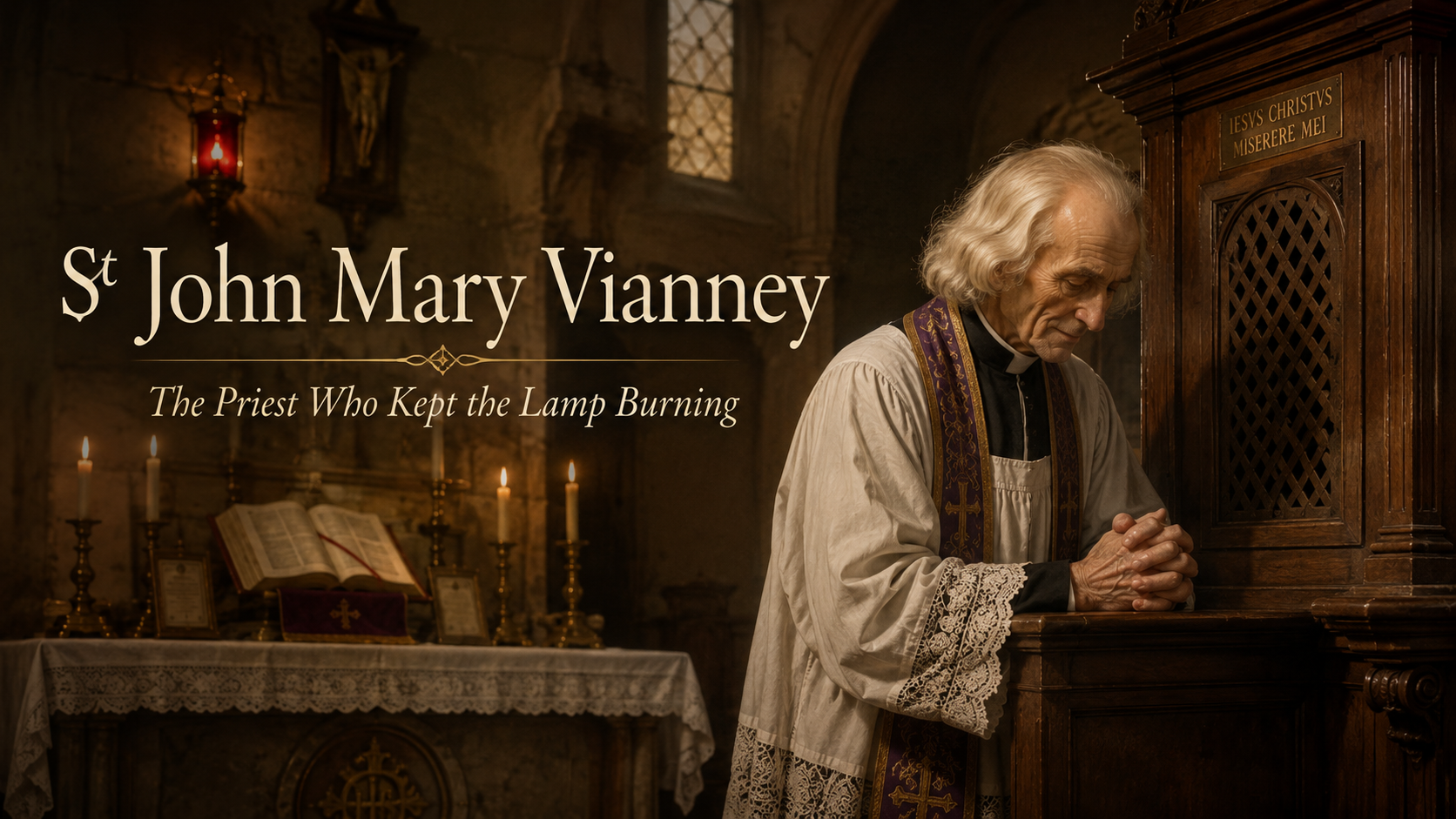
A Victim with Christ: St John Mary Vianney, Confessor — 9 August
The Priesthood, the Salvation of Souls, and the Burning Lamp in the Traditional Roman Rite

The life of Saint John Mary Vianney presents Christianity with an uncomfortable question: what would a priest look like if he behaved as though everything the Catholic Church teaches about the priesthood, sin, grace, the Mass, confession, judgement, heaven and hell were literally true? The answer is Ars. If the priesthood is chiefly an ecclesiastical profession, Vianney’s life was grotesquely disproportionate. If mortal sin is merely an unfortunate failure of personal development, his interminable hours in the confessional were obsessive. If penance has no supernatural efficacy within the Communion of Saints, his fasting and mortification were eccentric. If prayer does not obtain grace, his vigils before the tabernacle accomplished little. If the Mass is essentially an assembly gathered around a sacred meal, his almost overwhelming reverence at the altar was excessive. But if the Catholic Faith is true — if the Mass is truly the Sacrifice of Calvary made sacramentally present, if mortal sin really destroys sanctifying grace, if absolution really raises the spiritually dead, if prayer really obtains supernatural assistance, if the members of Christ may suffer for one another, and if every human soul is travelling towards an irrevocable eternity — then the Curé d’Ars was not excessive at all. He was simply consistent.
The traditional Roman liturgy understands him accordingly. In the older calendar Saint John Mary Vianney is kept on 9 August, the date assigned when his feast was extended to the universal Church by Pope Pius XI in 1928. He is celebrated as a Confessor with the Mass Os justi, from the Common of a Confessor not a Bishop, but with his own remarkable Collect. In the pre-1955 arrangement the feast, of Double rank, also carries the commemorations belonging to the ancient Vigil of Saint Lawrence and Saint Romanus the Martyr.¹ Thus the Church places this white-robed priest immediately before one of the greatest red feasts of Roman Christianity. Lawrence will surrender his body to the fire; Romanus belongs to the company of those who confessed Christ unto blood; Vianney underwent no execution, yet forty years of prayer, fasting, spiritual warfare, pastoral anxiety and almost superhuman labour progressively consumed him. The Church distinguishes martyr and confessor, as she must, but their proximity in the calendar discloses a common law of supernatural life: charity tends towards sacrifice.
Pius XI’s decision to establish the feast universally was itself an interpretation of the saint. The approved Roman Office does not canonise a romantic image of the lovable village curé. It speaks of the young Vianney’s extraordinary devotion, his struggle towards the priesthood, the transformation of Ars, his hours in the confessional, his promotion of frequent Communion, his devotion to the Immaculate Virgin, his missions, his fasting, vigils and mortifications, and his conviction that the shepherd ought in some measure to expiate the offences of the flock committed to his care.² In 1929 Pius XI went further, declaring Vianney the heavenly patron of all parish priests and pastors of souls throughout the world.³ The patronage is significant. The Church did not choose him because every priest must imitate every extraordinary austerity of Ars. She chose him because beneath those exceptional manifestations lay principles intrinsic to the priestly vocation itself: holiness for the sake of souls, prayer as the source of apostolate, sacrifice as the cost of charity, and Christ as the sole object of pastoral possession.
The Mass opens with words which seem almost providentially written for him: Os justi meditábitur sapiéntiam, et lingua ejus loquétur judícium: lex Dei ejus in corde ipsíus — “The mouth of the just shall meditate wisdom, and his tongue shall speak judgement: the law of his God is in his heart.”⁴ The choice is striking because Vianney was famously not an academic prodigy. His path to ordination was painfully obstructed by difficulty in formal studies, particularly Latin. Yet the Church deliberately places “wisdom” upon his lips.
She thereby teaches something more subtle than contempt for learning. Catholic tradition has never canonised ignorance. The same Church which venerates Vianney calls Augustine, Jerome, Gregory, Thomas Aquinas, Bonaventure, Bellarmine and Alphonsus Doctors. Vianney himself laboured to learn because priesthood demanded learning of him. What the Introit establishes is the hierarchy between knowledge and wisdom. Knowledge may place truths in the intellect; wisdom judges realities according to their highest cause and final end. A man may know much theology and remain spiritually foolish; another may possess less speculative brilliance yet have so thoroughly submitted his intellect, will and affections to revealed truth that he instinctively sees creatures sub specie aeternitatis — beneath the aspect of eternity.
Saint Thomas distinguishes precisely this higher judgement. Wisdom considers things according to the highest cause, and supernatural wisdom orders human judgement towards God.⁵ Vianney’s distinction was not that he knew nothing, but that what he knew had penetrated him. Lex Dei ejus in corde ipsius. The law of God was in his heart. It had passed from proposition to conviction, from conviction to prayer, from prayer to habit, and from habit into the very manner in which he regarded the sinner kneeling before him. He spoke of judgement as a man who believed in judgement; of heaven as a man already orientated towards heaven; of the Blessed Sacrament as a man who knew Whom the tabernacle contained.
Saint Teresa of Jesus, herself one of the most formidable mystical intellects in the Church, helps prevent misunderstanding. In The Way of Perfection she insists that the Church needs learned theologians and preachers; but she begs her daughters to pray that these defenders of the Church may also be holy. Learning and sanctity are not opposites. Indeed, the Church needs both.⁶ Vianney therefore condemns two errors at once: the anti-intellectualism which mistakes lack of formation for simplicity, and the clerical intellectualism which mistakes information about God for friendship with God. The first produces incompetence; the second can produce sterility. Ars reminds us that theology fulfils its purpose only when truth descends from the mind into the heart and from the heart into life.
But the theological heart of the feast is not the Introit. It is the proper Collect:
Omnípotens et miséricors Deus, qui sanctum Joánnem Maríam pastoráli stúdio et jugi oratiónis ac pœniténtiæ ardóre mirábilem effecísti: da, quǽsumus, ut ejus exémplo et intercessióne, ánimas fratrum lucrári Christo, et cum eis ætérnam glóriam cónsequi valeámus.
“Almighty and merciful God, Who didst make Saint John Mary wonderful by pastoral zeal and by the ardour of continual prayer and penance: grant, we beseech Thee, that by his example and intercession we may gain the souls of our brethren for Christ, and with them attain everlasting glory.”⁷
One could construct an entire theology of pastoral ministry from those few lines. The Church attributes the wonder of Ars to three things: pastoral zeal, continual prayer and ardent penance. She then places them beneath a single purpose: animas fratrum lucrari Christo — to gain the souls of our brethren for Christ.
The language is uncompromisingly supernatural. The goal is not merely to accompany souls, affirm them, organise them, entertain them or retain them within an institution. Nor is the object to win them for the priest, his movement, his personality or his reputation. They are to be won for Christ. The priest possesses no flock in his own right. The flock is Christ’s.
Saint Augustine, commenting upon the risen Lord’s command to Peter, gives the patristic principle with almost frightening clarity. “Feed My sheep,” he explains, means: feed them as Mine, not as thine; seek My glory in them, not thine; My dominion, not thine; My gain, not thine.⁸ That single passage could serve as an examination of conscience for every form of ecclesiastical ambition. The priest who creates admirers for himself rather than disciples for Christ has mistaken stewardship for possession. The bishop who treats a diocese as a personal court has forgotten whose sheep they are. The preacher who loves applause more than conversion has begun feeding himself upon the flock.
Vianney’s almost complete absence of worldly self-interest gave his pastoral authority its peculiar force. Crowds eventually travelled across France and from beyond France to see him, yet his fame appears only to have increased his desire to disappear. The Roman Office records the astonishing influx towards Ars, but it does so not to portray a nineteenth-century celebrity but to demonstrate supernatural fecundity.⁹ What people encountered there was not a priest drawing souls towards himself. They encountered a priest whose whole personality seemed to point beyond itself.
The Collect then explains how such pastoral fruitfulness becomes possible. First, pastorali studio: pastoral zeal. But zeal alone is dangerous. It may become activism, domination, vanity or restless interference unless purified by grace. Therefore comes jugi orationis: continual prayer. The shepherd knows that he cannot produce faith, contrition, conversion or sanctifying grace by natural technique. No sermon, however eloquent, can forgive mortal sin. No committee can regenerate a soul. No pastoral strategy can confer grace ex opere operato. God alone gives supernatural life. Therefore the true pastor must pray.
Then comes paenitentiae ardore: the ardour of penance. The choice of ardor is important. Penance is not presented as grudging payment but as something burning. Love makes sacrifice intelligible. Vianney did not mortify himself because he despised creation or the body. He did so because supernatural charity had taught him that suffering united to Christ could be offered, that appetites required discipline, and that the shepherd who implored mercy for sinners ought not himself to live as though Calvary had cost nothing.
The Roman Office states this with a directness which modern ears may find startling: Ratus vero pastoris esse, flagitia concreditae plebis expiare — believing it to belong to the pastor to expiate the offences of the people entrusted to him, he spared neither prayer, vigils, mortifications nor continual fasting.¹⁰ This does not place Vianney beside Christ as another redeemer. Catholic theology makes such an idea impossible. Christ’s satisfaction is unique, superabundant and sufficient. Rather, because the baptised are incorporated into Him, their prayers and sufferings acquire value through His merits and may be offered in charity for one another. The Head alone redeems; the members are nevertheless permitted to participate in the Head’s sacrificial charity.
This truth explains one of Vianney’s most famous practices. He could give a genuinely repentant sinner a relatively small sacramental penance and undertake additional penance himself. John XXIII records his explanation: “I impose only a small penance on those who confess their sins properly; the rest I perform in their place.”¹¹ The gesture teaches more theology than many treatises. Sin has consequences: therefore penance is real. Mercy is not indifference: therefore conversion matters. But Christian solidarity is also real: therefore the sinner does not stand alone. And behind both priest and penitent stands the immeasurably greater satisfaction of the Crucified.
Here Saint Catherine of Siena provides the mystical language which makes Ars intelligible. In the Dialogue, confession is described as a kind of continual washing in the Blood of Christ: priests possess the “keys of the Blood”, and in sacramental absolution the fruit of Christ’s Passion is applied to the contrite soul.¹² The language is characteristically vivid, but its theology is precise. The confessional exists because Calvary exists. Absolution is not ecclesiastical reassurance; it is the sacramental exercise of a power purchased in the Blood of the Lamb.
Seen in that light, the extraordinary confessional ministry of Ars ceases to look psychologically obsessive. Vianney was not fascinated by human depravity. He was fascinated by divine mercy. The sins wounded him because Christ had shed His Blood for the sinner. He could sometimes be demanding because sin was real; he could be immeasurably tender because redemption was more real still. John XXIII notes that near the end of Vianney’s life his confessional ministry occupied roughly fifteen hours a day, that tens of thousands came annually, and that even when bodily strength was failing, penitents still sought him.¹³ This was not mere availability. It was immolation by pastoral charity.
The contrast between authentic mercy and sentimentality becomes crucial here. Mercy does not mean persuading a sinner that his wound is imaginary. A physician who denies the disease is not compassionate. Neither is a confessor who calls bondage freedom. Saint Thomas places fraternal correction within charity precisely because charity seeks the good of the person loved and therefore seeks the removal of sin, which is the greatest spiritual evil afflicting him.¹⁴ Vianney’s severity and tenderness therefore belonged together. He could hate the sin without hating the sinner because he understood that the two were not identical. Indeed, he hated the sin because he loved the sinner and knew what sin did to him.
Saint John Chrysostom supplies the appropriate patristic gravity. In De Sacerdotio he marvels that men dwelling upon earth have been entrusted with powers touching heavenly realities and repeatedly contemplates the terrifying responsibility borne by those entrusted with souls.¹⁵ Such language sounds excessive only when judgement and eternity have ceased to seem real. The saints did not possess our capacity for maintaining doctrinal propositions at a safe emotional distance. They allowed consequences to follow from premises. If a soul can be lost, then pastoral negligence becomes something fearful. If absolution restores grace, then hearing confessions is not peripheral. If the Eucharist is God, then how the priest approaches the altar cannot be casual.
The Gospel of Os justi therefore seems almost biographical: Sint lumbi vestri præcíncti, et lucérnæ ardéntes in mánibus vestris — “Let your loins be girt, and lamps burning in your hands.”¹⁶ The servants wait for their lord through the watches of the night, ready to open immediately when he knocks. And here the traditional Office provides its own patristic commentary. The Gospel belongs to the Common of a Confessor not a Bishop, whose lessons at the Third Nocturn are drawn from Saint Gregory the Great’s thirteenth Homily on the Gospels. Gregory explains that the girded loins signify the restraint of carnal desire by continence, while the burning lamps signify good works shining before one’s neighbour. He then joins the two: abstaining from evil is insufficient unless one labours positively in good.¹⁷
This is extraordinarily important for understanding Vianney. His asceticism and apostolate are not separable. He did not fast because asceticism itself was his religion. He fasted in order to be free for God and souls. He did not practise chastity as sterile negation but as undivided readiness. He did not renounce possessions because poverty was picturesque but because possessions must not possess the shepherd. The loins are girded because the servant is waiting to work; the lamp burns because holiness must become light for another.
Cornelius a Lapide develops the same Gospel imagery by associating the girded servant with readiness, discipline and freedom from encumbrance, while the lamp manifests the light of charity in active virtue.¹⁸ The Catholic exegetical tradition thus refuses to separate interior asceticism from exterior fruitfulness. Contemplation without charity for neighbour becomes sterile self-occupation; activity without interior discipline becomes spiritually hollow. Ars held the two together.
Saint Gregory had already expressed the same equilibrium in his Pastoral Rule. The shepherd must be elevated towards God in contemplation and yet stoop compassionately towards the weaknesses of those entrusted to him; he must neither become so absorbed in exterior concerns that he abandons the interior life, nor become so enclosed in contemplation that he neglects those whom charity obliges him to serve.¹⁹ This is perhaps the deepest rhythm of Vianney’s priesthood: altar and confessional, contemplation and compassion, God and souls.
Before others awoke, he prayed. From prayer he went to the altar. From the altar he went to sinners. From sinners he carried burdens back to God. The circuit repeated until his strength was gone.
The altar necessarily stands at the centre. Saint Thomas teaches that in the consecration of the Eucharist the priest acts in persona Christi. The power to consecrate is conferred in ordination, and the priest exercises not a merely representative presidency but a sacramental ministry deriving from Christ Himself.²⁰ The objective efficacy of the Eucharistic Sacrifice does not depend upon the personal holiness of the celebrant — a distinction Thomas strongly safeguards — but precisely because the priest is entrusted with so sublime an objective ministry, the disparity between what he handles and what he himself is becomes a summons to sanctification.
The Mass therefore teaches the priest how to live.
At the altar he offers the Victim; therefore pastoral charity teaches him self-offering.
At the altar he holds the Body given for sinners; therefore he goes searching for sinners.
At the altar he sacramentally speaks the words of Christ; therefore he must fear contradicting Christ by his conduct.
At the altar he offers the Sacrifice for living and dead; therefore the horizons of his prayer cannot stop at the walls of his own immediate circumstances.
The priest does not become Christ ontologically, nor does his personal sacrifice add anything necessary to Calvary. But sacramental configuration to Christ the Priest creates an ascetical summons towards conformity with Christ the Victim. This is why Blessed Ildefonso Cardinal Schuster’s description of the Curé d’Ars is so powerful. Reflecting upon Vianney’s endless confessional ministry, fasting, vigils and continual prayer, Schuster invokes Saint Francis de Sales’s observation that there is a kind of martyrdom in confessing men before God, and concludes that the Curé became **“a victim with Christ.”**²¹
That phrase unlocks the saint.
Vianney did not merely perform priestly functions. He allowed priestly realities to consume his life. The Sacrifice he celebrated became the form of his charity. The reconciliation he pronounced became the labour of his days. The eternal truths he preached progressively detached him from temporal comforts. The Christ whom he adored in the tabernacle became the explanation of his existence.
The Epistle contributes another dimension. Ecclesiasticus praises the man “who hath not gone after gold, nor put his trust in money nor in treasures,” the man who could have transgressed and did not and who has therefore been proved faithful.²² Once again the Common appears providentially fitted to the saint. Vianney’s detachment from money was notorious. Gifts passed through him towards the poor, good works, missions and the adornment of divine worship. His poverty was not a theatrical contempt for material things but a judgment about their relative value. Gold is useful; a soul is immortal. Money may serve the kingdom; it cannot be the kingdom.
The passage is particularly apt for priests because possessions have a subtle capacity to reverse the order of service. The priest is supposed to employ temporal things for supernatural ends; soon enough, supernatural things may begin to be employed for temporal security, prestige or comfort. Ecclesiasticus praises the man whose heart has escaped that inversion. Augustine’s warning returns: feed Christ’s sheep, not yourself upon the sheep.
The Gradual sings: Justus ut palma florébit: sicut cedrus Líbani multiplicábitur in domo Dómini — “The just shall flourish like the palm tree; he shall grow up like the cedar of Lebanon in the house of the Lord.” The Alleluia adds: “Blessed is the man that endureth temptation; for when he hath been proved, he shall receive the crown of life.”²³ The liturgy refuses the illusion that sanctity emerges without combat. Ars was not built upon a naturally serene temperament moving effortlessly from virtue to virtue. The Roman Office speaks explicitly of Vianney’s spiritual trials and the extraordinary assaults which he endured with patience.²⁴ Whatever judgement one forms about individual phenomena recorded by his biographers, the theological fact is uncontested: holiness is tested.
The palm flourishes because it has endured heat. The cedar stands because it has grown deep.
So too the Curé’s apparently simple spirituality was the product of sustained warfare against self, discouragement, exhaustion and temptation. This matters because saints are often rendered harmless by sentimental biography. Their mature sanctity is presented without the struggle by which grace fashioned it, and ordinary Christians therefore conclude that saints constitute another species of humanity. The Roman liturgy is more realistic. Beatus vir qui suffert tentationem. Blessed is the man who endures temptation. Not the man who never experiences it.
The saint of Ars therefore belongs particularly to priests tempted to discouragement. His natural limitations did not prevent sanctity. His early struggles did not determine his final usefulness. An obscure assignment did not make his priesthood insignificant. Ars contained almost nothing by worldly measurements. There was no strategic importance to the place, no obvious platform, no prestige. Yet one priest took seriously the little portion of Christ’s flock entrusted to him, and eventually Europe travelled to his door.
This is one of the quietest judgements the feast passes upon ecclesiastical careerism. The kingdom of God does not require an important appointment before holiness becomes worthwhile. A priest does not need the right parish, the right bishop, the right audience or the right historical moment before becoming faithful. The Curé of Ars sanctified the place to which obedience sent him.
John XXIII emphasised this obedience in Sacerdotii Nostri Primordia. Vianney repeatedly desired the contemplative life and even attempted to escape the burden of Ars, yet in the end he subordinated personal attraction to pastoral duty and remained where obedience had placed him.²⁵ That detail prevents his heroic pastoral life from degenerating into voluntarism. He did not invent his mission. He received it.
The older liturgical date makes this lesson more striking. 9 August is the Vigil of Saint Lawrence. The Church is already looking towards the Roman archdeacon who will be stretched upon the gridiron. Beside that ancient Roman vigil stands the relatively modern French curé. Their historical worlds could hardly be further apart, yet each shows what occurs when charity ceases to calculate the cost.
Lawrence gives everything in the concentrated violence of martyrdom.
Vianney gives everything through attrition.
One is consumed by fire.
The other is consumed by souls.
The comparison must never erase the proper theological privilege of martyrdom, the supreme witness of blood. Yet Schuster’s description remains compelling because the underlying principle is one. Christ says of the Good Shepherd that he lays down his life for the sheep. Augustine’s commentary upon Christ’s commission to Peter therefore moves naturally from “Feed My sheep” towards Peter’s own death: the pastoral office tends, at its perfection, towards self-gift.²⁶ Not every shepherd will shed blood. Every shepherd must nevertheless possess a life which he is prepared to spend.
And this is why Saint John Vianney remains such an uncomfortable patron.
If priesthood is administration, he is incomprehensible.
If pastoral work is principally social facilitation, his life is grotesquely disproportionate.
If all men are practically assured of salvation, his fear for sinners is unnecessary.
If confession is little more than therapeutic reassurance, his insistence upon contrition and amendment is excessive.
If worship exists chiefly to express community, his absorption in the Eucharistic Sacrifice is misplaced.
If penance is an embarrassment inherited from a less enlightened age, his austerities are pathological.
If prayer changes nothing beyond the person praying, the hours he spent before the tabernacle were wasted.
But if Catholicism is true, Ars makes terrifyingly good sense.
This is not an argument for mechanically reproducing every extraordinary mortification practised by the Curé. The Church canonised his sanctity, not every contingent detail of his ascetical régime as a universal prescription. The argument is deeper. His actions reveal his premises. He believed that God was God, that sin was sin, that grace was grace, that the Mass was Sacrifice, that confession reconciled the sinner, that prayer obtained help, that penance mattered, and that souls were immortal. Therefore his life acquired its extraordinary proportions.
The great crisis of priesthood in any age begins when those premises remain formally affirmed but existentially cease to govern behaviour. Doctrine may still be written in books while practical life proceeds according to another creed entirely. Hell remains in the catechism but disappears from pastoral urgency. The Real Presence remains dogma but disappears from gesture. Sacrifice remains theological vocabulary but disappears from priestly expectation. The salvation of souls remains the traditional phrase while institutional maintenance becomes the practical priority.
Vianney reunites doctrine and consequence.
He does not allow us to say that Christ is present and then behave as though He were absent. He does not allow us to say that sin kills and then treat repentance as optional. He does not allow us to call priesthood supernatural while measuring its success exclusively by natural criteria. Above all, he refuses the fatal separation of personal sanctity from pastoral effectiveness.
Yet the feast is not an accusation before it is a prayer. The Collect begins not with Vianney’s achievement but with God’s action: Deus, qui sanctum Joannem Mariam… mirabilem effecisti — God made him wonderful. Grace is the protagonist. The same God Who called an academically struggling peasant from Dardilly, brought him to ordination, placed him in an obscure village and transformed that village through him remains the source of all priestly fruitfulness.
Nor does the Collect belong only to clergy. Its petition is placed upon the lips of the whole Church: grant that we, by his example and intercession, may gain the souls of our brethren for Christ. Every Christian is implicated according to his state. Parents must desire the salvation of their children. Teachers that of their pupils. Friends that of their friends. Religious must carry the Church and her priests before God. The sick may transform suffering into intercession. The housebound may share in apostolate through prayer. No member of the Mystical Body possesses Christian charity while remaining indifferent to whether another reaches his supernatural end.
Saint Teresa’s appeal to contemplatives to pray for preachers and theologians belongs here.⁶ Holy priests do not arise in isolation from the Church that receives them. Behind a faithful priest there are often invisible lives of prayer, sacrifice and maternal charity which history never records. Ars therefore calls the faithful not merely to demand saints in the sanctuary but to pray saints into the sanctuary.
At last the Mass returns to the Gospel’s great image. The Communion sings: Beátus servus, quem, cum vénerit dóminus, invénerit vigilántem: amen dico vobis, super ómnia bona sua constítuet eum — “Blessed is that servant whom, when his lord shall come, he shall find watching: amen I say to you, he shall place him over all his goods.”²⁷
This is the liturgy’s final interpretation of John Mary Vianney.
Not famous.
Not successful.
Not extraordinary.
Watching.
The word contains everything. The servant has not forgotten that the Master will return. Therefore the lamp must remain lit. Gregory explains that this lamp is the light of good works.¹⁷ Vianney’s burned in an obscure church at Ars: before the tabernacle in the small hours, upon the altar at Mass, in the confessional as another sinner knelt down, in the catechism lesson, beside the poor, in the mortification nobody saw, in the prayer offered for the soul that would never know what its conversion had cost another man.
John Mary Vianney died on 4 August 1859, exhausted by more than forty years of priestly labour. The Roman Office says with memorable simplicity that he was consumed more by his labours than by age.²⁸ The Master had found him where the Gospel said the servant should be: still at his post.
And perhaps that is why the Church gives us the Curé d’Ars on the threshold of Saint Lawrence. Before tomorrow’s martyr is consumed upon the gridiron, today she shows us another form of holocaust: not blood poured out in a single hour, but a life poured out drop by drop.
The tabernacle.
The altar.
The confessional.
The sinner.
The priest.
The Cross.
Everything converges there.
And the Collect finally reveals what the whole sacrifice is for. The Church does not ask merely that we save our own souls. She asks that, by Saint John Vianney’s example and intercession, we may gain the souls of our brethren for Christ — animas fratrum lucrari Christo — and then adds one of the most beautiful conclusions in the Sanctoral cycle: et cum eis aeternam gloriam consequi valeamus — and with them attain everlasting glory.
With them.
That is the heart of the shepherd. He does not wish to arrive before the throne of God alone. He hopes to come surrounded by the souls entrusted to his charity: the child whom he taught; the sinner whose confession he heard after thirty years away; the dying person whom he absolved; the wavering soul whom he strengthened; the grieving person whom he consoled; the unbeliever for whom he prayed; the hardened penitent for whom he did penance; the forgotten parishioner whose name appeared every morning before God.
That is pastoral success measured by eternity.
Thus on 9 August the Roman Church shows us a little village which had no reason to become famous, a priest who possessed almost none of the qualities by which the world predicts greatness, and a ministry founded upon methods so ancient that no fashionable age could possibly have invented them: the Holy Sacrifice of the Mass, the confessional, catechesis, prayer, fasting, penance, devotion to Our Lady, charity to the poor and an unrelenting hunger for the salvation of souls.
And Ars became famous precisely because John Vianney never tried to make Ars famous.
He tried to make it holy.
The difference is everything.
A priest knelt before a tabernacle while his village slept. He rose to offer the Sacrifice. He entered the confessional. He carried sinners before God and brought God’s mercy back to sinners. Day followed day, year followed year, until there was almost nothing left of him to give.
The lamp kept burning.
And when the Master came, He found His servant watching.
¹ Missale Romanum, Proprium Sanctorum, die 9 Augusti, S. Joannis Mariae Vianney Confessoris, Duplex; cf. the pre-1955 calendar and ordo for 9 August, with commemorations of the Vigil of St Lawrence and St Romanus.
² Sacra Rituum Congregatio, Office and Mass of St John Mary Vianney, Acta Apostolicae Sedis 20 (1928), pp. 154–156, Lessons IV–VI.
³ Pius XI, Apostolic Letter Anno Iubilari, 23 April 1929, AAS 21 (1929), pp. 312–313.
⁴ Missale Romanum, Common of a Confessor not a Bishop, Mass Os justi, Introit: Ps. 36:30–31.
⁵ St Thomas Aquinas, Summa Theologiae, II–II, q.45, especially a.1.
⁶ St Teresa of Jesus, The Way of Perfection, chs. 1–3.
⁷ Missale Romanum, Collect of St John Mary Vianney, 9 August.
⁸ St Augustine, In Ioannis Evangelium Tractatus 123, 5, on John 21:15–19.
⁹ Sacra Rituum Congregatio, Office of St John Mary Vianney, Lesson VI, AAS 20 (1928).
¹⁰ Ibid., Lesson V.
¹¹ John XXIII, Encyclical Sacerdotii Nostri Primordia, 1 August 1959, §§85–91.
¹² St Catherine of Siena, The Dialogue, ch. 75, on confession and the “keys of the Blood”.
¹³ John XXIII, Sacerdotii Nostri Primordia, §§85–90.
¹⁴ St Thomas Aquinas, Summa Theologiae, II–II, q.33, a.1.
¹⁵ St John Chrysostom, De Sacerdotio, especially Books III–VI.
¹⁶ Missale Romanum, Common of a Confessor not a Bishop, Mass Os justi, Gospel: Luke 12:35–40.
¹⁷ St Gregory the Great, Homiliae in Evangelia, Homily XIII, 1, on Luke 12:35–40.
¹⁸ Cornelius a Lapide, Commentaria in Scripturam Sacram, Commentary on Luke 12:35–40.
¹⁹ St Gregory the Great, Regula Pastoralis, II.1 and related chapters on the interior and exterior life of the pastor.
²⁰ St Thomas Aquinas, Summa Theologiae, III, q.82, especially aa.1, 3 and 5–6.
²¹ Bl. Ildefonso Cardinal Schuster, Liber Sacramentorum, vol. VIII, commentary for 9 August, St John Mary Vianney.
²² Missale Romanum, Mass Os justi, Epistle: Ecclesiasticus 31:8–11.
²³ Ibid., Gradual and Alleluia: Ps. 91:13–14; James 1:12.
²⁴ Sacra Rituum Congregatio, Office of St John Mary Vianney, Lesson V, AAS 20 (1928).
²⁵ John XXIII, Sacerdotii Nostri Primordia, on Vianney’s obedience and perseverance in the parish entrusted to him.
²⁶ St Augustine, In Ioannis Evangelium Tractatus 123, on John 21:15–19.
²⁷ Missale Romanum, Common of a Confessor not a Bishop, Communion: Matthew 24:46–47.
²⁸ Sacra Rituum Congregatio, Office of St John Mary Vianney, Lesson VI: Laboribus potius quam senio consumptus, AAS 20 (1928).
related articles


Latest articles
- Quod accepimus, custodimus et tradimus ~ What we have received, we guard and hand on: Spiritual Conference for Nuntiatoria CXXIVThe Catholic Faith has reached us at a time when parts of its doctrinal, moral and liturgical inheritance are contested, obscured or neglected even within the Church. This spiritual conference asks what happened, why it happened and, above all, what Catholics can do despite it. Fidelity in a crisis requires more than private endurance: Catholics must know the Faith, defend it, resist what would corrupt it, restore what has been damaged, build where institutions have failed and hand the inheritance whole to those who come after them. We are not called merely to outlast the crisis, but to fight for the Faith through it.
- Archbishop Viganò’s “Schism of the Head”: A True Diagnosis That Risks a False EcclesiologyArchbishop ✠Carlo Maria Viganò correctly identifies the limits of papal authority and the modernist practice of eroding doctrine through pastoral processes. His theory of a “schism of the head”, however, risks replacing papal maximalism with a private judgement that makes each resister the judge of whether the Pope remains united to the Church.
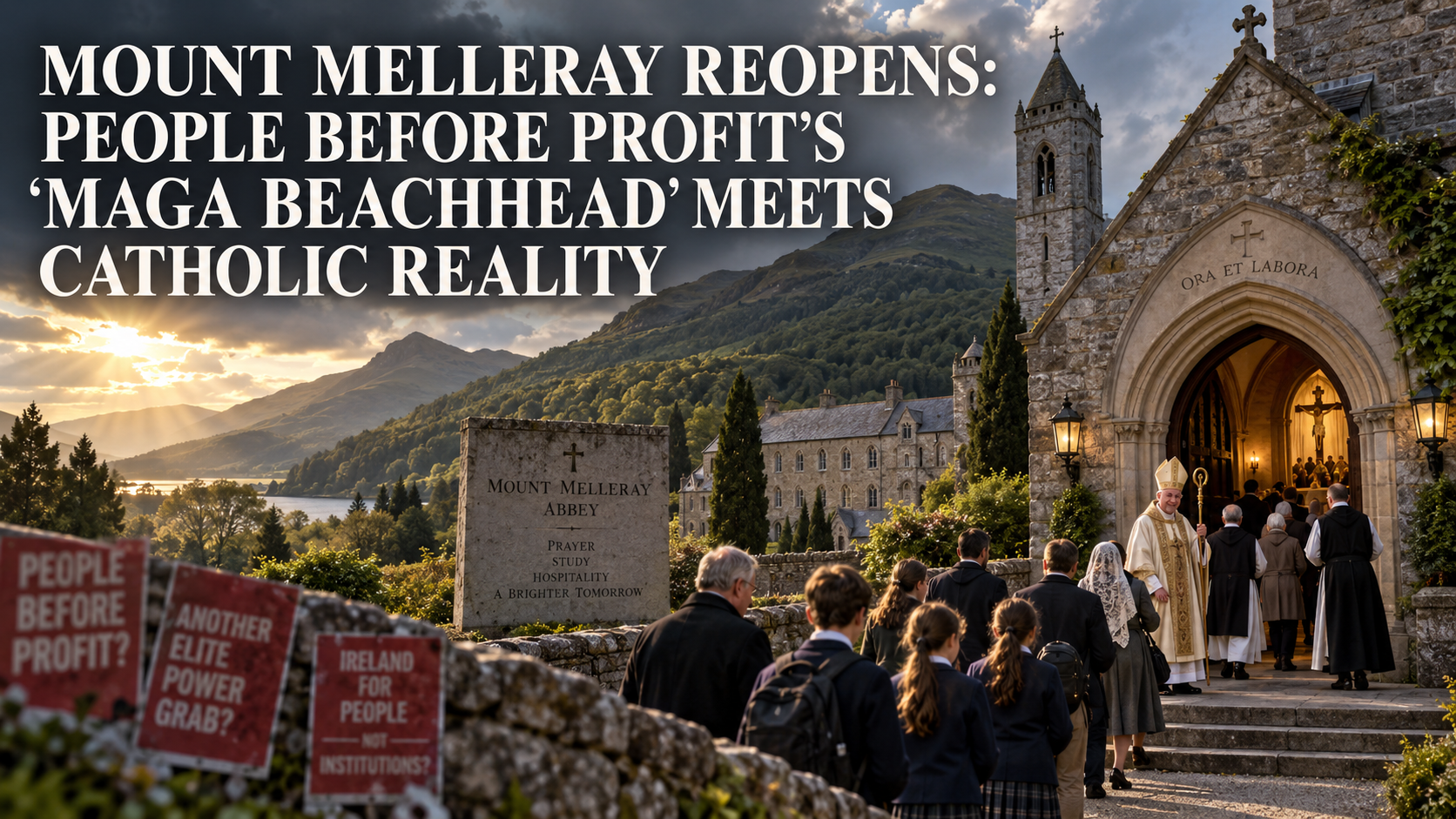
- MOUNT MELLERAY REOPENS: People Before Profit’s “MAGA beachhead” meets Catholic realityPeople Before Profit warned that Ave Maria University’s arrival at Mount Melleray would create a “MAGA beachhead” and has now demanded confiscatory taxation of Catholic property transactions. Yet the abbey has reopened with students, prayer, education and public worship. Behind the political rhetoric lies a more important question: when Ireland’s old religious communities can no longer sustain their foundations, must their patrimony inevitably be secularised?
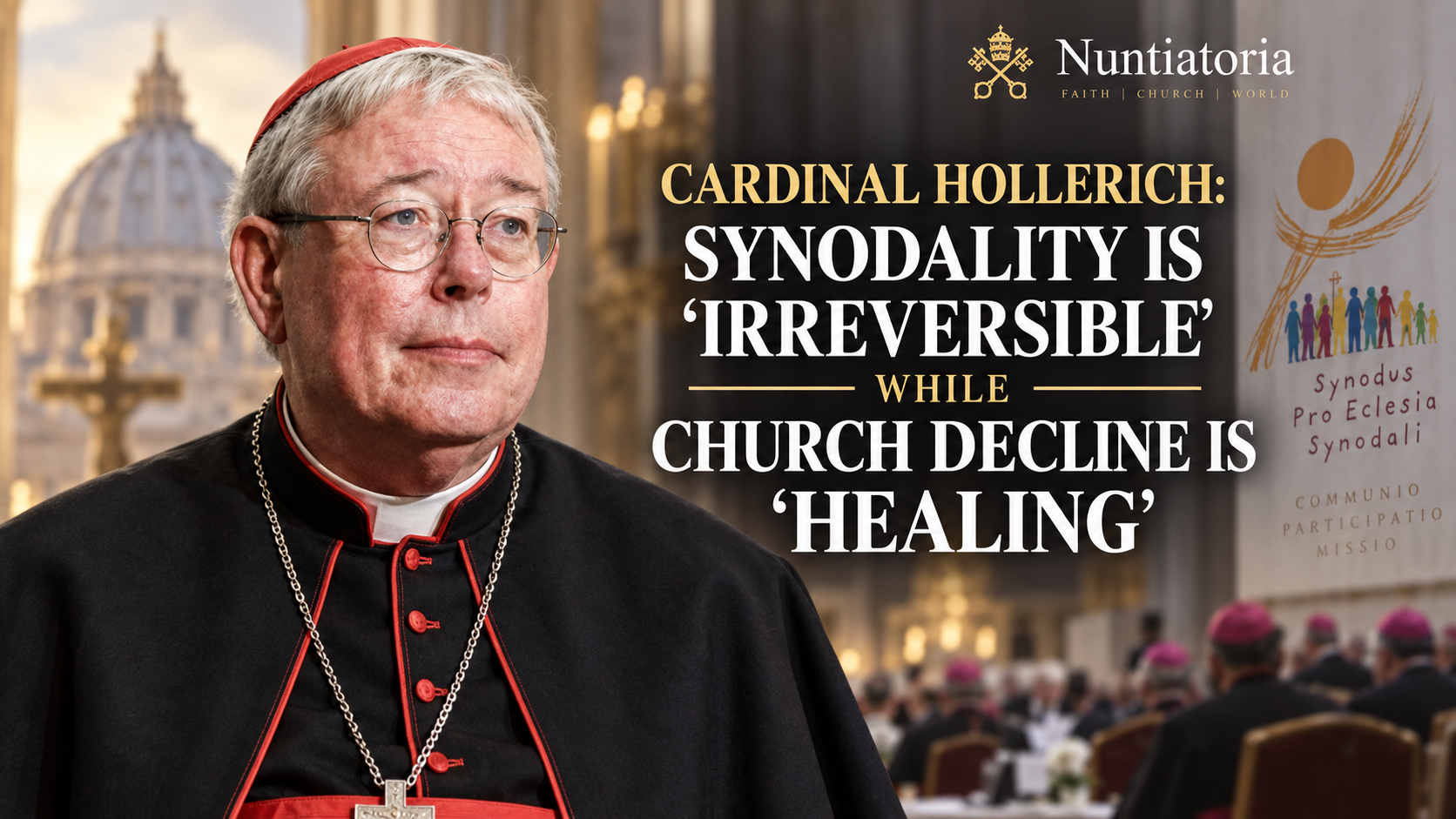
- Cardinal Hollerich: Synodality is “irreversible” while Church decline is “healing”Cardinal Jean-Claude Hollerich asserts that the synodal process initiated by Pope Francis is “irreversible”, viewing the decline in Catholic practice as a potential healing process. However, he warns against equating decline with justification. Evidence from France and Germany highlights the significant downturn in sacramental practice, urging a need for genuine evaluation of pastoral methods to ensure faithful transmission of the Faith.
- Cardinal Arborelius Faces New Evidence of Failure to Implement Vatican DecreeNew documentary evidence intensifies questions over the Diocese of Stockholm’s response to a Vatican decree declaring Fr Tobias Unnerstål’s suspension invalid. The affair has become a test not simply of one priest’s treatment, but of a more fundamental Catholic principle: whether canon law binds those exercising ecclesiastical authority as surely as those subject to it.



Leave a Reply