
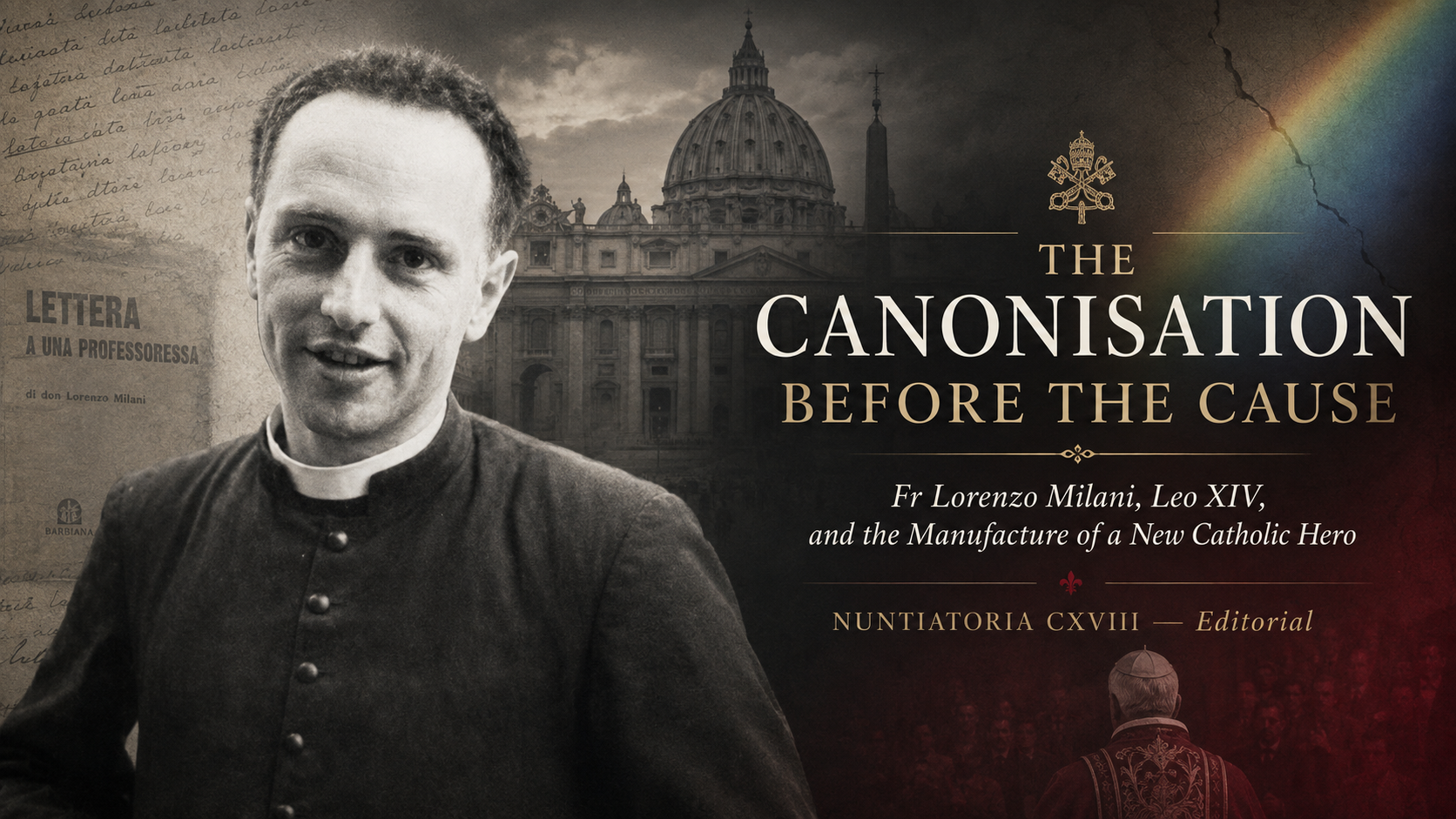
The Canonisation Before the Cause: Fr Lorenzo Milani, Leo XIV, and the Manufacture of a New Catholic Hero

There is, at present, no publicly announced cause for the canonisation of Fr Lorenzo Milani that would justify saying that Pope Leo XIV has decided to raise the controversial Florentine priest to the altars. There has been no papal announcement of such an intention, no decree declaring Milani venerable, and no miracle placed before the faithful as evidence of divine confirmation. Catholics should therefore resist the temptation to turn legitimate apprehension into prophecy presented as fact.
Yet that necessary caution makes the situation more rather than less interesting. For something approaching a canonisation has already begun—not juridically, but rhetorically; not through the Dicastery for the Causes of Saints, but through the manufacture of ecclesial memory. Milani is being progressively removed from the category of the disputed and placed within the category of the exemplary. His former controversies are increasingly interpreted as evidence of prescience. His conflicts with ecclesiastical authority are recast as the sufferings of a prophet. His social and educational activism is presented as a model of priesthood. And two successive Popes have now participated personally in that rehabilitation.
The distinction matters. The question is no longer simply, “Will Pope Leo XIV canonise Fr Lorenzo Milani?” The more important question is: why are Francis and Leo XIV teaching Catholics to regard him as though the essential verdict had already been reached?
Francis left little doubt about his own judgment. In April 2017, on the publication of Milani’s collected works, he invited Catholics to approach him as “a witness of Christ and of the Gospel.”¹ Two months later Francis travelled personally to Barbiana, prayed at Milani’s grave, met his former pupils and delivered what amounted to an ecclesiastical rehabilitation. The visit, Francis explicitly said, was intended to answer Milani’s repeated desire that his bishop recognise his fidelity to the Gospel and the rectitude of his pastoral action. The Pope then pronounced the crucial judgment: “the Church recognises in that life an exemplary way of serving the Gospel, the poor and the Church herself.”²
That is remarkably strong language. It does not amount canonically to a declaration of heroic virtue, but neither is it the vocabulary of detached historical appreciation. Francis was not merely saying that Milani had done some admirable things. He was authoritatively teaching the faithful how Milani’s life should be interpreted.
The rehabilitation continued. In January 2024 Francis received the National Committee established for the centenary of Milani’s birth. He praised Milani’s conversion, described him as “a priest in love with the Church,” declared that he had lived “to the full” the Beatitudes of poverty and humility, presented his educational programme as an expression of Gospel justice, and concluded by thanking God for the legacy of this “restless and unsettling priest.”³ The old image of the difficult, censured and controversial cleric had been replaced by that of the misunderstood evangelical pioneer.
Had this enthusiasm belonged solely to Francis, one might have expected a new pontificate simply to let the subject rest. Leo XIV has done precisely the opposite.
On 12 June 2025, addressing the clergy of Rome only weeks after his election, Leo spoke of the example furnished in recent times by “holy priests” who combined engagement with history and proclamation of the Gospel. The two men he named were Primo Mazzolari and Lorenzo Milani, whom he called “prophets of peace and justice.”⁴ Leo was not there discussing disputed twentieth-century ecclesiastical history. He was addressing his priests about the proper exercise of their ministry, and Milani was supplied as an example.
Four months later, on 11 October 2025, the language became still more striking. Addressing pilgrims from Tuscany, Leo XIV referred without qualification to “Don Lorenzo Milani, prophet of the Tuscan and Italian Church,” expressly repeating Francis’s description of him as a witness and interpreter of social and economic transformation.⁵
Again, this is not canonisation. But it is not nothing.
Popes have thousands of saints, doctors, confessors, missionaries, parish priests, educators and founders from whom to choose when proposing models to the clergy. When a Pope deliberately chooses a controversial twentieth-century priest and calls him a “holy priest” and a “prophet of the Church,” the selection itself carries ecclesial significance. When his immediate predecessor travelled to that priest’s grave and declared his life exemplary, we are entitled to notice continuity. When that continuity concerns a figure whose ideas and conduct were once sufficiently troubling to provoke serious ecclesiastical intervention, we are entitled to ask what exactly is being rehabilitated.
The historical record must be allowed to remain inconvenient.
Milani’s Esperienze pastorali was examined by the Holy Office in 1958. On 10 December the Cardinals of the Holy Office ordered the book withdrawn from commerce and directed that Milani’s Ordinary keep watch over him; Pope Pius XII approved the decision the following day. The surviving correspondence makes equally clear that the measure was not some imaginary later invention of reactionary traditionalists. Archbishop Ermenegildo Florit formally communicated Rome’s decision to Milani and instructed the publisher to withdraw the work.⁶
It is true that the book was not condemned by a formal decree as containing specified heretical propositions. That distinction should be maintained. It is equally true that the Holy Office did not regard the book as merely daring, prophetic or too enlightened for its age. It regarded its circulation as sufficiently injurious to require intervention. To transform that episode retrospectively into a simple morality play in which dull pre-conciliar authorities persecuted a visionary whom history eventually vindicated is itself an ideological act.
Nor should traditional Catholics make the opposite mistake. Milani cannot justly be reduced to a caricature. He abandoned considerable social privilege. His determination to educate poor rural children was real. His insistence that command of language enables the powerless to defend themselves contained an important truth. His pastoral labours demanded sacrifice. He professed attachment to the Church even when disciplined, and some of his letters reveal an unmistakable concern for salvation, confession, judgment and eternity.
None of this is the point at issue.
The Church does not canonise a man because every aspect of his life was worthless until progressive Catholics discovered him; nor should she canonise him because every aspect of his life was valuable once progressive Catholics adopted him. Canonisation concerns heroic Christian virtue. It is not a retrospective award for having anticipated the preferred social vocabulary of a later pontificate.
And it is here that the controversy surrounding Milani’s correspondence becomes impossible simply to wave away.
Milani used extraordinarily sexualised language in writing about his relationship with his pupils. Among the expressions that have subsequently generated controversy are his remark about the danger of loving his boys so much as to “take them to bed,” his statement elsewhere that his spiritual life consisted in “keeping my hands in place,” and another notoriously obscene passage employing anal sexual imagery while describing the intensity with which a teacher must love boys. Those passages are real and have been discussed publicly in Italy for years. Giorgio Pecorini reproduced some of the material in his biography of Milani, and the controversy erupted again in 2017 when the novelist Walter Siti interpreted the correspondence as evidence that Milani experienced sexual attraction towards boys.⁷
But evidence must be allowed to say what it says—and no more.
The existence of those words does not prove that Milani sexually abused a child. Former pupils and Milani scholars have strongly rejected that interpretation, arguing that his language was deliberately paradoxical, coarse and provocative. Siti himself acknowledged that his interpretation might have been mistaken. There is an obvious moral and intellectual difference between disturbing language, evidence of temptation, evidence of attraction and evidence of completed criminal acts.
Catholics who deplore trial by insinuation when accusations are made against priests we admire cannot suddenly regard insinuation as sufficient when the accused priest is one whom we distrust.
If a formal cause for Milani were ever opened, however, these passages could not responsibly be treated as irrelevant. The Church would be obliged to examine them rigorously and in context. His complete correspondence would matter. Testimony from surviving pupils would matter. The interpretation of his contemporaries would matter. His conduct would matter. His chastity would matter. His obedience would matter. His theological judgments would matter. His private life would matter. That is what an investigation of heroic virtue means.
Indeed the Church’s own procedural law regarding causes of saints requires thorough investigation of the candidate’s life and reputation for holiness. It expressly warns against celebrations or panegyrics capable of giving the faithful the impression that a favourable judgment has already been reached while an inquiry is still pending.⁸ The principle is obvious. Sanctity is to be discovered, not manufactured.
That is why the present phenomenon deserves a name: canonisation by atmosphere.
First comes the anniversary. Then the conference. Then the collected works. Then the papal message. Then the pilgrimage to the grave. Then the declaration that the controversial priest was faithful after all. Then he becomes a “witness.” Then an “example.” Then a “prophet.” Finally another Pope places him among “holy priests.”
At no stage need anyone say, “We are preparing the faithful for his beatification.” The symbolic work has already been done.
This is also why Archbishop Carlo Maria Viganò’s recent intervention, whatever one thinks of his present canonical position or broader analysis of the Church, cannot simply be answered by laughing at its rhetoric. Viganò connected the rehabilitation of Milani with the progressive normalisation of homosexuality within contemporary Catholic life. Gaetano Masciullo subsequently developed that argument in The Remnant, suggesting that Milani could eventually be reconstructed as precisely the kind of ambiguous “LGBT” ecclesiastical icon useful to the post-synodal Church.⁹
The specific prediction may prove wrong. Leo XIV may never open Milani’s cause. The sexual interpretation of Milani’s correspondence may itself prove exaggerated or false. But the underlying mechanism Viganò and Masciullo identify is real enough to deserve examination.
The Church has always distinguished temptation from consent, inclination from action, sinner from sin and compassion from moral approval. A man may experience the most violent disordered temptation and become a great saint precisely by resisting it. Indeed the greater the temptation, the more heroic his victory may be. There is nothing remotely contrary to Catholic doctrine in supposing that a person experiencing homosexual attraction can attain extraordinary sanctity.
What Catholic doctrine does not permit is the reverse operation: transforming the disordered inclination into an identity possessing positive theological significance, and then allowing the identity gradually to rehabilitate acts that revelation and natural law condemn.
The Catechism itself preserves the distinction with admirable clarity. Persons who experience homosexual tendencies must be treated with “respect, compassion, and sensitivity” and protected against unjust discrimination; at the same time homosexual acts are identified as intrinsically disordered and contrary to the natural law, while those experiencing such tendencies are explicitly called to chastity.¹⁰ The tradition is neither cruel nor confused. It distinguishes the dignity of the person from the morality of the act.
Modern identity politics works in precisely the opposite direction. It fuses inclination, behaviour, social identity and moral legitimacy into a single category. Thus one ceases to speak of a man who experiences same-sex attraction and begins to speak of an “LGBT Catholic.” The adjective is not incidental. It imports an anthropology.
Once the identity has been established, criticism of associated conduct can be characterised as hostility towards the person. Accompaniment then tends towards affirmation; affirmation towards celebration; celebration towards doctrinal embarrassment with whatever teaching still obstructs the process.
This does not normally occur by solemnly announcing that yesterday’s sin has become today’s virtue. Modern ecclesiastical revolution is subtler than that.
The doctrine remains printed in the book while pastoral practice creates a different moral intuition.
This is the importance of Fiducia Supplicans. The declaration insists that Catholic doctrine regarding marriage and sexual morality remains unchanged. It explicitly denies that a blessing of a same-sex couple legitimises the union. Yet it simultaneously introduced the possibility of blessing “couples of the same sex,” speaking of what might be “true, good, and humanly valid in their lives and their relationships.”¹¹ Rome subsequently had to issue a clarification insisting again that the union itself was not being blessed.
Whatever judgment one makes of the theological defence offered for that distinction, the episode illustrates the method. Doctrine is verbally maintained while the grammar of pastoral practice changes around it. What would once have been rejected because of the objective symbolism involved is admitted provided sufficient verbal qualifications accompany it. The boundary is shifted at the level of praxis before anyone admits that the doctrinal landscape has moved.
The same method operates through public symbolism.
A pilgrimage listed as an “LGBT” pilgrimage, a prelate appearing at an activist event, a priest presented publicly through sexual identity, or a controversial figure retrospectively reconstructed as a queer precursor need not contain a formal denial of Catholic teaching. Its effect lies precisely in requiring no such denial. Repetition normalises the association. The exceptional becomes familiar; the familiar becomes pastorally necessary; the pastorally necessary eventually demands theological justification.
Milani could become useful in exactly this way even if there were no evidence whatever that he engaged in homosexual acts.
Indeed that is the crucial point.
The activist construction does not require historical certainty. It requires only biographical ambiguity. A few striking passages can be separated from their context; the man can be presented as someone wrestling with forbidden desire; his social radicalism can be combined with sexual ambiguity; his conflict with ecclesiastical authority can be recast as persecution; and his subsequent rehabilitation by Popes can then be treated as ecclesiastical recognition of the whole reconstructed identity.
The logic then becomes irresistible to those already committed to the new anthropology. If the Church can praise such a man as a prophet, why condemn the identity attributed to him? If he becomes Blessed, why retain old language about disorder? If he becomes Saint Lorenzo Milani, why should the “lived experience” represented by his modern hagiography remain morally suspect?
The answer, of course, is that canonisation would prove no such thing. Saints are canonised because of heroic virtue, not because every temptation they experienced was virtuous. Augustine’s canonisation did not canonise fornication. Mary of Egypt’s sanctity did not sanctify prostitution. The whole point of Christian sanctity is the triumph of grace over sin.
But a culture which no longer wishes to speak clearly of sin can very easily invert that relationship. Instead of saying, “Here is a saint whom grace liberated from disordered passion,” it says, “Here is a saint whose holiness proves that what you called disordered was simply part of who he was.”
That is not development of doctrine. It is anthropological substitution.
Yet there is an even larger reason to be cautious about Milani’s elevation, and it has little to do with sexuality.
The contemporary cult of Milani expresses a particular understanding of the priesthood. The priest becomes principally the educator, activist, social critic, advocate of the marginalised and interpreter of economic transformation. His authenticity is demonstrated by proximity to those excluded from society. His prophetic quality is manifested in criticism of institutions. His greatness is measured by his capacity to disturb respectable assumptions.
Again, none of those things is necessarily wrong. A priest may educate, organise, criticise injustice and defend the poor. Catholic history contains innumerable examples.
But these works derive their Catholic meaning from something prior. The priest exists first for God. He offers Sacrifice. He absolves sinners. He preaches revelation. He baptises. He anoints the dying. He teaches men how to attain heaven. He calls the sinner to repentance and the just man to perfection. His social action proceeds from the supernatural order; the supernatural order does not exist to provide religious symbolism for his social action.
When this hierarchy is inverted, Christianity becomes humanitarianism with sacraments.
That danger can be detected in the language increasingly used to commend Milani. He is the interpreter of transformation. He gives the marginalised their voice. He creates citizenship. He challenges structures. He accompanies the excluded. He represents a Church embedded among the people.
Where, amid all this, is the great Catholic drama of sin and redemption, judgment and mercy, Sacrifice and sanctification, heaven and hell?
Milani himself sometimes spoke more explicitly of these things than his modern admirers do. That irony should not escape us. The very priest now being recruited into the service of the post-synodal ecclesial imagination could speak with striking bluntness about confession, salvation, hell and the need to remain within the Church. The historical Milani may prove considerably less useful to the revolution than the carefully edited Milani of contemporary commemoration.
Which is precisely why Catholics should insist upon the whole man.
If he was orthodox, demonstrate it. If he was chaste, demonstrate it. If provocative passages have been maliciously distorted, establish their context. If earlier authorities misunderstood him, show exactly where their judgment failed. If his social teaching can be reconciled with perennial Catholic doctrine, make the theological case. If his obedience was heroic, examine its limits and its evidence.
But do not give us hagiography first and investigation afterwards.
Do not tell us that controversy itself proves prophecy. Do not suggest that episcopal suspicion validates the suspect. Do not treat the judgment of a later ecclesiastical fashion as though it were the judgment of God. And above all, do not employ the altars—formally or informally—as instruments for resolving political arguments inside the Church.
The Church already possesses procedures for establishing sanctity because sanctity is too serious to be determined by enthusiasm. John Paul II’s legislation states that causes require investigation of a candidate’s life, virtues, reputation for holiness and alleged miracles, and the Church reserves the final judgment to the Roman Pontiff after this evidence has been examined.¹² Canonisation is not the sacramental form of reputation management.
There is therefore no need to claim that Leo XIV is secretly preparing Milani’s canonisation. What Leo XIV has actually said is sufficiently important.
He has called Milani one of the “holy priests” of recent times.
He has called him a “prophet of the Tuscan and Italian Church.”
Francis before him declared Milani’s life an “exemplary” service of the Gospel, the poor and the Church.
Those are facts. They demand analysis.
Perhaps Leo means only to commend Milani’s educational zeal and concern for the poor. If so, greater precision would be prudent. Popes cannot entirely control the meanings others attach to their words, but they can avoid supplying ambiguous symbols to movements already attempting to rewrite Catholic anthropology.
Perhaps a serious examination would ultimately vindicate Milani against his harshest critics. If so, Catholics should accept the truth.
Perhaps it would reveal a considerably more troubled figure than the emerging official legend permits. That truth too would have to be accepted.
But what the Church cannot safely do is decide what Milani needs to represent in 2026 and then reconstruct the historical man accordingly.
The crisis of the contemporary Church has too often involved exactly this reversal. Experience is allowed to judge doctrine. Pastoral policy reshapes moral perception. ambiguity becomes a pastoral opportunity. The vocabulary changes first; theology follows later. And once an innovation has acquired a human face—a sympathetic couple, a wounded individual, a celebrated priest, a supposed prophet—resistance to the innovation can conveniently be represented as cruelty towards the person.
This is emotional leverage masquerading as theological development.
Catholicism possesses a better way. Res sunt quod sunt: things are what they are.
If Lorenzo Milani was a saint, no amount of traditionalist hostility can make him otherwise. If he was not, no number of papal pilgrimages can manufacture heroic virtue. If his sexualised language was merely outrageous hyperbole, justice requires that it be recognised as such. If it disclosed something more troubling, justice requires that this too be faced. If his educational insights were sound, they remain sound notwithstanding his errors. If his social theology was defective, good intentions cannot baptise the defect.
Truth does not need propaganda.
And the Church needs saints rather than symbols.
A saint does not exist to reassure an ideological faction that history was on its side. A saint exists to manifest what divine grace can make of fallen man. He points beyond himself to Christ. His virtues illuminate the commandments rather than relativise them. His repentance demonstrates the seriousness of sin rather than its harmlessness. His chastity reveals freedom rather than repression. His obedience is supernatural rather than servile. His charity seeks not merely the temporal improvement of his neighbour but his eternal salvation.
That is the measure by which Lorenzo Milani must ultimately be judged.
So the question posed by Gaetano Masciullo—“Will Pope Leo XIV canonize an LGBT icon?”—is provocative but premature. We do not know that Leo intends to canonise Milani, and we do not possess sufficient evidence to call Milani an “LGBT icon” except in the sense that others may now seek to make one of him.
The deeper and more disturbing question is already before us.
Why is the contemporary Church constructing Lorenzo Milani as a prophet?
And if that construction continues, Catholics will be entitled to ask one final question before anyone dreams of placing his image upon an altar:
Are we being asked to recognise the sanctity of a man—or to venerate the anthropology of a revolution?
¹ Pope Francis, “Video Message to Participants in the Presentation of the Opera omnia of Don Lorenzo Milani at the Italian Publishing Fair,” 23 April 2017, Holy See Press Office.
² Pope Francis, “Commemorative Address during the Pilgrimage to the Tomb of Don Lorenzo Milani, Barbiana,” 20 June 2017, especially §§1–4, Holy See.
³ Pope Francis, “Address to the Members of the National Committee for the Centenary of the Birth of Don Lorenzo Milani,” 22 January 2024, Holy See.
⁴ Pope Leo XIV, “Address to the Clergy of the Diocese of Rome,” 12 June 2025, Holy See.
⁵ Pope Leo XIV, “Address to Pilgrims from the Dioceses of Tuscany and Others,” 11 October 2025, Holy See.
⁶ Supreme Sacred Congregation of the Holy Office, decree concerning Lorenzo Milani, Esperienze pastorali, Prot. No. 312/58/I, 10–15 December 1958, reproduced with the correspondence of Archbishop Ermenegildo Florit by the Fondazione Don Lorenzo Milani.
⁷ Giorgio Pecorini, Don Milani! Chi era costui?, Milan: Baldini & Castoldi, 1996, pp. 386–391; see also the contemporary discussion of Milani’s correspondence and Walter Siti’s interpretation in Corriere Fiorentino, 21 April 2017, and La Repubblica, 19 April 2017.
⁸ Sacred Congregation for the Causes of Saints, Normae servandae in inquisitionibus ab episcopis faciendis in causis sanctorum, 7 February 1983, especially nn. 3 and 36.
⁹ Gaetano Masciullo, “Will Pope Leo XIV Canonize an LGBT Icon? The Fr. Lorenzo Milani Controversy,” The Remnant, 6 August 2026.
¹⁰ Catechism of the Catholic Church, nn. 2357–2359.
¹¹ Dicastery for the Doctrine of the Faith, Declaration Fiducia Supplicans: On the Pastoral Meaning of Blessings, 18 December 2023, nn. 31, 39–41; and “Press Release concerning the reception of Fiducia supplicans,” 4 January 2024.
¹² John Paul II, Apostolic Constitution Divinus Perfectionis Magister, 25 January 1983, I.1–2, II.3 and III.13–15.
RELATED ARTiCLES


LATEST ARTICLES
- Today’s Mass: September 24 Our Lady of WalsinghamThe Feast of Our Lady of Walsingham commemorates the vision of Mary that inspired Richeldis de Faverches to build a replica of her house in Nazareth in 1061. This shrine became a significant pilgrimage site, attracting royal visits until its destruction in 1538. The revival of pilgrimage in the 20th century reaffirmed its spiritual importance.
- Sermon for Blessed Virgin Mary of RansomToday, we commemorate the feast of the Blessed Virgin Mary of Ransom, which honours the Mercedarians, a religious order founded in 1218 to free Christian captives from the Moors in Spain. Their mission persists today, highlighting the ongoing relevance of ransoming captives amidst contemporary persecution, combining spiritual redemption with social responsibility.
- OUR LADY OF RANSOM: THE MOTHER OF THE REDEEMER AND THE BREAKING OF CHAINSThe Feast of Our Lady of Ransom, celebrated on 24 September, commemorates the Mercedarian Order’s mission to redeem Christian captives, embodying the concept of liberation from sin through Christ’s sacrifice. This day’s significance links historical devotion with England’s Catholic restoration, connecting the feast to both the Incarnation and personal spiritual freedom.
- Today’s Mass: September 23 Pope Saint Linus, MartyrPope Saint Linus, a nobleman from Tuscany, became an early Christian leader, first in Gaul and then as the Pope after Saint Peter. He was martyred for his faith, noted for his role in baptising and appointing bishops. Saint Thecla, inspired by Saint Paul, chose virginity and endured persecution, ultimately receiving martyrdom.
- Quod accepimus, custodimus et tradimus ~ What we have received, we guard and hand on: Spiritual Conference for Nuntiatoria CXXIVThe Catholic Faith has reached us at a time when parts of its doctrinal, moral and liturgical inheritance are contested, obscured or neglected even within the Church. This spiritual conference asks what happened, why it happened and, above all, what Catholics can do despite it. Fidelity in a crisis requires more than private endurance: Catholics must know the Faith, defend it, resist what would corrupt it, restore what has been damaged, build where institutions have failed and hand the inheritance whole to those who come after them. We are not called merely to outlast the crisis, but to fight for the Faith through it.
CURRENT EDITION


Today’s Mass Propers
- Today’s Mass: September 24 Our Lady of Walsingham
 The Feast of Our Lady of Walsingham commemorates the vision of Mary that inspired Richeldis de Faverches to build a replica of her house in Nazareth in 1061. This shrine became a significant pilgrimage site, attracting royal visits until its destruction in 1538. The revival of pilgrimage in the 20th century reaffirmed its spiritual importance.



Leave a Reply