
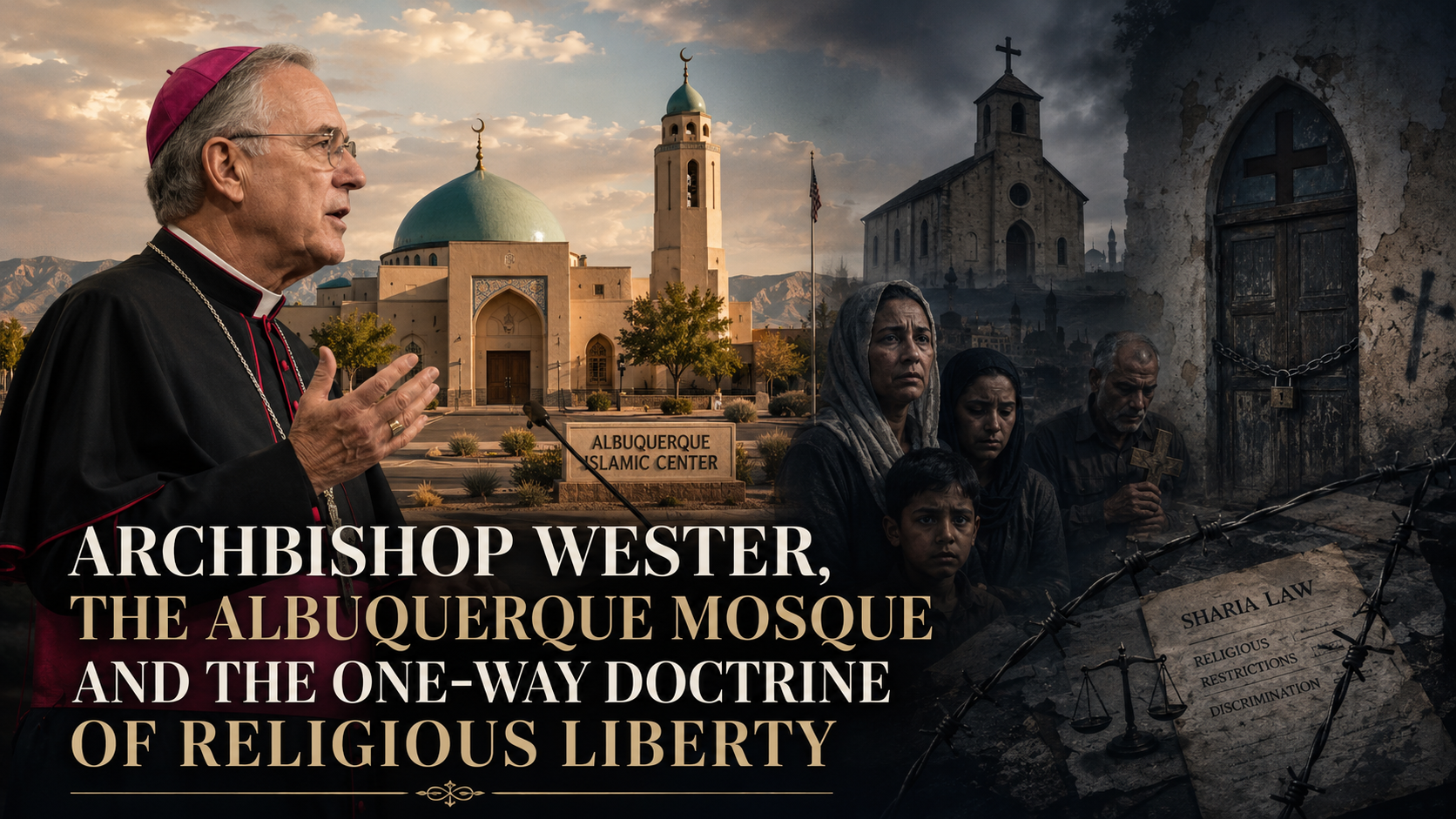
Archbishop Wester, the Albuquerque Mosque and the One-Way Doctrine of Religious Liberty
Archbishop John Wester was entitled to defend Muslims against unlawful discrimination. He was not entitled to turn support for a particular mosque into a Catholic moral obligation, while ignoring the severe legal and physical persecution endured by Christians across much of the Islamic world.

On 27 July, Archbishop John C. Wester of Santa Fe issued a statement supporting the proposed construction of a mosque and community centre in Albuquerque’s North Valley. Muslims, he said, possess “the same God-given and constitutionally protected right to worship freely” as every other religious community. Defending that right was “not only a civic duty but a core element of Catholic teaching”.¹
He did not confine himself to the uncontroversial proposition that Muslims must receive equal treatment before American law. Archbishop Wester declared that supporting the construction of the mosque was “entirely consistent with our own tradition and moral commitments”. He placed “opposition to their places of worship” among the forms of hostility towards Muslims which he considered incompatible with the Gospel, and urged the neighbourhood to welcome the project with goodwill.
The statement transformed a contested planning proposal into a test of Christian charity. That was an unwarranted step.
Muslims may not be assaulted, threatened or denied ordinary legal protection because of their religion. A public authority may not reject a planning application merely because the applicants are Muslim. American law expressly protects religious institutions against discriminatory land-use decisions.² Catholics have no reason to object to such protection.
Yet equal treatment under civil law does not make every application meritorious, nor does it require Catholics to regard the growth of Islamic institutions as a religious good.
A planning dispute placed under moral suspicion
The proposed Islamic centre had already attracted objections concerning traffic congestion and the scale of the development near Second Street and Alameda Boulevard. Plans for a school were removed during the approval process, and the Bernalillo County Planning Commission rejected an appeal against the project only after almost five hours of debate.³
Some opponents reportedly expressed objections directed against Islam itself. Those remarks may properly be judged upon their merits. They do not prove that every resident concerned about traffic, parking, building size or the effect upon the neighbourhood was animated by religious hatred.
These distinctions were largely absent from Archbishop Wester’s intervention. By grouping “opposition to their places of worship” with hostile rhetoric and suspicion, he suggested that resistance to the mosque was itself evidence of anti-Muslim prejudice. A local planning argument thereby became a moral confrontation between hospitality and fear.
Bishops should condemn genuine prejudice clearly. They should be equally careful not to manufacture it by collapsing prudential objections into hatred of persons. A Christian may love his Muslim neighbour, defend him against injustice and still conclude that a particular development is unsuitable for a particular site.
The Gospel does not settle questions of traffic management.
From protection against coercion to support for a mosque
Archbishop Wester grounded his position in Dignitatis Humanae, the Second Vatican Council’s declaration on religious liberty. The document teaches that persons and religious communities should not be subjected to coercion in religious matters. It also states that religious bodies should not be prevented by government from erecting buildings, appointing ministers and publicly teaching their beliefs, subject to the requirements of a just public order.⁴
The archbishop’s appeal to the Council was therefore not accidental. Dignitatis Humanae does provide the immediate doctrinal framework for his argument. The difficulty lies in the distance between civil immunity and positive Catholic support.
Even the post-conciliar Catechism insists that religious liberty is neither “a moral license to adhere to error” nor “a supposed right to error”. It describes a civil immunity from external coercion within just limits.⁵ The person remains protected from unjust force; the religion he professes does not thereby acquire truth, divine approval or an equal claim upon Catholic allegiance.
Islam denies the Trinity, the Incarnation, the divine Sonship of Jesus Christ, His redemptive death upon the Cross and the sacramental constitution of the Church. It explicitly repudiates truths which Catholics are bound to profess. Islamic worship cannot therefore be presented as another harmless expression of the same revealed faith.
A Muslim may intend sincerely to adore the Creator. His sincerity does not repair the objective deficiencies of the creed according to which he worships. Catholic charity recognises the person, protects his legitimate civil interests and seeks his salvation. It does not describe the institutional establishment of religious error as a Catholic moral commitment.
Archbishop Wester’s phrase “God-given right to worship freely” conceals the distinction. God has endowed man with intellect and free will; an act of faith cannot be produced by external force. This does not mean that God grants a positive moral right to deny His revelation or to render Him worship contrary to the religion He has established.
Civil immunity answers the question of what human government may justly compel. Religious truth answers the question of what man owes to God. Wester passed from one to the other as though no distinction existed.
What the Church had actually taught
The claim that the Church has “long affirmed” religious liberty in Archbishop Wester’s sense cannot be reconciled easily with the documentary record.
Gregory XVI condemned the proposition that unrestricted liberty of conscience should be maintained for everyone. Pius IX rejected the theory that freedom of worship was an absolute civil right which ought to be proclaimed in every properly ordered society. Leo XIII taught that the State owes public duties to God and may not regard truth and religious error as possessing equal rights.⁶
This doctrine did not require forced conversion. The Church consistently taught that faith must be free and that no one may be compelled to profess Catholicism against his will. She also recognised that governments might tolerate false worship where attempts to suppress it would cause greater disorder or impede the common good.
Toleration, however, was precisely that: the prudent endurance of something objectively erroneous for a proportionate reason. It was not a declaration that the public propagation of every religion possessed an identical natural title.
Leo XIII observed that circumstances might oblige the Church to acquiesce in modern liberties because their toleration was judged expedient. He did not treat such arrangements as desirable in themselves, nor did he absolve civil society from its duties towards the true religion.
Dignitatis Humanae professed to leave untouched “the traditional Catholic teaching on the moral duty of individuals and societies toward the true religion and the one Church of Christ”. Its subsequent account of a civil right to the public profession and propagation of religion has nevertheless remained one of the Council’s most disputed claims.
Archbishop Wester’s statement illustrates the reason. An immunity framed as protection against coercion has developed pastorally into an obligation to welcome the institutional expansion of another religion. The Council’s qualifications concerning public order remain in the text, but scarcely appear in episcopal applications. The duty to seek and embrace religious truth retreats still further.
The practical result is not mere toleration. It is ecclesiastical sponsorship of religious pluralism.
Religious liberty travelling in one direction
There is a further difficulty, made more serious by the conditions under which Christians now live throughout much of the world. Western bishops are often conspicuously eager to defend the right of Muslims to build mosques, establish schools and propagate Islam in countries formed historically by Christianity. The same episcopal urgency is rarely heard on behalf of Christians living under Islamic governments, courts and social systems.
The available global data do not provide a single exact percentage by which every act of Christian persecution can be assigned to the religion of its perpetrator. It would therefore be careless to manufacture a mathematically precise claim.
The broader pattern is nonetheless overwhelming.
Open Doors estimates that more than 388 million Christians experience high levels of persecution or discrimination because of their faith. Seven of the ten countries at the head of its 2026 World Watch List—Somalia, Yemen, Sudan, Syria, Pakistan, Libya and Iran—are Muslim-majority states. Nigeria, which occupies seventh place, is religiously divided, but Islamist militancy and violence by armed groups advancing an Islamic agenda form a substantial part of the persecution there.⁷
Open Doors recorded 4,849 Christians killed because of their Christian identity during its latest reporting period. Of these, 3,490 were killed in Nigeria. Its researchers describe the Nigerian crisis as a severe convergence of ethno-religious hostility, Islamist militancy, organised crime and failed government protection. They also report that the collapse of state authority across parts of sub-Saharan Africa has created a vacuum exploited principally by armed Islamist movements.⁸
Land disputes, ethnic rivalries, criminality, civil war and political instability complicate many individual cases. Recognising those factors does not explain away the religious character of organisations which attack churches, demand conversion, impose Islamic rule and select Christian communities as targets.
The persecution is not confined to spectacular atrocities committed by organisations formally designated as extremist. In several states it is built into ordinary law, public administration and social expectation.
Persecution administered by law
Saudi Arabia prohibits public non-Muslim worship and provides no legal route by which Christian communities may establish recognised churches. Recent reports indicate that some private Christian gatherings have been tolerated when conducted discreetly and with the knowledge of the authorities. That limited permission remains dependent upon state discretion. Non-Muslim religious bodies cannot register normally, public worship remains constitutionally prohibited, and worship materials have been confiscated by security officials.⁹
This is not the activity of a renegade terrorist cell. It is the settled legal order of a state with which Western governments and churchmen maintain cordial relations.
In Egypt, Christians form the largest Christian population in the Middle East and North Africa, yet continue to face restrictions involving church construction, blasphemy allegations and official discrimination. The United States Commission on International Religious Freedom reported that Egyptian authorities intensified detentions of Christians and non-believers during late 2025 and early 2026. In January, an Egyptian court sentenced the Christian Augustin Samaan to five years’ imprisonment for “contempt of religion”.¹⁰
Pakistan’s blasphemy laws continue to expose Christians and other religious minorities to imprisonment, false accusation and mob violence. An allegation alone can provoke lethal consequences before any judicial process has been completed. The difficulty cannot be reduced to private extremism when the State maintains the laws, prosecutes alleged offenders and repeatedly fails to restrain those who incite violence in their name.¹¹
Iran recognises certain historic Christian communities within strict limits, while treating conversion from Islam and unauthorised house-church activity as threats to national security. USCIRF reported at least 143 Christian arrests across twenty-four Iranian cities and approximately 162 active court cases involving Christians during 2025.¹²
Comparable inequalities appear elsewhere through apostasy provisions, prohibitions upon evangelisation, restrictions upon church construction, forced marriages, disinheritance, employment discrimination and family violence against converts. The perpetrators are not always jihadists. They may be judges, police officers, civil servants, teachers, employers, neighbours or relatives applying an Islamic legal or social norm which regards departure from Islam as betrayal.
Mosques operate openly in London, Paris, Rome, New York and Albuquerque. In parts of the Islamic world, a Christian cannot build a church, distribute a Gospel, receive a Muslim convert or speak openly about his faith without placing his liberty, livelihood or life at risk.
The asymmetry is plain. Episcopal rhetoric often is not.
The silence expected of Western Christians
No Muslim living peacefully in New Mexico bears personal guilt for the conduct of the Saudi government, the Iranian judiciary or an Islamist militia in Nigeria. Collective blame would be unjust and intellectually lazy. Catholics must judge individuals according to their own words and actions.
That moral duty does not require a pretence that Christianity and Islam meet upon equal terms throughout the world.
Archbishop Wester spoke of Muslim vulnerability in the United States without acknowledging Christian vulnerability under Islamic power. He urged Catholics to support a mosque but asked nothing publicly of Muslim leaders concerning the legal disabilities imposed upon Christians in Muslim-majority countries. The result was a sentimental picture of interreligious relations in which only one community required defence and only Christians were summoned to examine their prejudices.
This attitude has become familiar. Church leaders denounce “Islamophobia” promptly, sometimes before the facts of a dispute have been established, while persecution committed in the name of Islam is diluted into the vocabulary of conflict, poverty or generic intolerance. Legal inequality receives even less attention because it lacks the dramatic image of a burning church. A denied permit, an apostasy prosecution or a Christian child taught his religious inferiority is easier for Western prelates to overlook.
A serious commitment to religious liberty would demand reciprocity. Archbishop Wester could have defended Muslims against discrimination while asking the Islamic community in Albuquerque to advocate publicly for the right of Christians to build churches, evangelise and receive converts throughout the Muslim world. Such a request would have tested whether “dialogue” possessed any content beyond mutual congratulation.
He made no such request.
The missionary duty left unmentioned
Nostra Aetate urges Catholics to treat Muslims with respect and to work with them where possible for justice and peace. The same declaration states that the Church “ever must proclaim Christ, ‘the way, the truth, and the life’”.¹³ Respect for Muslims was never meant to abolish the command to convert the nations.
That command is missing from Archbishop Wester’s statement. Muslims appear as neighbours whose prayers enrich the civic community, but not as souls whom the Church longs to bring to Christ. The proposed mosque is praised for strengthening the social fabric; nothing is said of the doctrines which will be taught within it or of the Christian obligation to bear witness against them.
Our Lord commanded His Apostles: “Going therefore, teach ye all nations; baptizing them in the name of the Father, and of the Son, and of the Holy Ghost.” Saint Peter declared: “For there is no other name under heaven given to men, whereby we must be saved.”
A bishop need not append an entire treatise on salvation to a statement about planning law. He should avoid speaking as though the prayers offered according to every religion strengthen a neighbourhood merely because they are prayers. The object of worship matters. The truth professed about God matters. The denial of Christ matters.
Friendship with a Muslim does not require the concealment of Christianity. Properly understood, it forbids it.
Integrity’s diagnosis and its excessive conclusion
The Integrity Magazine article which prompted this discussion correctly identified Dignitatis Humanae as the principal conciliar authority behind Wester’s intervention. It also rightly observed that the archbishop’s statement contained no discernible concern for the conversion of Muslims.¹⁴
Its final conclusion—that the post-conciliar hierarchy has thereby demonstrated that it is not the Catholic Church—goes beyond the evidence and assumes a judgement which private persons do not possess the authority to deliver.
A serious contradiction may be identified as a contradiction. A destructive policy may be resisted. A conciliar proposition may be examined against the prior and more authoritative teaching of the Church. None of these acts confers jurisdiction upon the critic to declare that the visible hierarchy has ceased to constitute the Church.
That additional claim weakens an otherwise substantial indictment. There is no need to settle the canonical status of the entire hierarchy in order to recognise what Archbishop Wester has done. He has invoked Vatican II to move from protection against coercion to positive support for Islamic institutional growth. He has treated opposition to a particular mosque as morally suspect, described religious plurality as an enrichment in itself, and remained silent about Christians subjected to Islamic violence, law and social coercion.
That is grave enough.
Muslims must receive justice. They must be protected from violence and unlawful discrimination. A planning authority must judge their applications according to the same lawful criteria applied to other citizens.
Catholics are not thereby obliged to describe a mosque as a religious good. Nor should they accept lectures about hospitality from churchmen who seldom demand equivalent liberty for Christians under Islamic rule.
The Church’s charity towards the Muslim recognises him as a neighbour and defends him against injustice. It also speaks truthfully about Islam, remembers Christians persecuted under its temporal ascendancy and desires the Muslim’s conversion to Jesus Christ.
Anything less is not dialogue. It is surrender conducted in the language of goodwill.
¹ Archdiocese of Santa Fe, Archbishop John C. Wester, “Supporting Our Muslim Neighbors’ Right to Worship”, 27 July 2026.
² United States Department of Justice, Civil Rights Division, guidance concerning the Religious Land Use and Institutionalized Persons Act 2000.
³ Alika Medina, “Bernalillo County Planning Commission allows proposed Islamic Center in North Valley to move forward”, KOB 4, 2 July 2026; Jason McNabb, “North Valley mosque proposal faces community opposition”, KOAT 7, 10 June 2026.
⁴ Second Vatican Council, Declaration Dignitatis Humanae, 7 December 1965, nn. 2–4.
⁵ Catechism of the Catholic Church, nn. 2106–2109, especially n. 2108.
⁶ Gregory XVI, Mirari Vos, 15 August 1832; Pius IX, Quanta Cura and the Syllabus of Errors, 8 December 1864; Leo XIII, Immortale Dei, 1 November 1885, and Libertas Praestantissimum, 20 June 1888.
⁷ Open Doors, World Watch List 2026.
⁸ Open Doors International, Striking at the Foundations: World Watch List 2026 International Advocacy Report, pp. 3–5.
⁹ United States Commission on International Religious Freedom, Country Update: Saudi Arabia, May 2026; USCIRF, 2026 Annual Report, Saudi Arabia chapter.
¹⁰ United States Commission on International Religious Freedom, Country Update: Egypt, April 2026; USCIRF, “The Egyptian Government’s Escalation Against Religious Minorities”, 28 January 2026.
¹¹ United States Commission on International Religious Freedom, 2026 Annual Report, Pakistan chapter; USCIRF, “Blasphemy Law Remains an Impediment to Religious Freedom in Pakistan”, 2 December 2025.
¹² United States Commission on International Religious Freedom, 2026 Annual Report, Iran chapter.
¹³ Second Vatican Council, Declaration Nostra Aetate, 28 October 1965, nn. 2–3.
¹⁴ Riaan Van Zyl, “Upset over US archbishop supporting mosque construction? Blame Vatican II”, Integrity Magazine, 30 July 2026.
Related Articles


Latest ARTICLES
- QUI BENE DISTINGUIT, BENE DOCET ~ He who distinguishes well, teaches well: Spiritual Conference for Nuntiatoria CXXIIIIn a series of Tuesday conferences, the speaker explores themes about recognising reality, receiving divine gifts, and understanding spiritual truths. He highlights the importance of making careful distinctions to maintain sound judgment, especially in an age consumed by distractions and superficial assessments. True wisdom lies in distinguishing truth from perception and nurturing an authentic inner life centred on Christ.
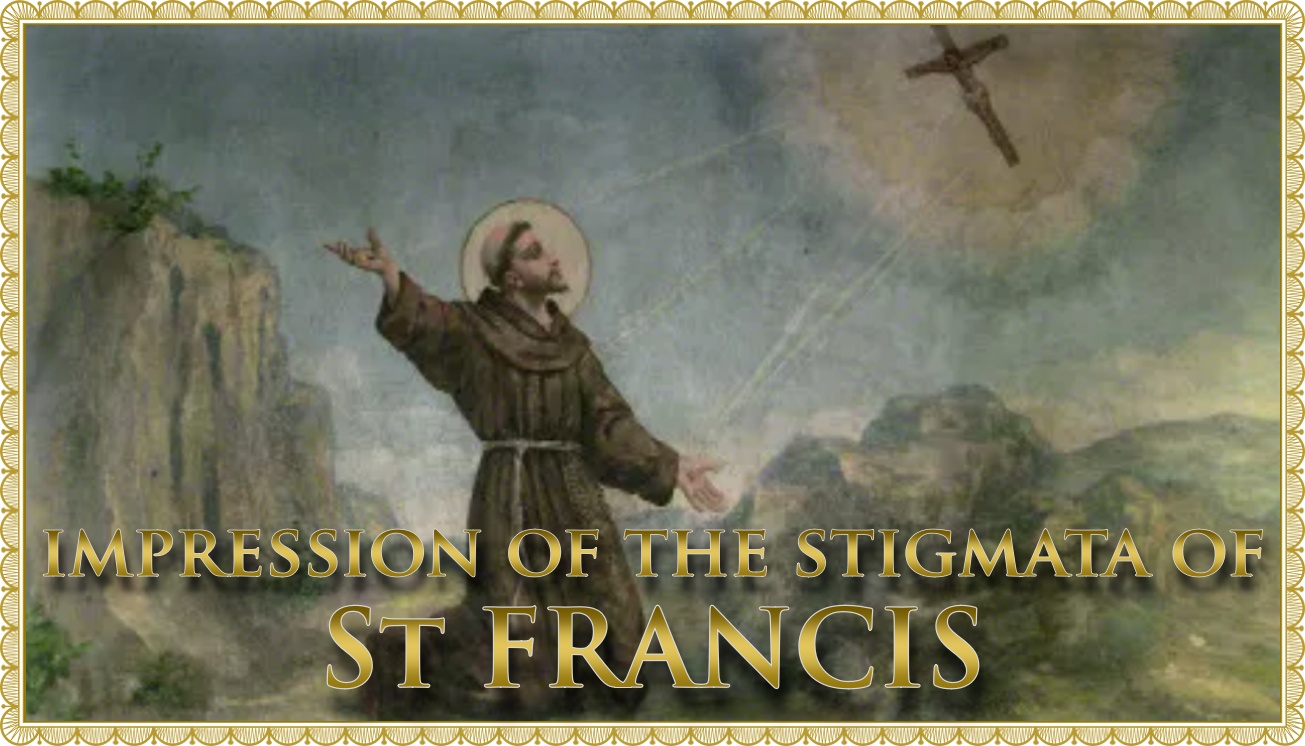
- Today’s homily: Impression of the Stigmata upon St FrancisFrom serving the lepers he once shunned to receiving Christ’s wounds upon Mount Alvernia, Saint Francis shows how grace transforms a soul through obedient love. His stigmata call us to let the Cross shape our lives, beginning with the particular act of mercy or sacrifice we have been reluctant to offer.
- Today’s Mass: September 17 Impression of the Stigmata of St Francis of AssisiSaint Francis received the stigmata because he had first allowed the Cross to transform his soul. His wounds were not a spectacle, but God’s answer to a world growing cold: the visible sign of a life consumed by crucified love. We may never bear Christ’s wounds in our flesh, but we must bear their likeness through penance, fidelity, patience, mercy and sacrificial love.
- Sermon for Stigmata of St. FrancisToday marks the feast of St. Francis’ stigmata, celebrating his transformation from a wealthy merchant’s son to a devoted preacher of poverty and humility. He founded the Franciscan order, emphasising evangelisation and simplicity. His experience of receiving the stigmata exemplifies the Christian doctrine of redemption through suffering, distinguishing it from other faiths.
- Today’s homily: Wednesday Michaelmas EmberThe homily reflects on the significance of fasting and prayer in the Christian faith, emphasising their role in spiritual growth and self-mastery. By juxtaposing scripture from Amos and the Gospel of Mark, it highlights the need for gratitude and humility during abundance, urging believers to recognise their dependence on God. True repentance transforms and restores one’s relationship with Him.



Leave a Reply