
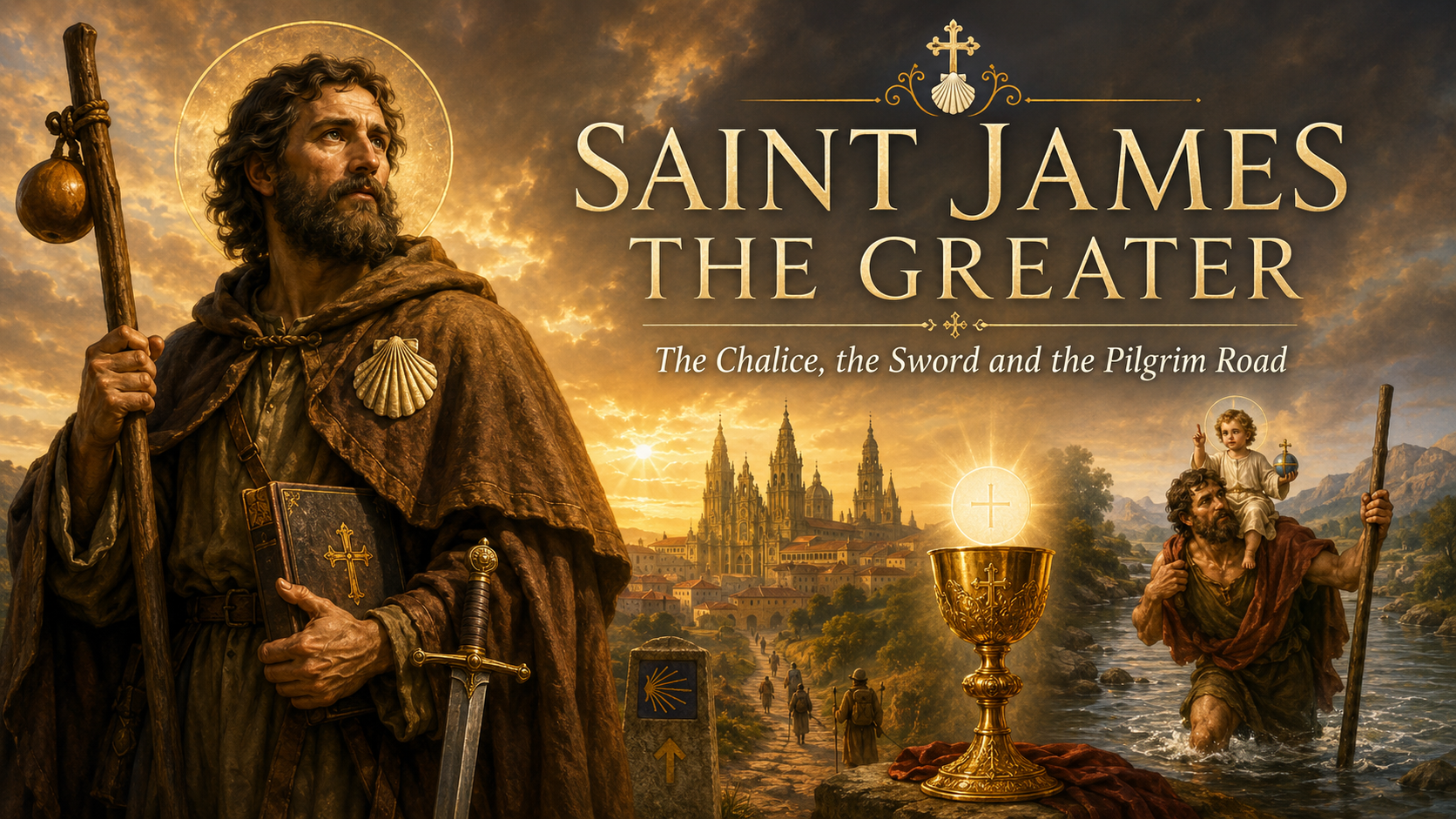
Saint James the Greater: The Chalice, the Sword and the Pilgrim Road
On 25 July, the traditional Roman Rite honours Saint James the Greater, the first of the Twelve Apostles whose martyrdom is recorded in Scripture, while commemorating Saint Christopher, Martyr. The feast gathers into one liturgical mystery the call of the Apostle, the purifying of ambition, the drinking of Christ’s chalice, the sword of Herod and the long pilgrim road to Compostela.

ThThe Roman liturgy does not commemorate Saint James the Greater as a successful religious organiser whose life ended unhappily, but as an Apostle whose apparent defeat disclosed the true nature of apostolic glory. Herod silenced him with the sword, yet the Church proclaims that his voice has gone forth into all the earth; the world treated him as expendable, yet the Introit numbers him among the friends of God whose principality is exceedingly strengthened. He once sought a throne beside Christ, but the Gospel reveals that he could reach it only through the chalice.
The entire feast is constructed around this paradox. Its Introit, Mihi autem, celebrates the honour and sovereignty of the Apostles, while its Epistle describes them as men appointed to death, hungry, homeless, reviled and treated as the refuse of the world. Its Gospel places the chalice of Christ before the sons of Zebedee, its Offertory carries their preaching to the ends of the earth, and its Communion promises seats of judgement to those who have followed the Lord. Apostolic honour is real, but it is reached through apostolic abasement; the throne is not abolished, but approached by way of the Cross.
The Son of Zebedee
James was the son of Zebedee and the brother of Saint John the Evangelist. The Gospels first show the brothers beside the Sea of Galilee, mending their nets in their father’s boat, and at the call of Christ they leave both boat and father to enter a discipleship whose demands they cannot yet measure. Saint Mark’s reference to the hired servants left with Zebedee suggests a settled fishing enterprise rather than the most abject poverty, while their mother is traditionally identified as Salome by comparing the women named in the accounts of the Crucifixion and the empty tomb. She belonged to the faithful company of women who ministered to Christ and remained near Him when many disciples had fled.
James is styled “the Greater” principally to distinguish him from James the son of Alphaeus. The title does not securely establish whether he was older, taller or more prominent than the other Apostle, but the Gospel does establish his place, with Peter and John, within the most intimate circle of the Twelve. These three alone entered the house where Christ raised the daughter of Jairus, ascended the mountain and saw the Lord transfigured, and were led more deeply into Gethsemane and commanded to watch while Christ entered His agony.
The sequence forms an exact preparation for apostolic ministry. In the house of Jairus, James saw Christ exercise dominion over death; upon Tabor, he saw the divine majesty concealed beneath the humanity of Jesus; and in Gethsemane, he saw the Son submit Himself to the Father beneath the weight of sorrow. James was therefore shown the power, the glory and the obedience of Christ, and he was made to understand that the Lord of glory is also the obedient Victim. The throne and the chalice belonged to one mystery.
The Son of Thunder
Our Lord gave James and John the name Boanerges, “sons of thunder,” and the name reveals something of their natural temperament. They were vigorous, ardent and impatient men, so much so that when a Samaritan village refused to receive Christ, they asked whether they should command fire to descend from heaven and consume it. Their loyalty was genuine, but their zeal had not yet been purified by the charity of the Crucified; they wished to defend Christ by destroying those for whom Christ was travelling towards Jerusalem to die.
The Gospels do not conceal this defect, just as they do not conceal Peter’s presumption, Thomas’s hesitation or the former life of Matthew. Christ did not choose men already finished by nature, but men whose very strengths could become dangerous when governed by self-love. Grace did not extinguish the thunder in James; it converted it. The man who once wished fire upon unbelievers would shed his own blood for unbelievers, and the disciple who initially imagined greatness as nearness to an earthly throne would learn that apostolic greatness meant becoming one of those whom Saint Paul describes as “appointed to death.”
The transformation of James is therefore not the destruction of character but its sanctification. Christianity does not require that every strong temperament be weakened into religious blandness; it requires that strength cease serving the ego and begin serving Christ. Stubbornness may become constancy, vehemence may become courage, sensitivity may become compassion, and ambition, once purged of vanity, may become zeal for the glory of God and the salvation of souls. The old James must die, but the son of thunder remains, only now the thunder has changed masters.
The Request of Salome
The Gospel appointed for the feast recounts the request made by the mother of James and John. She approaches Christ, worships Him and asks that her sons may sit, one at His right hand and the other at His left, in His kingdom. Her request was disordered, but not devoid of faith, for Salome believed that Christ was a King and that His kingdom was real. At a time when hostility towards Him was increasing, she still expected His triumph.
Her error lay in conceiving that triumph according to the pattern of an earthly court. She imagined places, rank and precedence, but did not yet understand that Christ’s throne upon earth would be the Cross, that His crown would be woven from thorns, and that those immediately beside Him upon Calvary would be two condemned thieves. Our Lord therefore does not deny the reality of thrones, but reveals the road to them: “You know not what you ask. Can you drink the chalice that I shall drink?”
James and John answer, “We can,” though they speak beyond their knowledge. James has not yet seen the scourging, the nails or the darkness of Calvary, and even after witnessing the agony at Gethsemane he will fail to remain awake with Christ. His answer contains presumption, but it also contains generosity, and Our Lord accepts the imperfect offering and foretells what grace will accomplish: “My chalice indeed you shall drink.”
Christ does not say that James is presently equal to the trial; He promises that James will be made equal to it. The Christian is often tempted to imagine a future cross and compare it with present weakness, yet God does not ordinarily bestow the grace of martyrdom years before martyrdom. He gives the grace proper to the duty when the duty arrives. James could not yet drink the chalice, but the Lord Who called him would prepare him to do so.
The Chalice of Christ
The chalice is the governing image of the feast, but it must not be reduced to a general metaphor for difficulty. Christ does not ask James merely whether he is willing to suffer, for every human life contains suffering and suffering does not automatically sanctify. Pain may soften a man or embitter him; it may deepen humility or inflame resentment. What sanctifies is not suffering considered in isolation, but suffering united to the obedience and sacrifice of Christ.
The question is therefore precise: can James drink the chalice that Christ shall drink? The chalice of Christ is the acceptance of the Father’s will when that will leads through humiliation, rejection and apparent failure. It is suffering received not as blind fate but as an oblation, and it is the surrender of self-will within the sacrifice of the Son.
The Mass makes this visible. The chalice upon the altar receives the Precious Blood of the Victim, and Holy Communion unites the faithful not to an abstract moral teacher but to Jesus Christ crucified and risen. To receive the Victim sacramentally is to consent that the form of His sacrifice should be reproduced within His members. This does not mean that Christians seek pain for its own sake, but that they reject the fantasy of union with Christ without self-denial, obedience or sacrifice. James desired the glory of Christ, and he was required to receive the form of Christ.
Herod and the Sword
The promise of the chalice was fulfilled in Jerusalem in approximately the year 44. Herod Agrippa I, grandson of Herod the Great, had acquired authority over a territory approaching the extent of his grandfather’s kingdom and, seeking to retain favour among influential Jewish constituencies, began to persecute members of the infant Church. The Acts of the Apostles records the death of James in one severe sentence: “He killed James, the brother of John, with the sword.”
James thus became the first of the Twelve Apostles whose martyrdom is recorded in the New Testament. Saint Stephen had already been stoned and other Christians had suffered persecution, but James was the first member of the apostolic college to seal his preaching with blood. Saint John Paul II later numbered him among those New Testament witnesses who died rather than deny Christ.¹
The brevity of Saint Luke’s account is itself striking. There is no recorded discourse before the king, no dramatic farewell and no miraculous interruption; the son of thunder is led away and silenced. The contrast with Saint Peter follows immediately, for Herod, seeing that the death of James had pleased his allies, imprisoned Peter, yet an angel entered Peter’s prison, broke his chains and led him to freedom.
James received no such deliverance, but this was not evidence that God loved Peter more or that the prayers of the Church had failed for James. Peter was delivered from the sword because his earthly ministry was to continue, whereas James was delivered through the sword because his ministry had reached its appointed consummation. Divine Providence may be glorified by preserving one servant and by permitting the death of another, and Christian faith cannot judge the favour of God by survival, safety or visible success.
Eusebius of Caesarea preserves an early tradition attributed to Clement of Alexandria concerning the Apostle’s last journey. According to that account, the man who had brought James to judgement was so moved by his testimony that he confessed Christ himself. As they were led away, he asked James to forgive him; James embraced him, greeted him with peace, and both were beheaded.² The episode does not possess the authority of Scripture and must be presented as early ecclesiastical tradition, yet it expresses with remarkable fitness the transformation of the Apostle. The man who once wished fire to descend upon the inhospitable now gives peace to the man who helped deliver him to death, and the son of thunder conquers his final adversary not by destroying him, but by begetting him as a brother.
The Apostle as Father
The Epistle of the Mass, taken from Saint Paul’s First Epistle to the Corinthians, is among the most uncompromising accounts of apostolic existence: “God hath set forth us apostles the last, as it were men appointed to death: we are made a spectacle to the world, and to angels, and to men.” The Apostles hunger, thirst and labour with their hands; they are buffeted, reviled, persecuted and treated as the refuse of the world. Their authority is not protected from humiliation, but proved within humiliation.
Saint Paul then explains the meaning of this suffering: “I admonish you as my dearest children: for if you have ten thousand instructors in Christ, yet not many fathers. For in Christ Jesus, by the gospel, I have begotten you.” The Apostle suffers because he is a father. He does not preach to construct a personal following or to enjoy the prestige of office, but through the Gospel begets souls for Christ.
This is the conversion of ambition into apostolic paternity. James once asked, in effect, where he should sit; the mature Apostle must ask for whom he shall spend himself. The principle applies to every form of Christian authority. A bishop bears the signs of apostolic office because he is bound to apostolic sacrifice; a priest stands before an altar because his own life must acquire the form of an offering; parents possess authority so that they may spend themselves for their children; teachers serve the formation of their pupils, rulers the common good, and superiors the salvation of those entrusted to them. Authority severed from sacrifice becomes domination, while authority formed by the chalice becomes fatherhood.
The Friends of God
The Introit proclaims: “To me Thy friends, O God, are made exceedingly honourable: their principality is exceedingly strengthened.” The words appear almost to contradict the Epistle, for the Apostle whom Saint Paul describes as refuse is proclaimed by the Church as a prince. The contradiction lies not within the liturgy but between the judgement of the world and the judgement of God. Herod regarded James as a politically useful victim, whereas God numbered him among the foundations of the heavenly Jerusalem.
The Offertory supplies the answer to the sword: “Their sound hath gone forth into all the earth, and their words unto the ends of the world.” Herod could stop the physical voice of James, but he could not stop the apostolic testimony that the martyr’s blood had confirmed. The death intended to suppress the Gospel became part of its proclamation.
The Preface of the Apostles asks the eternal Shepherd not to desert His flock, but to govern and protect it through the blessed Apostles and those established as pastors and vicars of His work. Apostolic authority therefore belongs to the divine constitution of the Church and is not a temporary administrative convenience. Yet the Gospel and Epistle prevent that authority from being interpreted as secular grandeur clothed in religious language, for the authority of the Apostle is the authority of one who has followed the Shepherd in laying down his life.
The Communion completes the liturgical movement: “You that have followed Me shall sit upon seats, judging the twelve tribes of Israel.” James receives the throne he once desired, but he receives it only after his desire has been purified through discipleship and martyrdom. The throne was not false; his first understanding of it was false.
Saint James and Spain
The connection between Saint James and Spain belongs to the most enduring traditions of Western Christianity. According to the Spanish tradition, the Apostle preached in the Iberian Peninsula before returning to Judaea, where he was martyred, and his body was afterwards carried to Galicia and buried near Iria Flavia.
Historical precision requires that several levels of evidence be distinguished. The call of James, his position among the Twelve and his death under Herod belong to scriptural certainty. The account preserved by Eusebius belongs to early ecclesiastical tradition. The Spanish mission and translation of the relics belong to a venerable but later tradition whose surviving documentary foundations do not provide the same degree of certainty. To make this distinction is not to insult devotion, but to prevent devotion from being weakened by exaggerated historical claims.
The medieval cult of Saint James at Compostela is, however, an indisputable historical fact of immense religious and civilisational importance. The official history of the cathedral relates that the burial place was rediscovered around the years 820–830 during the episcopate of Theodomir of Iria Flavia. When King Alfonso II learned of the discovery, he ordered a church to be built over the sepulchre.³
The sanctuary that developed there eventually gave rise both to the cathedral and to the city of Santiago de Compostela. The present cathedral continues to venerate beneath its high altar the relics traditionally identified as those of the Apostle, housed in a silver reliquary within a crypt occupying the site of the ancient mausoleum.⁴ The Romanesque cathedral was begun in 1075, and by the High Middle Ages Compostela had become one of the foremost destinations of Christian pilgrimage, standing with Rome and Jerusalem in the sacred geography of Latin Christendom.
The Road to Compostela
The pilgrimage routes to Compostela did not consist merely of tracks across the landscape, but generated an immense network of churches, monasteries, bridges, hospitals, hospices and roadside crosses. UNESCO’s account of the French and Spanish routes records the material infrastructure created to serve both the spiritual and physical needs of pilgrims travelling from across Europe.⁵
This network reveals the corporate nature of Catholic civilisation. Pilgrimage was not an individualistic exercise in private spirituality. The traveller was blessed by the Church, received by religious houses, protected by laws, tended in sickness and directed towards a shrine where the sacraments, not personal self-discovery, marked the culmination of the journey. The Camino was therefore theology written across the land.
The staff, scrip and scallop shell made visible the condition of the Christian. Man is not settled finally in this passing world, but is a traveller under judgement, sustained by grace and directed towards the heavenly country. The scallop shell became the familiar emblem of Saint James and those who journeyed to his shrine. Its precise origin is not reducible to a single explanation, but it could serve as evidence that a pilgrim had reached the Galician coast, while its converging ridges readily acquired symbolic interpretations: many roads leading towards one shrine, and many peoples gathered into one Church.
The pilgrim’s staff offered support and defence, while his scrip signified poverty and dependence. His clothing declared that he had left the apparent security of home to expose himself to the discipline of the road. Pilgrimage is doctrine enacted by the body, for the pilgrim does not merely praise detachment but leaves, does not merely admire perseverance but continues when tired, and does not merely speak of providence but becomes dependent upon hospitality, weather and the generosity of strangers. The road exposes what comfort conceals.
Pilgrimage and Tourism
The continuing appeal of the Camino in a secularised Europe is striking. Men and women approach it for many reasons, including explicit faith, bereavement, penance, curiosity, physical challenge, cultural interest or escape from the noise of ordinary life. Mixed motives need not invalidate the journey, but neither do they alter its objective meaning. The Camino does not lead merely westward, but to the shrine of an Apostle who confessed Jesus Christ and died for the Gospel.
Its chapels, crosses, monasteries and hospices did not arise from a vague human hunger for transcendence, but from the Catholic doctrines of sin, penance, grace, intercession, sacrifice and eternal life. The modern tourist may travel in order to accumulate experiences, whereas the pilgrim travels in order to be judged and changed. Tourism arranges the journey around the preferences of the traveller; pilgrimage arranges the traveller around a sacred end.
The distinction does not mean that the pilgrim is forbidden to delight in landscape, architecture, food or companionship, but that such things remain ordered towards conversion rather than consumption. A tourist may return with photographs, whereas a pilgrim should return with fewer sins. The Church therefore fails the Camino when she allows it to dissolve into therapeutic wandering or generic spirituality. Saint James did not leave his nets in order to discover his authentic self; he followed Christ. He did not die as a symbol of personal courage; he died because the Gospel was true. The road bearing his name must finally lead beyond the pilgrim’s feelings to confession, worship and amendment of life.
Saint Christopher, Christ-Bearer
The traditional Roman Mass of Saint James includes the commemoration of Saint Christopher, Martyr. The Roman Martyrology places his martyrdom in Lycia during the persecution of Decius and records a tradition of scourging, fire, arrows and eventual beheading. The detailed Acts cannot be treated as secure contemporary history, but the cult of a martyr named Christopher is ancient, and the Church has continued to honour him as such.⁶
His best-known Western legend developed over time and tells of a man of extraordinary strength who desired to serve the most powerful master. After discovering the limits of earthly rulers and of the devil himself, he was instructed in the Christian faith and undertook the work of carrying travellers across a dangerous river. One night a child asked to be borne across, and as Christopher entered the water the Child became so heavy that the strong man feared they would both be overwhelmed. Reaching the far bank, he learned that he had carried Christ, the Creator and Redeemer of the world.
The historical martyr and the developed legend must be distinguished, but legend need not be dismissed merely because it communicates truth poetically. The story gives form to the saint’s name, Christophorus, one who bears Christ, and expresses the doctrine of the Gospel that Christ presents Himself beneath the appearance of those who need to be served. Christopher does not discover Christ by escaping the burden; he finds Christ within the burden accepted for love.
The Patron of Travellers
Saint Christopher became one of the most widely invoked patrons of travellers. His image appeared near roads, gates and bridges, while medals bearing his likeness became familiar to drivers and passengers. In many traditional communities, vehicles are blessed on or near his feast.
The blessing of a vehicle is not a charm against every possible accident. A sacramental does not place machinery beyond the operation of nature or cancel the duties of prudence, but places a person and his activity beneath the prayer of the Church and disposes him to receive grace. The traveller asks not only that he may avoid collision or breakdown, but that he may travel soberly, prudently and in the state of grace. He asks not merely that his body arrive safely, but that every earthly journey be ordered towards his final destination, for a man may reach every appointment of his life and still fail to arrive in heaven.
The liturgical conjunction of James and Christopher is therefore more than accidental. James became the heavenly patron of Europe’s great pilgrim road, while Christopher became the protector of those exposed to the dangers of travel. James marks the destination, and Christopher carries the traveller.
The Feast and Christian Authority
The feast exposes every attempt to separate honour from sacrifice. The request of Salome has never disappeared from ecclesiastical life, but survives whenever men speak of the Kingdom while calculating their place within it, whenever office is desired without its burden, or whenever apostolic titles are claimed without apostolic fatherhood.
Christ does not answer by abolishing hierarchy, for the Communion explicitly promises thrones to the Apostles. Catholicism does not pretend that sacred office, precedence and jurisdiction are unreal. The correction concerns the purpose and form of authority. The throne belongs to the man who has followed Christ; the crozier belongs to the shepherd prepared to defend the sheep; and the mitre belongs to the man whose intellect must be subjected to revealed truth. Apostolic succession cannot be reduced to the transmission of sacramental power while apostolic doctrine, charity and willingness to suffer are treated as optional adornments.
The deepest crisis of authority in the Church is not merely administrative, but arises whenever office ceases to look paternal, doctrinal and sacrificial. The faithful do not primarily need religious managers, but fathers who have drunk from the chalice.
The Ordinary Chalice
Most Christians will not die beneath a persecutor’s sword, and most will never walk the entire road to Compostela. Yet the feast concerns every baptised person because the chalice usually appears first beneath ordinary forms. It is placed before spouses when fidelity becomes costly, appears in the sleeplessness and anxiety of parenthood, and is encountered in the care of an elderly relative, the forgiveness of a repeated injury and the resistance of temptations whose persistence is humiliating.
It appears also in work performed honestly without recognition, in Catholic truth confessed when silence would be easier, and in duties that seem too small to correspond with our imagined vocation. The Christian may desire some conspicuous act of generosity while resenting the quiet obligation through which God actually intends to sanctify him. Christopher sought the greatest master and found Him beneath the form of a child asking to be carried, while James sought a royal throne and found his crown beneath the sword of Herod. Divine Providence often hides greatness beneath inconvenience.
The Chalice and the Crown
The traditional feast of Saint James refuses both worldly triumphalism and sentimental defeat. It does not conceal the Apostle’s abasement, for he is arrested, treated as politically disposable and killed without visible deliverance. Yet the liturgy refuses to accept the world’s verdict. James is a friend of God, his principality is strengthened, his voice travels to the ends of the earth, and he sits upon a seat of judgement because he followed Christ when following meant surrender.
The road to Compostela translates this mystery into movement, for the pilgrim leaves, accepts hardship and travels towards an apostolic tomb, while Saint Christopher completes the image by reminding the faithful that Christ Himself may be concealed within the burden encountered along the way. The feast therefore draws together throne, chalice, sword, road and burden, none of which can be understood apart from Christ. Without Him, the throne becomes ambition, the chalice mere suffering, the sword senseless violence, the road tourism and the burden resentment; in Him, ambition is purified into service, suffering becomes sacrifice, death becomes testimony, travel becomes pilgrimage and duty becomes the bearing of Christ.
Herod believed that James had been removed from history, yet the Apostle’s name travelled farther than Herod’s power, his tomb gathered nations, and his feast still summons the Church to measure honour by sacrifice. The throne for which James once asked was real, but before he could occupy it, the son of thunder had to become an Apostle, the ambitious disciple a father, and the fisherman a martyr. The crown awaited him, but the chalice came first.
¹ Holy Scripture, Matthew 4:21–22; 17:1–8; 20:20–23; 26:36–38; Mark 1:19–20; 3:17; 5:37; 9:2–8; 10:35–40; Luke 5:10–11; 9:28–36, 51–56; Acts 12:1–2; John Paul II, Veritatis Splendor, 6 August 1993, no. 91.
² Eusebius of Caesarea, Ecclesiastical History, II.9, citing Clement of Alexandria’s lost Hypotyposes.
³ Cathedral of Santiago de Compostela, official historical account of the discovery during the episcopate of Theodomir and the patronage of Alfonso II.
⁴ Cathedral of Santiago de Compostela, official accounts of the crypt, reliquary, ancient mausoleum and Romanesque cathedral.
⁵ UNESCO World Heritage Centre, “Routes of Santiago de Compostela in France” and “Routes of Santiago de Compostela: Camino Francés and Routes of Northern Spain.”
⁶ Roman Martyrology, 25 July; The Catholic Encyclopedia, “St Christopher.”
related articles


Latest articles
- THE KING’S OATH AND THE DEAD OF SAINT GEORGE’SA tragic attack during a Christian funeral in Karak, Jordan, resulted in nine fatalities and numerous injuries. King Abdullah II has pledged severe retaliation, leading to the arrest of three suspects. The Latin Patriarchate supports the monarchy’s role in ensuring religious freedom, while the Orthodox community vows to remain in their homeland amidst ongoing concerns for their safety.
- THE LAW OF A CHURCH THAT HAS NOT YET BEEN REUNITEDAt the Angelicum conference, Orthodox and Anglican scholars discussed the future of ecclesiastical law alongside Vatican cardinals. Cardinal Koch advocated for a new ecumenical juridical order, connecting these discussions to the upcoming Synodal Assembly of 2028. The conference aimed to address how different Christian governance models could influence Catholic law and authority.
- ‘DWARFS TAVISTOCK’: Baroness Cass demands Inquiry into Brighton NHS ScandalBaroness Hilary Cass has called for an independent inquiry into Brighton’s WellBN practice, claiming it overshadowed the Tavistock scandal. An investigation revealed severe clinical failures affecting 78 children, alongside the distressing treatment of safeguarding GP Dr Sarah Redvers, who raised alarms about these practices and faced retaliation. Accountability within the NHS is urgently needed.
- “THAT’S JUST PARANOIA”: Dr Joseph Shaw and the Crisis beyond the Latin MassDr Joseph Shaw’s recent interview highlights his support for the Traditional Latin Mass but inadequately addresses the Society of Saint Pius X’s (SSPX) concerns regarding the Church’s doctrinal crisis. He dismisses SSPX’s fears as paranoia, yet the Society’s extensive theological arguments underscore that preserving the older liturgy is insufficient for restoring Catholic Tradition.
- THE REFUSAL IS NOW IN WRITINGThe Vatican has formally denied the Summorum Pontificum pilgrims permission to enter St Peter’s Basilica together for prayer, a decision communicated through published correspondence. The situation has sparked debate over administrative failures and the Church’s treatment of traditional Catholics. Key questions remain regarding the explanation for this refusal amidst wider pastoral concerns.




Leave a Reply