
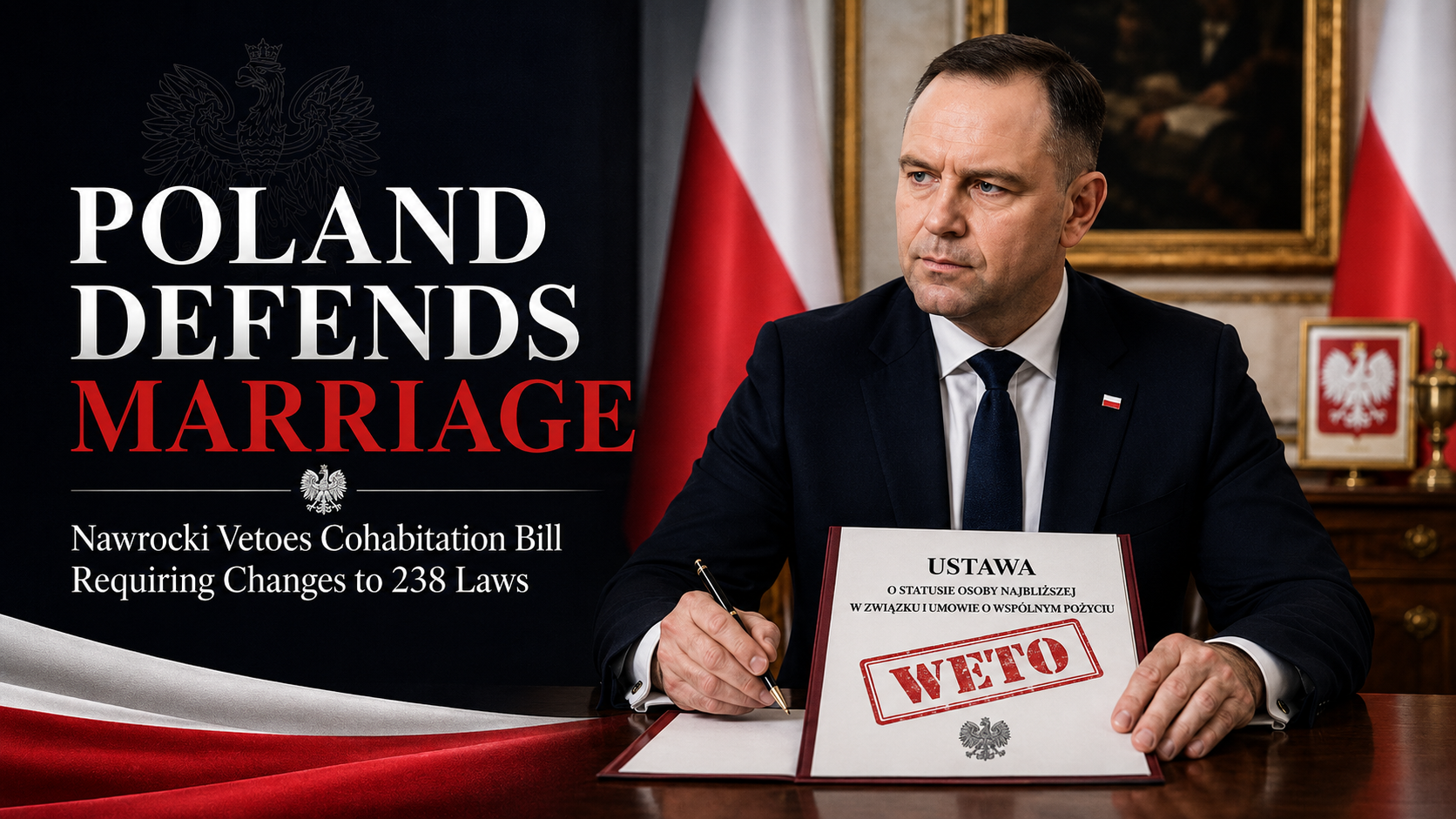
Karol Nawrocki Vetoes Poland’s 238-Law Cohabitation Settlement
Presented as practical assistance for people in informal relationships, Donald Tusk’s legislation would have established a state-registered family-law institution for opposite- and same-sex couples, extending privileges associated with marriage through amendments to 238 statutes. President Nawrocki was right to judge the scheme by its legal effects rather than its carefully softened title.

On 17 July, President Karol Nawrocki refused to sign two Acts passed by the Polish Parliament: the Act on the Status of the Closest Person in a Relationship and the Cohabitation Agreement, and the accompanying legislation required to insert that new status throughout Polish law. Both had been adopted by the Sejm on 29 May and accepted by the Senate without amendment on 25 June.¹
Nawrocki began with the title. “Simply changing the name of an Act does not change the legal character of the proposed solution,” he observed. The criticism was exact. The expression “closest person” suggests a practical arrangement for anybody who entrusts important matters to another: an elderly widow and her daughter, two siblings sharing a home, or a sick man relying upon a trusted friend. The government’s scheme was nothing of the kind. It concerned two adults entering a formal agreement before a notary, followed by registration at the civil registry office. It created a legally recognised couple.
The agreement could regulate property, maintenance, occupation of the common home, access to medical records, representation before public authorities and the disposal of property by will. The introductory Act then carried the consequences of that agreement across the statute book. According to the Polish Senate’s own summary, it amended 238 laws, in most cases granting a person registered under the new status rights already enjoyed by a spouse.²
Those changes included joint taxation, exemptions from inheritance and gift taxes, survivors’ pensions, employment protections, social-security entitlements, access to private pension savings, residence rights and privileges affecting members of the uniformed services. Some obligations could be selected by the parties; the public benefits followed from registration. The agreement might also be dissolved far more readily than a marriage, including, where provided, by a unilateral declaration before a notary.
A government does not revise 238 statutes to solve a difficulty at a hospital reception desk.
There are genuine problems surrounding medical information, funeral arrangements, tenancy, powers of attorney and representation during illness. They are not peculiar to sexual couples. A widower may depend upon a niece; an elderly woman may share her home with a lifelong friend; two unmarried brothers may care for one another. Legislation could make suitable forms of authority easier to create and ensure that a person’s nominated representative is respected. President Nawrocki has expressly indicated his willingness to consider such measures.
The government chose another course. It attached those practical provisions to a state-registered relationship, surrounded them with tax, pension and social advantages, and placed the resulting institution within family law. The medical and administrative questions supplied the sympathetic sales pitch. The legal substance was a civil partnership under an anaesthetised name.
Nawrocki described the proposal as reconstructing “the legal core of marriage” without its full obligations. That is the central objection. Marriage is not given a special place in law because the state considers married people more likeable than their neighbours. Its privileges recognise an institution founded upon the union of a man and a woman, naturally ordered towards the generation and upbringing of children, and imposing obligations intended to endure beyond passing convenience.
Not every marriage will produce children. Age, illness or infertility may prevent it. The nature of the institution is not altered by the circumstances of a particular couple. Marriage unites the two sexes in the kind of common life from which children ordinarily arise and within which their identity, dependency and inheritance can be secured. That public function supplies a rational basis for public protection.
A cohabitation agreement constructed chiefly from negotiable provisions cannot bear the same significance. Its parties might undertake serious mutual responsibilities, or relatively few. They could arrange property rights while avoiding the full legal consequences of marriage, receive substantial public advantages, and dissolve the arrangement without judicial scrutiny of the sort required in divorce. To grant comparable privileges while requiring fewer and more readily discarded obligations does not strengthen fairness. It encourages citizens to obtain the incidents of marriage while declining its discipline.
Article 18 of the Polish Constitution states that marriage, “being a union of a man and a woman”, together with the family, motherhood and parenthood, is placed under the protection and care of the Republic.³ The wording does not merely prevent the registrar from issuing a marriage certificate to two men or two women. It imposes upon the state a positive duty to maintain the distinctive position of marriage.
That protection would become largely ornamental if Parliament could reproduce the substance of marriage under a different heading. The constitutional question concerns more than vocabulary. A privileged institution ceases to be privileged when a parallel status receives many of the same public advantages, carries fewer obligations and is available to relationships which cannot possess marriage’s natural form.
The National Council of the Judiciary reached a similar conclusion in its opinion of 6 February. It judged the proposal incompatible with Article 18 and noted that the revised scheme was not qualitatively different from the earlier civil-partnership legislation, except that provisions relating to minors had been removed.⁴ The government had revised the packaging and narrowed the contents. The institutional purpose remained visible.
Accuracy is particularly important here. The vetoed legislation did not itself authorise joint adoption by same-sex couples or the adoption of one party’s child by the other. Opposition to the Act does not require pretending otherwise.
Its exclusion from the immediate text does not, however, settle the direction of travel. During the Senate’s consideration of the bill, supporters complained that it failed to secure full equality and did not satisfy all their objectives. The Senate’s official account nevertheless called it an important step towards legal recognition and “diversity”.⁵ Equality Minister Katarzyna Kotula, after the veto, promised to continue pursuing the widest possible benefits for same-sex marriages contracted abroad.⁶
Once the state establishes a registered same-sex relationship within family law, every distinction that remains can be portrayed as an injustice awaiting correction. Why tax equality but not automatic inheritance? Why pension rights but not parental status? Why a registered agreement but not marriage? The first enactment supplies both the legal structure and the language for the next demand.
This sequence is familiar because the campaign for civil partnerships seldom presents its final destination at the outset. The initial measure is described as modest, humane and administratively necessary. Once enacted, its very limitations become evidence of discrimination. What was sold as a settlement becomes the foundation for litigation and further legislation.
Poland has already encountered this pressure through European law. Following a judgment of the Court of Justice of the European Union, Polish authorities have begun recognising same-sex marriages contracted elsewhere in the Union for purposes connected with freedom of movement. Warsaw registered its first such marriage in May. The European judgment did not require Poland to introduce same-sex marriage domestically, but the boundary between recognition for a defined European purpose and recognition throughout national law is now a field of political contest.⁷
The veto therefore concerns more than one government bill. It determines whether Poland will answer that pressure by preserving the constitutional distinction around marriage or by constructing a domestic parallel which later governments and courts can steadily expand.
Donald Tusk responded that the President’s decision expressed contempt for people and their right to happiness and a normal life. The accusation substitutes emotion for argument. People living outside marriage possess the same human dignity as everybody else. They may organise their property, make wills, grant powers of attorney and nominate persons to receive medical information. Respect for them does not entail a public obligation to redesign family law around every intimate arrangement.
Nor does refusal to confer marital status amount to interference in private life. The state may tolerate, protect and facilitate private choices without declaring them socially equivalent to marriage. Liberal government once understood that distinction rather better than many present-day liberals.
The campaign conducted by Ordo Iuris and the Centre for Life and Family also deserves acknowledgement. On 2 July, representatives delivered more than 62,500 signatures to the Presidential Chancellery calling for a veto. They had supplemented the petition with legal opinions, parliamentary briefings and statistical material supplied to politicians and journalists.⁸
It would be excessive to claim that the petition alone determined Nawrocki’s decision. He had promised during his presidential campaign to oppose civil partnerships and had publicly stated his objections before the parliamentary vote. The National Council of the Judiciary and other legal bodies had also raised constitutional concerns. Yet public action helped demonstrate that opposition was organised, legally reasoned and shared by tens of thousands of Polish citizens. A government accustomed to presenting resistance as mere animosity was confronted with an argument rooted in constitutional text and institutional consequence.
The Catholic judgement reaches deeper than the Polish constitutional dispute. Marriage does not originate in parliamentary permission. It belongs to the natural order and, between the baptised, has been raised by Christ to the dignity of a sacrament. Pius XI described it in Casti connubii as the principle and foundation of domestic society and, through it, of human society itself. Its nature is not available for reconstruction according to the preferences of legislators or contracting parties.⁹
Civil law cannot confer sacramental reality, but it can either recognise the natural structure of marriage or obscure it. When the state treats marriage as one relationship model among several legally interchangeable choices, it weakens the institution upon which it still depends for the birth, upbringing and social formation of the next generation. No pension scheme, ministry or court can substitute for that work.
President Nawrocki’s veto does not solve Poland’s demographic crisis, restore broken families or reverse the cultural retreat from marriage. It does prevent the state from worsening those problems by offering a less demanding legal imitation carrying many of marriage’s benefits.
The defeat is also politically significant. Donald Tusk’s coalition had already reduced its ambitions to secure support from its more conservative elements. The resulting compromise omitted adoption and automatic statutory inheritance, avoided the familiar title of civil partnership, and presented itself as a practical arrangement rather than an ideological reform. Even in that attenuated form, it could not survive presidential scrutiny.
The government may return with another title and a narrower package. European litigation will continue, and campaigners will not abandon their objectives. Poland’s defenders of marriage should therefore treat the veto as a victory, but not as a final settlement.
For the moment, however, one important constitutional line has held. A relationship does not become marriage by acquiring a collection of its privileges, and marriage does not retain its special character merely because the word remains printed in a separate chapter of the statute book. Karol Nawrocki understood that law must preserve the substance as well as the name.
- Chancellery of the President of the Republic of Poland, “President of the Republic signed nine Acts and vetoed two”, 17 July 2026; Sejm of the Republic of Poland, Acts of 29 May 2026, parliamentary papers 2110 and 2111.
- Senate of the Republic of Poland, report of the joint committee proceedings, 17 June 2026; Act introducing the Act on the Status of the Closest Person in a Relationship and the Cohabitation Agreement, parliamentary paper 2111.
- Constitution of the Republic of Poland, Article 18, official English translation published by the Sejm Library.
- National Council of the Judiciary, opinion on the government bill concerning the status of the closest person in a relationship, 6 February 2026.
- Senate of the Republic of Poland, report of the joint committee proceedings, 17 June 2026.
- Reuters, “Polish president vetoes bills that would have improved rights of same-sex couples”, 17 July 2026.
- Court of Justice of the European Union judgment concerning recognition of a same-sex marriage contracted in another member state, 25 November 2025; Associated Press, report on the registration of the first such marriage in Warsaw, 14 May 2026.
- Ordo Iuris, “Stop civil partnerships: 62,000 signatures submitted to the Presidential Chancellery”, 2 July 2026; Presidential Chancellery public register of petitions for 2026.
- Pius XI, Encyclical Casti connubii, 31 December 1930, nos 1–6.
RELATED ARTICLES


LATEST ARTICLES
- The Dawn of Salvation: The Nativity of the Blessed Virgin MaryOn 8 September, the Church celebrates the Nativity of the Blessed Virgin Mary, heralded as the beginning of salvation. This feast underscores Mary’s unique role as the Mother of God, prepared by grace for the Incarnation of Christ. It acknowledges her obedience as the New Eve, integral to the divine plan of redemption.
- The Church Does Not Need Our Denial: Truth, scandal and the false defence of ecclesiastical reputationThe text explores the concept of “spiritual denial” within the Catholic Church regarding serious allegations against church leaders. It argues that this denial, often perceived as loyalty, leads to evasion of uncomfortable truths. The piece emphasises that acknowledging these failures does not undermine the Church’s integrity, urging faithful confrontation of wrongdoing while maintaining justice for all involved.
- The Dossier against the Victim: Bergoglio, Grassi and the Counter-Investigation the Church CommissionedAfter Fr Julio César Grassi was convicted of child sexual abuse, the Argentine Episcopal Conference, under Cardinal Bergoglio, commissioned a counter-investigation claiming his innocence, allegedly costing US$300,000. A new book by Grassi’s victim details intimidation faced by him post-conviction, highlighting the disparity in institutional support between the abuser and the victim.
- What takes priority? Leo XIV, Sexual Morality and the Synodal Reordering of Moral EmphasisPope Leo XIV has not rejected Catholic sexual morality, but his remarks hint at a pastoral shift prioritising issues such as justice and equality over sexual ethics. As the Amoris Laetitia synod approaches, concerns arise about whether moral teachings will remain authoritative as pastoral priorities evolve. The Church’s foundational beliefs may risk being undermined in this reordering.
- After the Mistrial: The Lindsay Clancy Spectacle DeepensThe mistrial concerning Lindsay Clancy’s case revealed a split jury regarding her criminal responsibility for the deaths of her three children. Although eleven jurors seemed to lean towards a lack of guilt due to mental illness, the incident highlights the complex interplay between compassion, public perception, and accountability in tragic cases.




Leave a Reply