
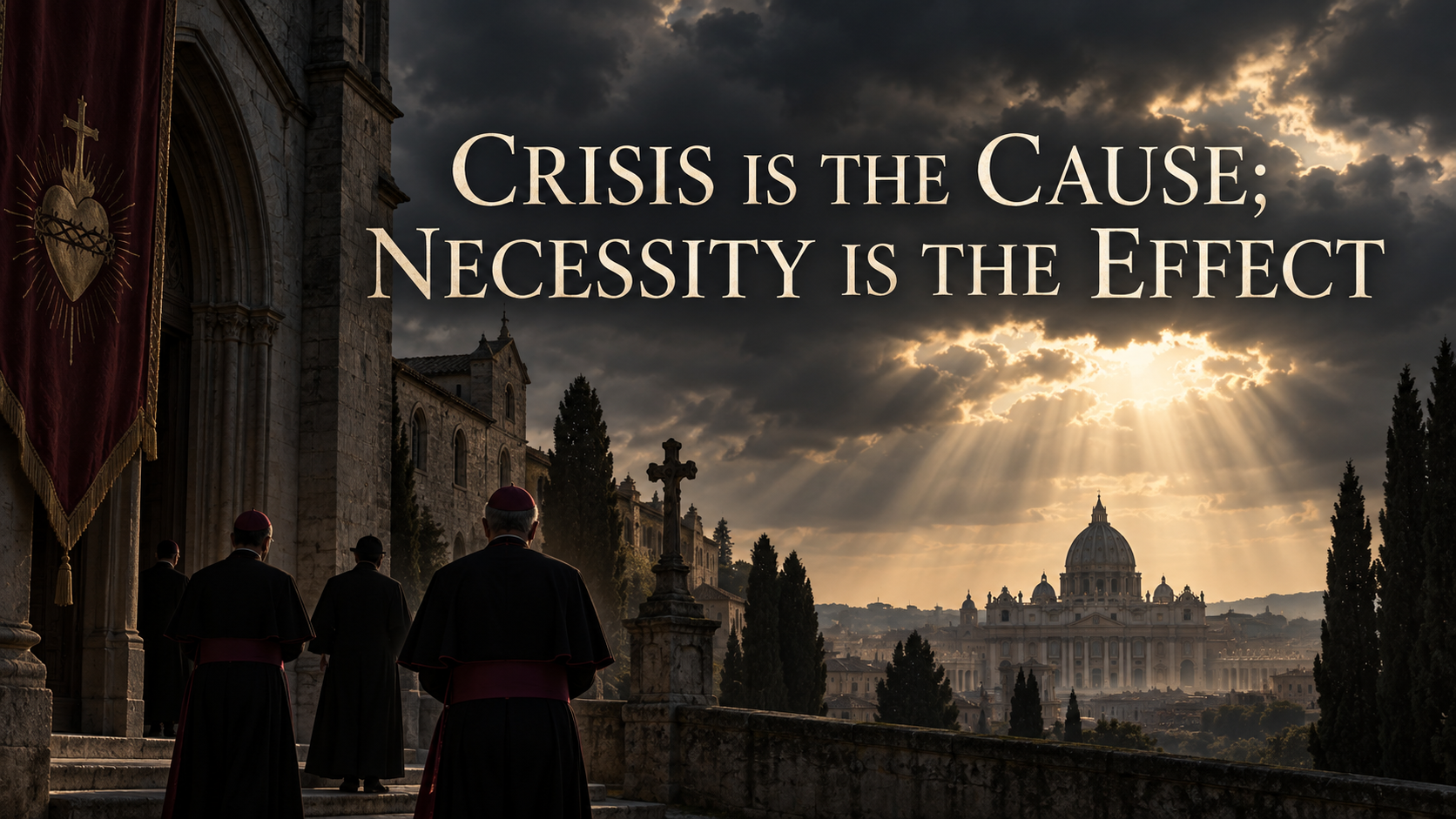
The SSPX has finally clarified the argument beneath Écône. Rome must answer its substance — while Écône must still prove that the remedy it chose was necessary and proportionate.
Michael Haynes has identified an important development in the continuing dispute surrounding the Society of Saint Pius X and the episcopal consecrations carried out at Écône on 1 July. Writing in the Catholic Herald on 5 September, Haynes draws attention to the latest explanation offered by Fr Daniele Di Sorco SSPX of the “state of necessity” upon which the Society has increasingly rested its canonical and moral defence. After months in which the expression has often been repeated more readily than defined, Di Sorco supplies a distinction which materially strengthens the coherence of the SSPX case: **the crisis in the Church is not itself the state of necessity; the crisis is the cause, while necessity is the effect produced when that crisis places the supernatural good of souls in sufficiently grave danger.**¹
That distinction is essential because “there is a crisis” is not, by itself, a canonical argument. The Church has endured immoral popes, corrupt bishops, political domination, doctrinal confusion and widespread clerical failure without every priest or bishop thereby acquiring a private exemption from ecclesiastical authority. What must be demonstrated is something more precise: that the crisis has produced circumstances in which adherence to the ordinary operation of a particular ecclesiastical law would seriously impede the higher supernatural good which that law ordinarily exists to protect. Only then does necessity become morally and juridically relevant.
Di Sorco is therefore attempting to bridge the gap between diagnosis and consequence. A crisis concerns objective disorder in ecclesial life; necessity concerns the danger arising from it. In the present case, the good alleged to be endangered is not institutional convenience, cultural preference or even the survival of the Society as an organisation. The SSPX claims that what is endangered is the preservation and transmission of the Catholic Faith itself, together with sacramental, doctrinal and liturgical conditions capable of securing the salvation of souls.² That is a substantially more serious argument than the caricature that traditional Catholics invoke emergency merely because they cannot find enough celebrations of the Traditional Latin Mass.
Nuntiatoria has consistently treated the controversy at this level. When Fr Davide Pagliarani announced the intended consecrations in February, we argued that the Society’s case would ultimately stand or fall not upon invocations of Archbishop Lefebvre, institutional continuity or traditionalist grievance, but upon whether the claimed necessity could actually be demonstrated. We returned to the same point in May: even where a profound ecclesial crisis exists, it remains necessary to establish that the resulting danger is sufficiently grave, that ordinary remedies are inadequate and that the extraordinary measure proposed is proportionate to the necessity alleged.³
Di Sorco’s latest explanation helps because it places the argument within recognisable Catholic moral and canonical categories. Law exists for the protection of goods. When exceptional circumstances create a conflict between the literal application of a law and the good which that law normally serves, Catholic jurisprudence does not pretend that circumstances are irrelevant. The Code itself reflects this principle. Canons 1323 and 1324 expressly address necessity, grave inconvenience and certain erroneous judgements concerning such circumstances when determining penal responsibility, while canon 1324 §3 provides that where the mitigating circumstances enumerated there are present, an offender is not bound by a latae sententiae penalty.⁴
This does not establish that the 1 July consecrations were justified. It establishes the narrower but indispensable point that the plea of necessity must be examined. Canon 1387 plainly prohibits episcopal consecration without pontifical mandate and attaches a latae sententiae excommunication to the act. But that canon does not abolish the Code’s general principles governing imputability. To cite the offence while refusing to consider the provisions determining culpability and penalty is not a complete canonical analysis.
That has been one of the central conclusions of Nuntiatoria’s reporting since June. An express papal prohibition intensified the objective gravity of proceeding without mandate, but it did not make the remainder of penal law disappear. Likewise, the decree of 2 July could declare a canonical conclusion without thereby eliminating the prior questions concerning necessity, imputability and the actual incurrence of an automatic penalty. The Society’s subsequent recourse therefore properly moved the dispute from denunciation towards adjudication: if necessity is pleaded as a defence, competent authority must assess it rather than assume that identification of the prohibited act settles every juridical question.⁵
Di Sorco’s argument becomes more consequential when he identifies the alleged necessity as primarily doctrinal and spiritual rather than merely liturgical. The Society is not simply claiming that traditional liturgical provision is scarce. Its contention is that the post-conciliar crisis has affected the ordinary transmission of Catholic faith and morals, and that the liturgical reform forms part of that wider problem because worship necessarily expresses and forms belief. The SSPX points particularly to religious liberty, ecumenism, ecclesiology, collegiality, moral theology and subsequent developments of the conciliar programme, together with a liturgical reform which it judges to have weakened the expression of doctrines that the traditional Roman rite manifested more precisely.²
Nuntiatoria’s own reporting has repeatedly encountered evidence which, at minimum, establishes that a profound ecclesial crisis demands explanation. Mass attendance has collapsed across much of the Catholic world. Seminaries, convents and religious houses have emptied or disappeared. Eucharistic belief has weakened dramatically among self-identifying Catholics. Catholic teaching on marriage, sexuality, priesthood and the uniqueness of the Church is publicly contradicted or obscured by clergy who remain canonically regular. Meanwhile, the inherited Roman liturgy has moved from universal possession, to restricted permission, to renewed limitation.
None of this proves every theological conclusion drawn by the SSPX. It does, however, make it impossible to dismiss the crisis as an invention created to rationalise canonical irregularity. Something immense happened to Catholic life in the decades following the Council. The demographic collapse, erosion of belief, transformation of worship and weakening of institutions are observable realities. The serious disagreement concerns their causes, theological meaning and juridical consequences.
This was the importance of our reporting in “Rome Must Name the Doctrine”, which examined the Society’s detailed Profession of Catholic Faith submitted to Pope Leo XIV and the College of Cardinals in June. The significance of that intervention lay in forcing the dispute out of the realm of labels and into the realm of propositions. If Rome maintains that the SSPX’s position is incompatible with Catholic communion, then it should identify the precise doctrinal errors involved and demonstrate the contradiction. Broad demands to “accept Vatican II” or “accept the Magisterium” are insufficient where the dispute concerns specific propositions and their compatibility with previous authoritative teaching.⁶
The same logic applies to liturgy. In “Reverence Cannot Rewrite History — Leo XIV and the Unanswered Question of Liturgical Reform”, we argued that the issue cannot be reduced to whether the Novus Ordo can be celebrated reverently or validly. The historical and theological question is whether the reform corresponded organically to the principles articulated by Sacrosanctum Concilium and whether the resulting liturgical culture adequately transmitted doctrines which the traditional rite expressed with greater density and clarity. Likewise, the evidence examined in “The Five-Point Question Facing Leo XIV”, indicating substantially stronger complete Eucharistic belief among Catholics exclusively attached to the Traditional Latin Mass than among exclusive attendees of the reformed rite in the survey concerned, does not prove the invalidity of the Novus Ordo. It does, however, confirm that liturgical forms and the cultures surrounding them can have measurable consequences for belief.⁷
Di Sorco’s concept of a “common necessity” is particularly significant here. Critics frequently argue that the existence of the Priestly Fraternity of Saint Peter, the Institute of Christ the King Sovereign Priest and similar communities disproves any SSPX claim of necessity. But that objection succeeds only if necessity means that no orthodox or traditional Catholic provision exists anywhere. That is not the argument now being made. If a widespread failure of ordinary provision can be demonstrated, the existence of particular exceptions does not by itself remove the underlying problem.
Our reporting on clandestine episcopal activity in China exposed the same principle from another direction. In “The Bishops in the Shadows: China, Écône, and the Question Rome Cannot Avoid”, underground Catholics were reported to fear that state influence over episcopal structures threatened the integrity of the Faith, with extraordinary episcopal provision discussed in the language of emergency. The circumstances were not identical to Écône, and we were careful not to claim that they were. The relevant point was narrower: Catholic ecclesiology and law do not treat necessity as an alien concept invented by traditionalists. Extraordinary circumstances can obstruct ordinary ecclesiastical provision to such an extent that exceptional action becomes a real theological and juridical question.⁸
Di Sorco nevertheless weakens his case if he treats the canonically regular traditional institutes as though their acceptance of Vatican II or the legitimacy of the reformed liturgy renders them incapable of remedying any aspect of the crisis. An FSSP or ICKSP priest does not become a transmitter of doctrinal error merely because his institute has reached a different judgement concerning its relationship with Rome. These communities have preserved traditional worship, formed priests, taught Catholic doctrine and sustained Catholic families under difficult conditions. Their existence may not disprove a general crisis or even a common necessity, but neither can their genuine ecclesial contribution be dismissed simply because they do not share the SSPX’s canonical position.
This distinction also permits a necessary correction to some of Fr Pagliarani’s earlier language. His February statement that in an ordinary parish the faithful “no longer find the means necessary to ensure their eternal salvation” is too broad if understood literally. If it means that many ordinary parishes no longer reliably provide integral doctrine, sound moral formation and reverent sacramental life, the criticism is supported by considerable evidence. But if it means that the Church’s ordinary parochial structures as such no longer possess the supernatural means of salvation, the proposition becomes ecclesiologically untenable.
Valid Baptism remains Baptism. Valid absolution remains sacramental absolution. A valid Eucharist remains the Body, Blood, Soul and Divinity of Jesus Christ. Faithful priests and bishops remain within the ordinary canonical structures of the Church. The Church has not defected. The recognise-and-resist position therefore cannot explain the present crisis by speaking as though the visible Church had ceased to be a genuine instrument of grace.
The more coherent account is that the present crisis consists in the coexistence of real authority and real disorder. The Pope remains Pope, bishops remain bishops, valid sacraments remain valid and the visible Church remains the Church founded by Christ. Yet legitimate authority can be exercised badly. Office-holders can tolerate error, govern imprudently, promulgate harmful disciplines, speak ambiguously in non-definitive teaching and suppress legitimate traditions. Resistance is meaningful precisely because authority remains real; if authority had vanished, there would be nothing to resist.
Di Sorco’s distinction therefore serves a wider theological purpose. It avoids both practical sedevacantism and ecclesiastical positivism. The existence of crisis does not prove that the hierarchy has ceased to exist, while the existence of legitimate hierarchy does not prove that every exercise of authority is prudent, beneficial or immune from resistance. Necessity does not manufacture ordinary jurisdiction or give individuals an unlimited private licence. It may, however, affect the operation and penal consequences of particular laws where exceptional circumstances threaten the higher good those laws normally serve.
Canon 1752 supplies the governing principle: salus animarum suprema lex — the salvation of souls must always be the supreme law of the Church.⁹ But this principle binds both Rome and Écône. The Society cannot invoke the salvation of souls and thereby excuse itself from proving that the action it adopted was genuinely necessary. Rome cannot invoke obedience and thereby avoid examining whether its own governance has contributed to the danger being alleged.
This leads to the decisive distinction which the latest SSPX explanation clarifies without resolving. The existence of a crisis is one proposition; the existence of a state of necessity arising from that crisis is another; the conclusion that episcopal consecrations without pontifical mandate constituted a necessary and proportionate remedy is a third. They are logically related, but none follows automatically from the previous one.
Écône must therefore demonstrate why episcopal consecration was required in July 2026. It must show why continued waiting or further negotiation would have endangered its sacramental and priestly mission to a degree sufficient to justify proceeding against an express papal prohibition. It must explain what alternative provision was available, why that provision was inadequate, what conditions Rome required, and whether accepting those conditions would genuinely have demanded doctrinal concessions incompatible with the prior Magisterium. A serious defence of necessity becomes stronger, not weaker, when subjected to that examination.
Rome bears an equivalent burden on the other side. If there is no necessity, it should demonstrate why. It should answer the Society’s doctrinal allegations proposition by proposition, explain the compatibility of disputed post-conciliar teaching with the prior Magisterium where contradiction is alleged, address the liturgical and pastoral evidence, and show that adequate episcopal and sacramental provision could have been supplied without requiring doctrinal surrender. Canonical punishment may enforce a prohibition; it cannot by itself answer the theological and pastoral allegations which gave rise to the act being punished.
Haynes is right, therefore, to welcome greater precision in Di Sorco’s explanation and right also to observe that some SSPX public commentary since February has lacked comparable discipline. A case involving episcopal consecration, papal prohibition and excommunication requires exact argument rather than categorical rhetoric. The Society’s strongest case lies in forcing Rome to confront the juridical and doctrinal issues, not in speaking as though those issues have already been conclusively decided in its favour.
Haynes is less persuasive, however, when he suggests that the Society undermines itself by lodging canonical recourse while maintaining that the declared penalty is invalid. There is no necessary contradiction in asking competent authority to correct an act one considers legally defective. The point of recourse is precisely to contest the justice or legality of an administrative decision, and canon 1353 recognises the juridical effect of recourse against decrees imposing or declaring penalties.¹⁰
Indeed, the recourse is ecclesiologically significant because it demonstrates that the Society has not simply declared itself outside Roman judgement. It appealed within the Church’s own canonical system. That does not prove its defence, regularise its status or nullify the decree. It does, however, complicate portrayals of the SSPX as though it operated upon the principle that Roman authority no longer possessed jurisdiction over it.
The latest clarification therefore brings the controversy into sharper focus. The SSPX claims that the post-conciliar crisis has produced a common spiritual necessity because ordinary ecclesiastical structures no longer reliably transmit, across significant portions of the Catholic world, the integral doctrinal, moral and liturgical inheritance they exist to preserve. That proposition is serious and contestable. Its factual scope must be demonstrated, its theological premises examined and its canonical consequences argued. But it cannot honestly be dismissed merely by saying that the Pope said no, that the FSSP exists, or that canon 1387 provides for excommunication. The Church’s own law is more sophisticated than that, and the condition of contemporary Catholicism is more serious than that.
For more than half a century Catholics have watched inherited certainties become qualified into ambiguities, missionary confidence yield to interreligious accommodation, ancient worship become first revised and then restricted, moral absolutes increasingly softened in pastoral practice, seminaries close, religious orders disappear, parishes merge and Eucharistic belief decline. They have seen clergy publicly challenge settled Catholic teaching while remaining institutionally secure, even as Catholics attached to the inherited Roman liturgy are increasingly treated as an ecclesial problem. It is not intellectually credible to say that there is no crisis; it is equally insufficient to say that the existence of crisis automatically justifies whatever measure is adopted in response.
That is why Di Sorco’s formulation should remain at the centre of the debate: the crisis is the cause; necessity is the effect. The sequence matters. First establish the crisis. Then identify the danger it creates. Then demonstrate the existence and extent of necessity. Finally, determine whether the remedy adopted was necessary and proportionate. That sequence protects the Catholic principles at stake on both sides: it refuses to abolish authority in order to explain abuse, but equally refuses to absolutise authority in order to deny abuse.
If there was no genuine necessity, Écône’s justification fails. If necessity existed but episcopal consecration was disproportionate, the defence still fails. But if a grave and common spiritual necessity can be demonstrated, and ordinary authority repeatedly failed to provide a remedy compatible with the preservation of Catholic Tradition, then repetition of the prohibition cannot settle the matter. Rome must answer the substance of the claim, and Écône must prove the necessity of its response.
The law exists for the Church, authority exists for the Faith, and both exist finally for the salvation of souls.
¹ Michael Haynes, “SSPX and the State of Necessity: Clarity at Last?”, Catholic Herald, 5 September 2026.
² Fr Daniele Di Sorco SSPX, “L’état de nécessité invoqué par la FSSPX est-il réel?”, FSSPX Actualités, 2 September 2026, reproducing the interview given to the SSPX District of Italy.
³ Nuntiatoria, “SSPX Announces New Episcopal Consecrations: Necessity, Continuity, and an Unresolved Ecclesial Fault Line,” 2 February 2026; “Consecration and Conscience: The SSPX, Fr Pagliarani, and the Persistence of Necessity,” 22 May 2026.
⁴ Code of Canon Law, canons 1323–1324.
⁵ Nuntiatoria, “The Pope Said No: Why That Does Not End the SSPX Debate,” 26 June 2026; “Roma Locuta Est, Causa Finita Est? The Decree, the Note and the Papalism That Swallowed the Law,” 7 July 2026; “The Verdict Before the Hearing,” 17 July 2026.
⁶ Nuntiatoria, “Rome Must Name the Doctrine,” 26 June 2026.
⁷ Nuntiatoria, “Reverence Cannot Rewrite History — Leo XIV and the Unanswered Question of Liturgical Reform,” 17 August 2026; “The Five-Point Question Facing Leo XIV,” 28 August 2026.
⁸ Nuntiatoria, “The Bishops in the Shadows: China, Écône, and the Question Rome Cannot Avoid,” 28 August 2026.
⁹ Code of Canon Law, canon 1752.
¹⁰ Code of Canon Law, canon 1353; FSSPX General House, communiqué concerning the Society’s recourse against the decree of 2 July 2026.


Leave a Reply