

What Lefebvre Voted For — and What He Did Not: Larry Chapp, Sacrosanctum Concilium, and the History Hidden Inside a Familiar Argument

Larry Chapp has again entered the liturgical controversy by “calling out” Peter Kwasniewski by name. There is much in his post that could detain us, but one assertion deserves particular attention because it has become almost axiomatic among conservative defenders of the post-conciliar settlement. “Let’s go back,” Chapp writes, “to the days of liturgies so poorly done that the vast vast vast majority of preconciliar bishops knew it needed reform. Even Lefebvre voted for Sacrosanctum Concilium. Regardless of the liturgical reform we actually got, the fact remains that Sacrosanctum called for a reform of the liturgy and Lefebvre voted in favor of that.”
The last sentence is perfectly true. Archbishop Marcel Lefebvre voted for Sacrosanctum Concilium. The Constitution called for liturgical reform. Lefebvre therefore voted for liturgical reform. Peter Kwasniewski need not deny it; nor need I; nor does any serious traditionalist historian. The weakness in Chapp’s argument begins precisely where that uncontroversial fact is made to carry more weight than it can bear. Nobody is disputing whether Lefebvre voted for a reform. The dispute is over what reform the Fathers thought they were authorising, what the Constitution actually prescribed, what was said to them while they debated it, and whether the liturgical order assembled in the years afterwards can simply be identified with what they had voted to do. Chapp himself inserts the revealing qualification, “regardless of the liturgical reform we actually got.” But the reform we actually got is not an incidental detail. It is the entire point at issue.
The first problem with the received history is the claim that the bishops entered Vatican II clamouring for extensive reconstruction because the inherited liturgy was widely recognised as pastorally exhausted. There certainly were bishops who wanted reform; there were badly celebrated Masses; there were Low Mass cultures in which congregational participation could be poor; there were legitimate questions about duplication, the intelligibility of certain rites, the distribution of Scripture, the participation of the faithful and the extent to which the aspirations of the Liturgical Movement might prudently be incorporated into ordinary parish worship. None of that establishes the proposition Chapp needs. Matthew Hazell’s research into the vota submitted during the ante-preparatory period is valuable precisely because it allows us to move away from retrospective narratives and ask what the future Council Fathers themselves actually requested when invited by Rome to identify the matters a council ought to address. His detailed study of proposals concerning the Mass lectionary reveals desires for enlargement and adjustment, but nothing resembling an episcopal mandate to abolish the inherited Roman cursus and construct the radically different system eventually promulgated after the Council. Some proposals even envisaged retaining the traditional cycle within an enlarged arrangement. The significant fact is not that no bishop wanted anything changed; it is that the documentary record does not disclose an episcopate demanding anything remotely comparable in scale to the reconstruction eventually undertaken.¹
That distinction immediately clears away another caricature. The traditionalist objection is not that the Roman Rite fell from Heaven complete in 1570 and thereafter became metaphysically incapable of alteration. It had developed for centuries before St Pius V, and it continued to develop afterwards. The history is there in the books themselves. The question is what constitutes development. Sacrosanctum Concilium supplied its own answer, and its language is considerably more restrictive than the subsequent history might lead an uninformed reader to expect. “There must be no innovations,” it says, “unless the good of the Church genuinely and certainly requires them”; even then, care must be taken that “any new forms adopted should in some way grow organically from forms already existing.”² That is not the vocabulary of permanent experimentation. It places the burden of proof upon the innovator, requires genuine and certain ecclesial benefit, and insists upon organic relation between what is inherited and what is introduced.
Read the Constitution itself without mentally supplying the parish liturgy of 1975 and the disparity becomes more striking. The Council did not abolish Latin; it decreed that “the use of the Latin language is to be preserved in the Latin rites.” It allowed a wider place for the vernacular, particularly in readings and specified parts, while expressly requiring that steps be taken so that the faithful should nevertheless be able to say or sing together in Latin the parts of the Ordinary belonging to them. It did not marginalise Gregorian chant; it declared chant “specially suited to the Roman liturgy” and said that, other things being equal, it should have “pride of place.”² The Constitution did not command celebration versus populum. It said nothing about Communion in the hand. It did not instruct the reformers to make the Roman Canon one Eucharistic Prayer among several. It did not abolish Septuagesima, the old Pentecost octave, the ancient Sunday cursus, Ember Days or Rogations. It did not command the replacement of the traditional offertory. One may defend some or all of those later developments; one may not transfer them retrospectively into the minds of the bishops who voted on 4 December 1963.
This is where the vote of Archbishop Lefebvre becomes interesting rather than embarrassing. Chapp invokes it as though the fact settles the argument. In reality it raises the question he leaves unanswered. Lefebvre had not reached Vatican II believing every liturgical reform intrinsically suspect. He accepted reform in principle. He was not campaigning in 1962 for a universal return to the books as they stood before Pius XII. His subsequent resistance therefore cannot be explained by pretending that a man who always believed liturgy incapable of reform accidentally voted for a reforming Constitution and afterwards recovered his senses. What requires explanation is how a bishop prepared to vote for measured reform in 1963 became, within little more than a decade, the best-known episcopal opponent of the reform that had actually emerged.
Lefebvre himself supplied the answer, and his testimony deserves a much more prominent place in this discussion than it ordinarily receives. In a conference delivered at Montreal in 1982, Lefebvre recalled the period immediately following the Council when, as Superior General of the Holy Ghost Fathers, he attended a meeting in Rome of eighty-four Superiors General. They had asked Annibale Bugnini to explain the projected Missa Normativa. The first words of Lefebvre’s recollection are extraordinarily revealing: the “Normative Mass,” the “New Mass,” the Novus Ordo, was suddenly being spoken about after the Council, yet, he said, **“It had not been spoken of at the Council. What had happened?”**³
That question is more damaging to Chapp’s argument than any retrospective traditionalist reconstruction could be, because it comes from the very man whose conciliar vote Chapp invokes against Kwasniewski. Lefebvre did not say, “I never voted for reform.” His testimony amounts to something much more interesting: I voted at the Council, and now something called a Normative Mass is being presented to us which I do not recognise as something we discussed there.
According to Lefebvre’s account, Bugnini then began describing what the projected rite would entail: changes here and there, “another Offertory,” reduced Communion prayers, alternative forms for the beginning of Mass and celebration in the vernacular. Lefebvre remembered the assembled superiors looking at one another in disbelief; he himself, normally anything but reticent in disagreement, said he was so stunned that he remained silent.³ This is Lefebvre’s recollection, delivered years after the event, and it should be presented as such rather than falsely elevated into a stenographic transcript. But as evidence of Lefebvre’s own understanding of the relationship between what he had voted for and what he subsequently encountered, it could hardly be clearer.
The sequence continued. When the Missa Normativa began to be put into practice, Lefebvre said that his alarm led him into discussions with priests and theologians connected with what became the Brief Critical Study of the New Order of Mass, subsequently presented to Paul VI under the names of Cardinals Ottaviani and Bacci.³ Again, one should not make this testimony carry more than it can. It does not settle every question about the drafting history of the Brief Critical Study. It does establish the trajectory Lefebvre himself remembered: conciliar reform accepted; post-conciliar construction encountered; alarm; resistance.
Later in the same conference Lefebvre reduced the matter to a sentence: “Ultimately it has always been a question of the Mass, right from the beginning.” He immediately added that it could not simply be said that he was “against the Council”; he distinguished particular conciliar texts he opposed from the broader event itself.³ Whatever judgment one makes about Lefebvre’s assessment of those other texts, this is highly relevant to the present controversy. His self-understanding was not that of a bishop who rejected Vatican II because Vatican II dared to propose liturgical reform. It was that of a bishop who believed the concrete liturgical revolution had travelled beyond what had been put before the Fathers.
That turns Chapp’s favourite fact on its head. Lefebvre’s vote for Sacrosanctum Concilium is not evidence that the later reform answered his intentions; Lefebvre’s own testimony is evidence that he believed it did not.
Nor were conservative expectations confined to Lefebvre. The history of the Council debates shows Fathers concerned about where particular provisions might lead and reassurances being given in response. The controversy surrounding the Roman Canon is especially revealing. Whatever language one uses to characterise those exchanges, the historically important point is narrower and safer: bishops voted under expectations concerning the continuity of the Roman Canon and inherited structure of the Mass considerably more conservative than the normal arrangements of only a few years later. Their vote cannot responsibly be interpreted as though the later outcome had already been displayed before them in finished form.⁴
The fate of the pre-conciliar citations in successive drafts of Sacrosanctum Concilium is similarly worth attention. Earlier drafts contained considerably more explicit references to preceding papal liturgical teaching, especially Pius XII’s Mediator Dei. The disappearance of numerous such citations from the final textual apparatus does not prove a conspiracy, and the case is weakened rather than strengthened when unnecessary claims about motive are attached to it. But citations are not meaningless decoration. They provide an interpretative setting. A Constitution repeatedly tethered in its notes to Mediator Dei, Tra le sollecitudini, Divini cultus and Musicae sacrae disciplina would have advertised in a visible way the continuity within which its reforming provisions were to be read. Their removal did not repudiate those documents; it did make that particular interpretative tether less visible.⁵
Then there is the scale of what eventually happened. Consider only the orations. The much-repeated claim that “87 per cent” of them were altered or removed has sometimes been quoted too casually, because percentages vary according to whether one is counting unchanged prayers, altered prayers, transpositions, newly composed texts or material brought in from other sources. Hazell’s comparative work nevertheless leaves the essential historical point untouched: the euchological corpus of the new Missal was subjected to extensive editorial reconstruction. This was not simply the ancient Roman collection with a few infelicities corrected and duplications removed. The degree of alteration was vast.⁶
The same point applies in different ways to the lectionary, calendar, offertory and Eucharistic Prayer. Sacrosanctum Concilium certainly asked that the treasures of Scripture be opened more lavishly. It did not prescribe the particular three-year Sunday and two-year weekday lectionaries subsequently created. It authorised revision of the Ordo Missae; it did not discuss Eucharistic Prayers II, III and IV, because they were not before the Fathers. It called for simplification and, where useful, the restoration of things lost through historical accident. It did not specify the disappearance of Septuagesima or the ancient octave of Pentecost. These observations do not by themselves establish the illegitimacy of every later development. They establish something more elementary, and fatal to the lazy argument: the bishops who voted for the Constitution did not thereby vote upon the detailed liturgical settlement eventually produced.
Joseph Ratzinger understood this distinction, which is why his 1976 judgment remains so awkward for anyone trying to dispose of the question by invoking Lefebvre’s vote. Writing to Wolfgang Waldstein, Ratzinger distinguished the Missal associated with St Pius V from the manner in which the new Missal had been produced and introduced. Pius V, in his account, did not manufacture a new rite but regulated an existing Roman Missal within a continuous liturgical history. The difficulty with the new Missal lay precisely in the appearance of an “entirely new book,” albeit assembled substantially from older material, accompanied by an attempted exclusion of what preceded it. Most pertinent of all, Ratzinger said that, from his knowledge of the Council debates and his rereading of the Fathers’ interventions, he could state with certainty that this outcome had not been intended by them.⁷
Ratzinger cannot conveniently be dismissed as an Écône polemicist. He had been a theological expert at Vatican II and belonged intellectually to the world from which much of the Council’s reforming energy emerged. He never denied the validity of the reformed Mass and celebrated it himself. Yet he also became the most distinguished theological critic of the notion that liturgy could be constructed by committee in the manner of a manufactured product. His criticism was not that Popes possess no authority over liturgical discipline, still less that rites must be archaeologically frozen. It was that authority receives a liturgical inheritance before it regulates it. Authority is stewardship before it is authorship.
This also exposes the weakness in Chapp’s accusation that Kwasniewski treats the traditional Mass as an “untouchable platonic form of liturgical perfection”. Kwasniewski’s point is not properly Platonic at all. His analogy to Aristotelian teleology is the better one. Living liturgical traditions have ends. They develop vigorously while their fundamental forms are being established, and they naturally acquire greater stability as they mature. The fact that the Roman Rite was not absolutely identical in the sixth, eleventh and sixteenth centuries does not imply that the degree of permissible reconstruction remains forever the same. A child’s body changes radically on its way to maturity. Nobody concludes that the healthy seventy-year-old should therefore have his skeleton rearranged every decade to demonstrate that he remains alive.
St Thomas understood the analogous problem in law. Human laws ought not to be changed whenever an improvement can be imagined because settled custom itself contributes to their force. Alteration carries a cost: habits are disturbed and goods accumulated under the existing order can be lost. The proposed benefit must therefore justify the damage caused by change.⁸ Applied to liturgy, the principle is obvious. A rite is not merely a collection of propositions to be optimised. It creates memory. The traditional Catholic year once possessed a density of observance in which Septuagesima prepared the faithful for Lent, Ember Days sanctified the seasons and surrounded ordinations, Rogations joined public prayer to locality and harvest, vigils taught anticipation through penance, octaves taught the faithful to dwell within a mystery, Friday abstinence marked every ordinary week, and recurring propers and Gospel pericopes formed instincts even among Catholics incapable of articulating a theory of liturgical theology. Alter enough of that ecology at once and one changes more than texts.
Newman had seen the analogous danger long before Vatican II. Writing in the Anglican context of the Tracts for the Times, he warned against assuming that apparently small liturgical alterations remained merely small. Changes could carry principles larger than themselves, and once alteration became habitual the appetite for further alteration could acquire momentum of its own.⁹ The observation has an uncomfortable applicability to the Roman experience because the post-conciliar transformation did not arrive in one dramatic package. Rubrics changed, vernacular permissions widened, ceremonies were simplified, altars altered, permissions granted, experiments tolerated or regularised, episcopal conferences and national commissions acquired increasing influence. A bishop did not go to bed with the 1962 Missal and wake the following morning facing the complete liturgical world of 1970. He travelled through years of cumulative alteration before the destination became fully visible.
This also helps explain why episcopal compliance after the Council proves much less than is sometimes supposed. The bishops were largely formed under Pius XI and Pius XII in an ecclesiastical culture of profound Roman obedience. Once reforms came with Roman authority, resistance was psychologically and ecclesiologically difficult to imagine. The ordinary diocesan bishop did not normally conceive himself as commissioned to adjudicate afresh whether each reform represented sound organic development. What came officially from Rome, or through structures acting with Roman approval, was implemented. It is one of the stranger ironies of the present controversy that an episcopate now cited as proof of enthusiasm for radical reform was also precisely the sort of episcopate least culturally disposed to tell Rome, once the machinery was moving: No. This has gone too far.
It is here that Lefebvre becomes historically exceptional. One need not endorse every subsequent judgment he made. Nor should he be recruited retrospectively into the contemporary pre-1955 movement. Lefebvre continued to use the 1962 books and did not make repudiation of the Pius XII and John XXIII reforms the foundation of his resistance. Kwasniewski goes further than Lefebvre on that question. But that difference makes Lefebvre’s witness stronger, not weaker. A bishop already sympathetic to moderate reform, prepared to accept authorised changes and willing to sign the Council’s liturgical Constitution eventually concluded that the process had crossed a boundary. He did not begin with an absolute refusal of reform. He arrived at resistance by watching reform unfold.
Alcuin Reid’s survey of surviving Council Fathers is useful precisely because it does not produce a conveniently uniform traditionalist answer. Some respondents regarded the reform as faithful to Sacrosanctum Concilium; others expressed serious reservations. Reid wrote in 1996 to approximately five hundred surviving Fathers and received sixty-two replies. The result destroys both simplistic narratives. It does not prove that the Council Fathers secretly opposed everything later done, but neither does it permit their 1963 vote to be treated as a collective retrospective endorsement of the Missal of 1970. Archbishop Spanedda, despite his broadly favourable judgment, acknowledged that the individual innovations were certainly not all explicitly present in the minds and wishes of the Fathers.¹⁰
Archbishop Robert Joseph Dwyer, who participated in all four sessions, later gave voice to the astonishment felt by at least some of those Fathers. Looking back upon the disappearance of the Latin liturgical world, he wrote that had the bishops been told on the day they voted for the Constitution that within a few years the Latin past of the Church would be all but expunged, “the thought of it would have horrified us.”¹¹ His evidence does not establish what every bishop thought. It establishes something Chapp’s rhetoric cannot accommodate: a Council Father could vote for Sacrosanctum Concilium and later believe that the liturgical transformation effected in its wake was something he never imagined he had authorised.
Lefebvre’s 1982 testimony belongs beside Dwyer and Ratzinger. Dwyer remembered an outcome that would have horrified him. Ratzinger judged that the manner in which the new Missal replaced the old was not the Fathers’ intention. Lefebvre remembered sitting among eighty-four Superiors General while Bugnini explained a projected Normative Mass and thinking: **“It had not been spoken of at the Council. What had happened?”**³
What, exactly, is Chapp’s invocation of Lefebvre’s vote supposed to prove against that?
His descent from historical argument to “massa damnata Catholicism”, “Hell fire and Latin” is still less persuasive. Beneath the sneer is a pastoral theory that should, after six decades, be judged by something more substantial than tone. Traditional liturgy, Latin, moral severity, fasting, judgment and a thick devotional culture were supposedly obstacles to evangelising modern man. Worship needed to become more comprehensible, more immediate, less hieratic, less culturally alien, less demanding. Whatever theological nuances accompanied that programme, it was subjected to an empirical test on a scale few pastoral theories ever enjoy.
The results do not justify triumphalism.
Guillaume Cuchet’s study of the collapse of French Catholic practice, drawing upon the remarkable statistical archive of Canon Fernand Boulard, places the decisive décrochage around 1965. Cuchet does not indulge the crude thesis that changing the liturgy on Monday emptied the churches on Tuesday; neither should we. Social secularisation, affluence, changing family structures and the sexual revolution all form part of the picture. But Cuchet does regard the Church’s own abrupt alteration of its system of obligations, sacramental habits and devotional culture as relevant to the speed and character of the collapse.¹² The opposite claim—that the Church could simultaneously dismantle much of the religious ecosystem by which Catholics had been formed and yet have exercised no influence whatever upon Catholic practice—would itself require rather more faith than sociology.
The recent French monastic figures make Chapp’s joke about Latin particularly ill-chosen. Research reported this summer concerning the fate of contemplative monasteries since 2007 indicates closure rates markedly higher among French-only houses than among those retaining Latin, with none of the small exclusively Latin cohort recorded as having closed.¹³ The sample is too small, and the variables too numerous, to establish that Latin causes flourishing. Latin will often be a proxy for something larger: stricter observance, stronger institutional identity, younger vocations, traditional habit, common discipline and a more definite theology of religious life. That qualification is not an embarrassment. It is almost exactly the traditionalist point. Liturgical forms are not isolated aesthetic preferences; they belong to an ecology.
Perhaps there is something to this Latin business after all.
The phenomenon among young traditional Catholics makes the old explanation even less satisfactory. A Catholic born in 2000 cannot properly be nostalgic for parish life under Pius XII. His parents may themselves have no memory of it. Such Catholics encounter chant, eastward worship, silence, the traditional propers, fasting and the old calendar not as recollections but discoveries. Some will leave; some are drawn first by aesthetics; traditional communities contain the same human follies as every other community. Yet sufficient numbers remain, marry, raise children, travel significant distances for Mass, learn chant, enter seminaries and religious houses and embrace moral teachings radically at odds with contemporary culture that “nostalgia” has become an evasion rather than an explanation.
Chapp’s own preference for the Anglican Ordinariate makes “Hell fire and Latin” more curious still. The Ordinariate exists upon a principle traditionalists understand instinctively: patrimony matters. Words matter. Music matters. Ritual memory matters. A liturgical culture can carry doctrine and shape identity in ways not reducible to bare sacramental validity or the orthodoxy of isolated texts. If Anglican cadences, ceremonial forms and musical inheritance may legitimately be treasured because Christians are formed through inherited worship, it is difficult to see why precisely the same insight becomes pathological when Roman Catholics apply it to their own received patrimony.
What, then, remains of Chapp’s original point? Lefebvre voted for Sacrosanctum Concilium. Yes. He voted for reform. Yes. Many bishops wanted reform. Certainly. The inherited liturgy was not always celebrated well. Obviously. There were reforms that could prudently have been made. Again, yes.
None of that answers the question.
The real questions begin where Chapp stops. What sort of reform did the bishops actually request before the Council? What did the Constitution itself say should remain? What anxieties were raised during its drafting, and what assurances answered them? Why does Sacrosanctum Concilium require Latin to be preserved and chant to have pride of place if their near disappearance from ordinary parish worship is supposed to be its uncomplicated fulfilment? What does “organic growth” mean if the inherited lectionary, offertory, calendar and euchological corpus may be subjected to extensive reconstruction within a few years? Why did Council Fathers later say that developments had occurred which they had not envisaged? Why did Ratzinger say the manner in which the new Missal displaced the old had not been intended? Why did Lefebvre himself remember his first presentation of the Missa Normativa by asking what had happened, since such a thing “had not been spoken of at the Council”?
Chapp has, in fact, conceded the logical point in his own sentence: “Regardless of the liturgical reform we actually got.” Once the reform actually got is distinguished from the reform Lefebvre actually voted for, the vote cannot possibly establish Lefebvre’s approval of the former. The historical inquiry must then measure the distance between the two.
That distance is the argument.
It is also why Lefebvre’s resistance remains significant far beyond the SSPX. One can dispute Écône, the 1988 consecrations, his canonical reasoning and any number of prudential judgments without denying the historical consequence of his refusal. The older Roman Rite survived as a living public liturgy through years when its extinction was widely assumed to be merely a matter of time. Communities later erected in full canonical communion with Rome inherited a patrimony whose survival was inseparable from the priests and faithful who had refused to abandon it. Traditional Catholics who strongly criticise Lefebvre nevertheless inhabit a liturgical landscape altered by the fact that he said no.
The conventional story was wonderfully simple. The old liturgy had failed. The bishops knew it. Vatican II ordered reform. The reformers carried out Vatican II. Lefebvre opposed the reform because he opposed the Council. Modernised liturgy would evangelise modern man. Traditionalism would die naturally with the generation that remembered the old Church.
Almost every proposition now requires qualification.
The bishops’ own vota disclose aspirations generally more modest than the reconstruction eventually undertaken. Sacrosanctum Concilium sounds markedly more traditional than the parish liturgical culture routinely attributed to it. The detailed reforms were neither debated nor voted upon individually by the Fathers. Some participants later expressed astonishment or regret. Ratzinger distinguished what the Council had intended from what actually happened. Lefebvre had voted for reform before resisting the form it eventually assumed. And the supposedly moribund old liturgy is now attracting Catholics born decades after anyone could plausibly attribute their interest to memories of the 1950s.
So by all means let us say that Archbishop Lefebvre voted for Sacrosanctum Concilium. Let us put it in bold type.
But let us finish the sentence.
Lefebvre voted for a Constitution which said Latin was to be preserved; that Gregorian chant was to enjoy pride of place; that there should be no innovations unless the good of the Church genuinely and certainly required them; and that new forms were to grow organically from forms already existing. He did not vote upon Eucharistic Prayers that had not yet been written, a reconstructed offertory that was not before him, a new lectionary he had never seen, the practical disappearance of Latin, Communion in the hand, the ordinary adoption of versus populum, the suppression of Septuagesima, or the eventual marginalisation of the very liturgical books in which every Latin bishop sitting in St Peter’s had himself been formed.
That is not polemic. It is chronology.
And Lefebvre himself told us what happened when he first encountered the next stage. Sitting among eighty-four Superiors General while Bugnini explained his projected Missa Normativa, his question was not why the Council had authorised a reform. He knew perfectly well that it had.
His question was much more dangerous:
“It had not been spoken of at the Council. What had happened?”³
That is the question Chapp’s “Lefebvre voted for Sacrosanctum Concilium” cannot answer.
It is not the conclusion of this controversy.
It is where the serious history begins.
¹ Matthew P. Hazell, “The Spirit of Liturgical Reform and the Vota of the Fathers of Vatican II on the Lectionary for Mass,” study of the ante-preparatory vota and proposals concerning reform of the Mass lectionary.
² Second Vatican Council, Constitution on the Sacred Liturgy Sacrosanctum Concilium, 4 December 1963, nn. 23, 36, 54, 116.
³ Archbishop Marcel Lefebvre, “The Infiltration of Modernism in the Church,” conference delivered at Montreal, Canada, 1982, especially his account, as former Superior General of the Holy Ghost Fathers, of the meeting of eighty-four Superiors General with Annibale Bugnini, his recollections concerning the projected Missa Normativa, and his later remarks concerning the centrality of the Mass to his dispute with the post-conciliar reforms.
⁴ Peter Kwasniewski, “The Lie That Was Told to Over 2,000 Council Fathers at Vatican II: What They Requested, What They Expected, and What Happened: Council Fathers on the Latin Roman Canon,” New Liturgical Movement, 27 May 2024, with the conciliar sources cited therein.
⁵ Susan Benofy, “Footnotes for a Hermeneutic of Continuity: Sacrosanctum Concilium’s Vanishing Citations,” Adoremus Bulletin, September 2024, together with the accompanying documentary comparison of citations removed during the final revision; Pius XII, Mediator Dei, 20 November 1947.
⁶ Matthew P. Hazell, “‘All the Elements of the Roman Rite’? Mythbusting, Part II,” New Liturgical Movement, 1 October 2021; Matthew P. Hazell, The Proper of Time in the Post-Vatican II Liturgical Reforms, Lectionary Study Press, 2018.
⁷ Joseph Ratzinger, letter to Wolfgang Waldstein, 14 December 1976, subsequently published in connection with discussion of the Roman Missal and later reproduced in studies of Ratzinger’s liturgical theology.
⁸ St Thomas Aquinas, Summa Theologiae, I–II, q. 97, a. 2.
⁹ John Henry Newman, “Thoughts Respectfully Addressed to the Clergy on Alterations in the Liturgy,” Tracts for the Times, Tract 3, 1833.
¹⁰ Alcuin Reid, “The Fathers of Vatican II and the Revised Mass: Results of a Survey,” Antiphon: A Journal for Liturgical Renewal, vol. 10, no. 2, pp. 170–190.
¹¹ Robert Joseph Dwyer, “Ten Years That Shook the Church,” 1973, and his retrospective observations concerning Vatican II and the post-conciliar liturgical reform.
¹² Guillaume Cuchet, Comment notre monde a cessé d’être chrétien: Anatomie d’un effondrement, Paris: Seuil, 2018, especially his analysis of the French Catholic décrochage around 1965 based upon the pastoral sociology of Canon Fernand Boulard.
¹³ Isabelle Jonveaux, research on French contemplative monasteries between 2007 and 2026, reported July 2026, concerning monastery closures and differing survival rates among communities according to their use of French and Latin in the Divine Office.
RELATED ARTiCLES


LATEST ARTICLES
- Today’s Mass: September 30 St Jerome of BethlehemSaint Jerome, born in Dalmatia in 329, was a prominent Doctor of the Church, known for his scripture translations and contributions to Catholic teachings. He emphasised monastic life and the Divine Office. Jerome died in Bethlehem on 30 September 420. Today also marks the name day of His Grace, Jerome OSJV of Selsey.
- Sermon for St. JeromeSt. Jerome, born around 342, was a pivotal biblical scholar and translator whose work established the Vulgate as the standard Latin Bible. His life reflected the tensions of early Christianity, as he struggled with controversies while advocating for orthodoxy. Jerome’s rich education and transformation from a pagan scholar to a Christian hermit marked his enduring legacy in the Church. He died in 420.
- Veritas non mutatur consensu ~ Truth is not altered by agreement: Spiritual Conference for Nuntiatoria CXXVThe text explores the theme of enduring truth amidst changing societal values, particularly within the Catholic faith. It emphasises that truth remains unchanged irrespective of popular opinion or individual feelings, urging believers to receive and embody divine teachings faithfully. The article concludes with a call to act upon this truth in daily life and relationships.
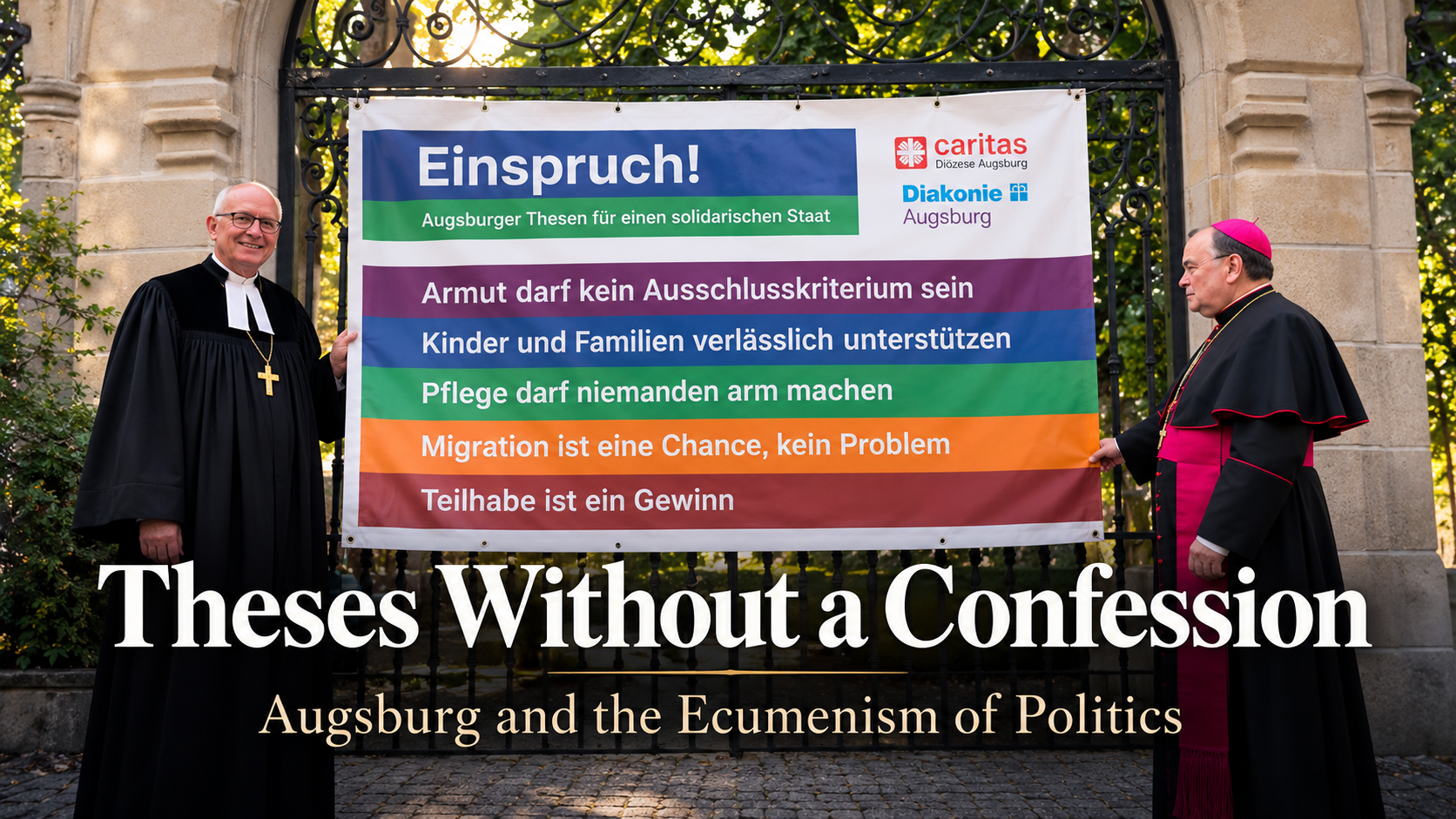
- Theses Without a Confession: Augsburg and the Ecumenism of PoliticsIn Augsburg, Catholic and Lutheran leaders have symbolically reposted theses on social issues like poverty and migration, reflecting Christian social teaching. This event highlights a growing divide where churches confidently address social policies while unresolved doctrinal differences remain. Cooperation on such issues is valuable but should not replace the pursuit of true Christian unity.
- Quis ut Deus? Michaelmas and the Order of HeavenThe Dedication of Saint Michael, celebrated on 29 September, highlights the Archangel’s role within divine order, illustrating humility and obedience before God. Rooted in ancient Roman traditions, the feast contrasts human pride with the recognition of God’s sovereignty. It underlines the importance of worship that connects earthly life to heavenly realities, centering around God’s presence.
CURRENT EDITION


Today’s Mass Propers
- Today’s Mass: September 30 St Jerome of Bethlehem
 Saint Jerome, born in Dalmatia in 329, was a prominent Doctor of the Church, known for his scripture translations and contributions to Catholic teachings. He emphasised monastic life and the Divine Office. Jerome died in Bethlehem on 30 September 420. Today also marks the name day of His Grace, Jerome OSJV of Selsey.

Leave a Reply