
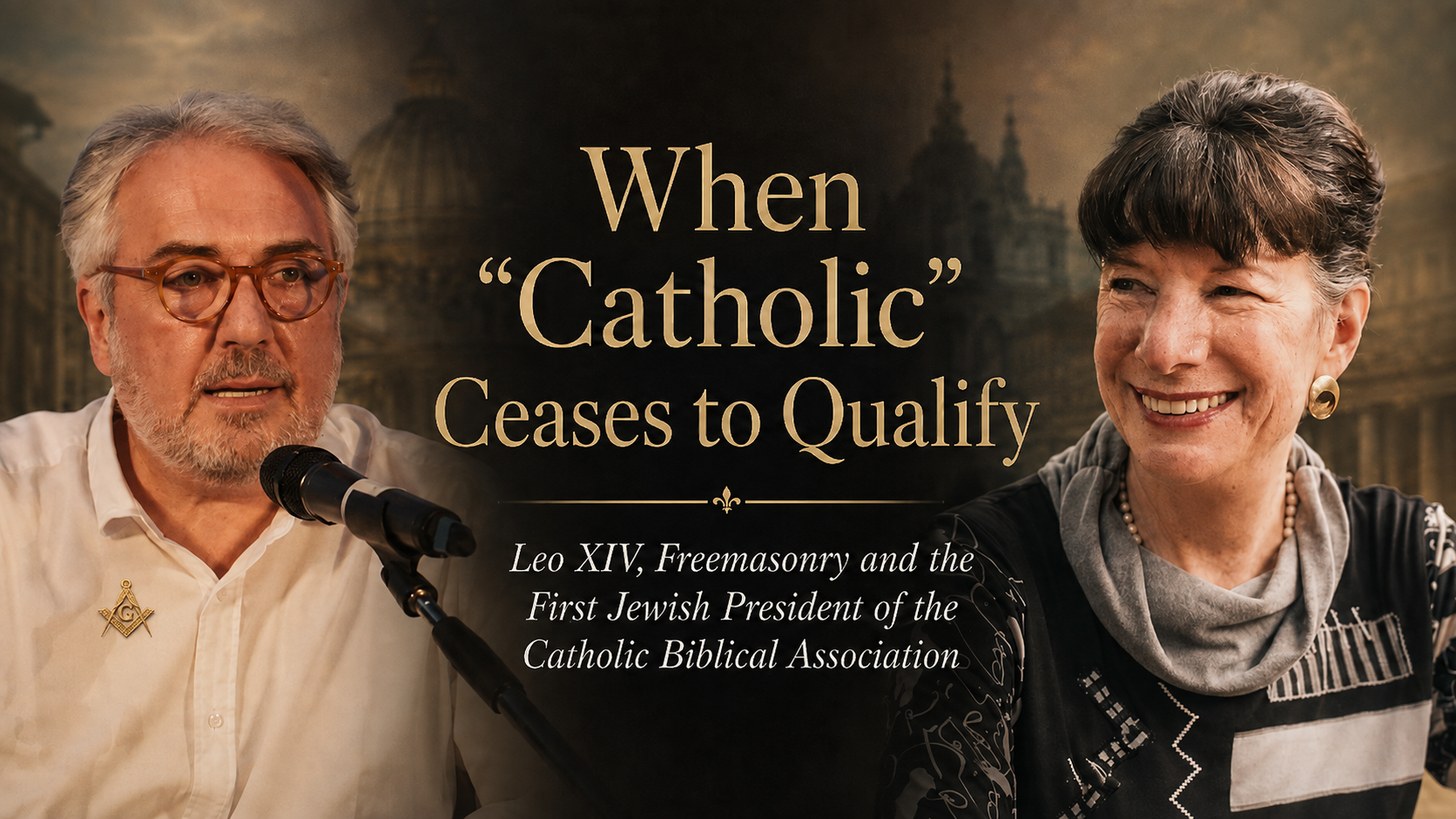
When “Catholic” Ceases to Qualify: Leo XIV, Freemasonry and the First Jewish President of the Catholic Biblical Association
Two appointments, different in character but striking in conjunction, raise the same uncomfortable question. Pope Leo XIV has appointed Professor Umberto Longo to the Pontifical Committee for Historical Sciences, while Longo’s name appears in a substantial documentary trail connecting him with Italian Freemasonry. In the United States, meanwhile, the Catholic Biblical Association has elected Professor Amy-Jill Levine, a Jewish scholar of the New Testament, as its president. The cases are not ecclesiastically equivalent. But together they raise a question Catholic institutions increasingly seem reluctant to answer: when an institution calls itself Catholic or pontifical, does Catholic identity still impose any meaningful qualification upon those chosen to represent it?

There are stories which become more revealing when placed beside one another. On 13 August Pope Leo XIV appointed Professor Umberto Longo, director of the Italian Historical Institute for the Middle Ages, as a member of the Pontifical Committee for Historical Sciences.¹ Only days earlier the Catholic Biblical Association of America had announced that Professor Amy-Jill Levine had been elected its president for 2026–27, making her the first Jewish president in the Association’s history.² The first is a papal appointment to an institution of the Holy See; the second an election by the members of a scholarly association. They must not be confused. Yet both expose an increasingly familiar uncertainty about what institutional Catholic identity is actually supposed to require.
The case of Professor Longo demands particular attention because the evidence connecting his name with Freemasonry is not merely the product of hostile blogs or anonymous speculation. An official publication of the Grande Oriente d’Italia reported a first-degree ritual meeting held at the Masonic House in Rome in March 2013. It described the gathering as attended by numerous Masonic brethren and specifically named Umberto Longo among the Maestri Venerabili — Worshipful Masters — present.³ That is rather different from discovering that an academic once attended an open conference at which Freemasons happened also to be present.
Nor does the documentary trail end there. In July 2014 the Grande Oriente d’Italia advertised an address by Umberto Longo during its Luglio Scozzese, devoted to the “dynamic path of perfection of the Scottish Knights,” tradition, rituality, regeneration and universality.⁴ The following year the journal Logos, published within the Italian Ancient and Accepted Scottish Rite, carried an article entitled La piramide rituale scozzese, signed “Fr. U. Longo 9°”. Its author writes not as a detached historian describing Masonic ritual from outside but in participatory terms, speaking of what “we” undergo in fourth-degree ritual and of the journey of “Masons and Scots.”⁵
The evidence must nevertheless be described precisely. These records establish a substantial documentary history concerning an Umberto Longo within Italian Masonic and Scottish-Rite circles. They do not, by themselves, prove current Masonic membership in August 2026. But the identification becomes considerably harder to dismiss when later public activity explicitly names Professor Umberto Longo of La Sapienza University as the lecturer at a 2022 event concerning the “initiatory universe” of Hugo Pratt and Corto Maltese, held under the patronage of the Fondazione Scozzese Triveneta.⁶ Taken cumulatively, the material is more than sufficient to justify scrutiny.
The question is therefore simple: what did the Holy See know?
That question matters because the Catholic position regarding Freemasonry is neither obscure nor obsolete. In 1983 the Congregation for the Doctrine of the Faith, under Cardinal Joseph Ratzinger and with the approval of Pope John Paul II, declared that the Church’s negative judgment regarding Masonic associations remained unchanged because their principles had always been considered irreconcilable with Catholic doctrine. Catholics enrolled in Masonic associations, the declaration stated, are in a state of grave sin and may not receive Holy Communion.⁷ There has been no doctrinal reversal of that judgment.
No one need question Professor Longo’s competence as a medieval historian. His academic credentials plainly explain his attraction to a historical committee. Nor is there any Catholic principle according to which the Church may never converse with or draw upon the expertise of those outside her communion. The Holy See has always dealt with scholars, scientists, artists and political authorities who were not Catholics. Catholic intellectual confidence does not require pretending that truth or competence exist only within the visible boundaries of the Church.
But consultation is not appointment, and a pontifical institution is not simply another academic conference.
Appointment to a body bearing the designation Pontifical creates a formal institutional association with the Apostolic See. It expresses confidence in the appointee’s suitability for work exercised under papal authority. If the Church still means what she says about Freemasonry, it is hardly unreasonable to suppose that a documented history of Masonic involvement would be relevant when somebody is selected for such an office.
Professor Longo may no longer possess any Masonic affiliation. He may have repudiated whatever earlier involvement existed. The material may have been known in Rome and judged no impediment, or it may not have been discovered during the vetting process. Any of those possibilities would materially affect the assessment. But each possibility itself raises a legitimate question. What cannot simply be assumed is that none of it matters.
For if a Catholic prohibition is sufficiently serious that Masonic membership places a Catholic in grave sin and bars him from Holy Communion, while a documented Masonic history is treated as immaterial when membership of a pontifical body is considered, Catholics are entitled to ask how doctrine is supposed to relate to governance.
The Levine case is different, but in another respect still more revealing.
Professor Amy-Jill Levine has not been appointed to head an American Catholic Biblical Commission. She has not been selected by Pope Leo XIV, the Holy See or the United States Conference of Catholic Bishops. The Catholic Biblical Association of America is a scholarly association, and its membership elected her president. Accuracy requires that distinction, because exaggerating the story would only weaken the legitimate question it raises.
The Association itself describes Levine as the first Jewish president in its history. She is an accomplished New Testament scholar, University Professor Emerita at Vanderbilt Divinity School, and has long been active in Jewish-Christian relations.² None of that is controversial. Nor should her scholarly ability, personal integrity or Jewish identity become the object of gratuitous criticism.
The remarkable thing is not Professor Levine. It is the Catholic Biblical Association.
For this is not an organisation whose Catholic title survives merely as an historical curiosity while its constitution makes no confessional claim. Quite the contrary. Its foundational documents state that it was formed in response to the Church’s veneration for the inspired Word of God and “in obedience to the desires of the Holy See.” Its stated mission commits it to the scholarly study of Scripture “in conformity with the teaching of the Magisterium.” It explicitly affirms the Church’s living teaching office, offers its expertise to the Church particularly through cooperation with the bishops, and distinguishes its purpose of promoting Catholic biblical scholars from its desire for constructive interchange with Christian and Jewish scholars.⁸
That distinction matters.
The Association’s own constitution already provides the conceptual framework: there are Catholic biblical scholars, whom the organisation exists to promote and support, and there are Christian and Jewish biblical scholars, with whom it seeks constructive interchange. Dialogue is therefore envisaged — indeed encouraged — without dissolving the difference between those who profess the Catholic faith and those who do not.
Yet the Association has now chosen a Jewish scholar as its presiding officer.
The presidency is not merely ceremonial. Under the constitution, the president acts as the presiding officer of the Association, chairs its annual general meeting, delivers its presidential address, appoints ad hoc committees and participates in the Association’s governing structure.⁸ The question, therefore, is unavoidable: if adherence to the Catholic faith is unnecessary for presiding over an organisation constitutionally committed to scholarship in conformity with the Catholic Magisterium, what precisely does “Catholic” qualify in the organisation’s title?
A Jewish scholar can unquestionably teach Catholics a great deal about the historical context of Scripture, Second Temple Judaism, Hebrew literature, rabbinic interpretation and the Jewish world in which Our Lord and the Apostles lived. Protestant, Orthodox, secular and unbelieving scholars may likewise make genuine contributions to philology, history, archaeology and textual criticism. Truth does not become false because its discoverer is not Catholic.
But Catholic biblical scholarship is not reducible to historical knowledge about ancient texts.
For the Catholic, Sacred Scripture is divinely inspired. The Old and New Testaments form one divine economy of revelation. Jesus Christ is not simply a first-century Jewish teacher who became the object of Christian devotion: He is the eternal Son made flesh. The Church is not merely one historical community of interpretation among many: she possesses a divinely constituted teaching office. Tradition is not merely reception history. The Scriptures belong within the deposit of faith and are authentically interpreted within the Church that received them.
A Jewish scholar does not profess those propositions. That statement is neither polemical nor disrespectful. It is simply the reality which makes Jewish-Christian dialogue possible in the first place.
There is consequently a meaningful distinction between inviting a Jewish scholar to address a Catholic biblical association and asking that scholar to preside over it.
Catholics once seemed capable of making distinctions of this kind without interpreting them as acts of hostility. A Protestant theologian could lecture at a Catholic university without becoming dean of its theology faculty. A Jewish Hebraist could instruct seminarians without being expected to subscribe to the Creed. A secular historian could be consulted by an ecclesiastical commission without anyone imagining that consultation required indifference to religious conviction. Cooperation presupposed identity rather than dissolving it.
What has changed is not the legitimacy of dialogue but confidence in the legitimacy of boundaries.
That is the common thread joining two otherwise distinct stories. Professor Levine is not equivalent to a Freemason, and the Catholic Biblical Association is not equivalent to a pontifical committee. To suggest otherwise would be foolish and unjust. The resemblance lies instead in the institutions and in what their decisions appear to disclose.
We are witnessing the gradual transformation of Catholic identity from a qualification into an atmosphere.
Across much of contemporary Catholic institutional life, the same pattern recurs. Universities remain Catholic because they were founded by religious orders; charities because bishops remain associated with them; hospitals because a saint’s name survives above the entrance; schools because Mass is still celebrated there. Catholic history, Catholic patronage and Catholic terminology endure while the question whether those entrusted with directing such institutions actually profess the Catholic faith comes increasingly to seem impolite, exclusionary or irrelevant.
The adjective remains while its practical consequences disappear.
Nobody regards it as strange that a Jewish institution should preserve Jewish identity, that an Islamic organisation should expect its religious leadership to be Muslim, or that a political society should require its officers broadly to support the principles for which it exists. Yet the suggestion that Catholic profession might be relevant to leadership within a Catholic organisation committed by constitution to the Catholic Magisterium can now sound, even to Catholics, embarrassingly sectarian.
That inversion tells us something important.
It suggests that Catholicity is increasingly understood not primarily as adherence to objective revealed truth, but as heritage, ethos, conversation, institutional ancestry or a set of ethical instincts. Once that transition occurs, requiring Catholic belief appears unnecessarily restrictive because belief is no longer what principally defines the institution.
But Catholicism is not merely an atmosphere.
It makes claims about reality. God has revealed Himself. Jesus Christ is God incarnate. He founded a Church. The Scriptures are divinely inspired. The Church possesses authority to teach in His name. The sacraments communicate grace. Some things are true; contrary things are false. Certain philosophical and religious systems are compatible with Catholic revelation and others are not.
Those convictions do not prevent dialogue. They are what make Catholic participation in dialogue Catholic.
A Church unsure whether Catholic identity should matter in Catholic appointments will eventually become unsure why Catholic doctrine should matter in Catholic institutions. The two questions cannot indefinitely be separated.
That is why the questions raised by these cases should be directed less at Professor Longo or Professor Levine than at those who chose them.
To Rome: was Professor Longo’s documented Masonic history known when Pope Leo XIV appointed him to the Pontifical Committee for Historical Sciences, and if so, why was it judged no obstacle?
To the Catholic Biblical Association: how does the election of a president who does not profess the Catholic faith accord with an institutional constitution explicitly committed to biblical scholarship in conformity with the Catholic Magisterium?
And to Catholic institutions more generally: what does the word “Catholic” now require?
It is entirely possible to welcome outsiders without surrendering identity, to admire scholarship without conferring leadership, to converse without pretending agreement, and to cooperate without obscuring fundamental differences. Catholic civilisation did all these things for centuries.
The present difficulty is more elementary. Increasingly, the proposition that Catholic identity should place any limitation upon eligibility for Catholic office is itself regarded as the problem.
Institutional secularisation therefore requires no dramatic apostasy. No creed need be publicly repudiated. The process proceeds more quietly. The language remains. The history remains. The ecclesiastical connections remain. The Catholic adjective remains prominently displayed.
Only the qualification disappears.
And when Catholic becomes a word that qualifies nothing, sooner or later it will cease to mean anything.
¹ Holy See Press Office, Resignations and Appointments, 13 August 2026.
² Catholic Biblical Association of America, Amy-Jill Levine Announced as New CBA President, 7 August 2026.
³ Grande Oriente d’Italia, Erasmo, no. 7–8, 2013, p. 27.
⁴ Grande Oriente d’Italia, Luglio Scozzese, due appuntamenti dedicati alla tradizione, alla ritualità e ai percorsi esoterici ed essoterici, 9 July 2014.
⁵ Rito Scozzese Antico e Accettato, Logos, 2015, La piramide rituale scozzese, pp. 44–45.
⁶ Società Internazionale Manlio Cecovini, Hugo Pratt: Venice and the Initiatory Universe of Corto Maltese, 2022.
⁷ Congregation for the Doctrine of the Faith, Declaration on Masonic Associations, 26 November 1983.
⁸ Catholic Biblical Association of America, Constitution and By-Laws.
RELATED ARTICLES


LATEST ARTICLES
- YET ANOTHER PRIEST TURNS TO THE SSPXThe Diocese of Knoxville has revoked Fr David Mary Engo’s faculties following his involvement with an SSPX-related ministry, just months after endorsing him. This case exemplifies a troubling trend of priests seeking traditional expressions of faith in response to the suppression of authorised liturgy, raising critical questions about the Church’s approach to tradition.
- IRELAND SHOWS CATHOLIC RSE NEED NOT SURRENDERIreland’s Living Love Senior programme aims to integrate Catholic anthropology into Relationships and Sexuality Education for post-primary students. Launched by Archbishop Eamon Martin, it addresses contemporary issues while emphasising the significance of human embodiment. This initiative seeks to ensure Catholic teaching consistently shapes educational practices, contrasting with existing approaches in England and Wales.
- BELLEFONTAINE: WHEN TRADITION MOVES INTO THE EMPTY CLOISTERThe arrival of twelve monks from Le Barroux at Abbey Bellefontaine highlights the French Church’s struggle with transmission amidst an ageing community. It underscores the survival of traditional liturgy, where Latin Office monasteries thrived compared to vernacular ones. With rising adult conversions and papal engagement, the Church faces a crucial opportunity for renewal through Tradition.
- Today’s homily: St Francis of AssisiThe homily reflects on Saint Francis of Assisi, highlighting his transformation from a wealthy youth to a devoted servant of Christ. Emphasising that true sanctity lies in humility and detachment from worldly possessions, it urges believers to seek a deeper faith that mirrors Francis’ commitment to the Cross and the Gospel, ultimately leading to true liberation.
- Today’s Mass: October 05 St Francis of AssisiSaint Francis of Assisi, born in 1182 in Italy, transformed from a wealthy youth to a devoted servant of the poor and sick after a life-changing experience in war. He founded the Franciscans and the Poor Clares, advocated for peace, and notably received the stigmata. He died in 1226 and was canonised shortly after.



Leave a Reply