
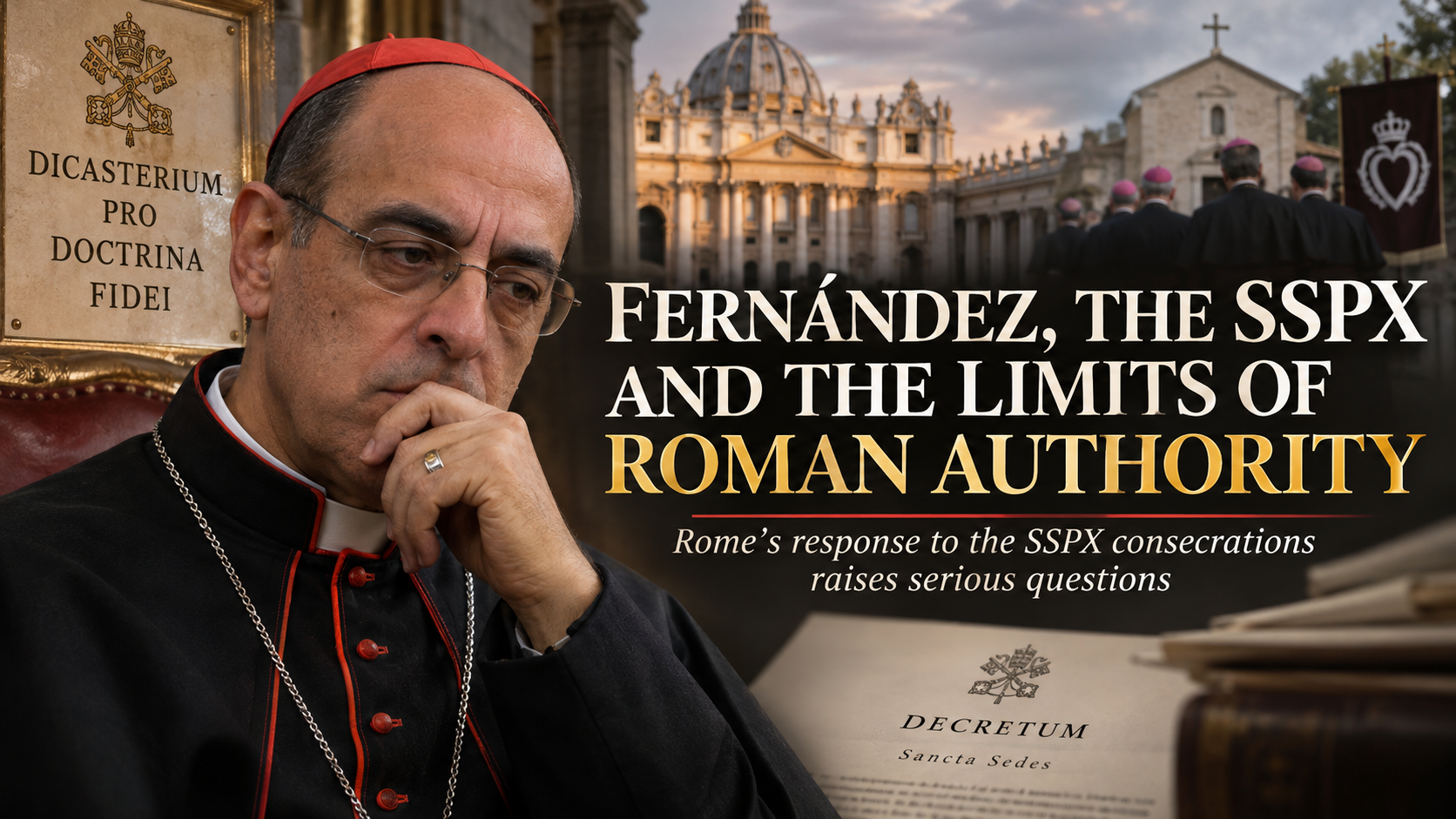
The Vatican’s response to the SSPX episcopal consecrations has produced a remarkable difficulty for Cardinal Fernández. Having declared the Society’s confessions and marriages invalid, his dicastery has apparently overlooked concessions made by Pope Francis, with Rome’s own canonical experts now questioning the consequences. The problem concerns more than defective drafting.
Cardinal Víctor Manuel Fernández’s difficulties as Prefect of the Dicastery for the Doctrine of the Faith have taken a rather extraordinary turn. According to Guido Horst, writing in the German Catholic newspaper Die Tagespost on 30 October, the Vatican’s own canonical specialists have raised serious objections to the documents issued following the Society of Saint Pius X’s episcopal consecrations in July. Four months later, the difficulties remain unresolved, and the Cardinal Prefect appears in no particular hurry to resolve them. Horst reports that the documents have been described in Vatican circles, with characteristic Roman delicacy, as having been written with one’s feet.¹
The criticism deserves attention because it concerns the exercise of authority at the very heart of the Holy See. A decree issued to defend papal jurisdiction appears to contradict sacramental concessions granted by the Pope himself, while an explanatory note intended to establish canonical clarity has created uncertainty about the validity of confessions and marriages. One might have expected the Prefect responsible to welcome assistance from the Dicastery for Legislative Texts, whose business, after all, is to understand the law. Instead, the documents remain unchanged.
The affair began on 1 July, when the SSPX proceeded with the consecration of four bishops at Écône, Switzerland, despite the express opposition of Pope Leo XIV. Bishop Alfonso de Galarreta performed the consecrations, assisted by Bishop Bernard Fellay. The following day, Fernández’s dicastery declared all six bishops excommunicated, invoking the canonical provisions concerning episcopal consecration without pontifical mandate and schism.²
The Society’s decision was a grave act of disobedience, and the argument that a state of necessity justifies episcopal consecrations against the express will of the Roman Pontiff presents serious ecclesiological difficulties. Apostolic succession cannot be reduced to the transmission of valid episcopal orders, as though the Church were merely an association of bishops possessing an independently exercisable sacramental power. The episcopate belongs within the visible, hierarchical communion established by Christ, and the primacy of Peter’s successor is an essential element of that constitution. Recognition of the Pope must mean something in practice.
Yet the question of whether an act is gravely wrong must still be distinguished from the precise canonical offences committed and the penalties consequently incurred. Canon 1387 concerns episcopal consecration without pontifical mandate; canon 1364 §1 concerns apostasy, heresy and schism. The provisions concerning imputability, necessity and mitigating circumstances form part of the same law. Whatever judgement is reached upon the Society’s conduct, the Holy See is obliged to apply its legislation correctly.
The difficulty is what followed the declaration against the six bishops. In an explanatory note, the Dicastery stated that the Society’s sacred ministers administered the sacraments illicitly and that confessions and marriages involving them were invalid.³ This was a remarkably sweeping assertion, and one which immediately raised questions about two decisions made under Francis.
In November 2016, Francis issued the apostolic letter Misericordia et misera, extending beyond the Jubilee of Mercy the faculty he had granted for Catholics attending SSPX chapels to receive valid and licit sacramental absolution from the Society’s priests. The concession was to continue until further provisions were made. Francis knew perfectly well that the Society lacked regular canonical status. Indeed, that was precisely why the concession was necessary. He wished to ensure that Catholics approaching its priests for confession could do so without anxiety concerning the validity of the absolution they received.⁴
In March 2017, the Pontifical Commission Ecclesia Dei published further provisions concerning marriages involving Catholics attached to the Society. These arrangements, expressly approved by Francis, authorised local Ordinaries to provide the necessary delegation, normally through a priest in regular canonical standing who would receive matrimonial consent before an SSPX priest celebrated the Nuptial Mass. Where this was impracticable, the Ordinary could delegate an SSPX priest to receive consent himself.⁵
The distinction between the two concessions is important. The faculty concerning confession was granted directly by the Pope to SSPX priests, while the matrimonial arrangements enabled diocesan bishops to grant specific delegations under established conditions. Neither concession regularised the Society’s canonical position. Both were intended to provide sacramental certainty for Catholics whose pastoral circumstances might otherwise leave them in doubt.
There is a further detail which makes Fernández’s present predicament particularly awkward. The 2017 letter was signed by Cardinal Gerhard Müller, then Prefect of the Congregation for the Doctrine of the Faith and President of Ecclesia Dei, together with Archbishop Guido Pozzo, the Commission’s Secretary. It expressly recorded that the arrangements arose from proposals made by the Congregation and the Commission, and that Francis approved them at an audience on 24 March.
Fernández’s own dicastery is therefore the institutional successor to one of the authorities responsible for establishing provisions which his explanatory note now appears to disregard. The relevant documents remain available on the Vatican website, so discovering their existence would hardly have required an expedition into the Secret Archives.
The problem was identified publicly on 18 July by Archbishop Juan Ignacio Arrieta, who had served as Secretary of the Dicastery for Legislative Texts until the preceding month. Speaking to AdVaticanum, Arrieta explained that the faculty concerning confession had been granted by papal authority and could not simply be withdrawn by an explanatory declaration from a subordinate dicastery. His reasoning was straightforward:
“These priests received the faculty to hear confessions by a pontifical act, and an act of the same nature is required to revoke it.”⁶
Arrieta’s intervention is particularly significant because he was decidedly unsympathetic towards the Society’s decision to proceed with the consecrations. He described them as a profound wound to ecclesiastical unity, rejected the Society’s appeal to necessity as unreasonable and questioned the ecclesiological assumptions underlying its actions. He also regarded the decree declaring the six bishops excommunicated as the formal recognition of a penalty incurred under canon law.
His objection concerned the consequences Fernández’s dicastery appeared to be drawing from those events. Arrieta understood that defending the authority of the Roman Pontiff did not dispense with the obligation to respect decisions already made through that authority.
The marriage question was rather different, and his interview made this clear. Unlike the universal faculty concerning confession, the 2017 arrangements depended upon delegation by local Ordinaries. Arrieta considered it unlikely that such delegations could legitimately be granted following the July consecrations. That is a serious qualification, and it prevents the two concessions from being treated as though they were identical. Nevertheless, it does not answer what became of the 2017 provisions themselves, nor establish that every marriage previously celebrated under a lawful delegation had somehow become invalid.
A further question concerns the authority by which Fernández’s dicastery issued its sweeping declaration. Horst observes that the July documents do not indicate specific papal approval for revoking or derogating from the earlier provisions. A dicastery can, of course, exercise authority entrusted to it by the Pope, and the absence of a particular formula of approval does not automatically render its acts ineffective. But where a declaration appears to reverse an express papal concession, the legal authority for doing so ought to be identifiable.
No publicly identified act of Leo XIV withdrawing Francis’s faculty concerning confession has been produced. Nor has the Holy See explained whether it considers that faculty to have ceased through some provision of law following the July consecrations. There may be an argument to that effect, but it has not been supplied in the explanatory note. It is difficult to see why Catholics should be expected to accept a conclusion concerning sacramental validity without being told the juridical grounds upon which it rests.
Horst reports that the Dicastery for Legislative Texts has already become involved. According to his account, a papal nuncio serving in a country with a considerable SSPX presence received clarification indicating that Fernández’s explanatory note could not be understood as evidence that the Pope had authorised the repeal of, or derogation from, the matrimonial arrangements approved in 2017.¹
There is an important qualification concerning this reported correspondence. Horst attributes its wording to a French publication, and the alleged letter has not been made publicly available. Rorate Caeli, examining the claim on 22 October, reported that neither it nor its contacts had seen the document.⁷ The account therefore remains unverified, and its contents cannot be treated as an authenticated intervention by the Dicastery for Legislative Texts.
But the underlying problem does not depend upon the letter’s existence. Arrieta’s interview is publicly available, as are Francis’s concessions and Fernández’s explanatory note. Indeed, AdVaticanum reported that it had contacted Archbishop John Joseph Kennedy, Secretary of the DDF’s Disciplinary Section, to ask whether any papal act had withdrawn the faculty concerning confession. The response was simply, “No comment.”⁶
One would have thought the validity of sacramental absolution deserved a slightly more illuminating answer.
Catholics who confessed to SSPX priests after Francis granted the faculty were entitled to rely upon his assurance. Couples who married under the arrangements authorised in 2017 were similarly entitled to rely upon the delegations granted by competent ecclesiastical authority. The validity of a marriage or sacramental absolution is scarcely an appropriate subject for competing interpretations between offices of the Roman Curia.
Nor is this merely a question of avoiding embarrassment. The distinction between validity and liceity is fundamental to Catholic sacramental theology and discipline. A priest may possess valid Holy Orders without possessing every faculty required to administer a particular sacrament validly. Equally, his irregular canonical position does not automatically invalidate every sacramental act he performs. The Church has developed precise rules concerning these matters because the faithful are entitled to certainty about the sacraments they receive.
There is a related difficulty concerning the way schism itself has been treated.
Following Archbishop Marcel Lefebvre’s episcopal consecrations in 1988, the Pontifical Council for Legislative Texts issued an explanatory note in August 1996 concerning formal adherence to the schismatic movement. Its assessment of the consecrations was unequivocal, and it considered the ministerial activity of the Society’s priests strong evidence of formal adherence. It nevertheless distinguished the position of lay Catholics, explaining that occasional participation in SSPX liturgies did not of itself establish such adherence. Even exclusive attendance, while potentially significant, required consideration of the person’s intentions and outward conduct.⁸
The Council also distinguished the moral reality of schism from the juridical offence attracting excommunication. These are not academic subtleties invented to excuse disobedience. They are distinctions established by the Church’s own law, intended to ensure that penalties are applied according to the actual circumstances and responsibility of those concerned.
Fernández’s explanatory note expressly invokes the 1996 clarification when discussing the position of lay Catholics. Yet the broader language of the July documents has left the status of the Society’s clergy, and particularly the validity of certain sacraments, less clear than it ought to be. A Catholic attending an SSPX chapel through attachment to the traditional liturgy cannot simply be presumed to have committed the canonical offence of schism. The Church may warn against the dangers of association with an irregular body without dispensing with the juridical conditions necessary for the incurrence of a penalty.
The Society has meanwhile pursued hierarchical recourse against the decree, maintaining its arguments concerning necessity and the consequences of canon 1353. Whether those arguments succeed is a separate question. The right to invoke the remedies provided by ecclesiastical law remains available even to those who have seriously disobeyed ecclesiastical authority.
There is a historical perspective which ought not to be overlooked. Benedict XVI remitted the excommunications of the four surviving bishops consecrated by Lefebvre in 1988, while making clear that the Society’s ministers remained without legitimate ministry until its canonical and doctrinal difficulties were resolved. Francis subsequently granted practical concessions concerning confession and marriage without pretending those difficulties had disappeared.⁹ Both Popes distinguished the defence of ecclesiastical discipline from the pastoral protection owed to Catholics who received ministry from the Society.
The July consecrations undoubtedly changed the circumstances. They did not, however, erase the previous exercise of papal authority or relieve the Holy See of the obligation to explain how its earlier decisions have been affected.
There is something distinctly odd about a Roman dicastery insisting upon obedience to papal authority while apparently failing to account for decisions made by the Pope himself. Those who uphold the traditional Catholic understanding of the papacy have every reason to insist upon that consistency. The Roman Pontiff is not a ceremonial figure whose decisions remain operative only for as long as they meet with the approval of his successors’ officials. Leo XIV possesses the authority to modify the concessions granted by Francis. Fernández has no independent authority to disregard them.
The affair also belongs within the wider questions Nuntiatoria has raised concerning the exercise of ecclesiastical authority and the discrepancy between the Church’s formal doctrinal and canonical structures and their practical administration. The authority of the Holy See cannot be strengthened by imprecision in its exercise. Nor is ecclesiastical unity well served when Catholics encounter apparently contradictory declarations from the offices responsible for safeguarding it.
For Fernández, the matter has acquired a significance beyond the SSPX dispute. His tenure as Prefect has already been marked by controversies surrounding the preparation and clarification of doctrinal documents, including Fiducia supplicans and Mater Populi fidelis. Those questions differ considerably, and disagreement with a theological document does not automatically establish incompetence. The present case concerns the quality of the juridical conclusions issued under his authority and the apparent failure to address objections which have been publicly identified for several months.
Horst’s criticism of the Cardinal’s apparent indifference is severe. His article does not, however, establish through published correspondence that Fernández personally refused repeated requests to cooperate. The distinction matters when assessing responsibility. The Prefect is answerable for the work of his dicastery, but an allegation of deliberate obstruction requires evidence which has not yet been made public.
Even without such evidence, the continued absence of clarification raises a serious question about the exercise of his office. A Prefect is not expected to possess the specialist knowledge of every canonist in Rome. He is expected to recognise when that knowledge is necessary and to ensure that documents issued under his authority are properly prepared. When an Archbishop who has served for almost two decades as Secretary of the Church’s principal body for legislative interpretation identifies a difficulty concerning sacramental faculties, the appropriate response is surely to examine it.
Instead, four months have passed without a satisfactory public explanation. The difficulty has become sufficiently conspicuous for Ed Condon, co-founder of The Pillar, to suggest that it may strengthen calls for Fernández’s replacement before the completion of his present term in 2028.¹ Whether Leo XIV is considering such a change is unknown. But confidence in the leadership of the Dicastery for the Doctrine of the Faith cannot be divorced indefinitely from the precision and reliability of the documents it issues.
The Pope must now establish the continuing force of Francis’s concessions and clarify the canonical consequences of the July decree. He should also determine whether the reported disagreement between the dicasteries reflects a genuine dispute over the law, defective communication or a failure of judgement in the preparation of the documents themselves. Those distinctions are necessary before deciding where personal responsibility lies.
The SSPX’s episcopal consecrations remain a grave matter. The Holy See has both the authority and the duty to defend ecclesiastical communion, and the Society cannot invoke fidelity to Catholic tradition while treating the jurisdiction of Peter’s successor as dispensable. But Rome must exercise that authority according to the law it expects others to obey.
Cardinal Fernández may have reasons for maintaining the July explanatory note in its present form. If so, they should be made known. If its conclusions are defective, they should be corrected. His suitability to remain Prefect is ultimately for Leo XIV to judge, although the continued inability to resolve a question of this importance can hardly strengthen confidence in his leadership.
Meanwhile, the faithful are left with a peculiar situation. Francis made explicit provision for the validity of certain sacraments received from SSPX priests. Fernández’s dicastery has apparently contradicted those provisions. Rome has yet to explain by what authority or operation of law the earlier concessions ceased to apply.
The offence against ecclesiastical communion has been declared with remarkable certainty. The consequences for the sacraments have been explained with considerably less care.
- Guido Horst, Exkommuniziert?, Die Tagespost, 30 October 2026.
- Dicastery for the Doctrine of the Faith, Decree and Note from Dicastery for the Doctrine of the Faith, L’Osservatore Romano, 6 July 2026.
- Dicastery for the Doctrine of the Faith, Explanatory Note to the DDF Decree, 2 July 2026.
- Francis, Misericordia et misera, Apostolic Letter, 20 November 2016, §12.
- Pontifical Commission Ecclesia Dei, Letter to the Ordinaries concerning Faculties for the Celebration of Marriages of the Faithful of the Society Saint Pius X, 27 March 2017.
- Niwa Limbu, Canonist Archbishop Arrieta Breaks Down the Vatican’s Response to the SSPX Bishops, AdVaticanum, 18 July 2026.
- Rorate Caeli, A Letter from the Dicastery for Legislative Texts on the SSPX? We Have Not Seen It Yet, 22 October 2026.
- Pontifical Council for Legislative Texts, Explanatory Note on the Excommunication for Schism Incurred by Adherents of Archbishop Lefebvre’s Movement, 24 August 1996, §§4–9; Communicationes, 29 (1997), pp. 239–243.
- Benedict XVI, Letter to the Bishops of the Catholic Church concerning the Remission of the Excommunication of the Four Bishops Consecrated by Archbishop Lefebvre, 10 March 2009.





Leave a Reply