
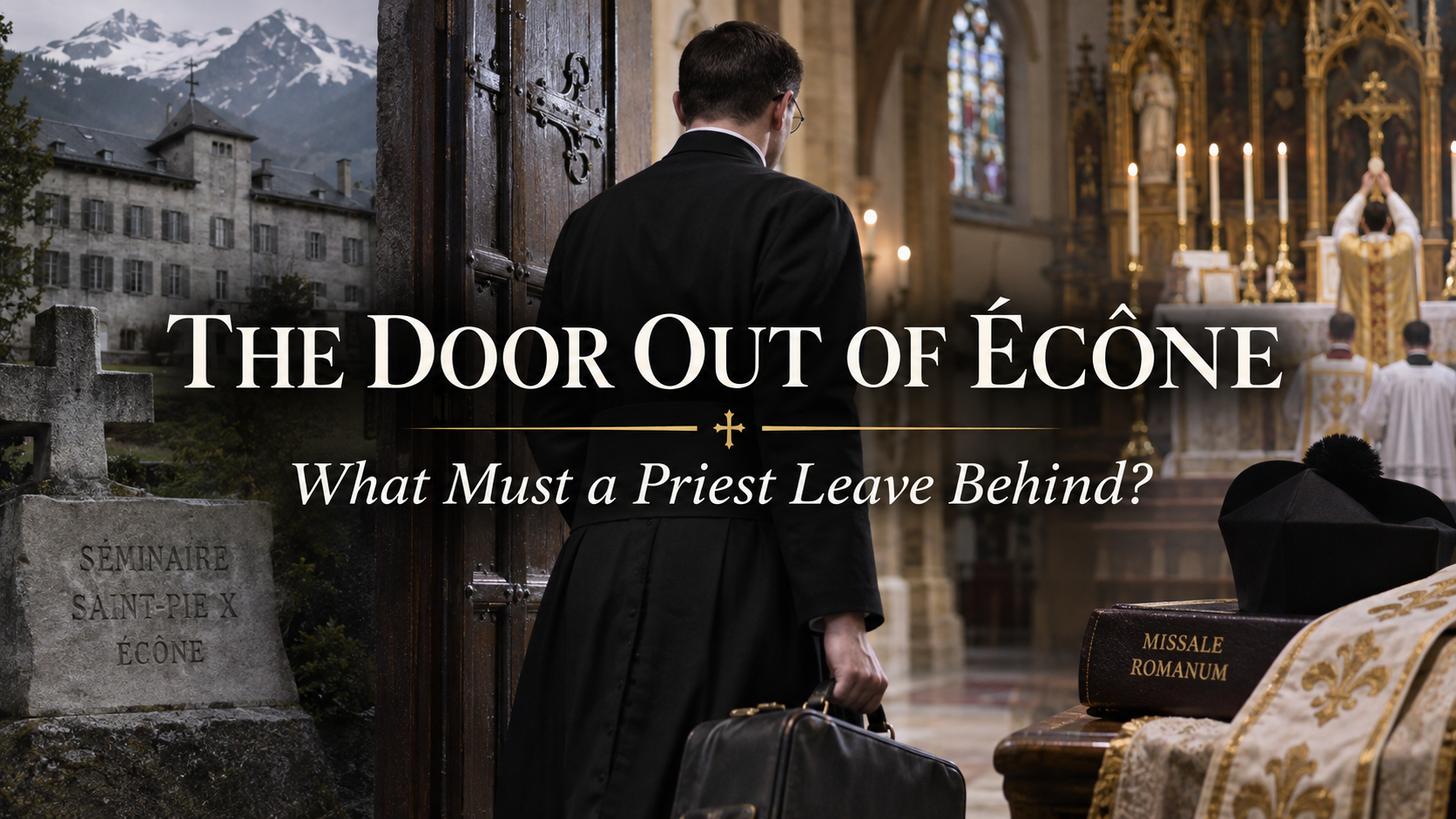
Former SSPX district superior Fr Patrick Duverger has accepted ministry within an FSSP apostolate. His decision comes as Rome offers priests a formal route away from Écône, but the conditions attached to that offer, and the experience of communities already enjoying canonical recognition, raise questions considerably larger than the movement of one priest.
Fr Patrick Duverger arrived at Viry-Châtillon, south of Paris, on Sunday 25 October, the feast of Christ the King according to the traditional Roman calendar. Bishop Michel Pansard of Évry-Corbeil-Essonnes had approved his appointment to serve the community associated with the Priestly Fraternity of Saint Peter (FSSP), and parishioners were invited to welcome their new priest with an apéritif after Mass. All very agreeable, and ordinarily of little interest beyond the parish concerned. Except that Duverger had spent more than thirty years in the Society of Saint Pius X (SSPX), including six as district superior for Belgium, the Netherlands and Luxembourg, and the priest who succeeded him in that office, Michel Poinsinet de Sivry, was among the four men consecrated bishops at Écône on 1 July without the authorisation of Pope Leo XIV.¹
A former senior SSPX priest has accepted ministry under a diocesan bishop within an apostolate belonging to the tradition of canonical regularisation which Archbishop Marcel Lefebvre’s followers rejected in 1988. Following July’s episcopal consecrations, Rome established a procedure intended specifically to receive priests wishing to leave the Society. Duverger would appear, at first sight, to illustrate precisely the development the Roman authorities were seeking.
Yet the circumstances require some care. The November bulletin of the Confraternity of Saint Peter records that Duverger remained an SSPX member until the summer of 2026 and attended the FSSP’s French priestly gathering on 22 October. The local announcement confirms his appointment. Neither establishes whether he has formally joined the FSSP as a member of its Society of Apostolic Life or undergone the reconciliation procedure published by the Dicastery for the Doctrine of the Faith in July. His reasons for leaving have not been made public.²
The timing naturally invites speculation, particularly because his successor is now a bishop whose consecration Rome has condemned. Duverger’s own earlier explanation of the Society’s position offers rather more substantial material for consideration.
In July 2017, shortly after completing his first year as Benelux superior, Duverger gave an interview to the SSPX district magazine Pour qu’Il règne. He defended the Society’s criticisms of the post-conciliar reforms, which he believed had produced deficient teaching and an equivocal, desacralising liturgy. Nevertheless, he expressly acknowledged the authority of Pope Francis and insisted that the Society belonged to the Roman Catholic Church. He argued that it deserved recognition through “a just canonical status”, while retaining the freedom to denounce errors which it considered destructive of Catholic Tradition.³
Canonical recognition was therefore something Duverger desired, provided it did not compromise what he understood to be the Society’s duty to defend the Faith. Nearly a decade later, he has accepted a recognised ministry. Whether his convictions have changed, or whether he has reached a different judgement about the best means of fulfilling his priestly vocation, remains unknown.
Rome’s present conditions for receiving SSPX priests make that distinction particularly interesting.
The procedure issued by the Dicastery for the Doctrine of the Faith on 2 July, applicable from 1 July, requires a departing SSPX priest to find an Ordinary willing to receive him ad experimentum. He must petition the Pope personally, request remission of applicable censures, supply evidence of his ordination and sign both the Professio fidei and a Formula adhaesionis. Following the Dicastery’s rescript, he may undertake a probationary period of between one and three years before incardination into the receiving diocese or institute. The preliminary conditions expressly require willingness to accept the Second Vatican Council and the legitimacy of the Novus Ordo Missae, notwithstanding the priest’s continued attachment to the older Roman rite.⁴
The accompanying Formula of Adherence deserves closer attention. The priest promises fidelity to the Catholic Church and the Roman Pontiff, undertakes to abstain from public declarations directed against the Pope’s person or Magisterium, accepts the teaching of Lumen gentium 25 concerning the obedience owed to authentic ecclesiastical teaching, and acknowledges the validity of Mass and the sacraments celebrated with the proper intention according to the approved post-conciliar rites. He also undertakes to observe the Church’s common discipline, particularly the 1983 Code of Canon Law.
These requirements involve distinct theological and canonical obligations. Recognition of sacramental validity concerns the reality of the sacraments celebrated according to the reformed rites. Acceptance of their legitimacy concerns the authority by which the Church regulates her worship. Neither requires a priest to maintain that every liturgical reform was desirable, that its implementation was beneficial, or that the pastoral culture subsequently developed around it faithfully transmitted the whole Catholic inheritance.
The more revealing provision comes in the formula’s treatment of doctrinal continuity. It expressly contemplates that certain teachings of Vatican II, or subsequent reforms of liturgy and canon law, may appear difficult to reconcile with earlier magisterial declarations. In such circumstances the priest undertakes to pursue a positive interpretation under the guidance of the Magisterium, preserving the relationship between the disputed teaching and the Church’s wider doctrinal patrimony.⁵
Rome has thus acknowledged, within the very document intended to regularise SSPX priests, that reconciling some later teachings and reforms with earlier declarations can present genuine difficulties. It does not concede that contradictions actually exist, but neither does it pretend that the questions are imaginary.
The prescribed response is interpretative submission to the Magisterium. Catholic doctrine necessarily requires fidelity to the Church’s divinely constituted teaching authority, and individual priests cannot make their private judgement the final arbiter of Catholic truth. Yet what happens when a priest conscientiously believes that a particular non-definitive teaching conflicts with an earlier authoritative declaration? May he explain the difficulty publicly, and by what means may he seek its resolution?
Canon 212 §3 recognises that the faithful, according to their competence and circumstances, may have both a right and a duty to communicate concerns about the Church’s welfare, including to other members of the faithful, while preserving reverence towards their pastors and the integrity of faith and morals. The Congregation for the Doctrine of the Faith’s 1990 instruction Donum veritatis likewise acknowledged that serious difficulties may arise concerning non-irreformable teaching. It required loyal engagement with the Magisterium and rejected organised public dissent, but did not deny that such theological difficulties could exist.⁶
The July formula leaves the practical boundary insufficiently defined. Does its prohibition concern personal attacks and organised repudiation of ecclesiastical authority, or might it also be employed against a priest who offers reasoned criticism of disputed non-definitive teaching? Much will depend upon the authorities interpreting and enforcing the undertaking.
For someone such as Duverger, who publicly defended the SSPX’s duty to criticise post-conciliar developments in 2017, this is no minor consideration. It would be instructive to know whether his present appointment has required any modification of his previous theological position. There is no evidence at present that it has.
Nuntiatoria examined Rome’s reconciliation arrangements in October’s Rome Built a Door Out of Écône ~ Priests Are Walking the Other Way. At that point only two SSPX priests had reportedly sought the new route by mid-September, while diocesan clergy continued to enter the Society, including men whose entire formation had taken place within the post-conciliar ecclesiastical system. Their decisions involved surrendering recognised appointments and faculties in order to pursue traditional priestly ministry under the Society’s auspices. Duverger’s departure supplies a significant instance of movement in the opposite direction, although it cannot yet be counted as a confirmed application under the July procedure.⁷
His decision also recalls the foundation of the FSSP in July 1988. Following Archbishop Lefebvre’s episcopal consecrations, priests and seminarians who disagreed with that course established a society dedicated to the traditional Roman liturgy within recognised canonical structures. Its subsequent work has demonstrated that traditional priestly formation and sacramental life can be sustained without adopting the SSPX’s exceptional canonical position.
The Fraternity has trained successive generations of priests, developed international apostolates and supported families seeking the traditional Roman liturgy. These achievements deserve proper recognition. It would be foolish to regard its priests as somehow less traditional because its founders accepted the Roman settlement of 1988.
Pope Francis himself recognised the importance of that decision. On 4 February 2022 he received Fr Benoît Paul-Joseph, the FSSP’s French district superior, and Fr Vincent Ribeton, rector of its seminary at Wigratzbad. According to the Fraternity’s official communiqué, Francis expressed admiration for the founders’ determination to remain faithful to the Roman Pontiff and said their decision should be “preserved, protected and encouraged”. On 11 February he signed a decree granting FSSP members the use of the liturgical books in force in 1962, expressly including the Missal, Ritual, Pontifical and Breviary. The concession authorised their use in the Fraternity’s own churches and oratories, while requiring the local Ordinary’s consent elsewhere, apart from private Masses.⁸
This was a substantial intervention following Traditionis custodes and the December 2021 Responsa ad dubia, which had restricted use of the former Pontificale Romanum. Francis recognised that the FSSP’s founding purpose depended upon the continued use of the traditional liturgical books and provided specific juridical protection for that purpose.
How far such protection extends when it encounters diocesan authority is another matter.
In August Nuntiatoria examined the controversy concerning North American Martyrs Parish in Edmonds, Washington. According to a parent’s account reported by LifeSiteNews and InfoVaticana, Archbishop Paul D. Etienne of Seattle had directed that children attending the FSSP parish should receive Confirmation elsewhere and undertake a two-year catechetical programme at another parish. Our editorial, The Children Must Go Elsewhere: Seattle and the Price of Canonical Obedience, examined the implications while recognising that the reported direction had not been confirmed in a published episcopal document.⁹
That remains the evidential position. The parish’s website continues to advertise Confirmation classes and registration, although its undated material cannot establish whether the alleged restriction was imposed, subsequently modified or misunderstood. No published directive has been identified which settles the matter.
What is documented is that Archbishop Etienne’s September 2021 decree retained North American Martyrs as a personal parish, recognised its traditional liturgical provision and entrusted pastoral care to FSSP priests. Nor was the traditional administration of Confirmation unprecedented there: Archbishop Alexander Brunett confirmed twenty-eight young parishioners according to the former Roman rite in December 2009.¹⁰
The Archbishop may have legitimate canonical reasons concerning the minister or place of Confirmation. A bishop remains the ordinary minister of the sacrament in the Latin Church, and an FSSP priest does not acquire the necessary faculty merely through his society’s permission to use the traditional Pontifical. But should the reported direction requiring children to undertake their preparation elsewhere prove accurate, it would raise a further question about the ability of a recognised traditional parish to fulfil its own catechetical responsibilities.
Nuntiatoria has already examined that question at length. Its relevance here concerns the extent to which the FSSP’s recognised position protects the ministry for which the Fraternity was established. Its pontifical privileges provide meaningful security, but they do not remove its apostolates from diocesan jurisdiction or prevent difficulties arising from restrictive interpretations of ecclesiastical legislation.
It was precisely this dependence upon diocesan authorities which Archbishop Lefebvre and his successors considered problematic. The SSPX maintains that the post-conciliar crisis has affected the ordinary transmission of Catholic doctrine and sacramental life so profoundly that traditional provision cannot safely depend upon authorities who may be unsympathetic to its preservation. The success of the FSSP demonstrates that substantial traditional ministry is possible within recognised structures. It cannot establish that adequate provision exists everywhere, or that the protection afforded to such communities will necessarily survive a change of diocesan bishop or Roman policy.
Francis’s 2022 assurance consequently deserves to be judged by more than its generous language. He recognised that the FSSP’s founding decision merited encouragement and issued a decree intended to protect its distinctive liturgical life. Yet the wider restrictions introduced by Traditionis custodes remain operative under Leo XIV, and the treatment of traditional communities continues to vary considerably between dioceses.
A priest entering recognised diocesan ministry accepts the legitimate authority of his Ordinary, together with its obligations concerning appointments, faculties and pastoral organisation. He may also discover that his bishop’s assessment of the post-conciliar crisis differs substantially from his own. For many priests these circumstances present no insuperable difficulty. Duverger may have reached precisely that conclusion, and nothing presently known suggests that Bishop Pansard has imposed inappropriate conditions upon his ministry.
Rome’s reconciliation arrangements, however, are intended to attract priests who have already concluded that ordinary diocesan structures do not adequately address the crisis. It is reasonable to expect those arrangements to confront their actual concerns rather than assume that canonical recognition renders them irrelevant.
Nuntiatoria’s September editorial Crisis is the Cause; Necessity is the Effect examined the Society’s argument at its strongest. The existence of a profound ecclesiastical crisis does not itself establish that extraordinary episcopal consecrations are necessary. The danger to souls must be demonstrated, the adequacy of ordinary remedies examined, and the proposed response shown to be proportionate. Our October examination of the Society’s continuing canonical recourse likewise insisted that its profession of papal allegiance and appeal to Roman jurisdiction deserved consideration without being treated as proof that the penalties declared after the consecrations were unfounded.¹¹
Those distinctions remain essential. The arrival of diocesan priests at Écône cannot justify episcopal consecrations undertaken against an express papal prohibition. Equally, the departure of a former SSPX district superior cannot establish that the Society’s concerns about doctrinal continuity and traditional sacramental provision have been satisfactorily answered. The canonical responsibility associated with consecrating bishops without a pontifical mandate is substantial, and the Society remains obliged to demonstrate its claim of necessity.
Rome, meanwhile, must address the conditions which have persuaded priests formed entirely within its recognised institutions to seek ministry elsewhere. A canonical settlement which leaves unresolved their principal doctrinal objections, or exposes their traditional ministry to unpredictable restrictions, may secure formal obedience without resolving the reasons for their original estrangement.
The Formula of Adherence is especially important here. It recognises that difficulties concerning doctrinal continuity may arise and prescribes the authority under which they must be examined. It properly demands fidelity to the Pope and adherence to Catholic teaching. What remains uncertain is how much freedom a regularised priest retains to investigate and responsibly express the difficulties which first brought him into the Society.
That uncertainty becomes more serious when one considers the theological culture which has acquired practical authority in many ecclesiastical institutions since the Council. The distinction between binding doctrine and prevailing theological opinion has frequently been obscured in seminaries, diocesan policies and pastoral practice. A priest may profess every defined dogma of the Catholic Faith while questioning interpretations of Vatican II which have become institutionally dominant. Fidelity to the authentic Magisterium is properly required of him. Uncritical acceptance of every contemporary interpretation advanced in its name cannot be treated as an equivalent obligation.
Duverger’s 2017 interview illustrates the distinction unusually well. His criticism of post-conciliar developments was accompanied by explicit professions of Catholic communion and recognition of the Roman Pontiff. If he now believes that his vocation can be exercised more fruitfully within an FSSP apostolate, his judgement deserves respect. If his doctrinal assessment has changed, that too would be significant. Neither conclusion can be inferred merely from his appointment.
The wider traditional Catholic movement includes priests working within diocesan structures, members of recognised institutes and those who have entered or remained in the SSPX despite its conflict with Rome. Their decisions reflect differing judgements about the conditions necessary to preserve Catholic doctrine and sustain traditional priestly ministry. Some may be mistaken; others may be prudentially defensible without being universally applicable. The Church’s authorities must judge them according to Catholic doctrine and law, while attending to the circumstances which have given rise to the dispute.
Duverger has found a place in which to exercise his priesthood under recognised authority. One hopes that his ministry will prosper and that the faithful of Viry-Châtillon will benefit from his long experience. His decision deserves to be understood on its own terms rather than pressed into service as an argument he has not himself made.
For Rome, his reception offers an opportunity to demonstrate what a workable settlement can achieve. The question is whether other SSPX priests could follow him while retaining the considered theological objections which Duverger himself expressed so plainly in 2017.
Can a priest leave Écône, retain his considered objections to post-conciliar developments, and exercise a stable traditional Catholic ministry without being required to silence legitimate criticism of the very difficulties which brought him into the Society?
Rome has supplied a procedure for receiving such priests. Its own documents acknowledge the difficulties which may arise when later teaching and reform are considered alongside the Church’s earlier Magisterium. The experience of the FSSP demonstrates the considerable good which canonical recognition can accomplish, while revealing the importance of providing security for the traditional sacramental life which that recognition is intended to sustain.
The answer will depend upon how Rome interprets its reconciliation conditions and how diocesan bishops exercise the authority entrusted to them. Those who have remained at Écône will be watching closely. So, one suspects, will priests already working within recognised traditional institutes.
¹ Annonces du dimanche 11 octobre 2026, Communauté tridentine et FSSP en Essonne; Annonces du dimanche 25 octobre 2026, Communauté tridentine et FSSP en Essonne; Former SSPX District Superior Joins FSSP Following Episcopal Consecrations, Ad Vaticanum, 11 November 2026.
² Novembre 2026, Confraternité Saint-Pierre, November 2026.
³ Interview with the District Superior of the Benelux Union, FSSPX News, 2 August 2017; Entretien avec le Supérieur de District du Benelux, FSSPX Actualités, 2 August 2017.
⁴ Prassi per la riconciliazione dei sacerdoti provenienti dalla Fraternità Sacerdotale San Pio X, Dicastery for the Doctrine of the Faith, 2 July 2026; Lefebvrite Priests and Lay Faithful: Procedure to Return to Catholic Communion, Vatican News, July 2026.
⁵ Prassi per la riconciliazione dei sacerdoti provenienti dalla Fraternità Sacerdotale San Pio X, Allegati A–B, Dicastery for the Doctrine of the Faith, 2 July 2026.
⁶ Code of Canon Law, Canon 212, Holy See; Donum veritatis: Instruction on the Ecclesial Vocation of the Theologian, Congregation for the Doctrine of the Faith, 24 May 1990.
⁷ Rome Built a Door Out of Écône ~ Priests Are Walking the Other Way, Nuntiatoria, 2 October 2026.
⁸ Official Communiqué of the Priestly Fraternity of St Peter, FSSP, 21 February 2022; Decree of Pope Francis Confirming the Use of the 1962 Liturgical Books, 11 February 2022.
⁹ The Children Must Go Elsewhere: Seattle and the Price of Canonical Obedience, Nuntiatoria, 17 August 2026; Sacraments, North American Martyrs Parish, accessed 12 November 2026.
¹⁰ Decree Implementing Traditionis Custodes in the Archdiocese of Seattle, Archbishop Paul D. Etienne, 8 September 2021; Seattle Apostolate News, Priestly Fraternity of Saint Peter, 27 January 2010.
¹¹ Crisis is the Cause; Necessity is the Effect, Nuntiatoria, 6 September 2026; The Bishops Who Defied Rome — and Still Appeal to It, Nuntiatoria, 16 October 2026.





Leave a Reply