
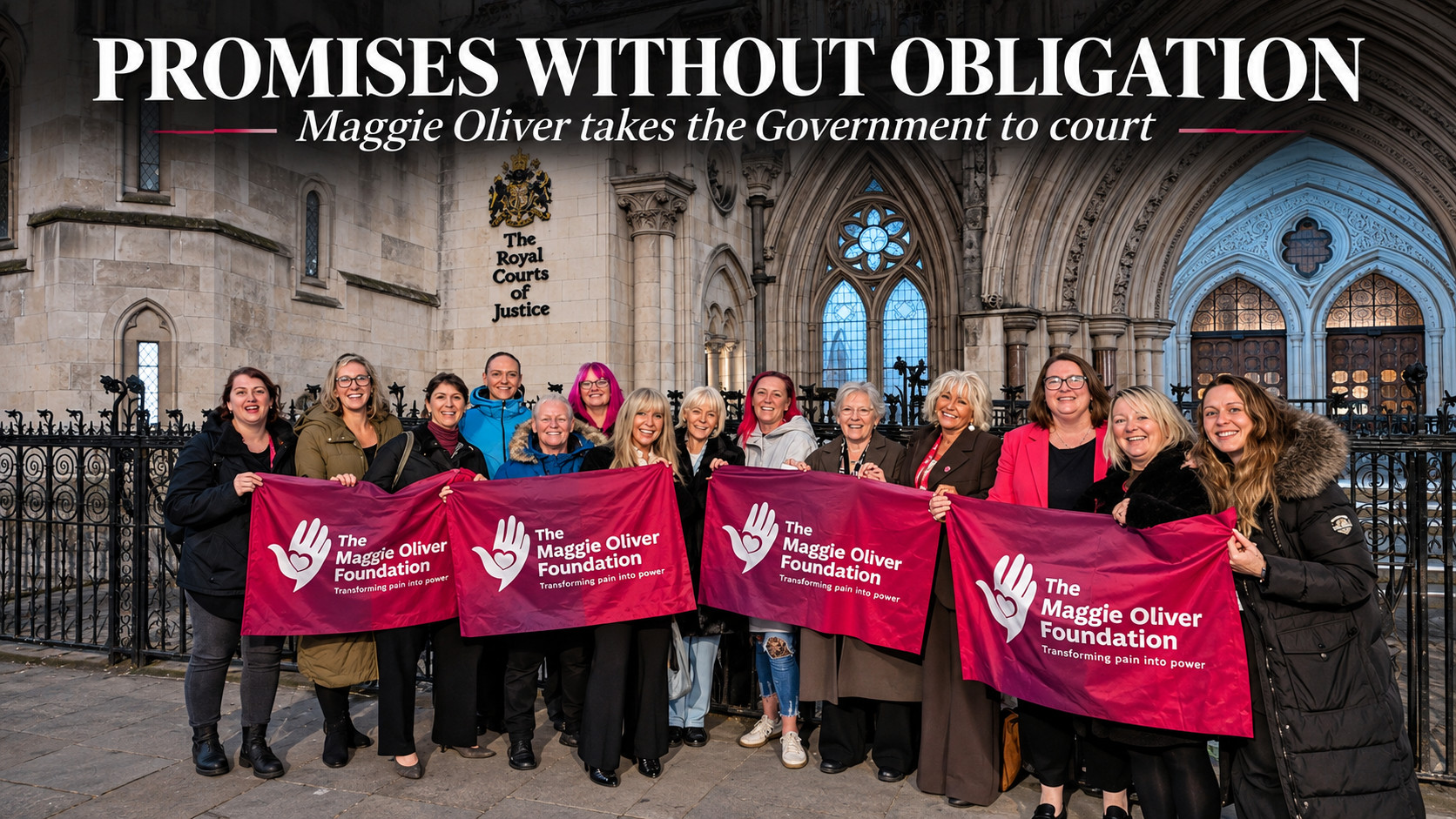
Three days in the High Court have exposed the Government’s legal defence of its failure to fulfil commitments made following Britain’s seven-year inquiry into child sexual abuse. With important recommendations still outstanding, professional regulation unresolved after eight years, and ministers unable to provide Parliament with an implementation timetable, Maggie Oliver’s challenge raises serious questions about the purpose of public inquiries and the accountability of those who commission them.
“They are no more than recommendations and do not carry any legal force.”
With those words, presented in written submissions to the High Court on Tuesday 10 November, the Government’s barrister, Jack Anderson, explained why ministers could not be compelled to implement the recommendations of the Independent Inquiry into Child Sexual Abuse (IICSA). The submission, independently reported by Sarah McGuinness of PA Media and ITV News Granada, formed part of the Government’s defence against judicial review proceedings brought by the Maggie Oliver Foundation. The charity contends that successive administrations made repeated commitments to implement reforms intended to protect children, only to leave substantial elements of the programme unfinished.¹
The argument has a certain constitutional respectability. Public inquiries advise ministers; they do not legislate. Governments must consider recommendations, and Parliament remains responsible for determining what becomes law. But the proceedings before Mr Justice Mansfield concern something more particular: whether assurances given repeatedly by ministers, and relied upon by survivors who participated in the inquiry, created obligations which the Government cannot lawfully disregard.
The distinction is important, although it may seem an extraordinary one to those whose lives have been affected by the failures IICSA investigated. The inquiry was established in 2015, concluded its work in October 2022 and produced twenty principal recommendations following an examination of institutional child sexual abuse across England and Wales. More than 7,000 victims and survivors contributed evidence. Its recorded expenditure to March 2023 amounted to approximately £190 million, although contemporary reporting frequently rounds the cost to £200 million. The scale of the exercise reflected the gravity of what had been uncovered: failures of policing, residential care, education, religious institutions and public administration which had exposed children to abuse, sometimes for years, while those responsible for their protection failed to intervene.²
Four years after publication of the final report, the Maggie Oliver Foundation maintains that only seven recommendations have been implemented. The figure requires qualification, since different assessments apply different standards of completion, and legislative developments during 2026 have altered the position. Nevertheless, the Government’s own records confirm that important reforms remain unresolved, including recommendations which predate the inquiry’s final report by several years.
Maggie Oliver’s involvement lends the proceedings a particular significance. A former Greater Manchester Police detective, she resigned from the force in 2012 after becoming increasingly concerned about its handling of organised child sexual exploitation in Rochdale. Her subsequent campaigning helped expose failures which had allowed perpetrators to operate while vulnerable girls struggled to secure protection and justice. She established the Foundation in 2019 to support survivors and campaign for institutional accountability. Its decision to confront the Government in court follows a familiar pattern in her work: challenging authorities whose assurances have proved rather more readily available than effective remedies.
Stephanie Harrison KC, representing the Foundation, told the High Court that child sexual abuse continued at what she described as near-industrial levels. She rejected the tendency to discuss the scandal principally as a historical phenomenon, pointing to an estimated 500,000 children experiencing sexual abuse annually. The figure, cited during proceedings and acknowledged in government safeguarding material, describes the estimated scale of child sexual abuse generally, rather than organised grooming gangs alone.
Harrison argued that repeated ministerial assurances had created a legitimate expectation that the recommendations would be implemented. The Government’s failure to honour those commitments, she maintained, constituted an abuse of power and a betrayal of those who had placed their trust in the inquiry.
Anderson disputed that proposition. The recommendations, he submitted, lacked the precision required to create the enforceable expectation alleged. Even if some expectation had arisen, departure from it would not necessarily be unlawful. He also argued that reliance upon certain ministerial statements made in Parliament would offend parliamentary privilege, and that the Court could neither compel the executive to introduce legislation nor require Parliament to enact it.³
Those are substantial legal arguments. Article 9 of the Bill of Rights 1689 protects parliamentary proceedings from being impeached or questioned in the courts, and the separation of judicial and legislative functions prevents judges from simply substituting their preferred programme of reform for ministerial decisions. Equally, public law recognises circumstances in which sufficiently clear representations by public authorities may give rise to legitimate expectations. The existence, scope and enforceability of any such expectation depend upon the particular assurances, their context and the reasons advanced for departing from them.
There is no need to resolve that dispute in advance of judgment. The question confronting ministers is wider than the legal minimum they may ultimately be required to observe. Where a government establishes an inquiry following grave institutional failures, invites extensive testimony from survivors and publicly undertakes to act upon the resulting recommendations, it incurs a responsibility to explain what it has done. That responsibility may not be enforceable in every particular by judicial review, but it remains a proper subject of parliamentary and public accountability.
Nuntiatoria examined the approaching legal challenge on 4 March, when we considered the implications of an inquiry costing approximately £200 million in commonly reported figures while leaving important safeguarding reforms unimplemented. Our further coverage on 5 March placed Oliver’s proceedings alongside continuing demands for accountability over organised grooming gangs, including Rupert Lowe’s independently funded investigation and proposals for a further statutory inquiry.
On 5 March, Mr Justice Kimblin granted permission for the Foundation to pursue substantive judicial review. He described the application as a “paradigm example of public interest litigation” and accepted that the arguments concerning legitimate expectation and pain-inducing restraint in children’s custody were sufficiently arguable to warrant examination.
Our reporting at the time described that decision in terms which should be understood more narrowly. Permission to proceed did not establish that ministerial assurances had created an enforceable obligation, nor that the Government’s conduct was unlawful. It established that the arguments merited a substantive hearing. The proceedings of 10–12 November were the consequence of that permission.⁴
The first day received independent courtroom coverage from PA Media and ITV Granada. Both reported the competing written submissions, including the Government’s argument about parliamentary privilege. Channel 4 News also reported on the challenge, concentrating upon the survivors and campaigners whose experiences gave the proceedings their wider significance. Subsequent coverage by The Independent and The Times recorded Oliver’s reaction to the Government’s defence.
This reporting provides an essential distinction between arguments independently recorded by journalists and the Foundation’s own accounts of exchanges during the second and third days. The latter are valuable contemporary evidence of how the proceedings were experienced by the claimants, but they cannot be treated as an agreed transcript or judicial findings.
On Wednesday 11 November, the Foundation reported that the Government had challenged its standing to pursue the claim and argued that unfulfilled commitments had caused “no detriment”. Oliver subsequently repeated her criticism in comments carried by The Independent, whose reporting also addressed Baroness Louise Casey’s frustration at the pace of safeguarding reform following her national audit of group-based child sexual exploitation.⁵
The legal meaning of detriment deserves some attention. In proceedings involving legitimate expectation, it may concern whether a claimant relied upon an official representation and suffered a legally relevant disadvantage when the public authority departed from it. The Government’s submission should therefore not be represented as a denial of the suffering caused by child sexual abuse. It concerns the legal consequences of the alleged assurances.
Yet there is a practical difficulty which the legal distinction cannot entirely remove. Survivors were encouraged to participate in IICSA because their experiences might help prevent further abuse. Many had already encountered authorities which failed to believe them, failed to investigate or failed to act. They were then asked to recount events of considerable personal suffering before another institution established by the state. Whether their participation creates an enforceable legal entitlement is one question. Whether they were reasonably entitled to expect that ministers would act upon the resulting evidence is another.
Professor Alexis Jay, who chaired IICSA, had already expressed her frustration in November 2025. Interviewed by Cathy Newman for Channel 4 News, she warned that the inquiry’s enormous expenditure and the efforts of survivors would be wasted unless implementation accelerated. Of those who had participated, she said:
“They were given great hope.”
At that point, Newman’s assessment was that no more than two of the twenty principal recommendations had been delivered. The Foundation subsequently reported three implemented recommendations before increasing its assessment to seven by November 2026. The progression is important, but it must be understood in the light of subsequent legislation and differing definitions of completion.⁶
An especially useful independent assessment appeared on 20 October this year, exactly four years after IICSA published its final report. Chris Tuck, a survivor and former member of the inquiry’s Victims and Survivors Consultative Panel, examined each recommendation against the available government, parliamentary and safeguarding records.
Her findings provide a more discriminating account than a single headline figure. Some reforms have been implemented, others have been enacted but remain awaiting commencement, while several are only partially delivered, subject to further consultation or expressly rejected.
The distinction matters. Recommendation Fifteen, concerning the removal of the ordinary three-year limitation period for qualifying civil personal-injury claims arising from childhood sexual abuse, has been implemented. The relevant legal changes came into force on 29 June 2026. Recommendation Nine has also undergone substantial implementation through the removal of the supervision exemption from 1 September, extending eligibility for appropriate barred-list checks in qualifying roles involving children.
The Crime and Policing Act 2026 provides for mandatory reporting of specified child sexual abuse, together with an offence of obstructing such reporting, and includes measures concerning grooming as an aggravating factor in sentencing. But mandatory reporting was not yet operational when Tuck completed her October assessment, with commencement expected in 2027. The enacted provisions also differ in some respects from the inquiry’s original proposal.
These are meaningful legislative developments. They should be recognised as such. Passing legislation, however, does not always establish that its provisions are operating, still less that the intended safeguarding improvement has been achieved. The Government is entitled to cite progress; the public is entitled to examine what that progress actually consists of.⁷
The difference between commitment and completion becomes particularly apparent in the proposed professional registration of staff working in children’s homes.
IICSA recommended professional registration in its interim report of April 2018. It proposed an independent regulatory body capable of maintaining standards of training, conduct and continuing professional development, with powers to enforce professional obligations through fitness-to-practise procedures. The purpose was to establish safeguards for children whose daily care depended upon staff operating within residential institutions, including secure children’s homes.
The Department for Education responded by undertaking further examination of the workforce. In July 2021, the Government accepted in principle that professional regulation might provide additional protection but continued to keep the recommendation under review. IICSA regarded this response as inadequate and repeated the recommendation in its final report of October 2022.
The Government’s May 2023 response acknowledged the potential importance of registration, while its April 2025 progress report described further work on qualifications, professional development and workforce standards. Yet a parliamentary question from Sarah Pochin MP on 20 January 2026 elicited another explanation of why the matter remained unresolved.
Responding on 28 January, Children’s Minister Josh MacAlister stated that the immediate priority was improving workforce standards and reviewing qualifications. Those measures, he explained, would provide the basis for considering the risks and benefits of professional registration, including wider consultation in the longer term.
Nearly eight years after IICSA’s original recommendation, the proposed independent register had still not been established.
There is a distinction between Ofsted’s existing regulation of children’s homes and their managers and the wider professional registration of staff providing daily care. IICSA expressly identified that difference. It also observed that comparable professional registration arrangements already existed elsewhere in the United Kingdom.
The Government may reasonably consider whether a proposed regulatory system would deliver its intended benefits, and whether appropriate training must accompany registration. What requires explanation is the length of time needed to reach a settled position. A safeguarding recommendation made in 2018, reconsidered in 2022 and still subject to prospective consultation in 2026 illustrates a problem which cannot be attributed simply to the ordinary complexity of public administration.⁸
The collection of reliable information about child sexual exploitation offers another example.
IICSA recommended a consistent national dataset capable of recording relevant characteristics of victims and alleged perpetrators, together with the circumstances in which abuse occurred. The proposal was intended to overcome fragmented recording practices which had prevented the authorities from identifying patterns of offending and institutional failure.
The importance of that work became clearer following Baroness Casey’s national audit of group-based child sexual exploitation in June 2025. Casey identified serious weaknesses in recording the ethnicity and nationality of suspects, together with evidence from particular police forces suggesting disproportionate offending by some demographic groups in certain localities. Her report also documented reluctance among institutions to examine uncomfortable evidence openly.
Nuntiatoria has previously considered the implications of those findings. Recording relevant demographic information accurately is an elementary requirement of serious investigation. Where such information assists in identifying offending patterns, authorities must be prepared to examine it. Equally, conclusions must follow the evidence and remain confined to what that evidence establishes. Neither collective suspicion nor administrative reluctance serves the protection of children.
The Government has committed itself to improving the recording of ethnicity and nationality information following Casey’s audit. Tuck’s October assessment nevertheless found that the comprehensive national data arrangements envisaged by IICSA had not yet been demonstrated to be fully operational. Improved recording by police forces is necessary, but the original recommendation concerned compatible information across a wider range of safeguarding and criminal justice bodies.⁹
The second substantive ground of the judicial review concerns the continued authorisation of pain-inducing restraint techniques in children’s custody.
IICSA recommended prohibiting techniques deliberately designed to induce pain as a means of securing compliance. Its concern arose from the treatment of vulnerable children detained in custodial institutions and from the dangers associated with permitting adults to inflict pain upon those over whom they exercise coercive authority.
Article 39, a children’s rights organisation, intervened in the proceedings, providing evidence concerning the physical and psychological consequences of such practices. Its executive director, Jodie Wickers, raised concerns about the adequacy of existing safeguards and the particular difficulties children face in challenging mistreatment within custodial institutions.
The Government maintains that carefully regulated emergency techniques must remain available to trained staff in circumstances where serious physical harm might otherwise occur. Those responsible for children in custody certainly have an obligation to protect them, as well as their colleagues and other detainees, from immediate danger. The question before the Court is whether the particular techniques authorised are lawful and whether the Government has adequately justified its position.
The inquiry’s recommendation was clear. The Government has chosen a different approach. Whether that approach satisfies the applicable legal requirements is for Mr Justice Mansfield to determine.¹⁰
There is, however, an additional documentary development which places the Government’s defence in an especially awkward light.
On 19 October, Liberal Democrat MP Helen Maguire submitted a written parliamentary question asking the Home Secretary whether she would publish a timetable for implementing IICSA’s recommendations.
The answer, given on 30 October by Home Office Minister Satvir Kaur, referred to continuing work on a proposed Child Protection Authority, the measures contained in the Crime and Policing Act 2026, investment of up to £50 million in expanding the Child House model and further initiatives concerning online child sexual abuse.
Those measures are relevant and some represent substantial commitments. But the Minister did not provide the requested timetable.
The question had been straightforward. Four years after the inquiry’s final report, a Member of Parliament wanted to know when its recommendations would be implemented. Eleven days before the judicial review began, the Government responded with another account of its activities without supplying the information requested.
Here the difficulties of political accountability become considerably more tangible. Whatever the Court eventually decides about legitimate expectation, Parliament is entitled to scrutinise the progress of reforms promised in response to a statutory inquiry. The Government should be capable of identifying which recommendations it has accepted, which it has rejected, which are partially implemented and which remain subject to further work. It should also be capable of explaining who is responsible for outstanding decisions and when those decisions are expected.¹¹
The third and final day of the judicial review brought the argument back to the discretion exercised by ministers.
In its statement following the conclusion of proceedings on Thursday 12 November, the Maggie Oliver Foundation reported that the Government’s lawyers had emphasised that “policymaking is complicated” and that governments face a “myriad of pressures”.
The Foundation’s characterisation of the final day’s proceedings has not been independently verified against a complete courtroom transcript. Similar considerations concerning consultation, competing demands and governmental discretion had, however, featured in the legal arguments advanced during the March permission proceedings, as reported by Mark Brown in The Guardian.
The Foundation’s statement also described a courtroom crowded with survivors, family members and supporters. It thanked those who had assisted the case and the donors who had enabled a comparatively small charity to pursue proceedings against the Government. Judgment was reserved following the third day.¹²
Reporting for The Times on Friday 13 November, Oliver described aspects of the Government’s case as “toe-curlingly horrific”. She warned that public inquiries could become convenient instruments for deflecting criticism without securing the changes which survivors had been promised.
The newspaper also recorded the Government’s response that it was investing £100 million in preventing and prosecuting child sexual abuse and pursuing its programme for implementing IICSA’s recommendations.
The expenditure and legislative activity should not be discounted. The Government has undertaken reforms, and some of the inquiry’s recommendations have resulted in changes to the law. But public expenditure cannot itself establish that particular safeguarding obligations have been fulfilled. The relevant questions concern what has been delivered, whether the arrangements are operating, and what remains outstanding.¹³
These proceedings have acquired additional significance because Britain is already preparing for another statutory inquiry.
The Independent Inquiry into Grooming Gangs, chaired by Baroness Anne Longfield, was established in 2026 following Casey’s national audit. Its projected budget is £65 million and its work is expected to continue for three years.
National Accountability Hearings are scheduled to begin in London during the week commencing 14 December, with further hearings planned for January, March and April 2027. Their stated purpose includes examining why findings and recommendations from previous inquiries, inspections and investigations failed to produce sustained improvements in institutional practice.
That is a necessary subject for investigation, although it presents an obvious difficulty. A new statutory inquiry is preparing to examine the failure to implement earlier recommendations while the Government is defending a legal challenge concerning its implementation of the recommendations of another major inquiry.
The new investigation may secure important evidence, establish responsibility and identify failures which previous inquiries could not. Its work deserves to be judged according to what it discovers and accomplishes. But survivors are entitled to expect more than another extensive report followed by assurances that ministers will consider its conclusions.
Professor Jay’s warning of November 2025 remains pertinent. There is little value in repeatedly inviting victims to recount their experiences if the institutions responsible for acting upon the evidence cannot explain why the resulting recommendations remain unresolved.¹⁴
There is also a consideration which Catholic institutions should recognise from their own experience of IICSA’s investigations.
The inquiry examined serious safeguarding failures within religious organisations, including Catholic institutions. It identified instances in which institutional reputation, inadequate leadership and failures to respond properly to allegations contributed to the mistreatment of children. Ecclesiastical authorities were expected, rightly, to acknowledge failures, cooperate with lawful investigations and establish effective protections.
The obligation to safeguard children arises from justice and the responsibilities of those entrusted with authority. In Catholic moral teaching, prudence governs the responsible exercise of that authority. It requires the careful examination of evidence and circumstances, including the likely consequences of proposed measures. It cannot reasonably be invoked to justify an indefinite refusal to reach decisions concerning dangers already identified.
That distinction applies equally to civil government. Ministers may reject recommendations which they judge ineffective, impractical or disproportionate. They should then explain their reasons and identify what alternative protection they intend to provide. Where recommendations have been accepted, their implementation should be subject to intelligible scrutiny. The authority to make policy carries responsibility for the decisions made under it.
The children whose treatment gave rise to IICSA’s investigations were frequently those least capable of demanding an account from the institutions responsible for their welfare. Many were already vulnerable through circumstances beyond their control. Their protection depended upon adults with authority, professional obligations and access to information. The inquiry established how often those responsibilities had been neglected or misused.
Mr Justice Mansfield must now decide whether the Government’s conduct has breached the legal obligations alleged by the Maggie Oliver Foundation. The result cannot be anticipated. Some of the Government’s constitutional arguments may succeed, and the Court’s powers are necessarily limited by the nature of judicial review.
The parliamentary and administrative record, however, requires no speculation. Professional registration first recommended in April 2018 remains unresolved. Other recommendations have been implemented, partially delivered, rejected or left awaiting commencement. On 30 October, Parliament asked for an implementation timetable and received no such timetable in reply.
The High Court will determine whether ministerial promises created obligations enforceable in law. The Government must still account for the years which have passed between those promises and their fulfilment, and for the safeguarding recommendations whose implementation remains outstanding.
¹ Sarah McGuinness, PA Media, Court Told Government ‘Abused Its Power’ by Not Adopting Child Sex Abuse Reforms, 10 November 2026; ITV News Granada, Government ‘Abused Its Power’ in Failure to Tackle Child Sexual Abuse, 10 November 2026.
² IICSA, Final Report, 20 October 2022; The Accountability Index, Independent Inquiry into Child Sexual Abuse: Recorded Expenditure 2015–2023; The Maggie Oliver Foundation, About Us.
³ ITV News Granada, Government ‘Abused Its Power’ in Failure to Tackle Child Sexual Abuse, 10 November 2026.
⁴ Nuntiatoria, Seven Years, £200 Million, and Still No Action, 4 March 2026; Nuntiatoria, High Court Allows Maggie Oliver’s Legal Challenge Against the Government to Proceed, 5 March 2026; Landmark Chambers, High Court Allows Challenge over Government’s Failure to Implement Child Abuse Inquiry Recommendations, 5 March 2026.
⁵ Carla Feric, The Independent, Baroness Casey Condemns ‘Appalling’ Abuse of Power by High-Profile Figures, 11 November 2026; The Maggie Oliver Foundation, Judicial Review Updates.
⁶ Cathy Newman, Channel 4 News, How Victims of Abuse Are Being Failed Despite Review After Review, 14 November 2025.
⁷ Chris Tuck, Survivors Of aBuse, Four Years On: Where Are the 20 IICSA Recommendations?, 20 October 2026; Home Office, Crime and Policing Act 2026: IICSA Recommendations Factsheet, 30 September 2026.
⁸ IICSA, Final Report, E.2: Regulation of the Workforce, October 2022; UK Parliament, Written Answer by Josh MacAlister on Registration of Children’s Homes Staff, 28 January 2026; Department for Education, Review of Professional Development for the Children’s Homes Workforce, June 2026.
⁹ Baroness Louise Casey, National Audit on Group-Based Child Sexual Exploitation and Abuse, June 2025; Chris Tuck, Four Years On: Where Are the 20 IICSA Recommendations?, October 2026.
¹⁰ Article 39, High Court Challenge over Pain-Inducing Restraint of Children, 5 November 2026; Landmark Chambers, Christopher Jacobs Appears in Judicial Review over Implementation of Child Abuse Inquiry Recommendations, 12 November 2026.
¹¹ UK Parliament, Helen Maguire’s Written Question and Satvir Kaur’s Answer on Implementation of IICSA Recommendations, 30 October 2026.
¹² Mark Brown, The Guardian, UK Government ‘Effectively Allowed’ Child Sexual Abuse, Campaigners Say, 5 March 2026; The Maggie Oliver Foundation, Judicial Review Updates and Documents; The Maggie Oliver Foundation, Facebook.
¹³ The Times, Inquiries Just a ‘Convenient Tool’ to Deflect Criticism, Says Whistleblower, 13 November 2026.
¹⁴ Independent Inquiry into Grooming Gangs, National Accountability Hearings Programme, December 2026–April 2027; Independent Inquiry into Grooming Gangs, Announcement of National Accountability Hearings, 22 October 2026.






Leave a Reply