
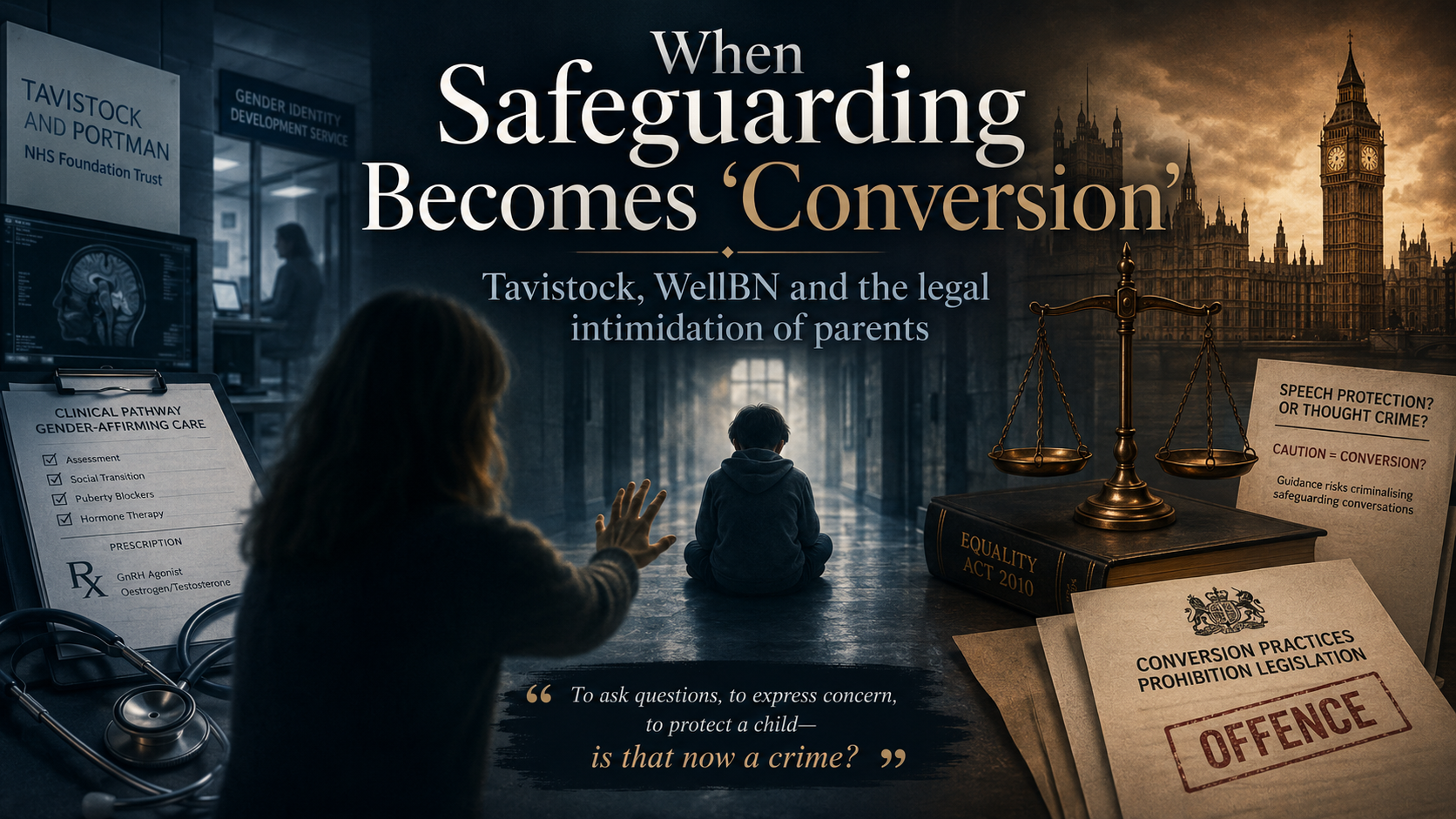
When Safeguarding Becomes “Conversion”: Tavistock, WellBN and the legal intimidation of parents
The physical complications now emerging from gender-related hormones and surgery cannot be separated from the safeguarding failures exposed at Tavistock and WellBN. Yet just as medicine is being forced to rediscover caution, the Government’s proposed Conversion Practices Bill risks making parents, counsellors, clergy and teachers afraid to question the beliefs that can place children upon an irreversible medical pathway.

The state and professional establishment which failed to protect children at Tavistock and WellBN is now proposing a legal regime under which the adults most likely to question gender affirmation may find themselves accused of abuse. This does not mean that every parent who refuses to affirm a child’s transgender identity will automatically be prosecuted. The criminal threshold in the draft Conversion Practices Bill is considerably higher than that. The danger is subtler and, in practice, more immediate: parents, therapists, clergy and teachers may learn that questioning a child’s declared identity can trigger complaints, safeguarding referrals, professional investigation, local-authority intervention and civil protection orders long before any criminal offence has been proved.
That danger must be considered in the light of what is now known about the medical pathway itself. Evidence presented by pelvic-health physiotherapist Elaine Miller at the Clinical Advisory Network on Sex and Gender conference in London on 6 July concerned the unwanted urinary and sexual consequences of transgender-related hormones and surgery. Miller and Professor Ruth Parry of Loughborough University have been examining published research and the experiences of adults who have undergone such interventions, including detransitioners. Their complete study awaits publication, but the complication rates upon which Miller drew are already present in peer-reviewed medical literature.¹
A systematic review and meta-analysis published in The Journal of Sexual Medicine reported urinary incontinence in as many as 15 per cent of males following vaginoplasty, urinary irritative symptoms in as many as 20 per cent and sexual dysfunction in a range extending to 75 per cent. Among females undergoing hysterectomy and phalloplasty, urinary incontinence was reported in as many as 50 per cent, urinary irritative symptoms in as many as 37 per cent and sexual dysfunction in 54 per cent. The authors cautioned that the available studies were limited and heterogeneous, but that qualification strengthens rather than removes the safeguarding concern: medicine is performing radical and irreversible operations while the quality of long-term evidence remains poor.²
These are not merely technical complications. Incontinence can govern whether a person travels, exercises, works, sleeps away from home or enters an intimate relationship. Urethral reconstruction can produce strictures, fistulas, obstruction, repeated operations and dependence upon catheterisation. Sexual dysfunction may mean chronic pain, loss of sensation or the permanent impairment of the very function which surgery was supposed to enhance.
This is the endpoint that safeguarding exists to prevent. Safeguarding is not confined to stopping an immediate assault or treating an already injured child. It includes protecting children from decisions whose consequences they cannot adequately understand, whose harms may not appear for years and whose irreversibility makes later regret medically useless. The adult learning to catheterise a surgically altered urinary tract was once the adolescent told that medical transition offered an authentic future. The woman living with pelvic pain or sexual dysfunction may once have been the girl whose distress, autism, sexuality, trauma or family difficulties were interpreted through the single explanatory category of gender identity.
Not every child who socially transitions will proceed to hormones, and not every child prescribed hormones will undergo surgery. The pathway is not an automatic conveyor belt. But neither is it a succession of entirely independent choices. Social transition changes the child’s relationships, expectations and public identity. Puberty suppression interrupts normal physical development. Cross-sex hormones produce permanent bodily changes and may intensify the perceived need for surgical reconstruction. Each step alters the conditions under which the next decision is made. What begins as an experiment in names and pronouns may therefore become a progressively narrowing corridor from which retreat grows socially, psychologically and physically more difficult.
The Tavistock Gender Identity Development Service demonstrated what happens when safeguarding is subordinated to an affirmative clinical culture. The independent Cass Review found that children presenting with gender distress frequently had complex mental-health, neurodevelopmental and psychosocial needs which had not been adequately integrated into their treatment. It warned that the evidence base for medical intervention was weak and that the Tavistock service had introduced innovative forms of care without the evidential rigour normally expected of new medicines and clinical procedures.
NHS England closed the Tavistock service on 31 March 2024 and replaced it with a fundamentally different regional model based within specialist children’s hospitals. Routine access to puberty blockers through NHS children’s gender services ceased. NHS England acknowledged the need for a holistic approach, stronger mental-health provision, multidisciplinary assessment and support for parents in understanding the importance of keeping options open and avoiding premature social transition.³
The importance of those reforms cannot be overstated. They amounted to an institutional admission that gender distress must not be permitted to eclipse the whole child. A declaration of identity is not a diagnosis. It does not explain why a child has come to reject his or her body. It does not resolve questions concerning autism, depression, obsessive behaviour, family conflict, trauma, same-sex attraction, peer influence or online immersion. Nor can it establish that a child possesses the maturity to comprehend infertility, sexual dysfunction, lifelong medication or the eventual removal and reconstruction of healthy organs.
The WellBN investigation proved that the safeguarding danger did not disappear when Tavistock closed. An independent NHS patient-safety investigation examined the prescribing of gender-related medication to children under eighteen at the Brighton and Hove GP practice. It concluded that potential harm had been caused to 78 children and young people and that the clinical approach, including oversight by the practice partners, “fell far short of what could be considered safe or appropriate”.⁴
The care was outside a commissioned NHS pathway. None of the clinicians examined by the investigation was professionally competent to initiate or assume responsibility for the medication without specialist oversight. There was an absence of necessary input from paediatric endocrinologists, specialists in gender incongruence, paediatricians, mental-health professionals and fertility specialists. Blood tests and other physical monitoring were often omitted. The investigators also identified badly maintained medical records, failures of clinical governance and concerns about the manner in which informed consent had been sought.⁵
These were not marginal procedural irregularities. Children were receiving powerful medications without the clinical architecture supposedly required to make such treatment safe. The practice was ordered to stop providing specialist gender care to under-eighteens, to cease prescribing hormonal medication outside NHS policy and to submit to enhanced monitoring. Former and current clinicians were referred for possible professional investigation.
Parents and campaigners had raised precisely the questions that the investigation was eventually compelled to ask. Had the children been properly assessed? Had coexisting mental-health and developmental conditions been explored? Had fertility and sexual function been discussed? Were clinicians acting within their competence? Were necessary tests being performed? Was consent meaningful?
Before the investigation, such questions could be characterised as hostility towards transgender people. Afterwards, the same questions appeared in the official language of patient safety. What critics called reckless prescribing became care falling far short of what was safe or appropriate. What parents called danger became “potential harm”. What had been dismissed as obstructive scepticism became the absence of competent specialist oversight.
That history should make Parliament extremely cautious about legislation which may discourage parents and professionals from questioning gender affirmation. Instead, on 25 June 2026, the Government published its draft Conversion Practices Bill for England and Wales. The proposal is explicitly trans-inclusive and would create offences relating to abusive conversion practices together with a new system of conversion practice protection orders.⁶
The Bill must be criticised accurately. It does not criminalise mere disagreement. To commit the principal offence, a person must undertake a “conversion practice”; that practice must be abusive; and it must cause serious physical or mental harm, or serious alarm or distress having a substantial adverse effect upon the individual’s ordinary activities. Healthcare is excluded unless the provider’s conduct falls far below the standards reasonably expected, a test which the explanatory notes equate with gross negligence. A calm conversation between parent and child is not, by itself, automatically a crime.
The difficulty lies in the breadth of what the Bill first designates as a conversion practice. It includes conduct undertaken with the intention of causing someone not to have, or not to believe that he possesses, a transgender identity. In deciding whether the practice is abusive, a court may consider controlling or coercive behaviour, economic pressure, psychological pressure and emotional pressure. There is no express protection for parents exercising ordinary parental responsibility, no specific guarantee for those declining to facilitate social transition and no statutory safeguard for counselling which explores gender distress without presuming that a declared transgender identity must be affirmed.⁷
The distinction between refusing to reinforce a belief and intending to make a child cease believing it may look straightforward in ministerial assurances. It will be less straightforward in the emotional disorder of a divided family. A parent may refuse to use a new name, decline to purchase a chest binder, restrict access to online communities, prevent attendance at an activist group, oppose private hormone treatment or insist upon exploratory counselling. Each of these may be a legitimate safeguarding decision. Each may nevertheless be described by an angry adolescent or activist adviser as controlling, coercive, economic or emotional pressure intended to suppress a transgender identity.
The parent may eventually be vindicated. That is not enough. The law does not need to convict a parent in order to silence one.
The allegation itself may provoke a school safeguarding referral, a social-services assessment, police contact, family-court proceedings or a professional complaint against a counsellor, teacher or clergyman. Parents already navigating a distressed child, a divided household and an ideologically charged school may decide that resistance carries risks they cannot afford. The chilling effect will arise not from the certainty of conviction but from the uncertainty of accusation.
The Bill’s proposed conversion practice protection orders make that danger more serious. A police force or local authority could apply for an order; another person could apply with the permission of the court; and a court hearing existing family proceedings could impose an order without a separate application. The court could include whatever prohibitions, restrictions or requirements it considered appropriate. In certain circumstances, an order could initially be made without notice to the person against whom it was directed. Breach of the order would itself carry criminal consequences.⁸
The implications for family disputes are obvious. A disagreement about social transition could be reframed as a question of protection from conversion. A parent who believes that a daughter is suffering from autism, trauma, same-sex confusion or online influence could find that the dispute is no longer whether affirmation is clinically justified, but whether parental resistance is abusive. The state would enter the family not merely to protect a child from violence, which it already has ample power to do, but potentially to regulate which understanding of the child’s identity may be expressed, reinforced or challenged.
This is especially perverse because current safeguarding policy is moving in the opposite direction. The Government’s own proposed guidance for schools recognises that gender-questioning children require sensitive and thoughtful consideration, that parental involvement can help to prevent safeguarding failures, and that social transition should not be treated as a routine or one-size-fits-all response. The guidance follows Cass in placing the child’s welfare above the demand for automatic affirmation.⁹
The Conversion Practices Bill may therefore establish a conflict at the heart of public policy. Schools are told to exercise caution, involve parents and avoid premature social transition. Parents who exercise that caution receive no explicit statutory protection from allegations that they are attempting to suppress a transgender identity. The state encourages parental safeguarding with one hand while creating new legal machinery capable of making that safeguarding hazardous with the other.
There is also a remarkable asymmetry between professionals and parents. The clinical institution enjoys an express healthcare protection, while the parent exercising ordinary safeguarding judgement receives no equivalent protection. The mother who says no may be required to defend her intention, her language, her restrictions and the emotional effect upon her child.
WellBN demonstrates why professional status cannot justify such confidence. The practice operated within healthcare, yet the investigation found that its care fell far short of what was safe or appropriate. It would be improper to declare in advance whether those facts would satisfy the Bill’s gross-negligence threshold. The broader lesson is nevertheless unavoidable: clinical credentials and affirmative intentions do not guarantee safe treatment. Institutions can fail. Specialists can be absent. Consent can be inadequate. Records can be defective. Tests can be omitted. Ideology can acquire the vocabulary of medicine while abandoning its disciplines.
Nor should sexual orientation and transgender identity be treated as though they present identical clinical and safeguarding questions. Coercive attempts to force a homosexual person to become heterosexual can involve genuine abuse and should be addressed by the ordinary criminal and safeguarding law. Same-sex attraction, however, does not ordinarily create a medical pathway towards puberty suppression, synthetic hormones, mastectomy, hysterectomy or genital reconstruction. A transgender identity may do precisely that. Questioning a child’s asserted gender identity may therefore be an attempt not to impose a new identity, but to prevent irreversible medicalisation while the causes of distress are properly explored.
Watchful waiting is not conversion. Non-directive counselling is not conversion. Refusing to tell a child that sex can be changed is not conversion. Declining to facilitate social transition is not conversion. Exploring autism, trauma, sexuality, family conflict or online influence is not conversion. Preserving a healthy body while a child’s personality develops is not conversion. These are the ordinary instruments of safeguarding.
Parliament should place those protections expressly upon the face of the Bill. The legislation should state unequivocally that parents may decline to facilitate social or medical transition; that counsellors may conduct open-ended exploratory therapy; that clergy may teach the moral and anthropological doctrines of their faith; that schools may recognise biological sex; and that professionals may challenge a diagnosis of gender dysphoria or a proposed treatment without their conduct being presumed to pursue an unlawful identity outcome.
The protection-order provisions also require substantial narrowing. They should not be employed to determine ordinary disagreements concerning names, pronouns, clothing, internet access, school policy, counselling or medical consent. No parent should face an order merely because he or she refuses to endorse the proposition that a child has changed sex or possesses an inner identity which overrides the body.
Real abuse should be prosecuted. Violence, threats, imprisonment, forced medication, sexual assault and deliberate psychological degradation are already morally abhorrent and substantially covered by existing law. The question Parliament must answer is not whether such conduct is wrong, but why a new and ideologically charged category is required—one which may transform disagreement about the nature of sex and the treatment of children into evidence of abusive intent.
The physical consequences described by Elaine Miller reveal what is at stake. Incontinence, strictures, sexual dysfunction, pelvic pain, repeated surgery and lifelong clinical dependence are not failures of social acceptance. They are bodily consequences of medical intervention. The law cannot make them disappear by classifying opposition to transition as conversion.
Children experiencing gender distress require compassion, patience and protection from cruelty. They also require adults willing to distinguish compassion from compliance. A safeguarding parent may need to tolerate a child’s anger. A responsible clinician may need to question the child’s preferred explanation. A faithful pastor may need to say that the body is not an accident and that sex is not a costume. None of these adults should be made afraid of the law for refusing to affirm what they believe to be false and dangerous.
Tavistock showed that institutions can mistake experimentation for care. WellBN showed that unsafe treatment can continue outside the specialist pathways supposedly created to prevent it. The evidence on surgical complications shows what may await those carried furthest along the pathway. The lesson should be humility, scrutiny and the recovery of parental authority.
Instead, Parliament risks creating a legal instrument through which the adults who say “stop” become suspects, while the institutions which said “proceed” retain the presumption of expertise.
The state which failed to stop unsafe prescribing must not make parents prove their innocence for stopping it at home.
- Nick Wallis, “Gender Surgery’s Incontinence Problem,” GenderBlog, 7 July 2026; Clinical Advisory Network on Sex and Gender and Society for Evidence-Based Gender Medicine, “Rethinking Youth Gender Medicine: First Do No Harm,” London, 5–6 July 2026.
- Mattia Dominoni et al., “Pelvic Floor and Sexual Dysfunctions after Genital Gender-Affirming Surgery: A Systematic Review and Meta-Analysis,” The Journal of Sexual Medicine 22, no. 1 (January 2025): 184–195.
- NHS England, “NHS England’s Response to the Final Report of the Independent Review of Gender Identity Services for Children and Young People,” 10 April 2024; NHS England, “Children and Young People’s Gender Services: Implementing the Cass Review Recommendations”; Department of Health and Social Care, “Ban on Puberty Blockers to Be Made Indefinite on Experts’ Advice,” 11 December 2024.
- NHS Surrey and Sussex Integrated Care Board, “Independent Patient Safety Investigation into Prescribing Practices at WellBN GP Practice in Brighton and Hove,” June 2026.
- Ibid.
- Office for Equality and Opportunity, Draft Conversion Practices Bill, CP 1604, 25 June 2026, updated 30 June 2026.
- Office for Equality and Opportunity, Draft Conversion Practices Bill, cl. 1; Explanatory Notes to the Draft Conversion Practices Bill, paras. 28–43.
- Office for Equality and Opportunity, Draft Conversion Practices Bill, sch., paras. 1–4.
- Department for Education, “Including Guidance on Children Who Are Questioning Their Gender in ‘Keeping Children Safe in Education’,” 12 February 2026.
RELATED ARTiCLES


LATEST ARTICLES
- Today’s Mass: October 16 St Hedwig of SilesiaHedwig of Silesia, a member of the Bavarian comital House of Andechs, was Duchess of Silesia from 1201 and of Greater Poland from 1231 as well as High Duchess consort of Poland from 1232 until 1238. She was canonized by the Catholic Church in 1267 by Pope Clement IV.
- Today’s Mass: October 15 St Teresa of AvilaSaint Teresa of Avila, born in 1515, was the reformer of the Carmelite Order and founded the Discalced Carmelites. Renowned for her mystical writings, she faced opposition while establishing numerous convents. Teresa’s deep spiritual insights and experiences led to her canonisation in 1622, and her feast is celebrated on 15 October.
- Today’s Mass: October 14 St Callistus, Bishop of Rome & MartyrCallistus was born to a Christian slave who had a Christian master in second-century Rome. He was placed in charge of a Christian bank which went broke. He fled the city, but was caught and sentenced to the treadmill, then later to the tin mines. He was later ransomed and returned to Rome…
- Sermon for St. WilfridToday marks the feast of St. Wilfrid, who was pivotal in establishing the Roman Christian tradition in England over the Irish. Born in 634 in Northumbria, he travelled to France and Italy, eventually becoming bishop of York. Despite conflicts with kings and church leaders, he successfully evangelised Sussex and laid foundations for future missions, showcasing both determination and a contentious spirit. St. Wilfrid passed away in 709, leaving a complex legacy of leadership and zeal for evangelism.
- THE GENERATION THAT WAS TOLD TO MOVE ON Is Rediscovering What the Church Left BehindArchbishop Salvatore Cordileone’s interview highlights the challenge of reconciling Catholic Tradition with contemporary practices, warning that restrictions like Traditionis custodes may deepen existing divisions. He notes younger Catholics are rediscovering traditional worship, which contrasts with the Church’s modern adjustments and emphasizes the need for reflective continuity in liturgical development.
CURRENT EDITION


Today’s Mass Propers
- Today’s Mass: October 16 St Hedwig of Silesia
 Hedwig of Silesia, a member of the Bavarian comital House of Andechs, was Duchess of Silesia from 1201 and of Greater Poland from 1231 as well as High Duchess consort of Poland from 1232 until 1238. She was canonized by the Catholic Church in 1267 by Pope Clement IV.




Leave a Reply