
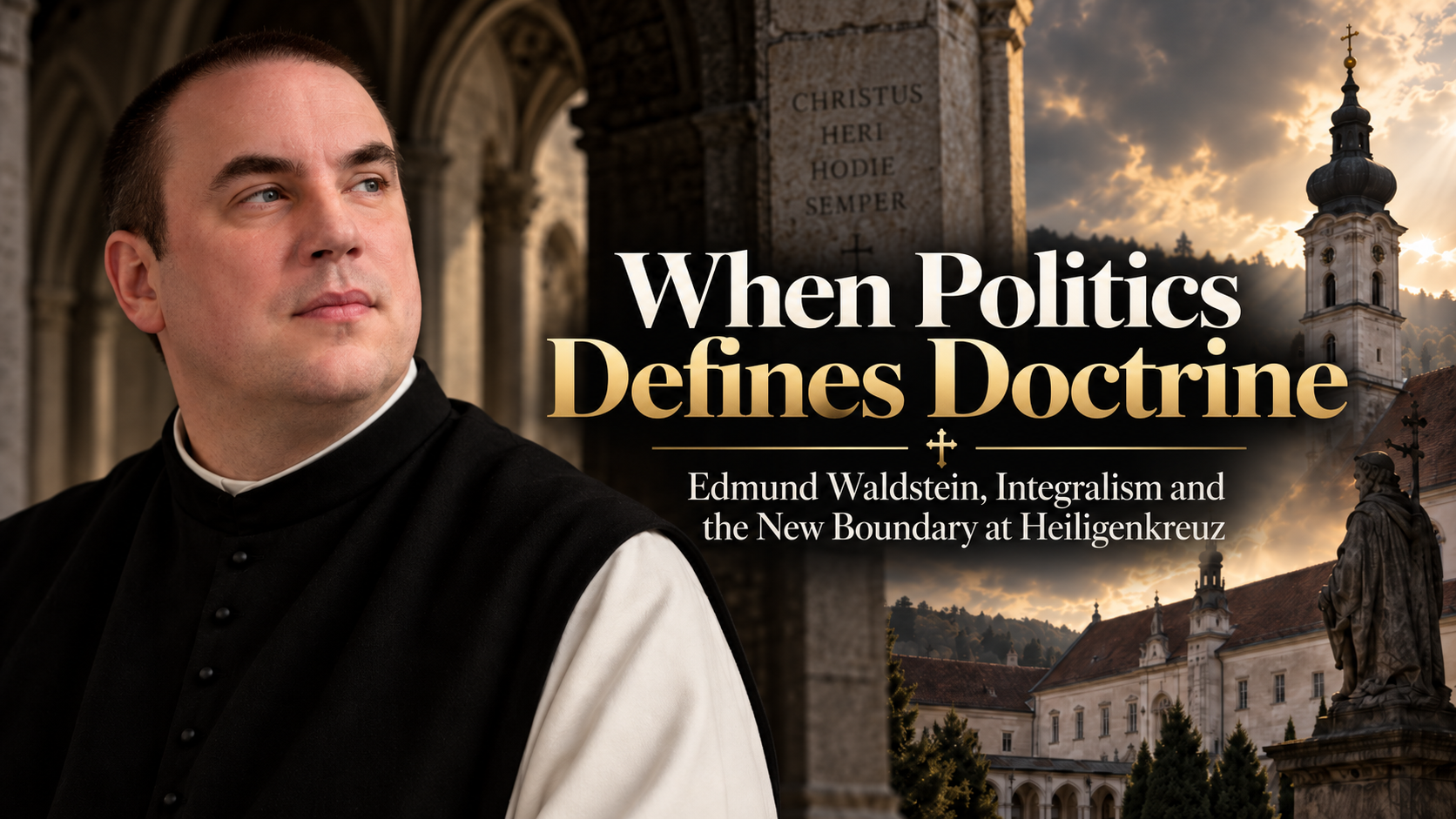
Father Edmund Waldstein’s continuing exclusion from teaching at Heiligenkreuz is now being welcomed as a defence of Catholic doctrine against “integralism”. Yet the controversy has outgrown the disputed writings of one Cistercian moral theologian. It raises a more consequential question about the boundaries of legitimate Catholic thought: whether inherited doctrines concerning political authority, the common good and the Social Kingship of Christ are being judged according to the Church’s own tradition, or increasingly through categories supplied by the contemporary liberal constitutional order.
When Professor Michaela Quast-Neulinger welcomed the decision that Father Edmund Waldstein OCist would not return to teaching at the Philosophical-Theological University Benedict XVI at Heiligenkreuz during Rector Wolfgang Klausnitzer’s term, she did more than endorse an academic disciplinary decision. “Integralist positions clearly contradict Catholic doctrine and the legal framework of a democratic constitutional state,” the Innsbruck theologian told Kathpress. She described the American-European networks with which Waldstein is associated as a danger both to democracy and to the Church, and invoked Pope Leo XIV’s Magnifica Humanitas as evidence that the integralist understanding of politics and the common good has now been rejected.¹
There is a legitimate argument to be had about Waldstein. His writings on the historical punishment of heresy invited criticism, and a professor of moral theology cannot reasonably complain when provocative claims about such a grave subject are examined with unusual care. There is also nothing inherently Catholic about every political programme which calls itself integralist. A theory which collapsed the proper distinction between ecclesiastical and temporal authority, or imagined the State simply as an executive instrument of the hierarchy, would raise serious objections from within Catholic teaching itself. The difficulty begins when these particular questions are absorbed into a much broader category in which “integralism”, “Christian nationalism”, the political Right and historic Catholic social doctrine gradually acquire the same ideological colouring.
Nuntiatoria addressed that problem directly yesterday in Christianity is right NOT rightwing. The distinction is fundamental. The political Right is a historically contingent political category; Catholic orthodoxy is not. Christians may arrive at positions commonly called conservative because the natural law and revelation require them to defend unborn life, marriage, the family, parental authority, sexual morality or the freedom of the Church. None of those doctrines derives its truth from conservatism. Equally, Catholic teaching cannot be reduced to the programme of a particular party, nation or political movement merely because that movement happens at one moment to defend some Catholic conclusions. The Church approaches political society through a vocabulary much older and more demanding than Left and Right: justice, natural law, subsidiarity, solidarity, the common good, the ordo amoris and the Social Kingship of Christ.²
The brief controversy surrounding J. D. Vance’s invocation of the ordo amoris illustrated how easily that vocabulary can itself be politicised. Vance expressed the principle imperfectly and conversationally, but the substance of his claim — that universal charity does not abolish differentiated duties towards family, neighbour, community and country — is hardly an invention of the American Right. Augustine writes of rightly ordered love; Aquinas gives an extensive treatment of the ordo caritatis and the differing practical obligations arising from proximity and relationship; the present Catechism itself places the love and service of one’s country within the “order of charity”. Francis was right to insist in his subsequent intervention that the Good Samaritan prevents ordered love from becoming an excuse for indifference towards the stranger. That qualification does not abolish the order. A parent has duties towards his own children which he does not possess in the same form towards every child in the world; public office likewise creates concrete responsibilities towards the political community entrusted to those who govern it. The episode was revealing less because Vance had discovered some neglected doctrine than because an orthodox moral distinction could so quickly be redescribed as evidence of nationalist ideology.³
Something similar is occurring around Waldstein. His own definition of integralism is considerably less exotic than the descriptions supplied by some of his critics. In May 2025, responding to accusations of right-wing extremism, he located his position in the sentence of Dignitatis Humanae which says that the Council’s teaching on religious liberty “leaves untouched traditional Catholic doctrine on the moral duty of men and societies toward the true religion and toward the one Church of Christ”. Waldstein argued for continuity between earlier and later Catholic teaching at the level of principle while allowing substantial discontinuity in historical application. He specifically stated that the Church no longer calls upon secular authority to act as her “secular arm”.⁴
He also made concessions which should remain part of any fair account of the dispute. Waldstein acknowledged that he had sometimes gone too far in defending earlier applications of Catholic principles. He stated unequivocally that he does not advocate the death penalty for heretics today and accepts the contemporary papal rejection both of that practice and of the present application of capital punishment more generally. He professed religious submission of intellect and will to the revised paragraph 2267 of the Catechism and to St John Paul II’s teaching on democracy and the rule of law. These statements do not prove his theological argument correct, but they materially alter the character of the accusation against him.⁴
The same is true of the official Heiligenkreuz declaration of January 2026. Waldstein signed that statement together with Abbot Maximilian Heim and Rector Klausnitzer. It repudiated right-wing extremism, stated that Waldstein rejects any political integralism in which either the State is subjected to the Church or the Church to the State, and affirmed his adherence to current Catholic social teaching, including the contemporary magisterial condemnation of the death penalty. It also affirmed human rights and opposition to coercive persecution. Whatever reservations Klausnitzer subsequently developed about Waldstein’s theological explanation, this was not a private qualification discovered after the event; it was a public statement carrying the signatures of the very parties now involved in the controversy.⁵
The latest dispute turns upon a scholarly treatment which Klausnitzer had requested from Waldstein and which, so far as the public record indicates, has not itself been published. According to the Rector, Waldstein did not adequately retract his earlier claims but tried instead to justify them through theological history. Klausnitzer went so far as to say that he would not accept Waldstein’s theological principles from a first-year student. The university has consequently ruled out his return to teaching during Klausnitzer’s rectorship, while the abbey has released Waldstein for further philosophical doctoral study in Rome. The severity of the judgement is clear; the argument being judged remains largely unavailable to those outside the university.⁶
That matters because there is a genuine theological problem beneath Waldstein’s provocative example. His earlier discussion involved Leo X’s Exsurge Domine, which condemned forty-one propositions drawn from Martin Luther, among them the proposition that burning heretics was contrary to the will of the Spirit. The bull does not assign an individual theological censure to each proposition, instead condemning the collection under a range of censures. It therefore cannot simply be converted into a timeless dogmatic command that Catholic rulers execute heretics. Yet neither can the history be honestly rewritten as though the Church’s approval of coercive penalties were merely a strange opinion accidentally entertained by a few medieval churchmen. The theological task is to distinguish enduring doctrine, disciplinary authority, prudential judgement and historical application without solving the difficulty by pretending that one side of the historical record never existed.⁷
The alteration of paragraph 2267 of the Catechism under Francis makes that problem more rather than less important. Before 2018 the Catechism, following Evangelium Vitae, began from the traditional principle that legitimate public authority was not absolutely excluded from recourse to capital punishment, while arguing that modern penal conditions had reduced cases of necessity to circumstances which St John Paul II described as “very rare, if not practically non-existent”. Francis’s revision rearranged the argument. Capital punishment is now described as something which “was long considered” an appropriate response to serious crime; the text then appeals to an “increasing awareness” of human dignity, a “new understanding” of penal sanctions and the availability of more effective detention before concluding that the death penalty is “inadmissible”.⁸
The semantic change deserves more attention than it often receives. The earlier wording presented the legitimacy of capital punishment in principle as part of the Church’s traditional moral teaching and then placed severe prudential restrictions upon its use. The 2018 wording historicises the previous position before introducing a developing awareness which leads to the present judgement. It stops short, however, of declaring the death penalty intrinsece malum. “Inadmissible” is not the established technical formula by which Catholic moral theology identifies an act as intrinsically evil, and the text itself continues to invoke changed penal circumstances. This allows an argument for continuity to be made, but it does so by reframing the question rather than explicitly repudiating what came before.
How the change was introduced is therefore relevant. Francis approved the new wording at an audience with Cardinal Luis Ladaria, then Prefect of the Congregation for the Doctrine of the Faith, and ordered it translated and inserted into every edition of the Catechism through a Rescriptum ex Audientia SS.mi. The accompanying CDF letter, likewise approved by Francis, presented the revision as an “authentic development of doctrine” and insisted that it stood in continuity with the preceding Magisterium. That gives the new formulation genuine magisterial authority. It was not, however, promulgated as a dogmatic definition declaring the historic teaching false, nor as a solemn doctrinal decree defining capital punishment as intrinsically evil. In the ordinary sense of the expression, the new wording was introduced by direct papal fiat: Francis approved the text and commanded its insertion. The precise character of that act matters when discussing what the amendment does, and does not, settle.⁹
A Catechism is an authoritative norm for teaching the Faith, but its authority is not magical and its individual propositions do not all possess the same theological note merely because they appear between the same covers. Fidei Depositum, by which St John Paul II promulgated the Catechism, described it as a sure norm for teaching the faith and a valid instrument of ecclesial communion. It remains a presentation of the deposit of faith rather than an independent source capable of creating new revelation. When a revised paragraph attempts to express a development in an area possessing a long scriptural, patristic, scholastic and magisterial history, theologians are entitled — indeed obliged — to ask how the new formulation stands in continuity with that history. The CDF’s own insistence upon continuity presupposes the legitimacy of the question.
This is especially important because St John Paul II had already provided an obvious route towards practical abolition without asserting that previous Catholic teaching had been morally defective. Evangelium Vitae concentrated upon necessity: where bloodless means suffice to defend society, public authority should limit itself to those means. John Paul’s restriction was formidable, but when he proceeded in the following section to formulate the absolute prohibition he spoke of the deliberate killing of the innocent. He had not simply collapsed execution after due conviction into the moral species of murder. One may oppose every execution carried out in Britain, America or anywhere else in the contemporary world and still recognise the theological importance of that distinction.⁸
The 2018 revision can accordingly be received as a strong contemporary magisterial judgement favouring abolition without requiring Catholics to believe that Augustine, Aquinas, the Roman Catechism, generations of approved theologians and earlier popes all defended something intrinsically contrary to human dignity without the Church noticing. If the new wording is genuinely continuous, continuity must be capable of theological explanation. A semantic strategy which moves the historic doctrine into the past tense but declines formally to condemn it may preserve enough room for that explanation; it does not make the historical problem vanish.
This is where the treatment of Waldstein becomes intellectually important. If his attempt to reconcile Exsurge Domine, earlier Catholic doctrine and the contemporary Magisterium fails, the failure should be demonstrated. The public discussion would benefit from seeing the argument which Klausnitzer considers so elementary a failure of theological method. Simply citing the latest Catechism wording cannot by itself answer a dispute whose subject is precisely the doctrinal relationship between that wording and the tradition it replaced.
Quast-Neulinger’s broader claim raises a different problem. She joins two propositions which ought to be kept distinct when she says that integralist positions contradict both Catholic doctrine and “the legal framework of a democratic constitutional state”. A proposal might well be constitutionally impossible in contemporary Austria and yet remain a legitimate subject of Catholic political theology. Conversely, democratic constitutional states enact laws which Catholics are bound to regard as gravely unjust. Abortion does not become morally good when enacted by parliament, and a doctrinal proposition cannot become false because the Austrian constitution has no place for it. Constitutional law possesses jurisdiction over the legal order of the State. It possesses none over the content of the Catholic Faith.¹
Nor does Magnifica Humanitas establish the equivalence suggested by Quast-Neulinger. Leo XIV is explicit about the proper autonomy of earthly realities. He affirms the distinction between the ecclesial and political communities, says that each operates within its own sphere, and states plainly that the Church does not claim the functions proper to the State. Those passages provide a clear answer to any integralist theory which would erase the institutional distinction between the two powers. Yet Leo immediately situates that autonomy within a Christian account of reality. His discussion of the common good begins with the necessity of a “firm relationship with God”, while the encyclical insists elsewhere that religion cannot simply be confined to private life and that social and political realities remain subject to moral discernment.¹⁰
The same encyclical describes Catholic Social Doctrine as containing a “core set of unchanging truths”. Its account of subsidiarity insists that higher authorities must respect and sustain the proper responsibilities of families, local communities and intermediary institutions rather than absorbing them; Leo also places upon the political community its own irreplaceable responsibility for the common good. None of this resembles an ecclesiastical seizure of the State, but neither does it resemble a secular order emancipated from God. The Pope’s distinction between Church and State is a distinction of competencies within the moral order, not a declaration that political society is metaphysically neutral.¹¹
The Council itself left a sentence which remains stubbornly resistant to attempts to resolve the matter by appealing simply to “Vatican II”. Dignitatis Humanae teaches civil immunity from religious coercion and roots that freedom in the dignity of the human person. In the same opening paragraph it declares that this teaching “leaves untouched traditional Catholic doctrine on the moral duty of men and societies toward the true religion and toward the one Church of Christ”. That qualification is not a traditionalist gloss imposed upon the declaration; it belongs to the conciliar text.¹²
The present Catechism retains the same proposition. Paragraph 2105 speaks of the social duty of religion and teaches that Christians should infuse the mentality, customs, laws and structures of their communities with the Christian spirit, thereby making manifest the Kingship of Christ over creation and, specifically, over human societies. Leo XIII had already developed the duties of civil society towards God in Immortale Dei while allowing considerable latitude concerning the legitimate form of government. Pius XI’s Quas Primas went further in expressly rejecting the exclusion of Christ and His law from political and public life. Whatever judgement is made about modern integralist strategies, those teachings cannot plausibly be reclassified as twentieth-first-century American Christian nationalism.¹³
That was the point made in Christianity is right NOT rightwing, and Heiligenkreuz now supplies an unusually concrete illustration. Political language can quietly perform theological work for which no doctrinal argument has been offered. A Catholic position is called “right-wing”; the political label acquires moral opprobrium; the opprobrium is then transferred back to the doctrine. Opposition to abortion, defence of the natural family and Catholic sexual morality have all been subjected to this process. The ordo amoris can be treated as nationalism, the public Kingship of Christ as integralism, and Catholic teaching concerning the obligations of political society as a threat to democracy. The original proposition may never actually have been examined.
Catholicism has its own means of preventing these doctrines from degenerating into political idolatry. The ordo amoris places country below God rather than above Him. Natural law constrains rulers rather than sanctifying whatever they wish to do. The common good requires the perfection of persons and communities and cannot be reduced to national power, economic prosperity or electoral preference. Subsidiarity protects the family and lesser communities from the State. Universal charity prevents patriotism from becoming contempt for foreigners. Above all, the supernatural destiny of man prevents political success from becoming the highest good. These principles expose the errors of nationalism from within Catholic doctrine without requiring the Church to adopt secular liberalism as their antidote.
They also explain why the Social Kingship of Christ cannot be reduced to nostalgia for confessional states. The doctrine begins with a claim about reality: Christ is King, man is created by God, moral truth does not originate in the State, and political communities remain subject to the moral law. The institutional forms through which societies acknowledge those truths have varied enormously and may vary again. Recognising that historical contingency is very different from conceding the secularist premise that Christ’s sovereignty becomes irrelevant the moment human beings act politically.
Heiligenkreuz already stood at the centre of another dispute about authority before the latest Waldstein development. In When Synodality Stops at the Cloister Door, Nuntiatoria examined Rome’s decision to suspend the ordinary abbatial election and require the community instead to elect an administrator for three years. More than eighty solemnly professed monks remain capable of choosing the man who will govern them, but for the prescribed period they may not elect him as their abbot. The anomaly was striking in an abbey which the Holy See itself had recently described as remarkably flourishing, and it sat uneasily beside the contemporary language of subsidiarity and participation.¹⁴
The Waldstein affair does not prove that the two controversies arise from the same cause, and it would be irresponsible to suggest that they do without evidence. It does, however, place Heiligenkreuz at another point where institutional authority and the limits of legitimate theological diversity meet. A university may decide that a lecturer’s scholarship does not satisfy its standards. A rector may judge that students should not be taught by him. Those are real responsibilities, not acts of persecution merely because the scholar concerned is associated with traditional Catholic thought. Yet a pontifical theological university bearing Benedict XVI’s name should be particularly capable of showing why an argument is defective rather than allowing political categories to do the work of theological criticism.
There is no need to turn Waldstein into a confessor for Tradition. Some of his earlier language was unnecessarily provocative, and the attempt to discuss the doctrinal history of capital punishment through the burning of heretics practically guaranteed that the distinction he wished to establish would be lost in the controversy surrounding the example. If his private submission to the university contains theological errors, they remain theological errors however sympathetically one regards his larger concern for continuity.
His critics assume an equally serious burden when they move beyond those errors and condemn “integralist positions” in general. Which positions? The subjection of temporal administration to episcopal government? Catholic tradition does not require it. Coercion in religion without regard to the development articulated in Dignitatis Humanae? That can be criticised directly. The proposition that society possesses duties towards the true religion? The Council itself says that doctrine remains untouched. The principle that political authority is subject to natural and divine law? Catholic social teaching still presupposes it. The public Kingship of Christ? Pius XI taught it with unmistakable clarity.
Precision here is not pedantry. Without it, “integralism” becomes a container into which inconvenient propositions may be placed before the container itself is declared beyond the boundaries of respectable Catholicism.
That is the larger importance of Heiligenkreuz. The Church has every right to reject political theories incompatible with her Faith, whether they arise from the revolutionary Left, nationalist Right, libertarian individualism or authoritarian reaction. She can exercise that judgement only while retaining her own criteria. The moment compatibility with the prevailing constitutional order becomes confused with doctrinal orthodoxy, the relationship has been reversed: Catholic teaching is no longer judging politics; politics has begun to determine which parts of Catholic teaching may still be spoken without embarrassment.
Edmund Waldstein may have failed in his treatment of difficult material. That question deserves judgement on the merits of his argument, not acquittal by association with Tradition. Yet the same standard belongs to those now judging him. The history of Catholic doctrine cannot be reduced to whatever can be reconciled most comfortably with the ideological settlement of 2026, and uncomfortable continuities cannot be removed by changing their political labels. The Church received neither the ordo amoris, natural law, the common good nor the Social Kingship of Christ from the modern Right. She did not receive them from liberal democracy either. They belong to a theological inheritance whose measure is ultimately Christ Himself, and it is from that inheritance — not from the fashions of the political age — that Catholic doctrine must continue to judge both Waldstein and his critics.
¹ Kathpress, 4 September 2026, “Heiligenkreuz: Theologen begrüßen Ausschluss von P. Waldstein”.
² Nuntiatoria, 8 September 2026, “Christianity is right NOT rightwing”.
³ St Augustine, De Doctrina Christiana, I.27; St Thomas Aquinas, Summa Theologiae, II-II, q.26, “The Order of Charity”; Catechism of the Catholic Church, nn. 2239–2241; Francis, 10 February 2025, “Letter to the Bishops of the United States of America”.
⁴ Edmund Waldstein OCist, 4 May 2025, “On an Article at Feinschwarz”.
⁵ Stift Heiligenkreuz, 23 January 2026, “Statement aufgrund des Berichts des Dokumentationsarchivs des Österreichischen Widerstandes”.
⁶ Kathpress, 4 September 2026, “Heiligenkreuz: Theologen begrüßen Ausschluss von P. Waldstein”.
⁷ Leo X, 15 June 1520, Exsurge Domine; Edmund Waldstein OCist, 4 May 2025, “On an Article at Feinschwarz”.
⁸ St John Paul II, 25 March 1995, Evangelium Vitae, nn. 56–57; Congregation for the Doctrine of the Faith, 1 August 2018, “New revision of number 2267 of the Catechism of the Catholic Church on the death penalty”.
⁹ Congregation for the Doctrine of the Faith, 1 August 2018, “Rescriptum ex Audientia SS.mi: New revision of number 2267 of the Catechism of the Catholic Church on the death penalty”; “Letter to the Bishops regarding the new revision of number 2267 of the Catechism of the Catholic Church on the death penalty”.
¹⁰ Leo XIV, 15 May 2026, Magnifica Humanitas, nn. 11, 19–22.
¹¹ Leo XIV, Magnifica Humanitas, nn. 46, 59–73.
¹² Second Vatican Council, 7 December 1965, Dignitatis Humanae, n. 1.
¹³ Catechism of the Catholic Church, n. 2105; Leo XIII, 1 November 1885, Immortale Dei; Pius XI, 11 December 1925, Quas Primas.
¹⁴ Nuntiatoria, 21 August 2026, “When Synodality Stops at the Cloister Door: Rome suspends the abbatial election at Heiligenkreuz”; Leo XIV, Magnifica Humanitas, nn. 68–72.




Leave a Reply