
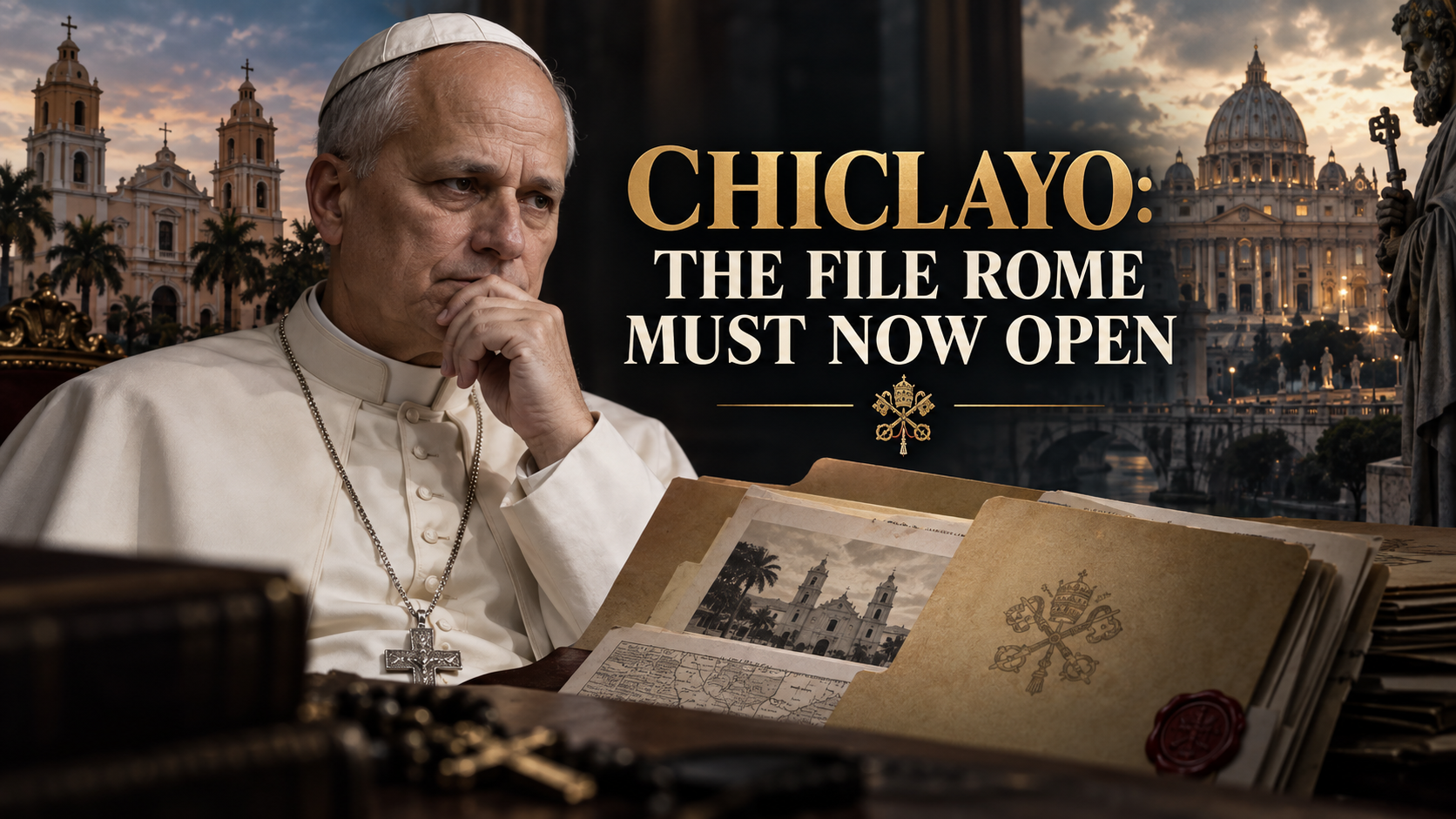
The allegations surrounding Robert Prevost’s handling of clerical abuse complaints in Chiclayo have never justified the easy accusation that the future Pope deliberately protected abusers. Nor, however, can the equally easy defence that everything was done properly now be sustained without qualification. A later Church-appointed investigator has been recorded describing the earlier inquiry as gravely deficient; his reading of Prevost’s own precautionary decree appears to contradict what the Diocese of Chiclayo subsequently told the public; one accused priest has died without any publicly demonstrated canonical investigation of the allegation against him; and another left the clerical state without the allegations receiving a canonical judgement on their merits. Leo XIV has repeatedly called for transparency in abuse cases. Chiclayo is now a test of that principle.
Nuntiatoria first examined the Chiclayo allegations in August 2025, when Ana María Quispe Díaz publicly challenged the account given by the Diocese of Chiclayo concerning complaints which she and two other women had brought against diocesan priests. We returned to the case when Fr Eleuterio Vásquez González, known locally as “Lute”, was granted a dispensation from the clerical state; again when serious questions arose about the handling of the canonical proceedings; and in July this year when the decisive issue became impossible to avoid: if the preliminary investigation which the diocese says was conducted under ✠Robert Prevost in 2022 actually happened according to law, where are the canonical acts which demonstrate it?¹
That question has become more serious, not less. Nothing published since then establishes that Robert Prevost deliberately concealed sexual abuse or knowingly sought to protect an abuser. It would be irresponsible to turn procedural questions into proof of corrupt motive. Quispe herself has described aspects of her first contact with Prevost in terms inconsistent with the crudest version of a cover-up: she says that when she spoke to him in 2020 he listened to her, expressed sorrow and encouraged recourse to the authorities. Prevost’s documented record in the entirely separate Sodalitium Christianae Vitae scandal also includes survivors who say that he listened when others would not, assisted them and helped bring their concerns before Rome.²
That evidence deserves its full weight. A serious investigation cannot begin with the conclusion that every ambiguity proves guilt. Neither, however, may Catholic loyalty begin with the opposite conclusion that the future Pope must therefore have handled every case correctly. The evidence now available suggests a more uncomfortable possibility: a bishop capable of acting decisively for victims in one setting may nevertheless have presided over a seriously inadequate canonical response in another. Human conduct is rarely tidy enough to furnish either hagiography or prosecution with everything it wants.
The Diocese of Chiclayo placed its own defence on the record in September 2024. Its statement said that three young women came to the bishopric in the first week of April 2022 with allegations against Vásquez; that ✠Prevost received them; that precautionary measures were imposed; that Vásquez was removed from his parish and prohibited from exercising priestly ministry; that a preliminary investigation was completed; and that the resulting dossier was sent to the Dicastery for the Doctrine of the Faith on 21 July 2022. The statement added that the civil complaint was subsequently closed on grounds of prescription, that the civil decision was forwarded to Rome in April 2023, and that the DDF archived the ecclesiastical case pro nunc on 10 August 2023.³
Those claims matter because they are not theological judgements or expressions of episcopal confidence. They are statements about documents, dates and juridical acts. Either the decree imposed the restriction described by the diocese or it did not. Either the preliminary investigation gathered the material which canon law contemplates or it did not. Either the resulting acts were transmitted to Rome or something less substantial was sent. These are questions which can be answered from the file.
The most striking new evidence concerns the precautionary decree itself. In recordings published by InfoVaticana, Fr Giampiero Gambaro OFM Cap., the canonist later appointed to work on the renewed proceedings, is heard reading what he identifies as ✠Prevost’s decree of April 2022. According to that reading, Vásquez was forbidden to hear confessions and deprived of the functions attached to his office as parish priest at Santa María Magdalena in Ciudad Etén. Gambaro then says that the decree did not prohibit Vásquez generally from celebrating Mass.⁴
That account sits uneasily with the Diocese of Chiclayo’s 2024 statement, which said that the priest had been prohibited from exercising priestly ministry and later spoke expressly of a prohibition on the “public exercise” of that ministry. The distinction is not semantic. Removal as parish priest and withdrawal of the faculty to hear confessions are specific canonical restrictions; a prohibition on public priestly ministry is considerably broader. If Gambaro accurately read the 2022 decree, the diocesan statement subsequently described the precautionary measures in terms wider than the written decree itself.
Nuntiatoria must place an evidential qualification around the recordings. They were published by InfoVaticana, an outlet which has taken a strongly critical position towards Prevost over Chiclayo, and Nuntiatoria has not independently authenticated the original audio files or inspected the original decree. But source criticism cuts both ways. The recordings are not anonymous descriptions of what Gambaro supposedly said: audio has been published, the speaker is identified, detailed passages have been transcribed, and no public repudiation of the substance by Gambaro or the Diocese of Chiclayo has emerged in the material we have been able to locate. They therefore require an answer, not dismissal by association.⁴
The same recordings raise a still deeper difficulty concerning the preliminary investigation. Gambaro is heard describing the earlier inquiry in exceptionally severe terms, calling it una tomadura de pelo and speaking of errors, superficiality and an inquiry in which, according to his account, very little was put to the accused priest. InfoVaticana translates the expression variously as a “joke” or “mockery”; the precise English rendering matters less than the unmistakable substance of Gambaro’s criticism. He was not describing an exemplary investigation with a few clerical defects. He was describing something which, in his judgement, had been seriously inadequate.⁵
That is not itself a formal judgement against ✠Prevost. Gambaro’s conversation with complainants was not a sentence of the DDF, and his appointment as an investigator did not transform every opinion he expressed into an official determination of the Holy See. Yet he was not an outside commentator either. He had been entrusted with work on the case and had access to material which the public has not seen. His assessment must therefore be weighed against the earlier diocesan assertion that the investigation had been conducted according to the Church’s norms. Repeating that assertion is no longer enough.
Canon law provides the proper test. Canon 1717 states that whenever an Ordinary receives information which at least appears true concerning a delict, he is carefully to inquire into the facts, circumstances and imputability unless an inquiry would be entirely superfluous. Canon 1719 further provides that the acts of the investigation and the decrees by which it is opened and concluded are to be preserved in the curial archive where they are not required for a subsequent penal process. The preliminary investigation is therefore not merely a bishop hearing a complaint, advising recourse to the police and sending a summary to Rome. It is a juridical procedure which necessarily generates acts.⁶
The DDF’s 2020 Vademecum, which was already in force when Quispe says she first contacted ✠Prevost, is even more explicit. A notitia de delicto is any information concerning a possible delict which reaches the Ordinary; it need not take the form of a formal complaint and may be communicated orally, in writing, through another person, through civil authorities, through the media or by other adequate means. Where the report is at least plausible, a preliminary investigation is ordinarily to follow. The revised Version 2.0 issued in June 2022 preserved the same essential rule.⁷
That point bears directly upon the second priest, Fr Ricardo Yesquén Paiva. Quispe says that she spoke to ✠Prevost concerning Yesquén in 2020. The Diocese of Chiclayo later acknowledged the Yesquén matter but said that no case could be opened because he suffered from a serious degenerative illness which left him unable to defend himself; it also stated that he had not exercised priestly ministry for years.³ The difficulty is not that illness was irrelevant. The condition of an accused priest can plainly affect the form and feasibility of a penal proceeding. The difficulty is that incapacity to undergo trial is not the same juridical question as whether a plausible report should have been received, documented and preliminarily investigated when it first reached the Ordinary.
Yesquén died in July 2026 aged fifty-nine. Reporting on the case states that no canonical investigation of the allegation against him was ever opened; the Diocese of Chiclayo’s own earlier statement had already said that a case could not be opened because of his condition.⁸ His death proves nothing about the truth or falsity of the accusation. What it does mean is that any possibility of a penal determination concerning his personal culpability has now disappeared with him. That makes the documentary question concerning what happened after the 2020 report more urgent, because recollection can no longer be tested against the accused in any later process.
The treatment of prescription creates another difficulty. The DDF Vademecum expressly distinguishes canonical procedure from civil procedure. It states that the preliminary canonical investigation is to be carried out independently of the corresponding civil investigation, subject to the requirements of local law, and warns that civil rules concerning prescription, the classification of offences and the age of victims may differ substantially from canon law. It further provides that even where canonical prescription appears to have elapsed, the Ordinary is still to respond to the notitia de delicto and transmit the matter to the DDF, which has authority to derogate from prescription in individual cases.⁹
The Vademecum does allow the results of a sufficiently thorough civil investigation to make a separate preliminary canonical inquiry unnecessary in some circumstances. But it expressly requires ecclesiastical authority to examine the civil investigation carefully before reaching that conclusion, precisely because the two legal systems may ask different questions and employ different limitation periods. A Peruvian prosecutor’s conclusion that a criminal prosecution cannot proceed because the alleged facts are prescribed is therefore not equivalent to a canonical determination that nothing remains to be investigated.
The later fate of Vásquez does not resolve the difficulty. Correspondence published in 2025 shows that a process was under way for his voluntary dispensation from the obligations of the priesthood and the clerical state. Subsequent documentation and Peruvian reporting state that the dispensation was granted in September 2025 and that the complainants were informed later that year.¹⁰ A dispensation from the clerical state is not a conviction for sexual abuse, and it must not be written about as though it were. Equally, it is not an acquittal.
That distinction is fundamental. A canonical penal process protects more than one interest at once. It protects an accused cleric from being condemned merely because an allegation has been made, but it also offers a juridical means by which grave allegations may be examined and, where the evidence permits, determined. Administrative departure from the clerical state can remove a man permanently from ministry. It cannot retrospectively supply a judgement on allegations which were never adjudicated.
The complainants regard that outcome as a denial of justice. Their conclusion is theirs and must be identified as such. What can be said objectively is that the departure of Vásquez from the clerical state left the central historical allegation without a canonical judgement on its merits. Nuntiatoria had already raised that difficulty in “When Justice Is Dispensed: Leo XIV, Clerical Abuse Survivors, and the Unfinished Truth of Chiclayo” in November 2025 and again in “When Zero Tolerance Ends in Silence: Leo XIV, Chiclayo and the Crisis of Credibility” the following month.¹¹ The subsequent publication of Gambaro’s comments has strengthened the documentary question those articles raised.
None of this disposes of the evidence favourable to Prevost. Associated Press interviewed victims of the Sodalitium who described him as an unusual ally inside the Peruvian hierarchy. They credited him with listening to them, helping some obtain reparations, supporting journalists who had exposed the movement and facilitating access to Pope Francis. AP also reported the contention of Sodalitium survivors and journalists that people sympathetic to the suppressed movement had reasons to attack Prevost’s reputation.² That possibility should not be dismissed merely because it is inconvenient to his critics.
Yet even a hostile campaign cannot make an authentic document say something it does not say. Nor can the defects of one advocate remove a defect from a canonical investigation. Ricardo Coronado Arrascue, who at one stage represented the complainants, has made assertions which Nuntiatoria has previously found exaggerated or unsupported, including claims concerning the later Peruvian safeguarding norms and speculation about Prevost’s motives. Quispe subsequently broke with him and accused him of pursuing an agenda of his own. Nuntiatoria dealt with those matters in July precisely because unreliable advocacy can damage a legitimate case.¹²
But Coronado is no longer the central evidential problem. Canon 1717 does not depend upon his credibility. The DDF Vademecum does not depend upon his credibility. The Diocese of Chiclayo’s 2024 statement does not depend upon his credibility. The wording of the decree which Gambaro is recorded reading does not depend upon his credibility, assuming the recording and document are authentic. Nor does Gambaro’s criticism of the earlier investigation become false merely because Coronado has weaknesses as a witness and advocate.
The proper Catholic position is therefore neither accusation by insinuation nor exoneration by office. Nuntiatoria stated earlier this month in “The Church Does Not Need Our Denial” that fidelity to the Church requires neither credulity towards every allegation nor the suppression of legitimate scrutiny when allegations concern senior churchmen. Catholic doctrine does not teach that administrative decisions made by a bishop become irreformable when that bishop later becomes Pope. Nor does respect for the Petrine office require a journalist to pretend that an apparent contradiction between a diocesan statement and a canonical decree is not there.¹³
Leo XIV’s own words make the standard still clearer. In June 2025 he called for a culture throughout the Church which would tolerate no form of abuse and said that such a culture must arise from active vigilance, transparent processes and sincere listening to those who have been wounded. Days later, addressing bishops during their Jubilee, he said that a bishop must be firm and decisive in dealing with every case of abuse, especially where minors are involved, and must respect the legislation in force.¹⁴ The principles are sound. Their credibility now requires their application to the Pope’s own previous government.
That does not require the indiscriminate publication of a confidential penal dossier. Victims have rights to privacy; accused persons have rights to their good name and defence; witnesses may have supplied evidence in confidence; canonical archives cannot simply be thrown open to satisfy public curiosity. Transparency is not the abolition of confidentiality. It is possible, however, to protect those legitimate interests while establishing whether the indispensable juridical acts actually exist.
Rome could commission an independent canonical review and publish a redacted chronology identifying the decree by which the preliminary investigation was opened, the person charged with conducting it, the principal investigative acts undertaken, whether and when the accused was questioned, the decree by which the preliminary investigation was concluded, the episcopal votum, the exact terms of the precautionary measures and the material transmitted to the DDF on 21 July 2022. It could also explain what canonical action followed the 2020 report concerning Yesquén, why the scope of ✠Prevost’s decree appears narrower than the Diocese of Chiclayo later represented it to be, and what role the Peruvian civil prescription decision played in the DDF’s pro nunc archiving of the case. None of this requires publishing the intimate testimony of the women involved.
Such an examination could exonerate Leo XIV from the gravest interpretation of events. If the acts show that a genuine preliminary investigation was completed, that the apparent discrepancy concerning the restrictions has an innocent juridical explanation, and that the cases were handled substantially according to the norms then in force, the Pope and the Church would be better served by allowing those facts to be demonstrated. If, on the other hand, the record shows an investigation which was perfunctory or defective, there is no theological reason why the defect cannot be acknowledged.
There is a peculiar danger in believing that papal reputation is protected by leaving such matters unresolved. The opposite is usually true. An allegation unanswered by evidence acquires a life of its own; a documentary contradiction left unexplained invites theories far more damaging than the original facts may justify. The Church learned painfully during the abuse crisis that institutional assurances unsupported by accessible evidence no longer settle serious questions.
Nuntiatoria therefore does not conclude that Robert Prevost covered up clerical sexual abuse in Chiclayo. The evidence presently available does not justify that finding, and motive cannot responsibly be manufactured from procedural inadequacy. What can now be said is narrower and firmer: serious questions exist about the adequacy of the 2022 investigation and the accuracy of the Diocese of Chiclayo’s subsequent public description of the precautionary measures imposed upon Vásquez. Those questions are grounded not merely in the claims of complainants or hostile commentators, but in canon law, in the diocese’s own statement and in the recorded words attributed to the Church-appointed investigator who later handled the case.
That is enough to require an answer. Leo XIV has asked the Church for transparent processes, vigilance and sincere listening in cases of abuse. Chiclayo gives him the opportunity to show what those words mean when transparency concerns his own record. Rome need not endorse the accusations, sacrifice canonical confidentiality or prejudge the dead and the untried. It need only establish the documentary truth.
The Church does not require another campaign for or against Robert Prevost. It requires the acts. If the investigation was done, let the record show what was done; if it was defective, let the defect be admitted and learned from. Until that happens, Chiclayo cannot honestly be described either as proof of a papal cover-up or as a matter already disposed of. The responsible conclusion is less dramatic, but more serious: the record remains unresolved, and Rome possesses the means to resolve it.
¹ “Pope Leo XIV Accused of Mishandling Abuse Allegations in Peru: Woman Contradicts Diocesan Account”, Nuntiatoria, 10 August 2025; “When Justice Is Dispensed: Leo XIV, Clerical Abuse Survivors, and the Unfinished Truth of Chiclayo”, Nuntiatoria, 23 November 2025; “If the Investigation Happened, Where Are the Acts? Ricardo Coronado, Pope Leo XIV and the Unresolved Chiclayo Record”, Nuntiatoria, 4 July 2026.
² “As Pope Leo XIV faces scrutiny, victims of abusive Catholic group say he helped when others didn’t”, Associated Press, 24 May 2025.
³ “Church Answers False Accusations Against Cardinal Francis Prevost”, Zenit, reproducing the Diocese of Chiclayo statement, 12 September 2024.
⁴ “Prevost never suspended Lute from the public ministry as a priest”, InfoVaticana, 6 November 2025.
⁵ “The Church admitted Prevost’s negligence in the Lute case”, InfoVaticana, 5 November 2025; “The instructor who called Prevost’s investigation in the Lute case a ‘joke’ reappears at the top of the Verbo Encarnado”, InfoVaticana, 1 September 2026.
⁶ Code of Canon Law, canons 1717–1719, Holy See.
⁷ “Vademecum on Certain Points of Procedure in Treating Cases of Sexual Abuse of Minors Committed by Clerics”, Congregation for the Doctrine of the Faith, 16 July 2020; Vademecum Version 2.0, Dicastery for the Doctrine of the Faith, 5 June 2022.
⁸ “Ricardo Yesquén, one of the priests from Chiclayo accused of abuse before Prevost, dies without having been investigated”, InfoVaticana, 23 July 2026.
⁹ “Vademecum on Certain Points of Procedure in Treating Cases of Sexual Abuse of Minors Committed by Clerics”, Congregation for the Doctrine of the Faith, 16 July 2020.
¹⁰ Correspondence concerning the requested dispensation of Eleuterio Vásquez González, July 2025; “Iglesia acepta salida del ‘padre Lute’ tras denuncia de agresión sexual en Chiclayo”, Correo, 16 November 2025; “New evidence shows Pope Leo XIV granted dispensation to accused Peruvian priest”, BishopAccountability.org, December 2025.
¹¹ “When Justice Is Dispensed: Leo XIV, Clerical Abuse Survivors, and the Unfinished Truth of Chiclayo”, Nuntiatoria, 23 November 2025; “When Zero Tolerance Ends in Silence: Leo XIV, Chiclayo and the Crisis of Credibility”, Nuntiatoria, 9 December 2025.
¹² “If the Investigation Happened, Where Are the Acts? Ricardo Coronado, Pope Leo XIV and the Unresolved Chiclayo Record”, Nuntiatoria, 4 July 2026.
¹³ “The Church Does Not Need Our Denial: Truth, scandal and the false defence of ecclesiastical reputation”, Nuntiatoria, 7 September 2026.
¹⁴ “Pope urges Church to foster a culture that does not tolerate abuse”, Vatican News, 21 June 2025; Meditation of Pope Leo XIV on the occasion of the Jubilee of Bishops, 25 June 2025; Francis, Vos estis lux mundi, 7 May 2019.



Leave a Reply