
The Rhode Island Files: abuse, accountability, and the unfinished reckoning
The release of the Rhode Island Attorney General’s report into clerical sexual abuse in the Diocese of Providence marks another sobering chapter in the long and painful reckoning with abuse within the Catholic Church in the United States. Published on 4 March 2026 following a multiyear investigation led by Attorney General Peter Neronha, the report documents decades of abuse by clergy and the institutional failures that allowed it to continue.¹
The investigation identified seventy-five Catholic clergy accused of abusing more than three hundred victims since 1950, though officials emphasized that the true number is likely significantly higher.² The report draws on hundreds of thousands of diocesan records spanning seventy years, including files from the diocesan secret archive—the confidential repository of sensitive personnel and disciplinary matters maintained in accordance with canon law.³
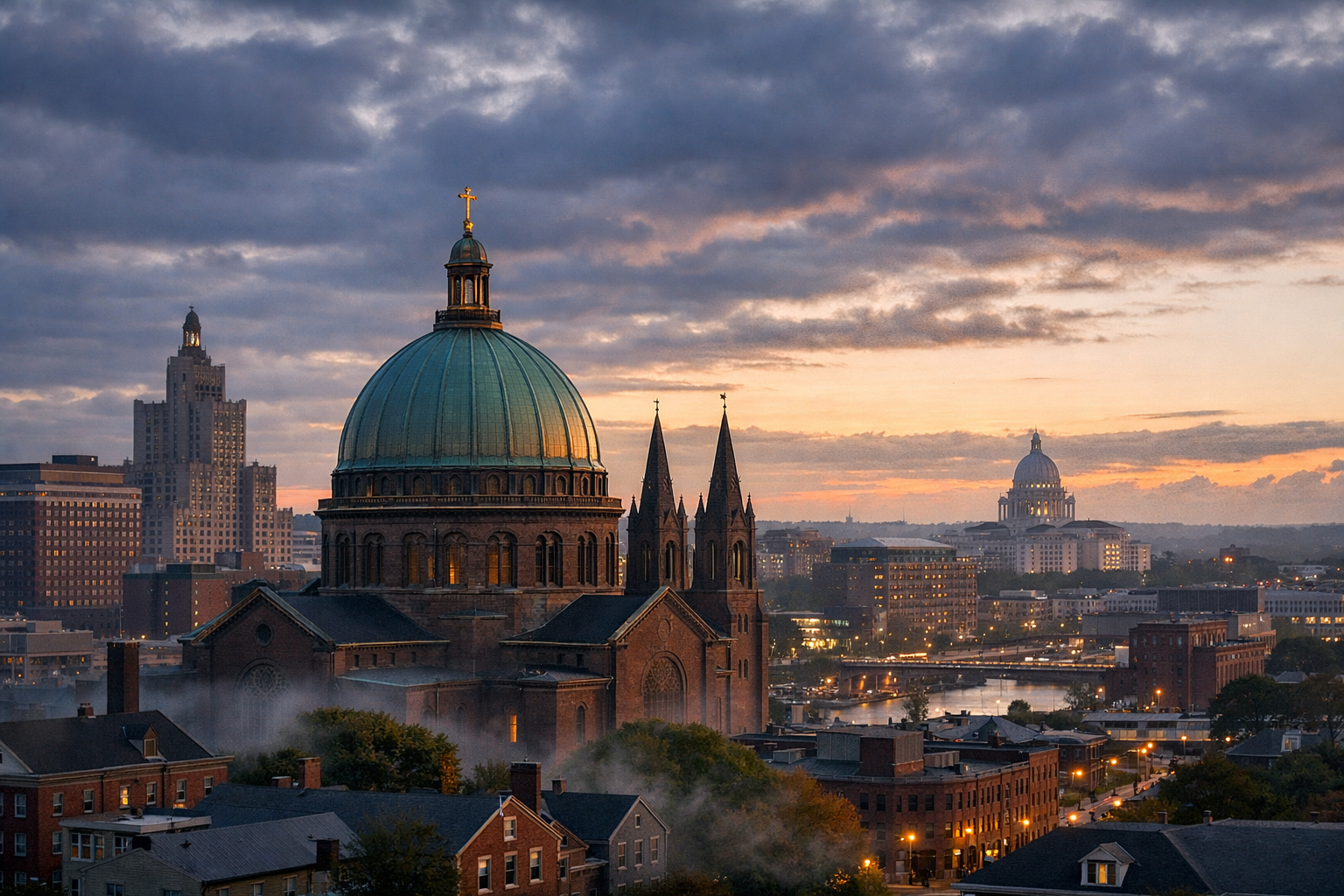
Rhode Island is an especially striking setting for such an inquiry. The state has long possessed the highest proportion of Catholics in the United States, with roughly four in ten residents identifying as Catholic, making the Church a central social and cultural institution in the region.⁴ The Diocese of Providence itself dates to 1872 and serves nearly 600,000 Catholics across the state.
Yet the investigation’s conclusions are deeply troubling. The report argues that many accusations were historically handled internally, with bishops prioritising the avoidance of public scandal and the preservation of clerical reputations. Priests accused of abuse were frequently transferred between parishes or sent to treatment facilities rather than removed from ministry or reported to civil authorities.⁵
This pattern—now widely documented across multiple dioceses—was already exposed two decades ago during the Boston clergy abuse crisis. The Boston Globe’s Spotlight investigation in 2002 demonstrated that diocesan leadership had reassigned priests known to have abused minors.⁶ Subsequent inquiries, including the Pennsylvania grand jury report of 2018, revealed similar systemic failures across large portions of the American Church.⁷
The Rhode Island investigation therefore confirms what earlier studies have suggested: the crisis was not confined to one diocese or one era but reflected a broader institutional pattern extending through much of the second half of the twentieth century.
A culture of secrecy and misplaced confidence
One of the most striking features of the Rhode Island report is the role played by the Church’s reliance on psychological treatment programs. Beginning in the 1950s, accused priests were sometimes sent to retreat-style centres or psychiatric facilities where specialists attempted to treat what was then considered a behavioural disorder.⁸
At the time, many church leaders believed that therapy could rehabilitate offenders and allow them to return safely to ministry. Investigators now describe this reliance on treatment as naïve and dangerously optimistic. Priests were often returned to parish work after treatment, sometimes with minimal supervision.
In numerous cases, victims and their families were not informed when accused clergy were reassigned. Nor were local communities made aware of prior allegations.
The result was a pattern that allowed abuse to continue in new settings.
Failures of accountability
The Rhode Island report found that only about one quarter of the accused clergy ever faced criminal charges, and only fourteen were ultimately convicted.⁹ Several factors contributed to this limited accountability.
Many crimes occurred decades earlier, placing them outside statutes of limitation. In other cases, victims delayed reporting abuse for many years—an extremely common phenomenon in child sexual abuse cases, where trauma and shame often prevent immediate disclosure.¹⁰
The investigation also identified instances in which individuals involved in diocesan review processes were themselves later accused of abuse. One priest who had served on the diocesan review board evaluating abuse claims continued in active ministry for years despite complaints against him, finally being removed only in 2022.¹¹
Such cases further undermined public confidence in internal church oversight mechanisms.
Legal and investigative constraints
Unlike the Pennsylvania investigation of 2018, Rhode Island law does not permit the public release of grand jury reports. This forced investigators to pursue an alternative legal arrangement with the diocese in 2019 to gain access to archival material.¹²
Under this agreement, the Diocese of Providence turned over decades of records from its confidential archives. However, investigators report that access was not unlimited; some requests for interviews with diocesan personnel responsible for handling abuse allegations were declined.
Despite these limitations, the report remains one of the most comprehensive examinations of clerical abuse ever conducted in Rhode Island.
The theological and ecclesial dimension
For Catholics, the scandal is not merely institutional or legal; it is profoundly theological. The priesthood exists to serve the sanctification of the faithful and the salvation of souls. When priests betray that sacred trust—especially by harming the young—the damage extends beyond individual victims to the credibility of the Church’s moral witness.
At the same time, a careful distinction must be maintained between the indefectible holiness of the Church as the Mystical Body of Christ and the grave sins committed by members of the clergy. Catholic doctrine has always recognised that priests remain capable of serious moral failure. The crisis therefore reveals not a defect in the sacramental priesthood itself but a catastrophic failure of discipline, oversight, and moral formation within certain ecclesial structures.
Many observers have also noted that the majority of documented cases occurred between the 1960s and the early 1990s, a period marked by deep turmoil within the Church following the Second Vatican Council. Some researchers have suggested that the collapse of traditional seminary discipline and moral clarity during this period contributed to the emergence of abusive behaviour and the institutional confusion that allowed it to persist.¹³
While such explanations remain debated, few deny that the post-conciliar decades witnessed a profound crisis of clerical identity and governance.
A reckoning still unfinished
The Rhode Island report is unlikely to close the chapter on the abuse crisis. Many victims have already died without seeing justice. Others may still come forward in the future. Records have been lost or destroyed over the decades, leaving gaps that may never be filled.
Yet investigations such as this remain essential if the Church is to confront its past honestly. Transparency, accountability, and genuine reform are necessary not only for the protection of children but also for the restoration of credibility in the Church’s mission.
The Catholic faith ultimately rests not upon the virtue of individual clergy but upon Christ Himself. Nevertheless, the moral authority of the Church in society depends in part upon the integrity of those who represent her publicly.
For that reason, the work of reckoning with abuse—however painful—remains indispensable.
- Rhode Island Office of the Attorney General, Report on the Investigation into Child Sexual Abuse in the Roman Catholic Diocese of Providence, March 2026.
- Associated Press, “Sprawling investigation finds decades of sexual abuse among Catholic priests in Rhode Island,” 4 March 2026.
- Code of Canon Law (1983), canon 489, concerning the maintenance of diocesan secret archives.
- Pew Research Center, Religious Landscape Study: Rhode Island, 2015.
- Rhode Island Attorney General Report (2026).
- Michael Rezendes et al., Boston Globe Spotlight Team reporting on clergy abuse, 2002.
- Pennsylvania Office of the Attorney General, Grand Jury Report on Catholic Clergy Sexual Abuse, 2018.
- Thomas G. Plante, “Catholic Clergy Sexual Abuse: A Review of the Literature,” Pastoral Psychology, vol. 51 (2003).
- Rhode Island Attorney General Report (2026).
- U.S. Department of Justice, Child Sexual Abuse: Delayed Disclosure Patterns, National Institute of Justice.
- Rhode Island Attorney General Report (2026).
- Associated Press reporting on the investigation agreement, 2026.
- Philip Jenkins, Pedophiles and Priests: Anatomy of a Contemporary Crisis (Oxford University Press, 1996).
RELATED ARTICLES


Latest ARTICLES
- Today’s homily: St Nicholas TolentinoThe reflection celebrates Saint Nicholas of Tolentino, emphasising that holiness is achieved not through personal efforts but through grace. It highlights his life of service, prayer, and self-discipline, suggesting that his true sanctity stems from dependence on God. The message reinforces the importance of a single-hearted focus on God in one’s spiritual journey.
- Today’s Mass: September 10 St Nicholas of TolentinoSaint Nicholas of Tolentino, born around 1246 in Italy, became a devout Augustinian hermit known for his piety and dedication to preaching. He spent his later years in Tolentino, promoting virtue, and maintaining his chastity until his death in 1306. Canonised in 1446, his tomb is revered by the faithful.
- Today’s Mass: September 09 Day II in the Octave of The Nativity of the Blessed Virgin MaryThe feast of Our Lady’s Nativity, of ancient Eastern origin and established at Rome by the time of Pope St Sergius I, celebrates Mary as the immaculate New Eve and the dawn of salvation, the chosen tabernacle from whom the Redeemer would take His flesh. Today the Church also commemorates St Gorgonius, an officer of the imperial household at Nicomedia who, with his companion Dorotheus, embraced the Faith and suffered martyrdom under Diocletian in A.D. 303; his relics were later translated to Rome.
- NOMEN MANET, RES DEEST ~ The Name Remains; the Reality Is Lacking: Spiritual Conference for Nuntiatoria CXXIIThe content emphasises the disconnect between the names associated with Catholicism and the actual practices of faith. It highlights the importance of embodying belief through genuine actions, urging self-examination rather than mere external observance. Ultimately, it advocates for a restoration of sincerity in faith, calling individuals to authentically reflect their beliefs through their lives and worship.
- Mary Is Co-Redemptrix: Cardinal Burke Reopens Rome’s Marian ControversyCardinal Raymond Leo Burke has declared the Virgin Mary as “Co-Redemptrix” amidst controversy over the Vatican’s restriction on this title. The debate revolves around the appropriateness of certain theological language and whether terminology historically used can still accurately express Marian cooperation in Redemption without compromising Christ’s unique role.




Leave a Reply