
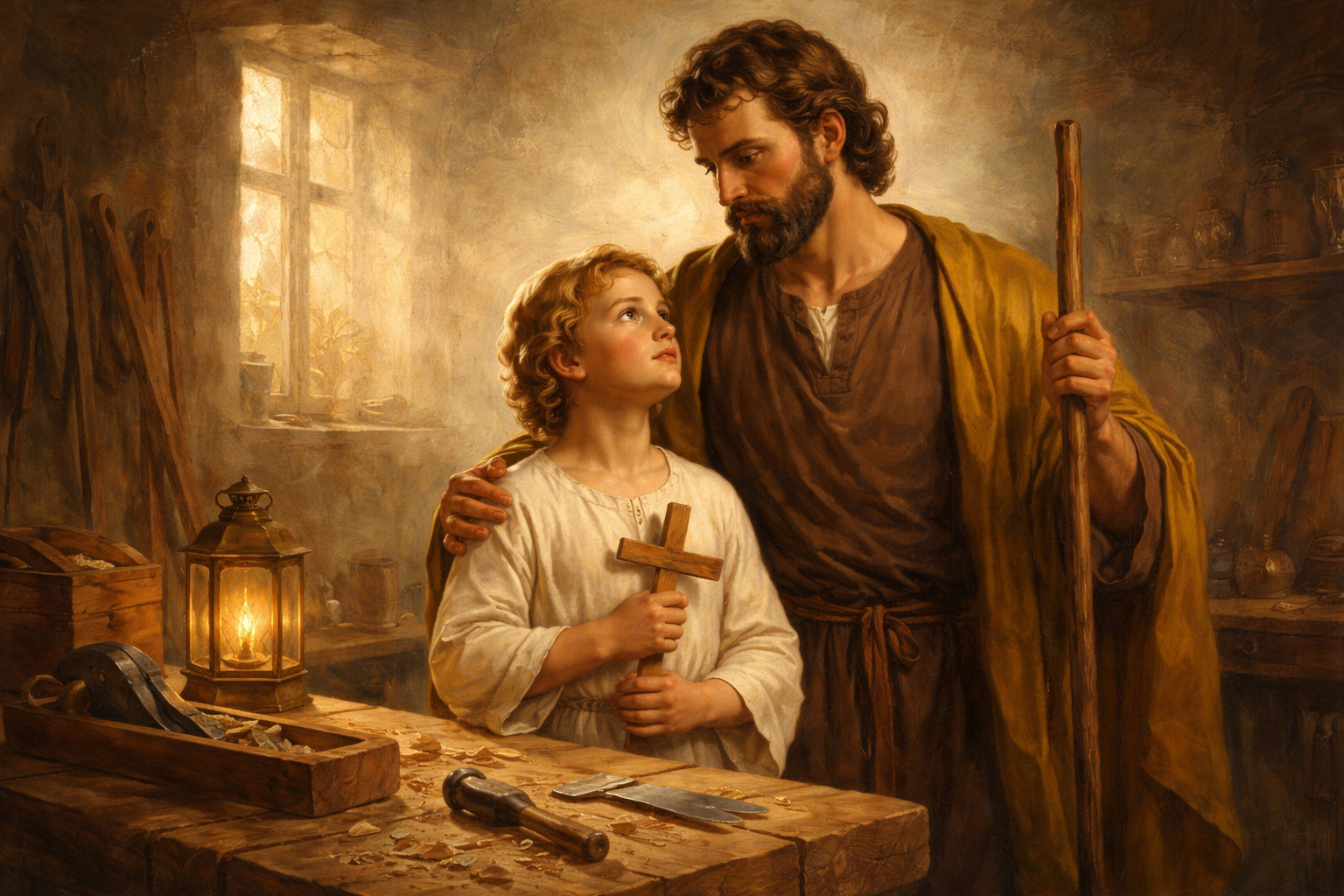
Novena: Under the Mantle of Saint Joseph, Reclaim True Fatherhood
The days before the Feast of St. Joseph are not merely devotional preliminaries. They are a summons.
From March 10 to March 18, the Church invites her children to enter the Novena in honour of the just man of Nazareth. But this year, the invitation must be heard more urgently. We do not approach St. Joseph out of sentiment. We approach him because fatherhood—domestic and spiritual—stands in need of restoration.¹
The confusion of our age is not accidental. It is paternal. Where fathers hesitate, homes weaken. Where fathers abdicate, authority dissolves. Where fathers become either domineering or passive, children are left unguarded. The crisis is not abstract; it is visible in families, parishes, and communities that no longer know how to lead with strength ordered by charity.²
Novena in Honorem Sancti Ioseph
Invocatio
V. Gloriose Sancte Ioseph,
R. Ora pro nobis.
Oratio
O gloriose Sancte Ioseph, Iesu Christi fidelis assecla, ad te corda et manus elevamus, tuam potentem intercessionem implorantes, ut a benignissimo Corde Iesu impetremus omnia auxilia et gratias necessarias ad salutem nostram spiritualem et temporalem, praesertim gratiam bonae mortis, necnon specialem favorem quem nunc petimus.
(Hic exprimatur intentio.)
O custos Verbi Incarnati, fiducia plena confidimus preces nostras per te ante thronum Dei exaudiri.
Amen.
Pater Noster…
Ave Maria…
Gloria Patri…
Collecta
Deus, qui ineffabili providentia beatum Ioseph sanctissimae Genetricis tuae Sponsum eligere dignatus es; concede, quaesumus, ut quem protectorem veneramur in terris, intercessorem habere mereamur in caelis. Per Christum Dominum nostrum. Amen.
NOVENA IN HONOUR OF ST. JOSEPH
Opening Invocation (Daily)
V. O glorious St. Joseph,
R. Pray for us.
PRAYER
O glorious St. Joseph, faithful follower of Jesus Christ, to thee do we raise our hearts and hands to implore thy powerful intercession in obtaining from the benign Heart of Jesus all the helps and graces necessary for our spiritual and temporal welfare, particularly the grace of a happy death, and the special favour we now implore:
(Here mention your intention.)
O guardian of the Word Incarnate, we feel animated with confidence that thy prayers in our behalf will be graciously heard before the throne of God. Amen.
Our Father…
Hail Mary…
Glory be…
Concluding Collect
O God, who in Thine ineffable providence didst vouchsafe to choose blessed Joseph to be the spouse of Thy most holy Mother; grant, we beseech Thee, that we may be worthy to have him for our intercessor in heaven whom we venerate as our protector on earth. Through Christ our Lord. Amen.
The Novena to St. Joseph: Indulgence, Theology, and Tradition
The devotion of the March 10–18 Novena developed widely after the proclamation of St. Joseph as Patron of the Universal Church by Pope Pius IX in the decree Quemadmodum Deus (8 December 1870).¹ The Raccolta incorporated various prayers in his honour, attaching indulgences in accordance with pre-1968 discipline.²
The indulgence formula most frequently attached to the principal prayer (“O glorious St. Joseph…”) granted:
– 300 days indulgence for each devout recitation
– Plenary indulgence once monthly under the usual conditions
The theological foundation rests on:
– The Church’s authority to bind and loose (Matt. 16:19)
– The doctrine of the Treasury of the Church (Clement VI, Unigenitus, 1343)³
– The reaffirmation of indulgences by the Council of Trent (Session XXV, 1563)⁴
The reform of indulgence discipline under Pope Paul VI, Apostolic Constitution Indulgentiarum Doctrina (1967), abolished numerical quantification but explicitly preserved the doctrine.⁵
Thus the Novena to St. Joseph stands within:
– Biblical foundation (Matt. 1–2)
– Magisterial affirmation
– Liturgical tradition
– Pre-conciliar devotional discipline
- Pius IX, Quemadmodum Deus, 8 December 1870.
- The Raccolta: A Manual of Indulgences, various pre-1968 editions (e.g., 1957 English translation).
- Clement VI, Unigenitus Dei Filius, 1343.
- Council of Trent, Session XXV, Decree on Indulgences (1563).
- Paul VI, Indulgentiarum Doctrina, 1 January 1967.
St. Joseph stands before us as the measure
He does not argue. He acts.
He does not posture. He obeys.
He does not dominate. He protects.
Sacred Scripture calls him a “just man” (Matt. 1:19), a title that signifies not mere moral decency but covenantal fidelity.³ His authority is rooted in submission to God. When commanded in a dream, he rises (Matt. 1:24; 2:14). When danger threatens, he moves decisively. Entrusted with the Virgin and the Child, he guards them without calculation or complaint.⁴
Such fatherhood is neither cultural nostalgia nor ideological assertion. It is theological reality. All human fatherhood derives analogically from the Fatherhood of God, as St. Paul teaches: “For this cause I bow my knees to the Father… of whom all paternity in heaven and earth is named” (Eph. 3:14–15).⁵ To distort fatherhood is to obscure divine order. To reclaim it is to cooperate with grace.
The Church has repeatedly affirmed this truth. The Council of Trent described the family as a divinely instituted order within which paternal governance serves both discipline and sanctification.⁶ In the modern era, papal teaching has warned that when fatherhood weakens, society itself destabilises.⁷
Therefore, we exhort the faithful—especially fathers, priests, and young men—to enter this Novena with deliberate intention.
Let fathers ask:
– Do I lead my household in prayer?
– Do I protect my family from moral harm?
– Do I model discipline, restraint, and courage?
Let priests ask:
– Do I exercise spiritual fatherhood with clarity and firmness?
– Do I guard the flock entrusted to me?⁸
Let young men ask:
– Am I preparing myself for responsibility?
– Do I cultivate strength governed by virtue?
The Novena is not a pious formality. It is an act of alignment. For nine days we place ourselves under the patronage of the man whom God trusted with His Son. In 1870, Pope Pius IX solemnly declared St. Joseph Patron of the Universal Church, recognising his enduring role as guardian and protector of Christ’s Mystical Body.⁹
If fatherhood is renewed, families will stabilise. If families stabilise, parishes will strengthen. If parishes strengthen, society will regain coherence. Renewal begins not with programmes, but with sanctity.
Enter the Novena. Invoke St. Joseph with seriousness and clarity. Ask not only for favours, but for formation.
Under his mantle, let vera paternitas—true fatherhood—rise again.

- Vera Paternitas: A Pastoral Epistle for the Feast of St. Joseph 2025, Nuntiatoria (19 March 2025).
- Cf. Catechism of the Council of Trent, Part II, On the Sacrament of Matrimony.
- Matthew 1:19 (Douay-Rheims).
- Matthew 1:24; 2:13–15.
- Ephesians 3:14–15 (Douay-Rheims).
- Council of Trent, Session XXIV, Doctrine on the Sacrament of Matrimony (1563).
- Cf. Pope Leo XIII, Rerum Novarum (1891), on the natural order of family authority; cf. also Pope Pius XI, Casti Connubii (1930).
- Cf. 1 Peter 5:2–3; John 21:15–17.
- Decree Quemadmodum Deus, 8 December 1870.
Related Articles





Leave a Reply