- The Accusation Is the Sentence: Nadeem Masih and Pakistan’s Blasphemy Machinery
Blind Catholic Nadeem Masih has been acquitted after ten months in a Pakistani prison, but his ordeal exposes a system in which a blasphemy accusation can remove a rival, seize a livelihood, silence a critic or terrorise an entire Christian community—without ever producing credible evidence.
- Synodality or Stage Management? Fr. James Martin, Study Group 9, and the Manufactured Consensus Crisis
Concerns arise regarding the Synod on Synodality, as signals suggest it prioritises selected narratives over genuine discernment, potentially undermining the Catholic Church’s teachings. Limited participation and the curation of testimonies have led to accusations of manufactured consensus, eroding trust in ecclesial processes and risking spiritual integrity within the faithful community.
- The Synod and the Revolt Against Revelation: Bishop Schneider’s Warning and the Crisis of Catholic Identity
Bishop Athanasius Schneider has warned that the recent Final Report of Synod Study Group No. 9 crosses into heresy, reflecting a broader crisis within the Catholic Church regarding the understanding of divine revelation. He cautions that modern language and concepts threaten traditional doctrines, risking the very identity of Catholicism.
- Judicial Rebuke: High Court Overturns OfS Free Speech Fine — Process Collapses, Not the Question Itself
The High Court overturned a £585,000 fine against the University of Sussex, ruling that the Office for Students acted unlawfully. While the issue of a “chilling effect” on free speech remains unresolved, the Court identified significant procedural failures and bias in the regulator’s approach, emphasising the importance of lawful reasoning in regulatory practices.
- Net Zero and the Moral Supply Chain Crisis: Britain’s Green Transition and the Hidden Cost of “Clean” Energy
The UK’s transition to Net Zero, framed as a moral necessity, faces scrutiny due to its reliance on “shadow supply chains” rooted in countries with poor human rights records. The extraction of critical minerals, notably cobalt and lithium, raises ethical concerns about child labour and environmental harm, questioning the integrity of Britain’s green policies.
- Audience Denied, Errors Embraced: Vatican II, the SSPX Crisis, and the Asymmetry of Rome’s Ecumenical Praxis
The current Church crisis highlights a contradiction in Rome’s ecumenical approach, where the SSPX faces penalties for seeking doctrinal clarity, while Anglican representatives, whose orders are invalid, are warmly received. This asymmetry underscores unresolved tensions from Vatican II regarding authority and doctrinal coherence, revealing a deeper crisis beyond mere discipline.
- Montagna Report: Vatican Preparing Schism Declaration Ahead of SSPX Consecrations — A Crisis of Ecclesial Authority and Legitimacy
The Montagna Report reveals that the Vatican’s Dicastery for the Doctrine of the Faith is preparing a declaration of schism in response to episcopal consecrations by the Society of St. Pius X, scheduled for July 1, 2026. This preparation highlights a significant crisis in ecclesial authority and the recognition of its legitimacy, amidst ongoing doctrinal and liturgical tensions.
- Crewe Raid Exposes a Known Safeguarding Pattern—And a System That Still Acts Too Late
The Crewe incident highlights a recurring pattern of safeguarding failures in the UK, characterised by institutional hesitation and ineffective responses to known risks. Despite existing legal frameworks, alleged abuses often go unaddressed until harm is compounded. This case tests the commitment of leaders to prioritise proactive safeguarding over reputational considerations.
- Abortion Images and Free Speech: R v Skinner Overturns Conviction in Landmark High Court Ruling
The High Court overturned the conviction of pro-life campaigner David Skinner for sending graphic abortion images privately to police, reaffirming that lawful expression cannot be criminalised simply because it offends. This ruling restores the principle of proportionality in free speech and protects against the expansion of public display definitions.
- Free Speech on Trial: The Crown’s Failure at Glasgow and the Fragility of Britain’s “Buffer Zone” Regime
The prosecution of Rose Docherty in Glasgow collapsed due to the Crown’s failure to establish a legal offence under the Abortion Services (Safe Access Zones) Act. The case highlighted the vague definitions and discretionary enforcement within the “buffer zone” legislation, raising concerns about potential infringements on free speech and legal certainty in future prosecutions.
- Rome Opens the File on Charlotte — A Test Case for Liturgical Authority
The Dicastery for Divine Worship has formally received a recourse regarding Bishop Michael T. Martin’s liturgical directives in Charlotte, raising issues of administrative accountability under canon law. This case, focusing on the removal of altar rails and kneelers, challenges the balance between diocesan authority and the rights of the faithful.
- Cardinal Ernest Simoni and Pope Leo XIV: The Witness of the Martyrs in an Age of Amnesia
In April 2026, Pope Leo XIV met Cardinal Ernest Simoni and Dame Sarah Mullally, symbolising contrasting ecclesial priorities. Simoni’s testimony, rooted in his experience of persecution, highlights the importance of sacrifice and martyrdom within the Church. In contrast, Mullally embodies diplomatic engagement, emphasising the need to balance doctrine with contemporary discourse on unity and peace.
- Pope Leo XIV and Sarah Mullally: When the Church Shows What She Does Not Teach
The meeting between Pope Leo XIV and Sarah Mullally highlights the tension between visible gestures of unity and the Church’s established doctrines. While aiming for ecumenical cooperation, the Church risks projecting an image of unity that contradicts its teachings, particularly on Anglican orders and women’s ordination. This encounter exemplifies the need for clarity in presenting doctrinal truth amidst evolving perceptions.
- Immanence and Transcendence: The Relocation of God and the Crisis of the Modern Church
The modern Church faces a fundamental crisis rooted in a shift from a transcendent understanding of God to an immanent one, where theology begins with human experience rather than divine revelation. This reorientation risks diluting doctrine and morality, redefining the role of God from a commanding presence to a mere interpreter of human meaning.
- Catholic Bishops’ Empty Moralizing? Dignity, Order, and the Collapse of Proportion in Contemporary Catholic Discourse
The involvement of the United States Conference of Catholic Bishops in the case Trump v. Barbara highlights a pressing constitutional issue regarding birthright citizenship. Their stance risks transforming prudential judgments into moral absolutes, neglecting the importance of political order and context, ultimately muddling the distinction between human dignity and governance principles.
- Independence Without Authority: CofE Safeguarding Reform and the Limits of Ecclesial Self-Regulation
The Church of England faces a credibility crisis leading to proposals for the Independent Safeguarding Authority (ISA) amid a public consultation. While ambitions for reform aim to address systemic failures, the ISA’s authority remains uncertain, lacking the power to enforce compliance. Without genuine accountability, concerns about safeguarding practices persist.
- “Who Is Tearing the Tunic?”: The SSPX Consecrations and the Unravelling of Postconciliar Ecclesiology
The upcoming episcopal consecrations by the Society of Saint Pius X (SSPX) on 1 July 2026 signify a critical moment for the Church, challenging the effectiveness of current authority structures in safeguarding Faith. Fr. Pagliarani argues that the crisis lies in the divergence of official teachings from Tradition, necessitating theological clarity over mere administrative solutions.
- Mary’s Month of May: The Queen Crowned in the Springtime of Grace
The Month of May is dedicated to the Blessed Virgin Mary, reflecting deep theological significance rather than mere sentimentality. It emphasises Mary’s integral role in salvation history, illustrating her influence through obedience and fidelity. The observance seeks to align personal devotion with doctrinal foundations, inviting imitation of Mary’s virtues amidst contemporary challenges.
- The Patronage of St Joseph: Guardian of the Church in an Age of Crisis
The Feast of the Patronage of St Joseph, established in 1870 by Pope Pius IX during a time of crisis, highlights Joseph’s role as protector of the Church. His authority, grounded in obedience and service, is critical amid contemporary challenges, demonstrating that divine providence sustains the Church rather than human efforts alone.
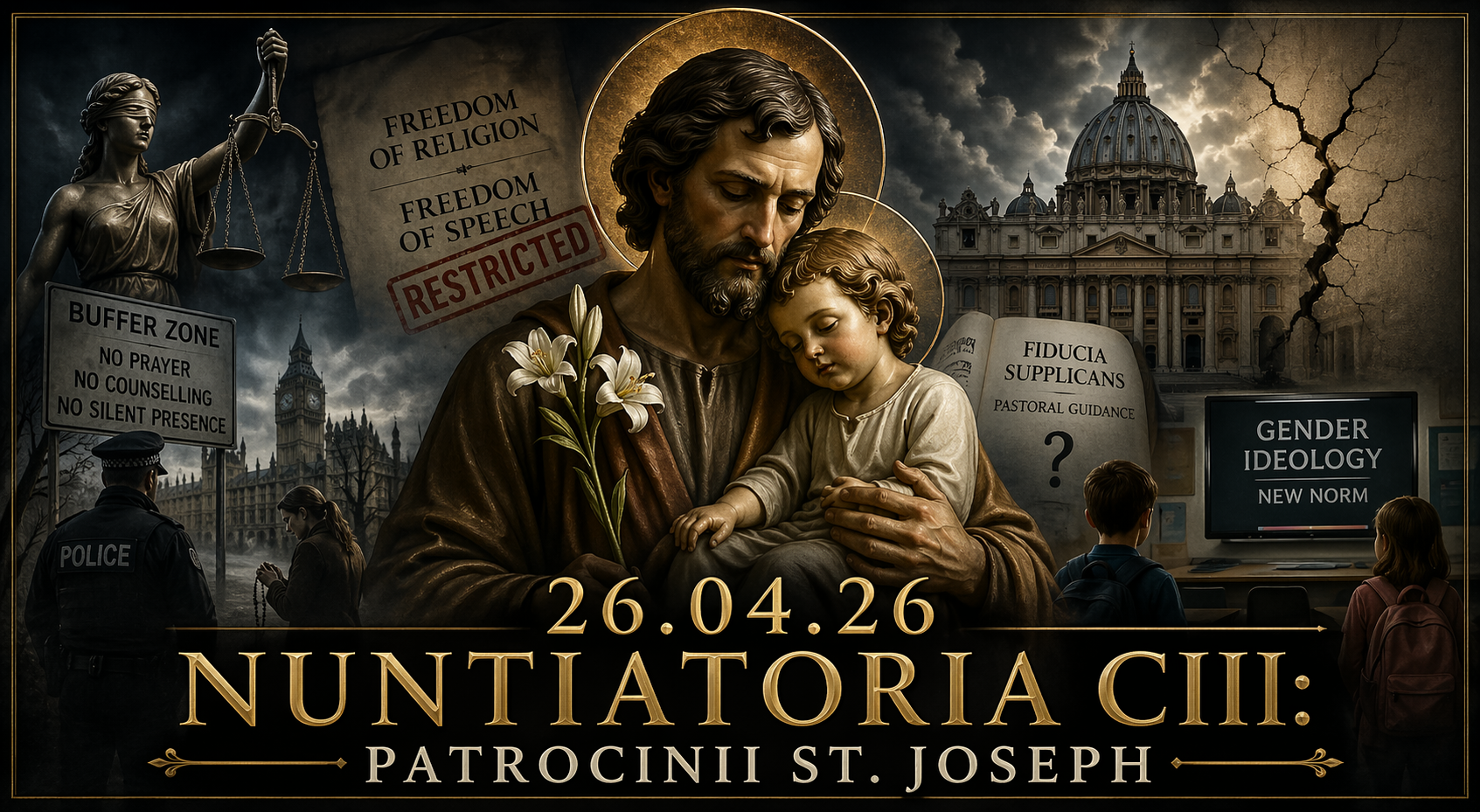
- 26.04.26 Nuntiatoria CIII: Editorial
This edition of Nuntiatoria argues that contemporary crises in Western society reflect a profound rupture in understanding human nature and moral order. It highlights issues such as the expansion of abortion rights and ideological shifts in education, suggesting these are symptoms of deeper cultural and theological confusion. The call is for personal conversion and a return to truth as the foundation of freedom, rather than succumbing to power dynamics.
- ORDO w/c 26.04.26
The content details a series of commemorations and liturgical celebrations within the Catholic Church for the week beginning 26 April. It includes notable figures such as St Joseph, St Peter Canisius, and St Catharine of Siena, reflecting on themes of protection, martyrdom, and doctrinal fidelity during the Paschal season.
- Reform or Restoration? Bishop Schneider and the Limits of the “Reform of the Reform”
Bishop Athanasius Schneider argues that the Novus Ordo Mass diverges from its intended continuity with the traditional Roman Rite, necessitating reform rather than mere improvement. He advocates for restoring practices like ad orientem worship and Latin, emphasising that genuine liturgical continuity is paramount for preserving the Church’s identity amidst increasing diversity and potential disparity in worship.
- Unity Without Truth? Pope Leo XIV, Moral Priority, and the Question of Blessings
Pope Leo XIV’s recent comments on the blessing of same-sex couples challenge the hierarchical structure of Catholic moral teaching. He suggests that unity should not centre on sexual issues but on broader social concerns. However, this view risks undermining the coherence of moral law, crucial for justice and family integrity, essential for societal stability.
- From Principle to Enforcement: The Reconstitution of Academic Freedom in Britain
The reconstitution of academic freedom in Britain marks a significant shift from rhetorical support to enforceable rights, with the Office for Students set to implement a complaints scheme in autumn 2026. This new framework allows individuals to challenge violations of free speech, imposing regulatory accountability on universities, though cultural issues surrounding academic conformity remain unresolved.
- Earth Day and the Restoration of the Steward: Creation, Crisis, and the Question of Interpretation
The article discusses the concept of stewardship rooted in Christian theology, emphasising that humanity is called to care for creation as divine stewards rather than exploiters or idolaters. It critiques modern interpretations that shift focus from God’s authority to human actions, ultimately arguing that restoring the steward is essential to address the deeper environmental crisis.
- Speech, the Soul, and the State: The Supreme Court, Therapy, and the Limits of Ideological Law
In March 2026, the US Supreme Court ruled in Chiles v. Salazar that Colorado’s ban on certain counselling for minors likely violates the First Amendment. This case reflects deeper ideological conflicts over identity, freedom, and the state’s role in defining moral standards, highlighting tensions between protecting minors and preserving free speech rights.
- From Rupture to Reconstitution: The Priesthood After the Break of Vatican II
The Catholic priesthood has undergone significant reconstitution since Vatican II, revealing a stark shift in theological outlook. Younger priests increasingly reject ambiguity, embracing doctrinal continuity and the classical theological tradition. This generational change indicates a necessary response to a crisis of identity and transmission within the Church, aiming to restore clarity and coherence.
- Preaching in the Public Square: Colchester, Clive Johnston, and the Quiet Reconfiguration of Religious Liberty
The cases of Clive Johnston in Northern Ireland and the situation in Colchester illustrate a worrying trend in the legal regulation of religious expression. Rather than risking outright bans, authorities are implementing content-sensitive restrictions, reshaping public discourse. This shift raises questions regarding the boundaries of freedom of expression and religious liberty in the UK.
- The Miracle Reinterpreted: “Sharing,” Multiplication, and the Doctrinal Stakes
In recent papal remarks, the miracle of feeding the five thousand has been reinterpreted as an act of sharing rather than divine multiplication. This article argues that this interpretation misrepresents key theological concepts, shifting the focus from divine action to human efforts, which undermines the understanding of miracles and the Eucharist within Catholic doctrine.
- Pastoral Ambiguity and Doctrinal Drift: The German Implementation of Fiducia Supplicans
The German Catholic Church’s adoption of blessings for couples in “irregular situations,” including those of diverse gender identities, marks a significant shift from pastoral exceptions to normative practice. This evolution poses challenges to doctrinal clarity, potentially leading to fragmentation in Church unity and an ambiguous understanding of blessings’ meanings within ecclesial life.
- The Crime of Meaning: Preaching, Presence, and the New Boundaries of Speech
Clive Johnston, a retired pastor, faces trial in Northern Ireland for allegedly influencing individuals in a buffer zone surrounding an abortion clinic through open-air preaching, with no direct mention of abortion. This case raises critical questions about the implications of law shifting from regulating actions to interpreting meaning based on context, challenging free expression rights.
- The Juridification of Morality: The European Court and the Reordering of Sovereignty in Hungary
The European Court of Justice’s ruling against Hungary’s 2021 “child protection” law signifies a pivotal shift in the European Union, redefining sovereignty by prioritising moral authority over national legislation. This decision highlights a conflict between individual rights and parental authority, reshaping the EU’s role in member states’ cultural and ethical frameworks.
- Fayoum and the Fault Line: Persecution by Administration in Modern Egypt
A confrontation at Deir al-Malak Monastery in Fayoum exposes a deeper reality: recurring clashes between Egyptian authorities and Coptic religious communities are not isolated incidents but part of a wider pattern of administrative pressure. When law is applied selectively, it ceases to be neutral and becomes a mechanism of structural persecution.
- Soft Blasphemy: The RAF Cadet Case and the Unofficial Policing of Thought in Britain
A Royal Air Force officer trainee was suspended for stating that “Islam is the greatest threat to Britain” during a class discussion. This incident has sparked criticism, highlighting a shift from legal boundaries to institutional controls on speech. Critics argue this culture of caution undermines clarity essential for national security discussions.
- Pronouns, Power, and the Formation of the Young
The modern educational environment faces ethical challenges concerning the use of pronouns, as teachers’ language carries significant authority in shaping young identities. Recent analyses suggest that affirming contested identity claims may mislead students, highlighting the need for cautious guidance and a clearer distinction between support and endorsement in educational practices.
- The Silence That Speaks: Abstraction and the Suffering Church
Why does the papal voice sharpen in Western political disputes—but soften where Christians are being killed? The contrast exposes a deeper tension in how the Church speaks—and what it leaves unsaid.
- The Instrumentalisation of Faith and the Illusion of Cultural Christianity
The revival of Christian language in British politics reflects a desire for moral coherence amidst social fragmentation. However, this is often a superficial appropriation rather than genuine belief, reducing Christianity to a cultural tool. True renewal demands a return to its core doctrines, not mere rhetoric or practice, to restore moral integrity.
- The Unmaking of the Child: Rights Without Nature
The debate on parenthood, particularly in surrogacy and adoption, illustrates a shift from natural law to rights-based reasoning, obscuring essential questions about identity and origin. This transformation risks undermining children’s dignity and their need for relational continuity, framing them as mere products rather than gifts, ultimately redefining family structures and responsibilities.
- The Limits of Obedience: Cardinal Muller, the Vincentian Canon, and the Question of Necessity
Cardinal Müller’s theological critique of the Society of Saint Pius X’s appeal for a state of necessity stems from the belief that resistance to ecclesiastical authority is unjustified. He upholds that continuity with Church teachings is vital, challenging claims of necessity when the sacraments remain accessible, thereby stressing the need for clarity in doctrine.
- The Mirage of an “Imperfect Council”: Authority, Illusion, and the Crisis of the Church
The Catholic Church faces a crisis of authority, leading to proposals for an “imperfect council” by traditionalist bishops. However, critics like Bishops Ramolla and Sanborn argue that such gatherings lack the necessary jurisdiction to elect a pope, highlighting that any attempt risks theological inaccuracies. Restoration requires fidelity to ecclesiastical principles, not impulsive actions.


 Blind Catholic Nadeem Masih has been acquitted after ten months in a Pakistani prison, but his ordeal exposes a system in which a blasphemy accusation can remove a rival, seize a livelihood, silence a critic or terrorise an entire Christian community—without ever producing credible evidence.
 Concerns arise regarding the Synod on Synodality, as signals suggest it prioritises selected narratives over genuine discernment, potentially undermining the Catholic Church’s teachings. Limited participation and the curation of testimonies have led to accusations of manufactured consensus, eroding trust in ecclesial processes and risking spiritual integrity within the faithful community.
 Bishop Athanasius Schneider has warned that the recent Final Report of Synod Study Group No. 9 crosses into heresy, reflecting a broader crisis within the Catholic Church regarding the understanding of divine revelation. He cautions that modern language and concepts threaten traditional doctrines, risking the very identity of Catholicism.
 The High Court overturned a £585,000 fine against the University of Sussex, ruling that the Office for Students acted unlawfully. While the issue of a “chilling effect” on free speech remains unresolved, the Court identified significant procedural failures and bias in the regulator’s approach, emphasising the importance of lawful reasoning in regulatory practices.
 The UK’s transition to Net Zero, framed as a moral necessity, faces scrutiny due to its reliance on “shadow supply chains” rooted in countries with poor human rights records. The extraction of critical minerals, notably cobalt and lithium, raises ethical concerns about child labour and environmental harm, questioning the integrity of Britain’s green policies.
 The current Church crisis highlights a contradiction in Rome’s ecumenical approach, where the SSPX faces penalties for seeking doctrinal clarity, while Anglican representatives, whose orders are invalid, are warmly received. This asymmetry underscores unresolved tensions from Vatican II regarding authority and doctrinal coherence, revealing a deeper crisis beyond mere discipline.
 The Montagna Report reveals that the Vatican’s Dicastery for the Doctrine of the Faith is preparing a declaration of schism in response to episcopal consecrations by the Society of St. Pius X, scheduled for July 1, 2026. This preparation highlights a significant crisis in ecclesial authority and the recognition of its legitimacy, amidst ongoing doctrinal and liturgical tensions.
 The Crewe incident highlights a recurring pattern of safeguarding failures in the UK, characterised by institutional hesitation and ineffective responses to known risks. Despite existing legal frameworks, alleged abuses often go unaddressed until harm is compounded. This case tests the commitment of leaders to prioritise proactive safeguarding over reputational considerations.
 The High Court overturned the conviction of pro-life campaigner David Skinner for sending graphic abortion images privately to police, reaffirming that lawful expression cannot be criminalised simply because it offends. This ruling restores the principle of proportionality in free speech and protects against the expansion of public display definitions.
 The prosecution of Rose Docherty in Glasgow collapsed due to the Crown’s failure to establish a legal offence under the Abortion Services (Safe Access Zones) Act. The case highlighted the vague definitions and discretionary enforcement within the “buffer zone” legislation, raising concerns about potential infringements on free speech and legal certainty in future prosecutions.
 The Dicastery for Divine Worship has formally received a recourse regarding Bishop Michael T. Martin’s liturgical directives in Charlotte, raising issues of administrative accountability under canon law. This case, focusing on the removal of altar rails and kneelers, challenges the balance between diocesan authority and the rights of the faithful.
 In April 2026, Pope Leo XIV met Cardinal Ernest Simoni and Dame Sarah Mullally, symbolising contrasting ecclesial priorities. Simoni’s testimony, rooted in his experience of persecution, highlights the importance of sacrifice and martyrdom within the Church. In contrast, Mullally embodies diplomatic engagement, emphasising the need to balance doctrine with contemporary discourse on unity and peace.
 The meeting between Pope Leo XIV and Sarah Mullally highlights the tension between visible gestures of unity and the Church’s established doctrines. While aiming for ecumenical cooperation, the Church risks projecting an image of unity that contradicts its teachings, particularly on Anglican orders and women’s ordination. This encounter exemplifies the need for clarity in presenting doctrinal truth amidst evolving perceptions.
 The modern Church faces a fundamental crisis rooted in a shift from a transcendent understanding of God to an immanent one, where theology begins with human experience rather than divine revelation. This reorientation risks diluting doctrine and morality, redefining the role of God from a commanding presence to a mere interpreter of human meaning.
 The involvement of the United States Conference of Catholic Bishops in the case Trump v. Barbara highlights a pressing constitutional issue regarding birthright citizenship. Their stance risks transforming prudential judgments into moral absolutes, neglecting the importance of political order and context, ultimately muddling the distinction between human dignity and governance principles.
 The Church of England faces a credibility crisis leading to proposals for the Independent Safeguarding Authority (ISA) amid a public consultation. While ambitions for reform aim to address systemic failures, the ISA’s authority remains uncertain, lacking the power to enforce compliance. Without genuine accountability, concerns about safeguarding practices persist.
 The upcoming episcopal consecrations by the Society of Saint Pius X (SSPX) on 1 July 2026 signify a critical moment for the Church, challenging the effectiveness of current authority structures in safeguarding Faith. Fr. Pagliarani argues that the crisis lies in the divergence of official teachings from Tradition, necessitating theological clarity over mere administrative solutions.
 The Month of May is dedicated to the Blessed Virgin Mary, reflecting deep theological significance rather than mere sentimentality. It emphasises Mary’s integral role in salvation history, illustrating her influence through obedience and fidelity. The observance seeks to align personal devotion with doctrinal foundations, inviting imitation of Mary’s virtues amidst contemporary challenges.
 The Feast of the Patronage of St Joseph, established in 1870 by Pope Pius IX during a time of crisis, highlights Joseph’s role as protector of the Church. His authority, grounded in obedience and service, is critical amid contemporary challenges, demonstrating that divine providence sustains the Church rather than human efforts alone.
 This edition of Nuntiatoria argues that contemporary crises in Western society reflect a profound rupture in understanding human nature and moral order. It highlights issues such as the expansion of abortion rights and ideological shifts in education, suggesting these are symptoms of deeper cultural and theological confusion. The call is for personal conversion and a return to truth as the foundation of freedom, rather than succumbing to power dynamics.
 The content details a series of commemorations and liturgical celebrations within the Catholic Church for the week beginning 26 April. It includes notable figures such as St Joseph, St Peter Canisius, and St Catharine of Siena, reflecting on themes of protection, martyrdom, and doctrinal fidelity during the Paschal season.
 Bishop Athanasius Schneider argues that the Novus Ordo Mass diverges from its intended continuity with the traditional Roman Rite, necessitating reform rather than mere improvement. He advocates for restoring practices like ad orientem worship and Latin, emphasising that genuine liturgical continuity is paramount for preserving the Church’s identity amidst increasing diversity and potential disparity in worship.
 Pope Leo XIV’s recent comments on the blessing of same-sex couples challenge the hierarchical structure of Catholic moral teaching. He suggests that unity should not centre on sexual issues but on broader social concerns. However, this view risks undermining the coherence of moral law, crucial for justice and family integrity, essential for societal stability.
 The reconstitution of academic freedom in Britain marks a significant shift from rhetorical support to enforceable rights, with the Office for Students set to implement a complaints scheme in autumn 2026. This new framework allows individuals to challenge violations of free speech, imposing regulatory accountability on universities, though cultural issues surrounding academic conformity remain unresolved.
 The article discusses the concept of stewardship rooted in Christian theology, emphasising that humanity is called to care for creation as divine stewards rather than exploiters or idolaters. It critiques modern interpretations that shift focus from God’s authority to human actions, ultimately arguing that restoring the steward is essential to address the deeper environmental crisis.
 In March 2026, the US Supreme Court ruled in Chiles v. Salazar that Colorado’s ban on certain counselling for minors likely violates the First Amendment. This case reflects deeper ideological conflicts over identity, freedom, and the state’s role in defining moral standards, highlighting tensions between protecting minors and preserving free speech rights.
 The Catholic priesthood has undergone significant reconstitution since Vatican II, revealing a stark shift in theological outlook. Younger priests increasingly reject ambiguity, embracing doctrinal continuity and the classical theological tradition. This generational change indicates a necessary response to a crisis of identity and transmission within the Church, aiming to restore clarity and coherence.
 The cases of Clive Johnston in Northern Ireland and the situation in Colchester illustrate a worrying trend in the legal regulation of religious expression. Rather than risking outright bans, authorities are implementing content-sensitive restrictions, reshaping public discourse. This shift raises questions regarding the boundaries of freedom of expression and religious liberty in the UK.
 In recent papal remarks, the miracle of feeding the five thousand has been reinterpreted as an act of sharing rather than divine multiplication. This article argues that this interpretation misrepresents key theological concepts, shifting the focus from divine action to human efforts, which undermines the understanding of miracles and the Eucharist within Catholic doctrine.
 The German Catholic Church’s adoption of blessings for couples in “irregular situations,” including those of diverse gender identities, marks a significant shift from pastoral exceptions to normative practice. This evolution poses challenges to doctrinal clarity, potentially leading to fragmentation in Church unity and an ambiguous understanding of blessings’ meanings within ecclesial life.
 Clive Johnston, a retired pastor, faces trial in Northern Ireland for allegedly influencing individuals in a buffer zone surrounding an abortion clinic through open-air preaching, with no direct mention of abortion. This case raises critical questions about the implications of law shifting from regulating actions to interpreting meaning based on context, challenging free expression rights.
 The European Court of Justice’s ruling against Hungary’s 2021 “child protection” law signifies a pivotal shift in the European Union, redefining sovereignty by prioritising moral authority over national legislation. This decision highlights a conflict between individual rights and parental authority, reshaping the EU’s role in member states’ cultural and ethical frameworks.
 A confrontation at Deir al-Malak Monastery in Fayoum exposes a deeper reality: recurring clashes between Egyptian authorities and Coptic religious communities are not isolated incidents but part of a wider pattern of administrative pressure. When law is applied selectively, it ceases to be neutral and becomes a mechanism of structural persecution.
 A Royal Air Force officer trainee was suspended for stating that “Islam is the greatest threat to Britain” during a class discussion. This incident has sparked criticism, highlighting a shift from legal boundaries to institutional controls on speech. Critics argue this culture of caution undermines clarity essential for national security discussions.
 The modern educational environment faces ethical challenges concerning the use of pronouns, as teachers’ language carries significant authority in shaping young identities. Recent analyses suggest that affirming contested identity claims may mislead students, highlighting the need for cautious guidance and a clearer distinction between support and endorsement in educational practices.
 Why does the papal voice sharpen in Western political disputes—but soften where Christians are being killed? The contrast exposes a deeper tension in how the Church speaks—and what it leaves unsaid.
 The revival of Christian language in British politics reflects a desire for moral coherence amidst social fragmentation. However, this is often a superficial appropriation rather than genuine belief, reducing Christianity to a cultural tool. True renewal demands a return to its core doctrines, not mere rhetoric or practice, to restore moral integrity.
 The debate on parenthood, particularly in surrogacy and adoption, illustrates a shift from natural law to rights-based reasoning, obscuring essential questions about identity and origin. This transformation risks undermining children’s dignity and their need for relational continuity, framing them as mere products rather than gifts, ultimately redefining family structures and responsibilities.
 Cardinal Müller’s theological critique of the Society of Saint Pius X’s appeal for a state of necessity stems from the belief that resistance to ecclesiastical authority is unjustified. He upholds that continuity with Church teachings is vital, challenging claims of necessity when the sacraments remain accessible, thereby stressing the need for clarity in doctrine.
 The Catholic Church faces a crisis of authority, leading to proposals for an “imperfect council” by traditionalist bishops. However, critics like Bishops Ramolla and Sanborn argue that such gatherings lack the necessary jurisdiction to elect a pope, highlighting that any attempt risks theological inaccuracies. Restoration requires fidelity to ecclesiastical principles, not impulsive actions.




Leave a Reply