This edition confronts the convergence of institutional failure across Church and state: Germany’s accelerating collapse in membership and vocations; prelates who diagnose crisis yet maintain the very frameworks producing it; UK disputes over religious accommodation, free expression, and unequal legal enforcement; the political targeting of dissenting voices; and a Vatican financial prosecution unravelled on appeal.…
Cardinal Jean-Claude Hollerich argues that the future of the Church depends on women’s access to ordained ministry, likening the male priesthood to gender discrimination under European law. French scholars support this view, contending that ordination should not be seen as a profession but a sacrament that excludes women, raising significant theological and legal implications.
This edition of Nuntiatoria examines the collapse of institutional integrity across Church, state, and society. From liturgical displacement to legal contradictions and cultural fragmentation, it exposes a civilisation retaining its forms while abandoning their substance—revealing a growing gulf between authority, truth, and the lived reality of the modern West.
A banquet at Windsor. A sermon at Lambeth. Days later—mass graves in Nigeria. Britain knew the reality and chose silence. This is not diplomacy. It is policy by omission.
At its hundredth edition, Nuntiatoria defines its mission with precision: to defend truth, uphold tradition, and interpret the crises of Church and society through a coherent theological lens. No longer mere commentary, it now stands as a disciplined voice committed to clarity, continuity, and the restoration of Christian order.
In a recent podcast, Peter Hitchens expressed a tentative acceptance of women’s ordination in the Church of England, influenced by personal encounters with female clergy. However, critics argue he confuses acclimatisation with legitimacy, neglecting deeper theological questions. The discussion raises fundamental issues about the Church’s identity and purpose in a changing cultural landscape.
Nuntiatoria XCIX (29.03.26) presents a stark juxtaposition between the ordered, sacrificial, and Christocentric reality revealed in the liturgy of the Passion and the fragmentation, confusion, and ideological drift characteristic of the modern West and the postconciliar Church. The solemn progression of Holy Week—marked by restraint, silence, and unwavering orientation toward the Cross—stands as both indictment and remedy: it exposes a culture that has replaced sacrifice with sentiment and truth with subjectivity, while calling the faithful back to a reality that is not constructed but received, not negotiated but revealed. In this light, the Passion emerges as the interpretive key to the present crisis, reasserting divine order in the face of modern disintegration.
A pastoral response to the House of Lords debate on abortion up to birth, warning that the principle now advanced makes human life conditional on judgement. If accepted, it reshapes law, medicine, and society—not only in the UK, but wherever such reasoning is allowed to spread.
This edition confronts the convergence of institutional failure across Church and state: Germany’s accelerating collapse in membership and vocations; prelates who diagnose crisis yet maintain the very frameworks producing it; UK disputes over religious accommodation, free expression, and unequal legal enforcement; the political targeting of dissenting voices; and a Vatican financial prosecution unravelled on appeal. Set against Passiontide’s stark themes of concealment, conflict, and judgment, these are not isolated controversies but signs of a deeper disorder—authority retained in form yet emptied of clarity, consistency, and trust.
The liturgical week from March 22 to March 29 focuses on Passiontide, emphasizing themes of suffering, sacrifice, and anticipation of Easter. Key events include the beginnings of the Passion, reflections on the Cross, and the Annunciation’s place within Passiontide. Each day’s Mass highlights the interplay of joy and penitence leading to Christ’s ultimate sacrifice.
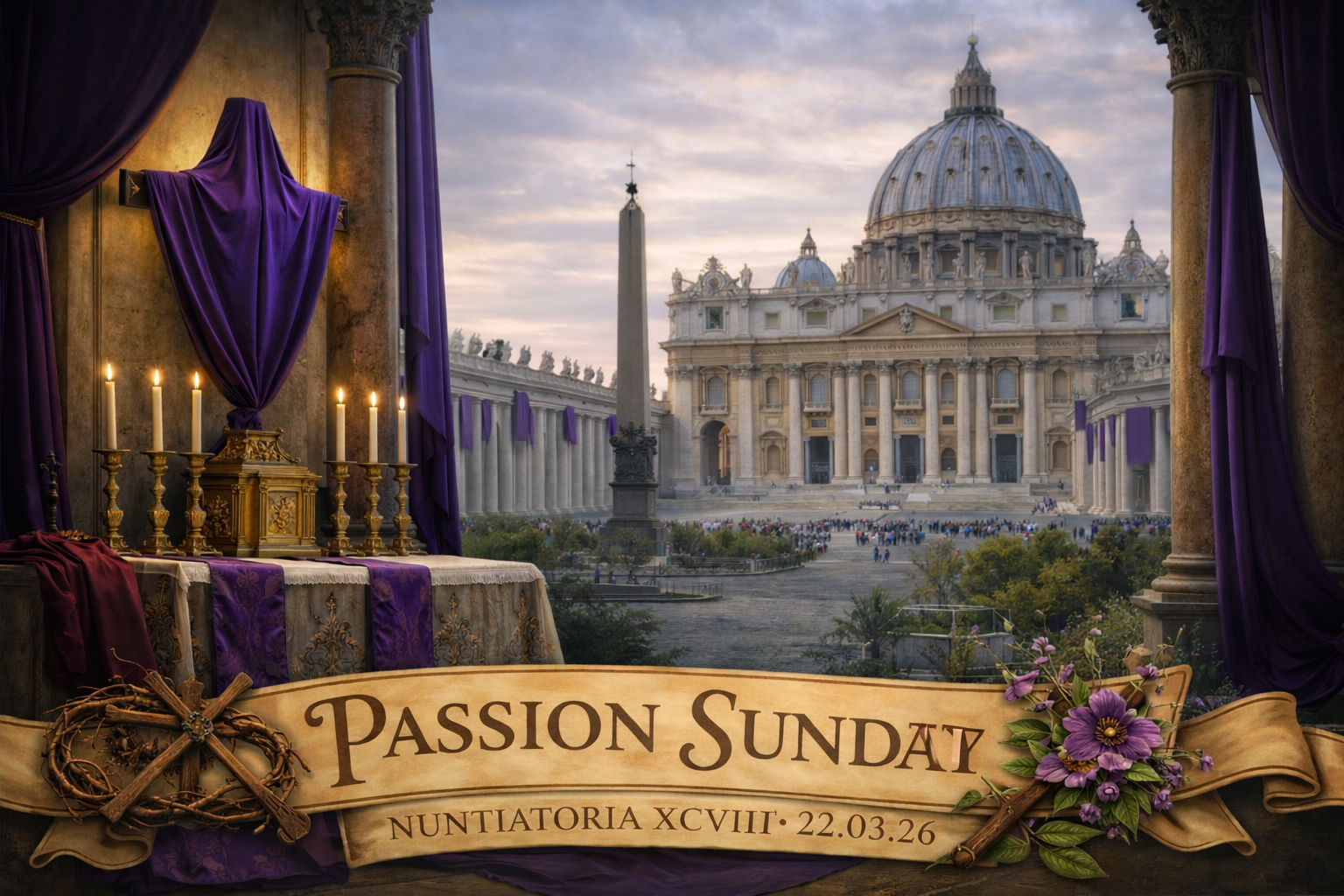
Passion Sunday inaugurates Passiontide, shifting the liturgy from penitence to contemplation of Christ’s suffering. Images are veiled, praise is restrained, and Psalm Judica me is reassigned from priestly preparation to Christ’s public voice. The Church enters the hidden Passion, emphasizing sacrifice, divine identity, and faith amid obscurity before the triumph of Easter.
In March 2026, the Church of the Holy Sepulchre faced closure due to regional conflict, highlighting Christianity’s reliance on historical geography. This unprecedented restriction, unlike previous closures, interrupts access to the central site of Christ’s Passion during Lent, raising concerns about the future of public proclamation and pilgrimage amid ongoing political and military tensions.
Secular Britain faces a crisis of governance due to the removal of its Christian moral framework, leading to societal instability. This void is being filled by various religious expressions, particularly from Islam, reflecting a shift from traditional civic integration to identity-driven politics. The implications challenge public coherence and threaten foundational societal values.
Pope Leo XIV’s return to the Apostolic Palace signifies a restoration of tradition and coherence following Pope Francis’ decision to reside elsewhere. This move re-establishes the papal office within its historical, liturgical, and administrative framework, emphasizing the importance of the papal residence in Catholic identity while addressing operational and financial implications associated with prior arrangements.
The 1995 Augustinian symposium in Brazil, attended by Pope Leo XIV, sparked controversy over its ecotheological themes and the inclusion of indigenous symbolism. The event reflects a significant theological evolution in Latin America, prefiguring later discussions, like those at the Amazon Synod, about the relationship between culture, ecology, and Catholic worship.
The author questions the significance of the King’s title “Defender of the Faith” amidst unacknowledged Christian persecution. They emphasize that for the crown to maintain its meaning, the King must publicly address suffering faithful, stating that silence equates to abandonment. The letter calls for clarity and action in upholding Christian truth.
Pope Leo XIV asserts that health should not be a luxury, highlighting the moral imperative of equitable access to healthcare as essential for human dignity. He critiques contemporary systems that prioritize market logic, arguing that justice requires prioritizing individuals over economic efficiency. True healthcare is a moral practice that acknowledges the inherent value of each person.
The House of Lords has quietly advanced significant amendments to the Crime and Policing Bill, rejecting measures that would limit the decriminalisation of abortion and telemedical services. This shift in legislation transforms abortion from a prohibited act to a matter of personal choice, undermining existing legal protections and removing essential safeguards.
Secular Britain faces a crisis of governance due to the removal of its Christian moral framework, leading to societal instability. This void is being filled by various religious expressions, particularly from Islam, reflecting a shift from traditional civic integration to identity-driven politics. The implications challenge public coherence and threaten foundational societal values.
The Calgary school’s cafeteria policy, designating “no food” zones during Ramadan, sparked controversy regarding the balance between accommodating religious practices and imposing restrictions. Critics argue that such measures unfairly shift the burden onto non-fasting students, challenging the principle of fairness in pluralistic societies and raising concerns about the broader implications of accommodation in public institutions.
Scotland’s Parliament has rejected the assisted suicide Bill by 69 to 57 votes, marking a significant moral judgment against legalizing euthanasia. The decision reflects concerns over safeguarding the vulnerable and maintaining the integrity of the medical profession. This outcome signals a commitment to protecting life amidst ongoing global discussions about assisted dying legislation.
The Sloane Avenue trial in Vatican City has highlighted serious procedural flaws, revealing a potential crisis in its justice system. The Court of Appeal’s decision to renew the trial stems from significant compromises to the right of defense, raising concerns about transparency, accountability, and the balance of powers within Vatican governance.
Pope Leo XIV’s return to the Apostolic Palace signifies a restoration of tradition and coherence following Pope Francis’ decision to reside elsewhere. This move re-establishes the papal office within its historical, liturgical, and administrative framework, emphasizing the importance of the papal residence in Catholic identity while addressing operational and financial implications associated with prior arrangements.
The post discusses the modern crisis within the Church, highlighting the roles of Ratzinger and Eijk. Ratzinger identified deep-rooted issues but lacked decisive action, while Eijk preserves orthodoxy without addressing its causes. The absence of authoritative example undermines attempts to restore continuity, leaving the Church’s faithful navigating unresolved tensions and fragmented gestures.
The article discusses systemic disparities in hate crime prosecutions in Britain, highlighting that anti-Muslim hate crimes are prosecuted more frequently than antisemitic crimes. It emphasizes the erosion of public trust in the justice system due to perceived inequalities, advocating for increased transparency and reform to ensure equal justice is genuinely upheld for all communities.
The Green Party has proposed disestablishing the Church of England, raising significant constitutional implications. This change could transform England’s legal and cultural framework, challenging the long-standing integration of Christianity into the state’s identity. The proposal comes amid a rise in sectarian religious politics, highlighting the complexities surrounding national identity and civic foundations.
The Archbishop-designate of Canterbury, Sarah Mullally, is undertaking a symbolic pilgrimage from London to Canterbury Cathedral. This journey coincides with parliamentary debates on abortion legislation, raising concerns about her absence from moral discussions in the House of Lords. Critics argue this highlights the Church’s diminishing influence in public life.
A new transparent barrier has been installed around the papal altar in St. Peter’s Basilica to protect it from public intrusion, a response to recent vandalism incidents. This development highlights the erosion of sacred space reverence, signaling a shift in cultural values where churches are seen more as tourist attractions than centers of worship.
Pope Leo XIV’s acceptance of Bishop Emanuel Hana Shaleta’s resignation highlights the Church’s struggle with financial misconduct among its leaders. Shaleta is accused of misappropriating $270,000 in church funds. This controversy, alongside recent ecclesiastical transitions, raises significant questions about episcopal accountability and the ongoing erosion of trust within the Catholic Church.
Bishop Egan’s remarks highlight the tension between pastoral concerns and canon law regarding Catholic Mass obligations. While he states that attending SSPX Mass does not fulfill the Sunday obligation due to their irregular status, canon law specifies that validly celebrated Masses in Catholic rites suffice. Archbishop Naumann’s approach acknowledges this distinction, suggesting attendance can satisfy the obligation despite pastoral advisories.
The Court of Justice of the European Union’s ruling on Bulgaria’s civil-status law highlights the growing power of EU law via judicial interpretation. This case reflects an evolution in EU authority, emphasizing individual rights and free movement, showcasing the tension between national sovereignty and supranational governance within the EU’s constitutional framework.


 Cardinal Jean-Claude Hollerich argues that the future of the Church depends on women’s access to ordained ministry, likening the male priesthood to gender discrimination under European law. French scholars support this view, contending that ordination should not be seen as a profession but a sacrament that excludes women, raising significant theological and legal implications.
 This edition of Nuntiatoria examines the collapse of institutional integrity across Church, state, and society. From liturgical displacement to legal contradictions and cultural fragmentation, it exposes a civilisation retaining its forms while abandoning their substance—revealing a growing gulf between authority, truth, and the lived reality of the modern West.
 A banquet at Windsor. A sermon at Lambeth. Days later—mass graves in Nigeria. Britain knew the reality and chose silence. This is not diplomacy. It is policy by omission.
 At its hundredth edition, Nuntiatoria defines its mission with precision: to defend truth, uphold tradition, and interpret the crises of Church and society through a coherent theological lens. No longer mere commentary, it now stands as a disciplined voice committed to clarity, continuity, and the restoration of Christian order.
 In a recent podcast, Peter Hitchens expressed a tentative acceptance of women’s ordination in the Church of England, influenced by personal encounters with female clergy. However, critics argue he confuses acclimatisation with legitimacy, neglecting deeper theological questions. The discussion raises fundamental issues about the Church’s identity and purpose in a changing cultural landscape.
 Nuntiatoria XCIX (29.03.26) presents a stark juxtaposition between the ordered, sacrificial, and Christocentric reality revealed in the liturgy of the Passion and the fragmentation, confusion, and ideological drift characteristic of the modern West and the postconciliar Church. The solemn progression of Holy Week—marked by restraint, silence, and unwavering orientation toward the Cross—stands as both indictment and remedy: it exposes a culture that has replaced sacrifice with sentiment and truth with subjectivity, while calling the faithful back to a reality that is not constructed but received, not negotiated but revealed. In this light, the Passion emerges as the interpretive key to the present crisis, reasserting divine order in the face of modern disintegration.
 A pastoral response to the House of Lords debate on abortion up to birth, warning that the principle now advanced makes human life conditional on judgement. If accepted, it reshapes law, medicine, and society—not only in the UK, but wherever such reasoning is allowed to spread.
 This edition confronts the convergence of institutional failure across Church and state: Germany’s accelerating collapse in membership and vocations; prelates who diagnose crisis yet maintain the very frameworks producing it; UK disputes over religious accommodation, free expression, and unequal legal enforcement; the political targeting of dissenting voices; and a Vatican financial prosecution unravelled on appeal. Set against Passiontide’s stark themes of concealment, conflict, and judgment, these are not isolated controversies but signs of a deeper disorder—authority retained in form yet emptied of clarity, consistency, and trust.
 The liturgical week from March 22 to March 29 focuses on Passiontide, emphasizing themes of suffering, sacrifice, and anticipation of Easter. Key events include the beginnings of the Passion, reflections on the Cross, and the Annunciation’s place within Passiontide. Each day’s Mass highlights the interplay of joy and penitence leading to Christ’s ultimate sacrifice.
 Passion Sunday inaugurates Passiontide, shifting the liturgy from penitence to contemplation of Christ’s suffering. Images are veiled, praise is restrained, and Psalm Judica me is reassigned from priestly preparation to Christ’s public voice. The Church enters the hidden Passion, emphasizing sacrifice, divine identity, and faith amid obscurity before the triumph of Easter.
 In March 2026, the Church of the Holy Sepulchre faced closure due to regional conflict, highlighting Christianity’s reliance on historical geography. This unprecedented restriction, unlike previous closures, interrupts access to the central site of Christ’s Passion during Lent, raising concerns about the future of public proclamation and pilgrimage amid ongoing political and military tensions.
 Secular Britain faces a crisis of governance due to the removal of its Christian moral framework, leading to societal instability. This void is being filled by various religious expressions, particularly from Islam, reflecting a shift from traditional civic integration to identity-driven politics. The implications challenge public coherence and threaten foundational societal values.
 Pope Leo XIV’s return to the Apostolic Palace signifies a restoration of tradition and coherence following Pope Francis’ decision to reside elsewhere. This move re-establishes the papal office within its historical, liturgical, and administrative framework, emphasizing the importance of the papal residence in Catholic identity while addressing operational and financial implications associated with prior arrangements.
 The 1995 Augustinian symposium in Brazil, attended by Pope Leo XIV, sparked controversy over its ecotheological themes and the inclusion of indigenous symbolism. The event reflects a significant theological evolution in Latin America, prefiguring later discussions, like those at the Amazon Synod, about the relationship between culture, ecology, and Catholic worship.
 The author questions the significance of the King’s title “Defender of the Faith” amidst unacknowledged Christian persecution. They emphasize that for the crown to maintain its meaning, the King must publicly address suffering faithful, stating that silence equates to abandonment. The letter calls for clarity and action in upholding Christian truth.
 Pope Leo XIV asserts that health should not be a luxury, highlighting the moral imperative of equitable access to healthcare as essential for human dignity. He critiques contemporary systems that prioritize market logic, arguing that justice requires prioritizing individuals over economic efficiency. True healthcare is a moral practice that acknowledges the inherent value of each person.
 The House of Lords has quietly advanced significant amendments to the Crime and Policing Bill, rejecting measures that would limit the decriminalisation of abortion and telemedical services. This shift in legislation transforms abortion from a prohibited act to a matter of personal choice, undermining existing legal protections and removing essential safeguards.
 Secular Britain faces a crisis of governance due to the removal of its Christian moral framework, leading to societal instability. This void is being filled by various religious expressions, particularly from Islam, reflecting a shift from traditional civic integration to identity-driven politics. The implications challenge public coherence and threaten foundational societal values.
 The Calgary school’s cafeteria policy, designating “no food” zones during Ramadan, sparked controversy regarding the balance between accommodating religious practices and imposing restrictions. Critics argue that such measures unfairly shift the burden onto non-fasting students, challenging the principle of fairness in pluralistic societies and raising concerns about the broader implications of accommodation in public institutions.
 Scotland’s Parliament has rejected the assisted suicide Bill by 69 to 57 votes, marking a significant moral judgment against legalizing euthanasia. The decision reflects concerns over safeguarding the vulnerable and maintaining the integrity of the medical profession. This outcome signals a commitment to protecting life amidst ongoing global discussions about assisted dying legislation.
 The Sloane Avenue trial in Vatican City has highlighted serious procedural flaws, revealing a potential crisis in its justice system. The Court of Appeal’s decision to renew the trial stems from significant compromises to the right of defense, raising concerns about transparency, accountability, and the balance of powers within Vatican governance.
 Pope Leo XIV’s return to the Apostolic Palace signifies a restoration of tradition and coherence following Pope Francis’ decision to reside elsewhere. This move re-establishes the papal office within its historical, liturgical, and administrative framework, emphasizing the importance of the papal residence in Catholic identity while addressing operational and financial implications associated with prior arrangements.
 The post discusses the modern crisis within the Church, highlighting the roles of Ratzinger and Eijk. Ratzinger identified deep-rooted issues but lacked decisive action, while Eijk preserves orthodoxy without addressing its causes. The absence of authoritative example undermines attempts to restore continuity, leaving the Church’s faithful navigating unresolved tensions and fragmented gestures.
 The article discusses systemic disparities in hate crime prosecutions in Britain, highlighting that anti-Muslim hate crimes are prosecuted more frequently than antisemitic crimes. It emphasizes the erosion of public trust in the justice system due to perceived inequalities, advocating for increased transparency and reform to ensure equal justice is genuinely upheld for all communities.
 The Green Party has proposed disestablishing the Church of England, raising significant constitutional implications. This change could transform England’s legal and cultural framework, challenging the long-standing integration of Christianity into the state’s identity. The proposal comes amid a rise in sectarian religious politics, highlighting the complexities surrounding national identity and civic foundations.
 The Archbishop-designate of Canterbury, Sarah Mullally, is undertaking a symbolic pilgrimage from London to Canterbury Cathedral. This journey coincides with parliamentary debates on abortion legislation, raising concerns about her absence from moral discussions in the House of Lords. Critics argue this highlights the Church’s diminishing influence in public life.
 A new transparent barrier has been installed around the papal altar in St. Peter’s Basilica to protect it from public intrusion, a response to recent vandalism incidents. This development highlights the erosion of sacred space reverence, signaling a shift in cultural values where churches are seen more as tourist attractions than centers of worship.
 Pope Leo XIV’s acceptance of Bishop Emanuel Hana Shaleta’s resignation highlights the Church’s struggle with financial misconduct among its leaders. Shaleta is accused of misappropriating $270,000 in church funds. This controversy, alongside recent ecclesiastical transitions, raises significant questions about episcopal accountability and the ongoing erosion of trust within the Catholic Church.
 Bishop Egan’s remarks highlight the tension between pastoral concerns and canon law regarding Catholic Mass obligations. While he states that attending SSPX Mass does not fulfill the Sunday obligation due to their irregular status, canon law specifies that validly celebrated Masses in Catholic rites suffice. Archbishop Naumann’s approach acknowledges this distinction, suggesting attendance can satisfy the obligation despite pastoral advisories.
 The Court of Justice of the European Union’s ruling on Bulgaria’s civil-status law highlights the growing power of EU law via judicial interpretation. This case reflects an evolution in EU authority, emphasizing individual rights and free movement, showcasing the tension between national sovereignty and supranational governance within the EU’s constitutional framework.



Leave a Reply