
Pilgrimage or Responsibility?
The Archbishop-Designate of Canterbury, the Lords Spiritual, and the Defence of Human Life
Pilgrimage and Parliamentary Duty
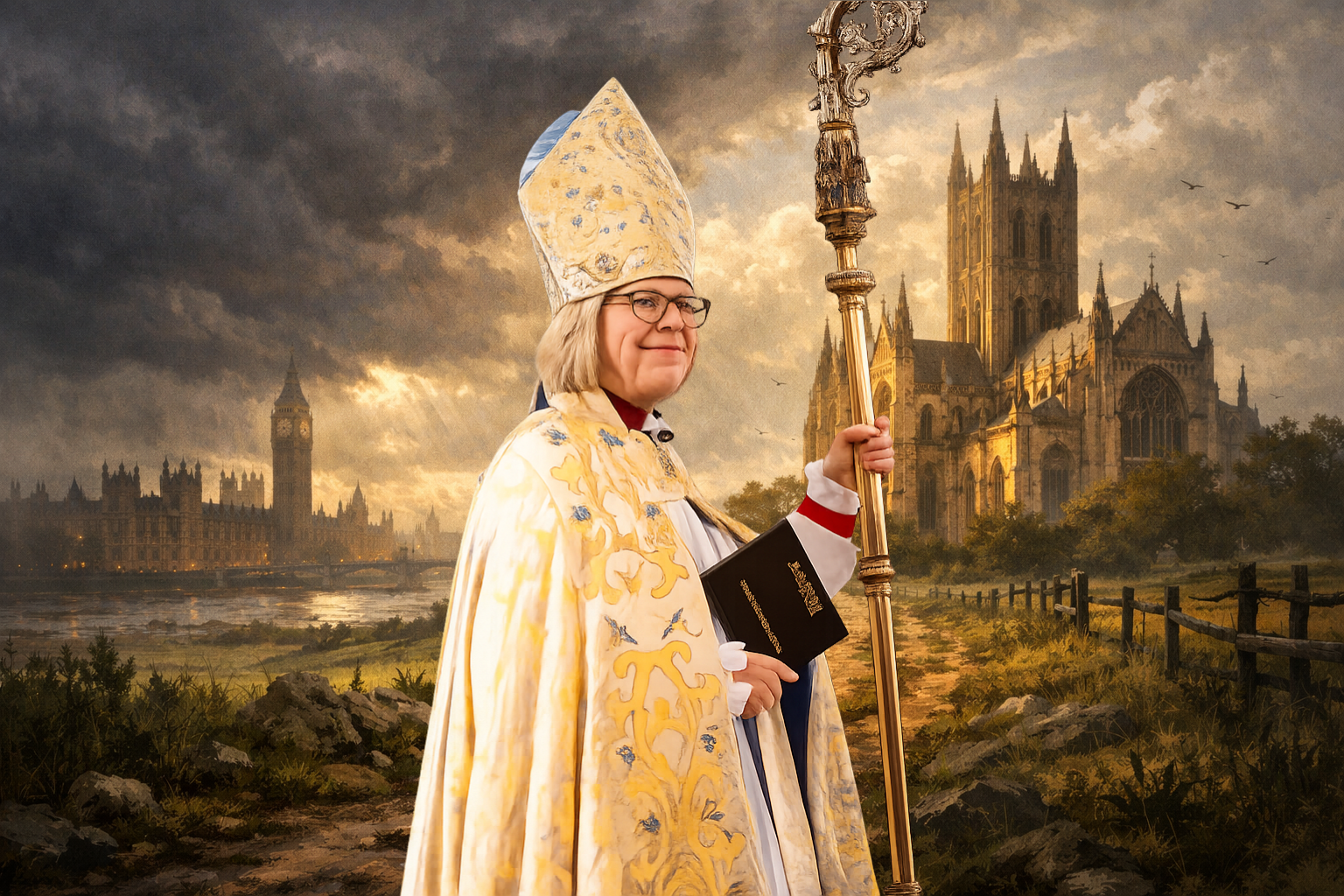
In these days the Rt Revd Sarah Mullally, Bishop of London and Archbishop-designate of Canterbury, is undertaking a six-day pilgrimage on foot from London to Canterbury Cathedral ahead of her installation as Archbishop of Canterbury later this month.¹ The journey follows the ancient route associated with the medieval pilgrimages to the shrine of St Thomas Becket, the martyred Archbishop of Canterbury whose death in 1170 transformed Canterbury into one of the most important pilgrimage destinations in Christendom.² Pilgrimage has long been honoured within the Christian tradition as an act of repentance, prayer, and preparation for sacred responsibility.³ From the earliest centuries of the Church, believers travelled to holy places as outward signs of interior conversion, undertaking journeys that marked decisive moments of spiritual transition. The road itself becomes a metaphor for discipleship: a reminder that the Christian life is not static but a continual movement toward God.

Few would deny that such symbolism possesses genuine spiritual resonance. Yet the timing of this particular pilgrimage has placed it at the centre of an unexpected controversy. While the Archbishop-designate walks the historic road toward Canterbury, the House of Lords is debating and voting on legislation that critics warn could effectively decriminalise abortion outside the current statutory framework.⁴ The proposed amendment would remove criminal penalties for women who procure abortions outside the conditions established by the Abortion Act 1967,⁵ legislation that currently regulates abortion within defined legal limits in England and Wales. Opponents argue that such decriminalisation could weaken the safeguards that the law presently maintains concerning abortion after twenty-four weeks of pregnancy.⁶ In practical terms the debate therefore touches one of the most profound moral questions any legislature can confront: the protection of human life before birth.
In this context the absence of the incoming Archbishop of Canterbury from the House of Lords has drawn criticism. The issue is not merely that Sarah Mullally is one of the twenty-six bishops who sit in Parliament as part of the Lords Spiritual.⁷ Rather, the concern arises because she is about to assume the office of Archbishop of Canterbury itself, an office historically regarded as the senior Christian voice within the constitutional life of Britain. When Parliament debates matters touching the sanctity of life, many instinctively assume that the Archbishop of Canterbury—or at least the Archbishop-designate—ought to be present, speaking and voting as a witness to the moral tradition that has shaped the nation’s law.
The controversy arises from a striking contrast between two realities. On the one hand stands a voluntary devotional act rich in symbolism but not required by ecclesiastical law or custom. No Archbishop of Canterbury is obliged to undertake a pilgrimage before installation. On the other hand stands a legislative vote that occurs once and cannot be repeated, shaping the law of the land and affecting the protection afforded to unborn life. A pilgrimage may be postponed, repeated, or undertaken at another time; a parliamentary division, once taken, cannot be recalled. For critics, therefore, the question becomes one of priorities. Should the Archbishop-designate be absent from Parliament during a decisive vote on abortion legislation while undertaking a symbolic journey that, however spiritually meaningful, remains optional?
The Constitutional Stakes
The question becomes sharper when considered against the historic expectations attached to the office she is preparing to assume. Since the settlement of the English Reformation, the Archbishop of Canterbury has occupied a unique place within the constitutional order of Britain.⁸ The Archbishop is not merely a church leader but a participant in the moral deliberations of the nation itself. The presence of bishops within the House of Lords is one of the most distinctive features of the British parliamentary system, a constitutional arrangement reflecting the historic conviction that the moral wisdom of Christianity should have a voice within the governance of the realm.⁹ The Lords Spiritual exist precisely so that Christian moral reasoning may be heard within legislative debate when Parliament considers questions touching the sanctity of life, the dignity of the human person, marriage, family, and the moral foundations of society.
This arrangement rests upon an older and deeper conviction, namely that law cannot ultimately be separated from moral truth. For centuries English law developed within a cultural and intellectual framework shaped by Christian teaching. The presence of bishops in Parliament therefore symbolises more than ecclesiastical privilege; it represents the recognition that moral reasoning grounded in the Christian tradition has historically contributed to the ethical foundations of the nation’s law.
Yet this settlement is increasingly contested in contemporary political discourse. Recently Zak Polanski, deputy leader of the Green Party of England and Wales, publicly argued that the Church of England should be disestablished, including the removal of bishops from the House of Lords as part of a broader programme of constitutional reform.¹⁰ Such proposals would fundamentally alter the relationship between Christianity and the British state. Since the Act of Supremacy of 1559, the monarch has served as Supreme Governor of the Church of England, and the Church’s presence within national institutions has reflected the long-standing belief that religion and public morality cannot be entirely separated from political life.¹¹ If these arrangements were dismantled, the constitutional architecture that has shaped British public life for nearly five centuries would be profoundly transformed.
At precisely the moment when such challenges are emerging, critics argue that the visible participation of church leaders in national moral debates becomes more important rather than less. If the Church of England is to justify its continued presence within the constitutional structure of the nation, it must demonstrate that its voice still contributes meaningfully to the moral deliberations of the state.
The Church of England and the Question of Abortion
The controversy surrounding Mullally’s absence therefore intersects directly with the Church of England’s own teaching on the issue under debate. The Church has long maintained what is often described as a position of qualified opposition to abortion. Official statements of the General Synod and the Church’s Mission and Public Affairs Council have repeatedly affirmed that human life is a gift from God deserving protection from its earliest beginnings, even while recognising the tragic circumstances in which abortion may occur.¹² The Church of England has accepted the legal framework established by the Abortion Act 1967, while emphasising that abortion should never become routine and that society must continue to uphold the value of unborn life.¹³ In recent years the Church has also expressed concern about proposals to remove criminal sanctions surrounding abortion, warning that such changes could alter the moral and legal framework within which abortion is regulated.¹⁴
Given these concerns, many observers expected the Church’s senior leadership to be visibly engaged in parliamentary debate on the issue. When bishops occupy seats in the House of Lords precisely in order to represent the moral tradition of Christianity, absence during such debates appears difficult to reconcile with the purpose of their presence in Parliament.
The Becket Paradox
The symbolism of the pilgrimage itself deepens the irony of the moment. The road from London to Canterbury commemorates the witness of St Thomas Becket, whose martyrdom symbolised the Church’s willingness to defend spiritual authority against political power.¹⁵ Becket’s death at the hands of agents of King Henry II became one of the defining events of English ecclesiastical history. His martyrdom testified to a principle that shaped medieval Christendom: that the Church must sometimes confront the state when moral truth is threatened. The pilgrims who travelled to Canterbury in the centuries that followed did so precisely because Becket had embodied the courage to defend the independence of the Church and the primacy of conscience before the law.
That history inevitably casts the present moment in a curious light. While the Archbishop-designate walks the ancient road commemorating Becket’s witness, Parliament debates legislation touching the protection of unborn life. The Church recalls its past courage even as questions arise about its present resolve.
Mothering Sunday and the Anthropological Icon
Another irony has been noted in the days surrounding the debate. On Mothering Sunday, Mullally released a video reflection discussing the significance to her of “The Three Mothers” icons by the contemporary artist Regan O’Callaghan, which hang outside her office at Lambeth Palace.¹⁶ In the reflection she speaks warmly of the images as meditations upon motherhood and maternal care. Yet the images themselves depart significantly from the traditional iconography of Christian art. Classical Christian iconography—especially the Virgin and Child—is fundamentally Christological, revealing the mystery of the Incarnation through the figure of the Mother who bears the Son of God. By contrast, O’Callaghan’s images portray three women symbolically representing motherhood in contemporary society without depicting the child who would traditionally constitute the theological centre of such imagery. The emphasis shifts from divine revelation to human experience, from the vertical orientation of classical sacred art to a more anthropological reflection on motherhood as social identity.
For some observers the juxtaposition was difficult to ignore. While the Archbishop-designate publicly reflects on symbolic meditations upon motherhood, Parliament debates legislation affecting the legal protection of unborn children. The contrast between the celebration of motherhood in symbolic form and the uncertainty surrounding the defence of unborn life in law inevitably invites reflection.
The Wider Political Context
The controversy unfolds within a broader political climate in which the Christian foundations of the British constitutional order are increasingly questioned. The present Labour Government has advanced initiatives aimed at combating what it describes as anti-Muslim hatred, including discussions around a formal definition of Islamophobia influenced by earlier proposals developed through the All-Party Parliamentary Group on British Muslims.¹⁷ While the protection of religious minorities from discrimination is a legitimate aim of any government, critics warn that some proposed frameworks risk introducing restrictions on speech that resemble blasphemy protections in practice. Britain abolished its historic blasphemy offences in 2008 through the Criminal Justice and Immigration Act, ending centuries-old legal protections for Christian doctrine.¹⁸ Yet some observers argue that new policy frameworks defining religious offence could effectively restore similar constraints through equality or public-order legislation.
Taken together, these developments suggest that the Christian character of Britain’s constitutional settlement is increasingly fragile. At a time when leading political figures openly question the establishment of the Church and propose dismantling its constitutional role, the actions of the Church’s leaders inevitably acquire heightened significance.
The Final Question
The controversy surrounding Mullally’s pilgrimage therefore raises a broader question about the role of the Church of England within national life. For centuries the established Church served as a moral presence within the institutions of the state. Bishops spoke in Parliament not merely as ecclesiastical representatives but as guardians of the moral tradition that shaped English law and culture. In recent decades that role has become increasingly uncertain. The Church itself has experienced profound internal divisions, while British society has become more secular and religiously plural.
Against that backdrop, moments such as the present debate acquire symbolic importance. The question raised by Mullally’s pilgrimage is therefore not simply whether one bishop attended one vote. It is whether the Church of England still understands its role within the moral life of the nation.
Pilgrimage, after all, is ultimately a metaphor for the Christian journey. It represents the movement of the soul toward God and the recognition that life is a path marked by repentance and transformation. Yet the saints who walked the roads of Christendom did not withdraw from the world; they sought to sanctify it.
The witness of St Thomas Becket reminds us that spiritual preparation and moral courage are not opposing realities. The pilgrimage to Canterbury commemorates a man who prayed deeply and acted decisively when confronted by injustice.
That historical memory leaves the Church today with a question that cannot easily be avoided. When the moral foundations of law are debated in Parliament, should the Church’s leaders be walking toward Canterbury—or standing in the House of Lords defending the sanctity of human life?
- Harriet Sherwood, “Archbishop-designate plans pilgrimage to Canterbury before installation,” The Tablet.
- Anne Duggan, Thomas Becket (London: Hodder & Stoughton, 2004).
- Philip Sheldrake, Spirituality and History (London: SPCK, 1991).
- UK Parliament, Hansard, debates on abortion law reform amendments (House of Commons and House of Lords debates, 2024–2025).
- Abortion Act 1967, c.87.
- Royal College of Obstetricians and Gynaecologists, Review of Abortion Law and Regulation (2017).
- House of Lords Library, The Lords Spiritual, Briefing LLN-2017-0012.
- Norman Doe, The Legal Framework of the Church of England (Oxford University Press, 1996).
- House of Lords Library, Bishops in the House of Lords, Briefing LLN-2015-0034.
- Green Party of England and Wales, constitutional reform policy proposals concerning disestablishment.
- Act of Supremacy 1559, 1 Eliz. I c.1.
- Church of England Board for Social Responsibility, Abortion and the Sanctity of Life (London: Church House Publishing, 1984).
- Church of England, General Synod debate on abortion law, February 2023.
- Church of England Mission and Public Affairs Council, parliamentary briefing on abortion law reform.
- Frank Barlow, Thomas Becket (University of California Press, 1986).
- Sarah Mullally, Mothering Sunday reflection referencing The Three Mothers icons by Regan O’Callaghan, posted on X (2026).
- All-Party Parliamentary Group on British Muslims, Islamophobia Defined (2018).
- Criminal Justice and Immigration Act 2008, s.79.
RELATED ARTICLES


LATEST ARTICLES
- Today’s Mass: October 08 St Bridget of SwedenSaint Bridget of Sweden, born around 1302, was a noblewoman renowned for her piety and prophetic revelations. After marrying Prince Ulpho and raising eight children, she led a life of austerity and charity, founding the Order of the Holy Saviour. She died in Rome in 1373 and was canonised in 1391.
- Today’s Mass: October 07 Pope St Mark, ConfessorSt Mark’s brief pontificate teaches that God measures fidelity, not duration or worldly achievement. Christ alone possesses the everlasting priesthood; His servants are stewards of what they have received. With the commemorated martyrs, St Mark reminds us to persevere faithfully, so that when the Lord comes, He finds us “so doing.”
- Omnia autem probate: quod bonum est tenete ~ Prove all things; hold fast that which is good: Spiritual Conference for Nuntiatoria CXXVIThe conference reflects on St Paul’s assertion to “prove all things” in relation to self-judgement and the Church. It explores themes of synodality, ecumenism, and the importance of discernment, emphasising the need for humility in understanding truth and the challenge of maintaining genuine holiness in the midst of contemporary ecclesiastical crises.
- FROM PERMISSION TO PRESUMPTION: Fort Worth and the Chalice Vatican II never made the NormBishop Michael Olson has implemented strict limitations on the distribution of Communion under both species in the Diocese of Fort Worth, prompting a discussion on the historical evolution of liturgical practices following Vatican II. This decision aims to reaffirm the doctrine of the Eucharist, emphasising that Christ is fully present under either species, while addressing misconceptions surrounding modern practices.
- AUGSBURG 2030: Can Rome commemorate a Confession it once confuted?Pope Leo XIV aims to revitalise the ecumenical spirit of the Augsburg Confession for its 2030 anniversary. However, historical responses from Rome highlight significant doctrinal differences between Catholics and Lutherans. True reconciliation must acknowledge these unresolved issues, as merely celebrating commonality risks glossing over critical theological distinctions that led to the Reformation.



Leave a Reply