
A Ceremony and a Massacre: The Crown, the State, and the Politics of Selective Silence
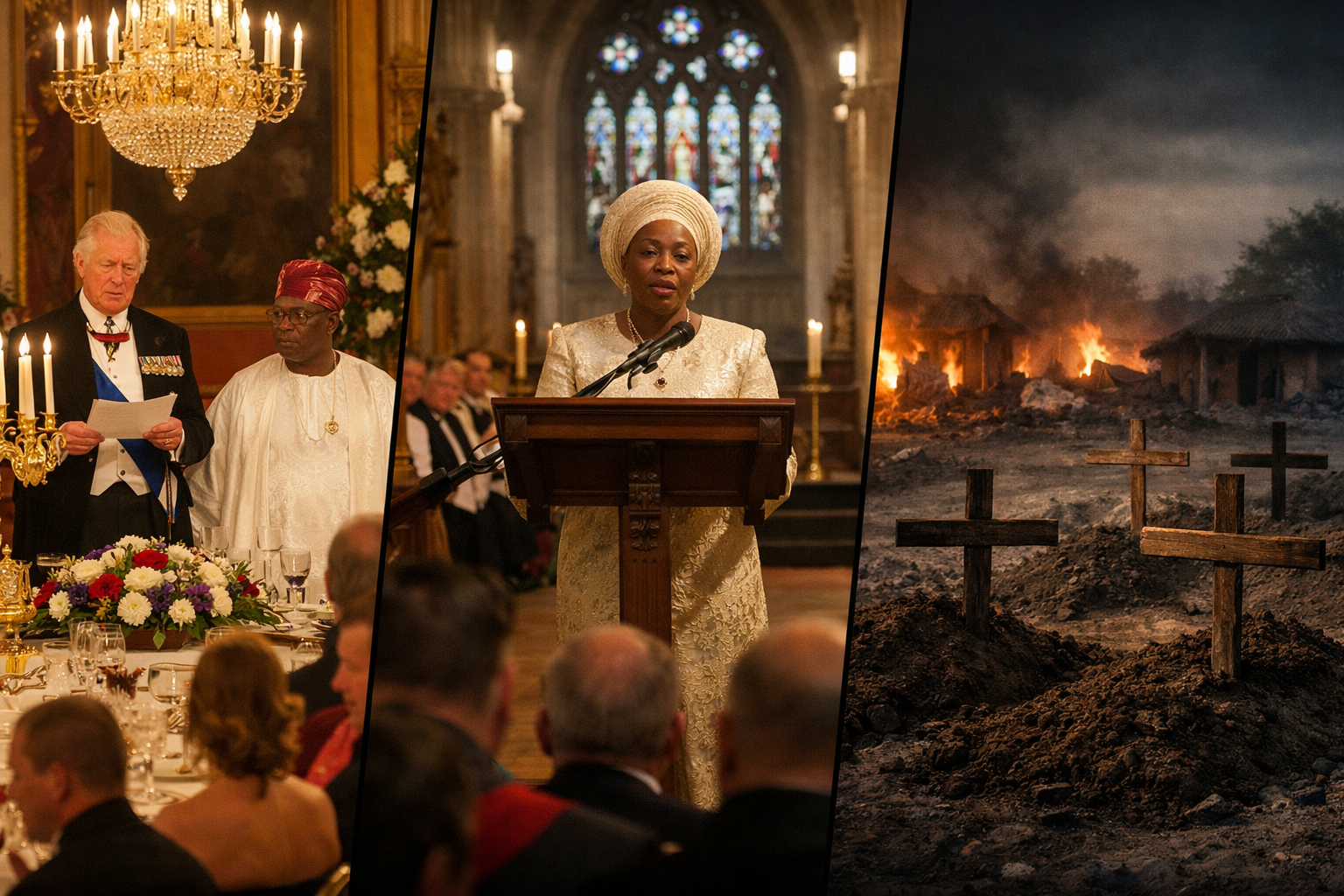
On 16 March 2026, at least twenty-three people were killed in a terrorist attack in Maiduguri, in Nigeria.¹ Within forty-eight hours of that attack, the President of Nigeria, Bola Ahmed Tinubu, was received in the United Kingdom with full ceremonial honours. On 18–19 March 2026, Charles III hosted the visit at Windsor Castle with a state banquet and formal diplomatic engagements, while at the same time, at Lambeth Palace, the Nigerian First Lady, Oluremi Tinubu, was invited to preach at a Christian prayer service, delivering a sermon grounded in Scripture and invoking divine mercy and moral renewal.² Less than ten days later, on 29 March 2026—Palm Sunday—Christians in Plateau State were massacred.³ This sequence establishes that the United Kingdom acted in full knowledge of an ongoing pattern of anti-Christian violence and chose not to name it at the moment of greatest visibility.
That knowledge had already been formally articulated. In 2019, under Jeremy Hunt, the Foreign and Commonwealth Office commissioned the review led by Philip Mounstephen. The report concluded:
“The level and nature of persecution of Christians… is arguably coming close to meeting the international definition of genocide.”⁴
Nigeria was identified explicitly within that assessment as a locus of sustained violence against Christian communities.⁴ The report documents patterns including village attacks, church destruction, and abductions, establishing a consistent and recognisable form of targeted violence.
When that context is applied to the events at Windsor and Lambeth, the significance of what was not said becomes determinative. The state visit proceeded in the language of diplomatic cooperation, while the prayer service at Lambeth Palace placed Christian theology explicitly at the centre of the occasion. Yet in neither setting was the defining reality acknowledged that Christians in Nigeria were being killed in sustained and repeated attacks. This omission cannot be attributed to lack of knowledge or lack of appropriate setting. It reflects a deliberate decision not to articulate a known reality.
The argument that such restraint is required by diplomacy does not withstand scrutiny when considered alongside the state’s behaviour in other contexts. Under Charles III, official messages marking Islamic observances are issued publicly and in explicitly moral terms. In a Ramadan message, the King referred to:
“the profound spiritual values of compassion, generosity and self-discipline.”⁵
This demonstrates that the state is willing to articulate religious meaning publicly when it considers it appropriate to do so. The issue is therefore not the limits of diplomatic speech, but the criteria by which those limits are applied.
The same selectivity is evident in policy. The United Kingdom has established formal mechanisms addressing anti-Muslim hatred, including advisory structures within government. The Department for Levelling Up, Housing and Communities describes the role of its adviser as addressing “anti-Muslim hatred in all its forms.”⁶ No equivalent structure exists addressing anti-Christian hatred, despite the scale of violence identified in official government analysis. The explanation that Muslims constitute a minority within the United Kingdom does not resolve this disparity, since in global contexts such as Nigeria, Christians are frequently the vulnerable population subject to violence.
The events of March 2026 therefore form a continuous and coherent sequence. The terrorist attack in Maiduguri on 16 March, the state visit and Lambeth sermon on 18–19 March, and the Palm Sunday massacre on 29 March are not isolated incidents but successive moments within a single context. At each stage, the United Kingdom possessed knowledge, access, and opportunity. At no stage did it publicly articulate the nature of the crisis it had already identified.
The conclusion follows directly from the evidence. When a state recognises a form of violence in its own analysis, demonstrates the capacity to address religious issues publicly, and declines to apply that capacity where it is most evidently warranted, the resulting silence cannot be understood as neutral. It reflects a decision about which realities are to be named and which are to remain unspoken. In that sense, silence is not the absence of policy but one of its clearest expressions.
¹ Reuters, “At least 23 killed in Maiduguri suicide bombings,” 16 March 2026. “At least 23 people were killed in multiple blasts in Maiduguri…”
² Premier Christian News, “First Lady of Nigeria preaches on God’s mercy at Lambeth Palace,” 20 March 2026; Anglican Communion News Service, 19 March 2026. “She was invited to preach at a short Service of Prayer…”
³ Open Doors UK, “Palm Sunday attack in Nigeria leaves dozens dead,” 2026; Religion Unplugged, 2 April 2026. “At least 27 people were killed in Plateau State…”
⁴ Bishop of Truro Review, Final Report, July 2019, p. 15. “Arguably coming close to meeting the international definition of genocide.”
⁵ Royal Household, “Message for Ramadan,” 2024. “The profound spiritual values of compassion, generosity and self-discipline.”
⁶ UK Government, Department for Levelling Up, Housing and Communities, “Independent Adviser on Anti-Muslim Hatred,” policy description (2019–2025). “Addressing anti-Muslim hatred in all its forms.”
RELATED ARTICLES


LATEST ARTICLES
- QUI BENE DISTINGUIT, BENE DOCET ~ He who distinguishes well, teaches well: Spiritual Conference for Nuntiatoria CXXIIIIn a series of Tuesday conferences, the speaker explores themes about recognising reality, receiving divine gifts, and understanding spiritual truths. He highlights the importance of making careful distinctions to maintain sound judgment, especially in an age consumed by distractions and superficial assessments. True wisdom lies in distinguishing truth from perception and nurturing an authentic inner life centred on Christ.
- Today’s homily: Impression of the Stigmata upon St FrancisFrom serving the lepers he once shunned to receiving Christ’s wounds upon Mount Alvernia, Saint Francis shows how grace transforms a soul through obedient love. His stigmata call us to let the Cross shape our lives, beginning with the particular act of mercy or sacrifice we have been reluctant to offer.
- Today’s Mass: September 17 Impression of the Stigmata of St Francis of AssisiSaint Francis received the stigmata because he had first allowed the Cross to transform his soul. His wounds were not a spectacle, but God’s answer to a world growing cold: the visible sign of a life consumed by crucified love. We may never bear Christ’s wounds in our flesh, but we must bear their likeness through penance, fidelity, patience, mercy and sacrificial love.
- Sermon for Stigmata of St. FrancisToday marks the feast of St. Francis’ stigmata, celebrating his transformation from a wealthy merchant’s son to a devoted preacher of poverty and humility. He founded the Franciscan order, emphasising evangelisation and simplicity. His experience of receiving the stigmata exemplifies the Christian doctrine of redemption through suffering, distinguishing it from other faiths.
- Today’s homily: Wednesday Michaelmas EmberThe homily reflects on the significance of fasting and prayer in the Christian faith, emphasising their role in spiritual growth and self-mastery. By juxtaposing scripture from Amos and the Gospel of Mark, it highlights the need for gratitude and humility during abundance, urging believers to recognise their dependence on God. True repentance transforms and restores one’s relationship with Him.



Leave a Reply