

A major Theos study reveals a Britain increasingly anxious to preserve its Christian inheritance while uncertain what Christianity actually requires. Its findings expose the dangers of racial nationalism, the emptiness of merely cultural religion and the inadequacy of secular assumptions about public faith. But beyond the statistics lies a question neither nationalism nor secular liberalism can adequately answer: does Christianity possess authority in public life because the nation approves of it, or because Christ is King?
Britain appears increasingly determined to defend a Christianity it is considerably less willing to practise. Crosses are carried at political demonstrations, Christian civilisation is invoked in arguments about immigration, and the disappearance of churches is lamented by people who seldom enter them. Yet the same society frequently regards the doctrinal and moral claims of Christianity as unwelcome intrusions into public affairs. The inheritance is celebrated as a national possession while the religion which produced it is expected to accommodate contemporary political preferences. Christianity has become politically conspicuous in a country where its actual practice has declined. The contradiction is not merely cultural. It raises fundamental questions about what Christianity is, who possesses the authority to define it, and what obligations it places upon individuals and society.
That contradiction lies at the heart of a substantial new report from the religion and society think tank Theos. Published in October 2026, Beyond “Christian Nationalism”: Measuring Attitudes to Christianity and Britishness Today, by Dr Nick Spencer and Dr Yinxuan Huang, examines public attitudes towards Christianity, national identity, immigration, religious affiliation and political authority. Its findings challenge the careless use of a term which has become simultaneously an accusation in secular discourse and an aspiration among certain political movements. The research provides substantial evidence for distinctions previously advanced in Nuntiatoria: Christianity cannot be reduced to a badge of national belonging, and the legitimate defence of Christian civilisation must be distinguished from the political appropriation of Christian symbols. What the new study adds is a more detailed picture of just how extensive, and how contradictory, those attitudes have become.¹ ²
Theos commissioned RED C to survey 10,848 adults across six European countries between 7 and 27 April 2026, including 1,765 respondents in the United Kingdom. The researchers then employed principal component analysis and latent class analysis to identify five distinct orientations towards Christianity and Britishness. These are statistical classifications derived from patterns of answers, rather than organised movements or identities chosen by respondents themselves. Thirty-four per cent were classified as Committed Separatists, rejecting almost every proposed relationship between Christianity and national life. Sixteen per cent were Cultural Separatists, generally sharing that position while resisting the displacement of familiar cultural institutions. Twenty-six per cent were Values Integrationists, favouring recognition of Christianity’s contribution to British history and values. Eleven per cent were Identity Integrationists, attaching Christianity strongly to national identity. The remaining thirteen per cent were Belief Integrationists, favouring a closer relationship between Christianity and the nation principally because they wished to promote the Christian faith. The distinctions expose the inadequacy of treating everyone who invokes Christian Britain as though they belonged to a single political or theological constituency.¹

The headline figures reinforce that conclusion. Only eight per cent strongly agreed that a person needed to be Christian to be truly British, with a further nine per cent expressing qualified agreement. Just one per cent considered Christianity the most important criterion of Britishness. Yet 37 per cent supported the Government formally declaring Britain a Christian country. That disparity is among the report’s most consequential findings. Evidently, many people wish to acknowledge or preserve Britain’s Christian character without believing that non-Christians cannot genuinely belong to the nation. Recognition of an historical inheritance is not identical with imposing religious qualifications upon citizenship. Nor does a country’s particular religious history require the exclusion of those who do not share it. Confusing these propositions has made much contemporary discussion unnecessarily contentious and intellectually impoverished.¹
The distinction becomes still more interesting when the report considers the disappearance of Christian institutions. Fifty-five per cent of respondents would be unhappy if their local church closed and became a mosque. Among Cultural Separatists, the proportion reached 99 per cent, notwithstanding their general rejection of Christianity as a defining characteristic of British national identity. The finding resists an easy explanation. The closure of a church may be regretted for religious, architectural, communal, historical or cultural reasons. Its conversion into a mosque may additionally provoke concerns about changing religious demographics or the disappearance of a familiar local institution. Some objections may arise from prejudice, but the question does not establish that all do. To infer hostility towards Muslims from every expression of concern would be as unwarranted as assuming that everyone who regrets a church closure believes in the Real Presence or attends Sunday worship. The survey records attitudes; it does not establish the complete moral reasoning of every respondent.¹
The most revealing evidence concerns the contrast between those primarily attached to Christian identity and those more actively engaged in religious practice. Among Identity Integrationists, 81 per cent described themselves as Christian, but only thirteen per cent reported attending church weekly. Among Belief Integrationists, 77 per cent identified as Christian and 31 per cent reported weekly attendance. The latter were also more likely to pray weekly, take an interest in the Bible and regard religion as important to their lives. This disparity does not establish the orthodoxy of either group, or distinguish Catholic sacramental practice from that of other Christian denominations. Nevertheless, it exposes the difference between Christianity as cultural identification and Christianity as a practised religion. The preservation of Christian civilisation may be a legitimate concern, but attachment to its symbols cannot substitute for supernatural faith, conversion, worship and obedience to God’s commandments.¹

Here contemporary appeals to Christian Britain encounter their first theological difficulty. Christianity is not simply an inheritance received through ancestry, architecture, national ceremonies or customary observance. It is a revealed religion, requiring supernatural faith and calling men to repentance and the sacramental life. Its truths are not made true by their antiquity, their contribution to social cohesion or their usefulness in distinguishing one nation from another. One may admire Gothic architecture without believing in the Incarnation, or defend a parish church without accepting the authority of the Church. Such sentiments are not necessarily worthless. They may preserve institutions through which future generations encounter the Faith. But they must not be confused with Christian discipleship itself. The possession of a civilisation’s visible remains is not proof that its animating religion remains alive.
Theos’s research also challenges any comfortable assumption that greater religious practice necessarily produces sounder political judgement. Its Belief Integrationists, despite reporting the highest levels of churchgoing, display considerable agreement with some troubling propositions. Sixty-six per cent agreed that Europe’s white population was being deliberately replaced by migrants from Muslim countries. Sixty-two per cent favoured strong political leaders prepared to break rules, while 25 per cent agreed that political violence was sometimes necessary. Among Identity Integrationists, agreement with the alleged demographic-replacement proposition reached 82 per cent, while substantial majorities also expressed support for forceful political leadership. Such findings cannot be dismissed merely because they complicate a preferred defence of practising Christians. They demand examination, including examination by the churches themselves.¹

That examination nevertheless requires distinctions which contemporary controversy frequently neglects. Demographic change is observable and measurable. Government immigration policy may be investigated, criticised and contested. Allegations of a coordinated programme deliberately to replace a population are different claims, requiring independent evidence of purpose and organisation. Agreement with a survey proposition does not establish its truth. Nor does the mere fact of concern about migration demonstrate racial hatred. Nations possess legitimate responsibilities concerning borders, public order, cultural continuity, housing, integration and the common good. Such concerns must be assessed upon their merits, not dismissed through speculative judgements about motives. Conversely, nationality and racial ancestry cannot be made qualifications for Christian dignity or membership of Christ’s Church. The Church was established for the salvation of all nations, not as the supernatural confirmation of one people’s ethnic preferences.
The findings on political authority deserve similar precision. The proposition that political violence is sometimes necessary is insufficiently specific to distinguish unjust aggression from legitimate defence or resistance to tyranny under the stringent conditions considered by Christian moral theology. It would be improper to treat every affirmative response as an endorsement of unlawful violence. Equally, the figures concerning political leaders prepared to break rules ought not to be trivialised. Catholic teaching does not permit the abandonment of moral obligations because political objectives are attractive or because those objectives are presented as Christian. Political authority is not absolved from justice by religious rhetoric. A movement claiming to defend Christian civilisation while cultivating contempt for truth, lawful authority or the dignity of persons may contradict the very religion it professes to protect.
The reception of the Theos report has revealed a further problem. Writing in the Church Times on 11 October, Madeleine Davies emphasised the description of Identity Integrationists as deeply anxious about the state of Britain. The anxiety is evident in the report, but anxiety is neither a refutation of a concern nor proof that the concern is justified. Britain has undergone substantial religious, demographic and institutional change. Whether particular consequences are harmful must be established by evidence and moral reasoning. The fact that people experience insecurity does not make them irrational; neither does the sincerity of their apprehension validate every explanation offered for it. To investigate the causes of such concerns would be constructive. To employ the language of anxiety as a substitute for evaluating their substance would reproduce the condescension which has already done so much to impoverish public debate.³
Humanists UK approached the findings from another direction. Responding on 12 October, it argued that the high levels of religious practice among Belief Integrationists undermine attempts to separate Christian nationalism from Christianity itself. Its criticism identifies a genuine weakness in any account which attributes objectionable political convictions exclusively to nominal or culturally affiliated Christians. The data do not support so simple a distinction. But neither do they establish that the moral or political errors of professing Christians are authentic expressions of Christian doctrine. The distinction between a religion’s teaching and the beliefs or conduct of its adherents is indispensable. A Christian who endorses injustice must be judged against Christianity’s moral claims, not permitted to redefine those claims through allegiance to a political programme. Equally, those wishing to discredit Christianity cannot reasonably select objectionable attitudes among its adherents and treat them as authoritative interpretations of the Faith.⁴
The more fundamental limitation of the Theos research, however, lies elsewhere. Its questionnaire examines Christianity principally through belief, practice, values, heritage and identity. These are legitimate categories for sociological investigation, but they do not exhaust the theological question. Whether political leaders should be Christians, whether legislation should reflect Christian values, or whether a country should formally acknowledge Christianity are matters upon which citizens may express their preferences. The Catholic doctrine concerning political authority does not, however, originate in those preferences. The moral obligations of civil society are not created by electoral majorities, religious demographics or historical sentiment. If a law violates natural justice, its injustice is not altered by the number of citizens who approve of it. If divine revelation is true, its authority does not diminish because fewer people profess it.
Leo XIII addressed precisely this distinction in Immortale Dei. Civil society, no less than the individual, possesses obligations towards God. Spiritual and temporal powers have distinct jurisdictions, but political authority is neither morally autonomous nor free to determine the ultimate purpose of human existence. The State is not the Church; neither is it an authority competent to redefine divine truth. Its proper responsibilities concern temporal society and the common good, exercised within the natural moral order and without usurping ecclesiastical jurisdiction. The Catholic understanding of political society therefore differs fundamentally from an arrangement in which religion becomes merely one cultural interest competing for recognition within a supposedly self-sufficient secular order.⁵
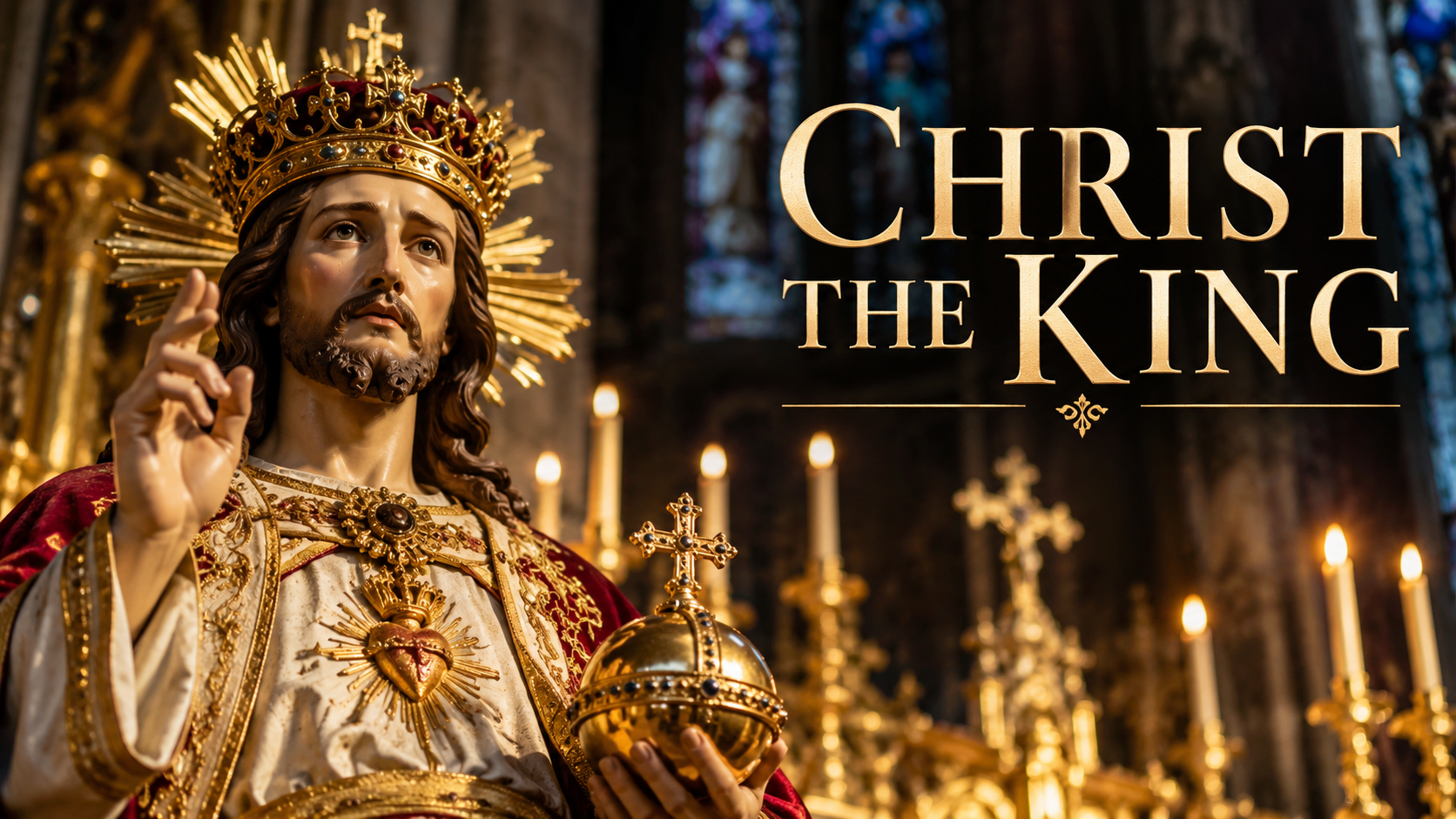
Pius XI developed the same teaching in Quas Primas, establishing the feast of Christ the King in 1925. His concern was not that European nations should preserve Christian imagery to maintain their cultural distinctiveness. It was that individuals and governments had increasingly excluded Christ and His law from public affairs. The encyclical proclaimed the universal kingship of Christ, extending to all peoples because His sovereignty is not conferred by civil authority or confined within national boundaries. Indeed, Pius XI expressly warned against selfishness concealed beneath professions of patriotism. His doctrine cannot therefore be enlisted to justify racial nationalism or the elevation of national interest above divine justice. But neither can it be reconciled with the proposition that Christianity must remain politically silent because modern society prefers religion to be private.⁶
The distinction between the natural and supernatural orders is indispensable here. Political society possesses a genuine common good, including peace, justice, security and the conditions necessary for virtuous human life. Such goods are not contemptible or merely incidental. They constitute legitimate purposes of civil authority. But man’s supreme good is not reducible to political stability, material prosperity or national continuity. His ultimate end is God. Christ’s command to seek first the kingdom of God and His justice (Matthew 6:33) establishes an ordering of ends which no national programme can reverse. Love of neighbour demands concern for temporal welfare precisely because the person possesses a dignity and ultimate destiny exceeding the purposes of the State. Christian charity cannot be reduced to humanitarian sentiment, any more than Christian patriotism can be reduced to the preservation of familiar national customs.
This has important consequences for religious liberty. The objective claims of Christianity do not entitle the State to manufacture supernatural faith through coercion. Belief cannot be compelled into existence by legislation, and political authority possesses no power to administer the sacraments or determine revealed doctrine. Nor does the confession of Christianity’s truth justify denying justice to those who profess other religions. A Catholic may reject Islamic theology while defending the dignity, security and legitimate civil rights of Muslim neighbours. Criticism of Islam as a religion, concern regarding Islamism as a political phenomenon, arguments about immigration and hostility towards Muslim persons are distinguishable matters. Nuntiatoria examined precisely these distinctions in its earlier commentary on Rowan Williams and Nigel Farage. To collapse them into a single accusation of religious intolerance is to make serious discussion almost impossible.⁷
There is also a specifically British historical difficulty in the contemporary invocation of a national Christianity. The religious inheritance of these islands cannot simply be identified with the established Church of England or with the constitutional settlement that followed the Reformation. The Catholic faith formed British religious, intellectual and institutional life for centuries before those events, and subsequent history introduced profound divisions concerning ecclesiastical authority, doctrine and worship. To defend the Christian inheritance of Britain without addressing what Christianity teaches risks turning a contested theological history into an agreeable national mythology. An institution may be ancient without possessing doctrinal authority; a religious custom may be familiar without being an adequate expression of supernatural faith. For Catholics, the Church’s universality and doctrinal claims cannot be subordinated to the religious arrangements of any particular nation.
This problem is intensified by the failure of Christian instruction and witness. The popularity of Christian symbols among people with limited religious practice did not arise in isolation. Generations have encountered Christianity increasingly as a source of ethical sentiment, community service, social harmony and cultural identity, while its more demanding supernatural and moral claims have been neglected, qualified or obscured. Where preaching hesitates to proclaim conversion, judgement, sin, repentance and salvation, Christianity becomes vulnerable to appropriation by those who admire its historical influence but feel little obligation to embrace its teaching. The modern secularist may wish to preserve Christian charity without Christian doctrine. The nationalist may wish to preserve Christian civilisation without Christian obedience. Neither arrangement constitutes the Christian religion.
The churches must therefore confront a challenge more serious than the political misuse of religious language. It is entirely possible for a nation to retain elaborate Christian ceremonies while much of its population remains ignorant of the Creed. Cathedrals may continue to attract visitors, Christmas carols may remain popular, and politicians may profess admiration for Christian values, while the Faith itself recedes from public understanding. The answer cannot be simply to condemn those who retain cultural attachment, for such attachment may offer an opening towards genuine belief. Nor can it be to congratulate ourselves that Christian symbols have returned to the political arena. The question is whether those symbols will lead people to Christ or merely provide a sanctified vocabulary for grievances and ambitions which remain substantially secular.
The limitations of the Theos report should not obscure its value. Its authors acknowledge that their research examines attitudes at a particular moment; it cannot establish from a single survey whether Christian nationalism is growing. They also acknowledge that asking about Britishness rather than Englishness, Scottishness or Welshness may affect the results. The five groups depend upon the questions selected and the statistical model employed, and their characteristics are weighted estimates rather than fixed identities. These qualifications are not reasons to dismiss the research. They are reasons to interpret it carefully. The study is particularly successful in demonstrating that attitudes towards Christianity and national identity cannot be reduced to a simple opposition between devout Christians and secular opponents, or between enlightened cosmopolitans and religious nationalists.¹
Its most consequential finding may be that the Christian inheritance retains significance even among those who do not practise Christianity, while greater religious observance does not guarantee freedom from political error. The former challenges a secularism eager to regard Christianity as merely a private preference with no continuing national relevance. The latter challenges Christians tempted to suppose that political movements become trustworthy because their members attend church or invoke the name of Christ. Each side must confront evidence that disturbs its preferred account. Neither may assume that its judgement is vindicated merely because the other has been shown to possess inconsistencies.
A Catholic response must therefore refuse the false choice between national self-erasure and religious nationalism. Nations possess legitimate histories, institutions, traditions and duties. Patriotism, rightly ordered, is a moral virtue, not a pathology. But nations are not churches, and Christianity does not acquire its authority from serving national identity. Civil rulers remain answerable to justice; ecclesiastical authority remains ordered to the supernatural salvation of souls; and the universal sovereignty of Christ cannot be confined to the cultural preferences of any particular people. The State must neither appropriate the Church nor presume to silence her. Christians, for their part, must neither abandon public life nor surrender their religion to whichever political faction most enthusiastically employs its language.
Britain’s difficulty is not simply that Christianity has become entangled with nationalism. It is that the weakening of Christian belief and practice has left a vast religious inheritance increasingly available for rival political interpretations. Some wish to preserve its cultural prestige while rejecting its supernatural obligations. Others regard its continued public influence as an obstacle to secular progress. Between them, Christianity risks being treated either as a national possession or as an unwelcome private opinion. The actual claims of the Faith are larger, more demanding and considerably less convenient to both parties.
Theos has measured what the British think Christianity should mean for their nation. It cannot tell them whether Christianity is true, what obligations follow from that truth, or by what authority rulers and citizens must answer for their conduct. Those questions cannot be settled by sociology, party allegiance or the prevailing political consensus. They belong to the order of truth and ultimately to the judgement of God.
Britain will not recover Christianity by displaying crosses while neglecting the Cross, defending churches while abandoning worship, or invoking Christian civilisation while resisting Christian morality. Nor will it become morally neutral by excluding Christianity from public affairs. The necessary recovery begins with the profession and practice of the Faith, the formation of conscience, the conversion of souls and the recognition that neither the individual nor the nation is morally self-sufficient.
Christ is not King because Britain is Christian. Britain, like every other nation, is answerable to Christ because He is King.
- Nick Spencer and Yinxuan Huang, Beyond “Christian Nationalism”: Measuring Attitudes to Christianity and Britishness Today, Theos, October 2026, especially pp. 6–10, 18–25, 34–35, 74–85 and 118–119.
- Nuntiatoria, Christian Nationalism in Britain: A False Label and a Misguided Revival, 29 March 2026.
- Madeleine Davies, Attitudes to Christianity and Britishness Reflect Deep Anxiety, Theos Report Says, Church Times, 11 October 2026.
- Humanists UK, We Can’t Tackle Christian Nationalism by Pretending It Isn’t Christian, 12 October 2026.
- Pope Leo XIII, Immortale Dei, 1 November 1885, §§3–6.
- Pope Pius XI, Quas Primas, 11 December 1925, §§13–19, 24–25.
- Nuntiatoria, Christian Britain Is Not Anti-Muslim: Rowan Williams, Nigel Farage and the Increasingly Dangerous Confusion Between Christian Identity and Hostility to Islam, 21 August 2026.



Leave a Reply