
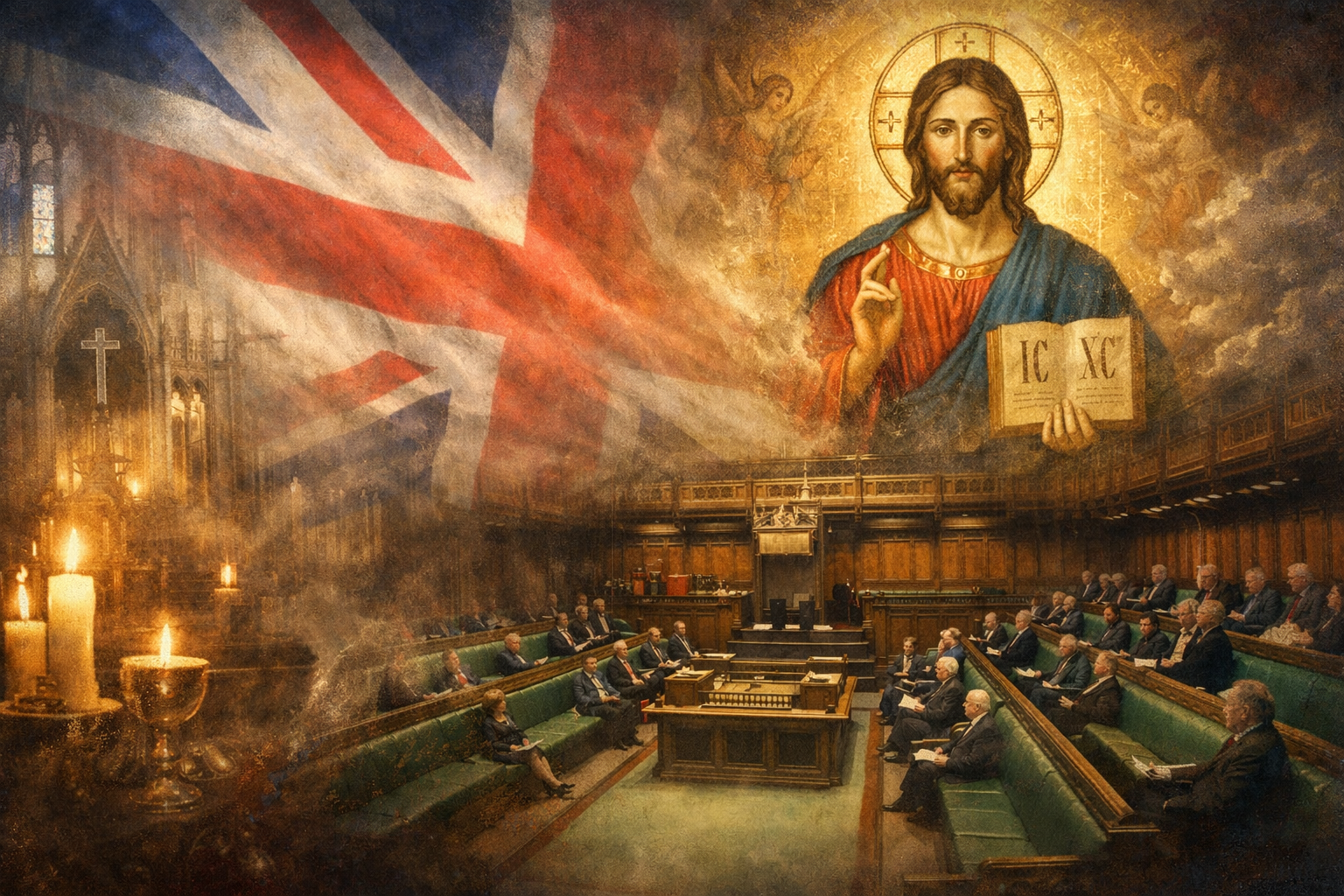
Christian Nationalism in Britain: A False Label and a Misguided Revival
When liberal ecclesial voices misname Christian conviction as extremism, and political movements reduce Christianity to identity, the result is not renewal but confusion—and the eclipse of Christ’s true kingship
By the Titular Archbishop of Selsey
The phrase “Christian nationalism” has entered British discourse with increasing frequency, yet with little corresponding increase in precision. Imported largely from debates in the United States and adapted without sufficient attention to Britain’s distinct constitutional and ecclesial context, it now functions as a diffuse and polemical label. In his recent essay, Nick Spencer defines Christian nationalism as the belief that Christianity and the nation are coterminous, such that belonging to the nation depends upon adherence—formal or cultural—to Christianity.¹ While this definition captures certain rhetorical tendencies, it fails to distinguish adequately between theological doctrine, cultural inheritance, and political appropriation.
At one level, the phenomenon Spencer describes is real. Contemporary Western discourse often reduces Christianity to a set of “values,” “heritage,” or “identity markers,” detached from doctrinal and sacramental substance. This reduction is evident in both secular and ecclesial contexts, where Christianity is invoked as a civilisational memory rather than professed as a revealed truth. Yet such a reduction is incompatible with the Church’s own self-understanding. As Pope Pius XI affirms, Christ’s kingship is not merely symbolic but extends to “all men, whether collectively or individually,” and therefore to societies themselves.²
The first major distortion in the British context arises from within the Church, particularly among liberal ecclesial voices that have adopted the assumptions of secular political theory. In this framework, any attempt to articulate the public relevance of Christianity—whether in relation to marriage, education, or moral law—is liable to be labelled as “Christian nationalist.” This can be seen in commentary surrounding debates on religious freedom, sex education policy, and the legal definition of marriage, where traditional Christian positions are frequently characterised as attempts to impose belief through state power.³ Such characterisations rest upon the assumption that the public square must be religiously neutral, an assumption that is itself contested.
The Church’s teaching rejects this neutrality. Pope Leo XIII states explicitly that “the State is bound to worship God” and cannot act as though religion were irrelevant to public life.⁴ This teaching does not entail the coercion of belief, but it does affirm that civil society must recognise objective moral truth. The relegation of Christianity to the private sphere, therefore, is not a neutral arrangement but a substantive reordering of society along secular lines.
This tension is particularly evident in the case of the Church of England, whose constitutional status remains formally embedded in the life of the nation. Bishops of the Church of England continue to sit in the House of Lords as Lords Spiritual, participating in legislative scrutiny and debate.⁵ Yet public interventions by senior clergy have increasingly reflected alignment with contemporary social and political priorities, including statements on inclusion, identity, and public policy, often framed in language indistinguishable from that of secular institutions.⁶ In this context, the invocation of “Christian nationalism” as a term of critique functions less as a theological judgment than as a means of distancing the Church from traditional doctrinal positions.
A second and distinct distortion arises within certain strands of contemporary British politics. Figures such as Nigel Farage have spoken of Britain’s “Judeo-Christian culture” as foundational to national identity, particularly in relation to debates on immigration and social cohesion.⁷ Similarly, Danny Kruger has argued for the importance of Christianity in shaping the nation’s moral and institutional life.⁸ These interventions reflect a legitimate recognition of historical reality: Britain’s legal, educational, and cultural institutions were indeed shaped within a Christian framework. However, the manner in which Christianity is invoked in such contexts often lacks theological specificity, reducing the Faith to a set of generalised “values.”
This reduction is not without consequence. When Christianity is detached from its doctrinal content and sacramental life, it becomes available for instrumental use within political discourse. It ceases to function as a claim about truth and becomes instead a marker of identity or cohesion. This is precisely the phenomenon Spencer identifies, yet it is not adequately addressed by collapsing it into a broader category of “Christian nationalism.” For what is at issue here is not the assertion of Christianity’s public relevance, but its dilution into a cultural artefact.
Moreover, certain political expressions risk approaching what Catholic theology identifies as a genuine error: the sacralisation of the nation. While Britain does not exhibit the overt theological nationalism found in some other contexts, rhetorical appeals to the defence of “Christian Britain” can, at times, blur the distinction between the natural and supernatural orders. The Church has consistently rejected any identification of a particular nation with the people of God in a salvific sense. As Mystici Corporis Christi teaches, the Church alone constitutes the Mystical Body of Christ, transcending all national and ethnic boundaries.⁹
Between these two distortions—the liberal marginalisation of Christianity and its political instrumentalisation—lies the authentic doctrine of Catholic political theology. This doctrine affirms neither the privatisation of religion nor its reduction to identity, but the proper ordering of society under the Kingship of Christ. The state, while distinct from the Church, is not autonomous in relation to truth. Its authority is real but limited, and it is bound to govern in accordance with the moral order. As Libertas teaches, freedom is not the absence of constraint but the capacity to act in accordance with truth.¹⁰
In this light, the term “Christian nationalism,” as currently employed in British discourse, obscures more than it clarifies. When used by liberal ecclesial voices, it functions as a mechanism for delegitimising orthodox Christian teaching by associating it with political extremism. When adopted within political rhetoric, it risks reducing Christianity to a cultural signifier, subordinate to national identity. In neither case does it accurately describe the Church’s teaching on the relationship between faith and society.
The deeper issue is not the presence of Christianity in public life, but the absence of a coherent account of its proper role. The myth of neutrality continues to dominate political and ecclesial discourse, despite its evident incoherence. Every legal system embodies moral judgments; every society is ordered toward some conception of the good. The exclusion of Christianity from this ordering does not eliminate moral claims but replaces them with alternatives.
In Britain today, the language of “Christian nationalism” functions simultaneously as accusation and aspiration, yet in both cases it misidentifies the reality it seeks to describe. It is a false label when applied to the legitimate expression of Christian doctrine in public life, and a misguided aspiration when Christianity is reduced to a component of national identity. The task is not to abandon Christian political thought, but to recover its proper form. For only when Christ is acknowledged not merely as a figure of cultural memory but as King—of persons, societies, and nations—can the present confusion be resolved and the common good rightly understood.
- Nick Spencer, “Christian Nationalism: an explainer,” Theos, 23 March 2026.
- Quas Primas, §18.
- UK debates on Relationships and Sex Education policy: UK Department for Education, Relationships Education, Relationships and Sex Education (RSE) and Health Education Guidance (2019, updated 2023).
- Immortale Dei, §6.
- UK Parliament House of Lords, “Lords Spiritual,” official parliamentary description of bishops’ role.
- Public statements from the Church of England on social issues (e.g. Living in Love and Faith process, 2023–2024 reports).
- Statements by Nigel Farage referencing “Judeo-Christian culture” in speeches and interviews (e.g. Reform UK policy commentary, 2024–2025).
- Danny Kruger, speeches and essays on national identity and Christianity, including reports from the New Social Covenant Unit (2023–2025).
- Mystici Corporis Christi, §13.
- Libertas, §§21–23.
Related Articles


LATEST ARTICLES
- Today’s homily: St John CantiusThe account of St John of Kenty illustrates true charity, as he prioritised the needs of a poor man over his own comfort, exemplifying how knowledge of faith must translate into actions. His life was marked by humility, generosity, and a dedication to both charitable works and doctrinal integrity, urging a holistic expression of faith.
- Today’s Mass: October 22 St John CantiusSt John of Kenty, originally a humble country lad, succeeded as a theology professor in Kraków but faced opposition that led to his role as a parish priest. Known for his kindness, he lived simply, aiding the poor. After winning his parishioners’ hearts, he returned to teaching, living a life of humility and faith.
- Today’s Mass: October 21 St Ursula, Virgin Martyr & CompanionsSt Ursula and Companions, Virgins and Martyrs; Commemoration of St Hilarion, Confessor. Though legends concerning Ursula and eleven thousand virgins are historically uncertain, early Christian martyrs were venerated at Cologne. St Hilarion, Palestinian hermit and disciple of St Anthony, embraced severe penance and solitude, dying in 371 aged eighty.
- FR RIPPERGER’S YEAR OF SILENCE: Obedience is not an explanationFr Chad Ripperger has accepted a year-long withdrawal from public speaking as requested by Archbishop Golka of Denver, aimed at focusing on his priestly community. This decision, following the removal of another exorcist, raises concerns about the Church’s balance between discretion and public witness regarding exorcism and supernatural matters.
- Today’s Mass: October 20 Octave Day of St Edward, King & ConfessorEdward the Confessor, England’s last Saxon king, ruled from 1042 until his death in 1066. Born in 1003, he fled to Normandy during Danish rule and returned to take the throne. His reign is debated, seen as both weak and a time of peace. Edward’s legacy includes the establishment of Westminster Abbey, where he is buried.



Leave a Reply