

The Liturgy Has Not Forgotten Israel
Catholic worship, before and after the Second Vatican Council, still prays for the conversion of the Jewish people. The fashionable claim that the Church abandoned the fulfilment of the Mosaic covenant in Christ cannot survive contact with her own prayers.

One of the most persistent myths of post-conciliar Catholicism is that the Church abandoned the doctrine that the Mosaic covenant was fulfilled and superseded in Jesus Christ. The assertion is repeated so often, and with such confidence, that many Catholics now assume it must be true. Yet the evidence against it is not hidden in forgotten theological manuals or buried in obscure patristic commentaries. It is found in the Church’s own public prayer. Every Christmas, every Easter and every Good Friday, Catholics pray precisely what modern commentators insist the Church no longer believes.
The controversy is often obscured by the word “supersessionism”, a term now commonly used less to clarify than to condemn. It can describe a crude and false theory according to which God simply rejected the Jewish people, revoked every promise made to Israel and transferred His favour to an entirely unrelated Gentile body. Catholic doctrine does not teach this. St Paul explicitly affirms that “the gifts and the calling of God are without repentance”.¹ The patriarchs remain the fathers of the faith, the Hebrew Scriptures remain the word of God, and Israel retains a singular place in salvation history.
Yet “supersessionism” may also describe the traditional Christian doctrine that the Mosaic economy was provisional, that its priesthood, sacrifices, ceremonial observances and juridical prescriptions pointed forward to Christ, and that the New Covenant has replaced it as the definitive order of salvation. In this sense, the doctrine is not a medieval distortion, an anti-Jewish accretion or a dispensable theological opinion. It is the teaching of the New Testament, the Fathers, the scholastics and the Catholic liturgy itself.
The essential distinction is between the covenant with Abraham and the covenant at Sinai. The promises made to Abraham are irrevocable because they culminate in Christ. The law given through Moses, however, was never intended to be final. It formed, disciplined and prepared the chosen people for the advent of the Messiah. Its sacrifices prefigured Calvary. Its priesthood foreshadowed the eternal priesthood of Christ. Its ritual separations anticipated the holiness of the people whom God would gather from every nation. Once the reality had come, the shadows could no longer retain their former authority.
The Epistle to the Hebrews states the matter without embarrassment: “In saying a new covenant, he hath made the former old. And that which decayeth and groweth old is near its end.”² St Paul argues throughout Galatians that the Mosaic law cannot remain a parallel means of justification after Christ. To return to circumcision and legal observance as salvific necessities is not fidelity to revelation but a retreat from grace. The Apostolic Church did not preach one covenantal path for Jews and another for Gentiles. It preached one Lord, one faith and one baptism.
This is what the Church still prays.
When Pope Benedict XVI revised the Good Friday prayer for the Jews in the 1962 Missal, he asked that God might “enlighten their hearts, so that they may recognise Jesus Christ as the Saviour of all men” and that, as the fullness of the Gentiles enters the Church, “all Israel may be saved”.³ The reaction was immediate. Benedict was accused of reviving an abandoned doctrine, reopening an old wound and returning Catholic worship to a supersessionist past.
The accusation was historically and liturgically false. Benedict restored nothing that had disappeared. He merely stated clearly what the post-conciliar liturgy had continued to say all along.
The revised Divine Office promulgated under Paul VI contains a remarkable series of intercessions for the conversion of Israel. On the evening of Christmas Day, the Church addresses Christ as the One awaited from the beginning of the world and asks Him to reveal His presence to those who still await Him. On 31 December she prays: “We pray that Israel may recognise you as its Messiah.” On 2 January she asks that the Gospel may be accepted by “the people of the promise”. On Easter Sunday she prays: “Let Israel recognise in you her longed-for Messiah.” During Paschaltide she asks God to reveal to the children of Israel the fulfilment of the promise made to their fathers.⁴
These prayers are not medieval survivals inadvertently left in the books by inattentive reformers. They were newly composed and formally promulgated after the Second Vatican Council. The very liturgical establishment commonly credited with abandoning traditional supersessionism continued to pray for the Jewish people to recognise Christ, receive the Gospel and enter the fullness of redemption.
The irony is considerable. Theologians, bishops, journalists and ecumenical officials have sometimes spoken as though Catholic teaching had decisively moved beyond the conversion of Israel, while priests and religious continued every year to ask God for precisely that conversion in the official prayer of the Church. The liturgy preserved what theological fashion sought to obscure.
The Good Friday prayer in the Missal of Paul VI is less direct but no less significant. It asks that the Jewish people may grow “in love of his name and in faithfulness to his covenant” and that the people God first made His own may attain “the fullness of redemption”.⁵ Some have interpreted this as an affirmation that the Mosaic covenant remains eternally valid and salvifically sufficient for Jews after Christ.
That interpretation cannot be sustained.
The prayer itself points not to Moses but to Abraham: “Almighty and eternal God, who bestowed your promises on Abraham and his descendants.” The covenant invoked is therefore the primordial covenant of promise, not the temporary economy of Sinai. The Abrahamic covenant is not abolished in Christ; it is fulfilled, enlarged and universalised. The Gentiles are grafted into the cultivated olive tree, not planted in an unrelated field. Those who belong to Christ become the children of Abraham by faith.⁶
The Mosaic covenant, however, cannot remain religiously sufficient after the Passion, Resurrection and Ascension without emptying those mysteries of their universal significance. If the law of Sinai remains an independent salvific path, then the New Covenant is not truly definitive, the sacrifice of Calvary is not universally necessary, and the apostolic commission contains an ethnic exception never mentioned by Christ or His Apostles.
The Fathers of the Church knew no such theory.
St Justin Martyr argued against Trypho that Christians, united to Christ, participate in the true inheritance promised to Abraham. St Irenaeus taught that the law educated humanity for the coming of the Son and found its completion in Him. St Augustine expressed the relationship with lapidary precision: the New Testament lies hidden in the Old, and the Old is unveiled in the New. St Thomas Aquinas taught that the ceremonial precepts of the old law prefigured Christ and ceased to bind once the realities they signified had been accomplished.⁷
This is not contempt for Israel. It is the grammar of Christian revelation.
The Church does not honour the Jewish people by pretending the Messiah has not come. Nor does she show respect by withholding the name of Christ from those whose prophets foretold Him, whose patriarchs anticipated Him and from whose race, according to the flesh, He was born. To suggest that Jews have no need of Christ is not an act of theological delicacy. It is a denial of His universal mission.
The command to teach all nations was not qualified by an exemption for the descendants of Abraham. The Apostles themselves first preached the Gospel in the synagogues. St Peter proclaimed Christ to Israel. St Paul endured persecution, hunger, imprisonment and death in order that both Jew and Gentile might be reconciled in one Body. The apostolic mission was born from the conviction that the promises made to Israel had been fulfilled, not abandoned, in Jesus of Nazareth.
The Second Vatican Council did not overturn this doctrine. Nostra Aetate condemned hatred, persecution and the reckless attribution of collective guilt to the Jewish people. It recalled the spiritual bond linking the Church to the stock of Abraham and insisted upon respect for the Jewish people. It did not teach that the Mosaic covenant remains a separate and sufficient means of salvation. Nor could it have done so without contradicting the New Testament and the Council’s own teaching that Christ is the way, the truth and the life, in whom men find the fullness of religious life.⁸
The confusion has been intensified by statements that the “Old Covenant” has never been revoked. The phrase is theologically imprecise unless the covenant in question is identified. Applied to the promises made to Abraham, it is true. Applied to the Mosaic economy as a continuing salvific dispensation, it is false.
The distinction is not a contrivance invented to rescue an embarrassed tradition. It is embedded in Scripture itself. Abraham precedes Moses. Promise precedes law. Faith precedes circumcision. The law was added for a time; the promise reaches its fulfilment in Christ. The covenant with Abraham endures because Christ is its fulfilment. The covenant at Sinai gives way because Christ has accomplished what it prefigured.
It is therefore more accurate to speak of fulfilment than rejection. The Church is not a Gentile replacement for Israel but the Catholic fulfilment of God’s people, in which Jew and Gentile are reconciled in one Mystical Body. The olive tree remains; some branches were broken off through unbelief; wild branches were grafted in; and the natural branches may yet be grafted in again.⁹ The Church does not glory over Israel. She hopes for Israel.
That hope is expressed in St Paul’s prophecy that a hardening has come upon Israel only in part, until the fullness of the Gentiles should enter, and “all Israel should be saved”.¹⁰ The precise manner and chronology of that mystery remain hidden in divine providence. The direction of the hope does not. Israel’s salvation is not conceived apart from Christ but through recognition of Him.
This is why the Good Friday prayer matters. It is not an insult. It is an act of Christian hope. It asks that the people who received the promises may recognise their fulfilment; that those who preserved the Scriptures may behold the Word made flesh; that the descendants of the patriarchs may enter the fullness of the inheritance prepared for them in the Messiah.
The alternative is not respect but religious indifferentism. It is the suggestion that Christ is necessary for some but unnecessary for others; that baptism is a divine command except where social sensitivity advises silence; that the Church may honour Israel only by ceasing to speak as the Church.
The liturgy refuses such evasions.
At Christmas, it prays that those who still await the Messiah may recognise His presence. At Easter, it prays that Israel may acknowledge in Christ the fulfilment of its hope. On Good Friday, it prays that the people first chosen may attain the fullness of redemption. These prayers span both forms of the Roman Missal and the post-conciliar Divine Office. They form a continuous and coherent witness.
The Church has never taught that God has abandoned Israel. She has never taught that His promises have failed. She has never taught that the Jewish people have ceased to possess a unique place in the mystery of salvation. Yet neither has she taught that the Mosaic covenant remains a parallel route to God after Calvary.
The modern attempt to separate Israel from Christ does violence to both. It empties Israel’s history of its divinely appointed fulfilment and reduces Christ from the promised Messiah of Israel to the founder of a religion for Gentiles. Catholic faith permits neither distortion.
The truth is more demanding and more beautiful. The promises remain because they are fulfilled. The election is not mocked because it reaches its purpose. The law is not despised because it has accomplished its preparatory work. Israel is not forgotten because the Church continues to pray for the day when the natural branches will be grafted once more into their own olive tree.
Every Christmas, every Easter and every Good Friday, the Catholic Church says so. She says it not in a polemical tract, nor in the heat of controversy, but on her knees before God.
The liturgy has not forgotten Israel.
It has remembered what too many Catholics have forgotten: that Jesus Christ is not merely the Saviour of the Gentiles, but the glory of His people Israel and the light of revelation to the nations.¹¹ The covenant has not failed. It has been fulfilled.
¹ Romans 11:29, Douay-Rheims.
² Hebrews 8:13, Douay-Rheims.
³ Benedict XVI, Oremus et pro Iudaeis, promulgated 6 February 2008.
⁴ Liturgia Horarum iuxta Ritum Romanum, second typical edition, vol. I, pp. 361, 408 and 433; vol. II, pp. 441, 549, 579, 649, 679 and 791.
⁵ Missale Romanum, third typical edition, Good Friday, Solemn Intercessions, “For the Jewish People”.
⁶ Romans 4; Galatians 3:6–29.
⁷ St Justin Martyr, Dialogue with Trypho; St Irenaeus, Adversus Haereses; St Augustine, Quaestiones in Heptateuchum II, 73; St Thomas Aquinas, Summa Theologiae, I-II, q. 103.
⁸ Second Vatican Council, Nostra Aetate, no. 4; Ad Gentes, no. 8.
⁹ Romans 11:17–24.
¹⁰ Romans 11:25–26, Douay-Rheims.
¹¹ Luke 2:32, Douay-Rheims.
RELATED ARTiCLES


LATEST ARTICLES
- Today’s Mass: September 05 Saint Lawrence JustinianSaint Lawrence Justinian, the first Patriarch of Venice, dedicated his life to the poor and the establishment of monasteries, rejecting noble marriage. Renowned for his humility and pastoral dedication, he emphasised the spiritual integrity of Venice’s safety. He was a precursor to the reforms of the Council of Trent, dying on 8 January 1455.
- 06.09.26 Nuntiatoria CXXII: NOMEN MANET, RES DEESTThis edition of Nuntiatoria explores the disconnect between the names of Catholic institutions and the realities they signify. Despite retaining their titles, many aspects of Catholicism—such as episcopal authority in China and religious practice in Poland—exhibit deteriorating substance. The piece cautions against superficial continuity, stressing the importance of genuine faith and practice over mere nomenclature.
- ORDO w/c 06.09.26The document outlines the liturgical schedule for the week of 6 to 13 September 2026, highlighting significant religious observances such as the Fifteenth Sunday after Pentecost and the Nativity of the Blessed Virgin Mary. It reflects on themes of compassion, holiness, fidelity, and humility, underscoring their importance in Christian life.
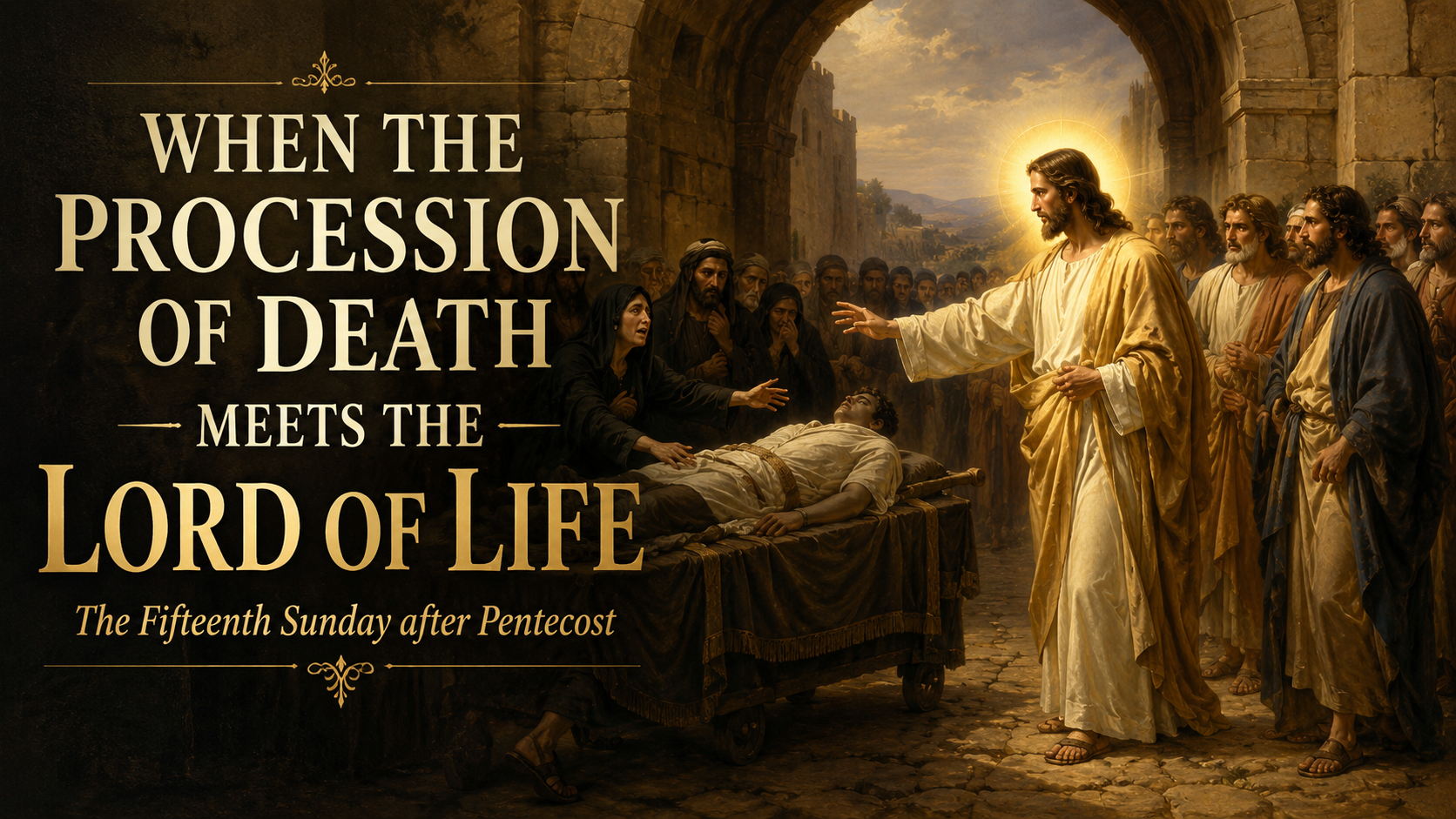
- The Fifteenth Sunday after Pentecost: When the Procession of Death Meets the Lord of LifeThe Fifteenth Sunday after Pentecost focuses on the transformative power of Christ, emphasising the supernatural life granted through grace. The liturgy highlights the Church’s role as a nurturing mother, mourning the spiritually dead while seeking their restoration. Christ’s compassion leads to resurrection, demonstrating that true life is found in dependence on Him.
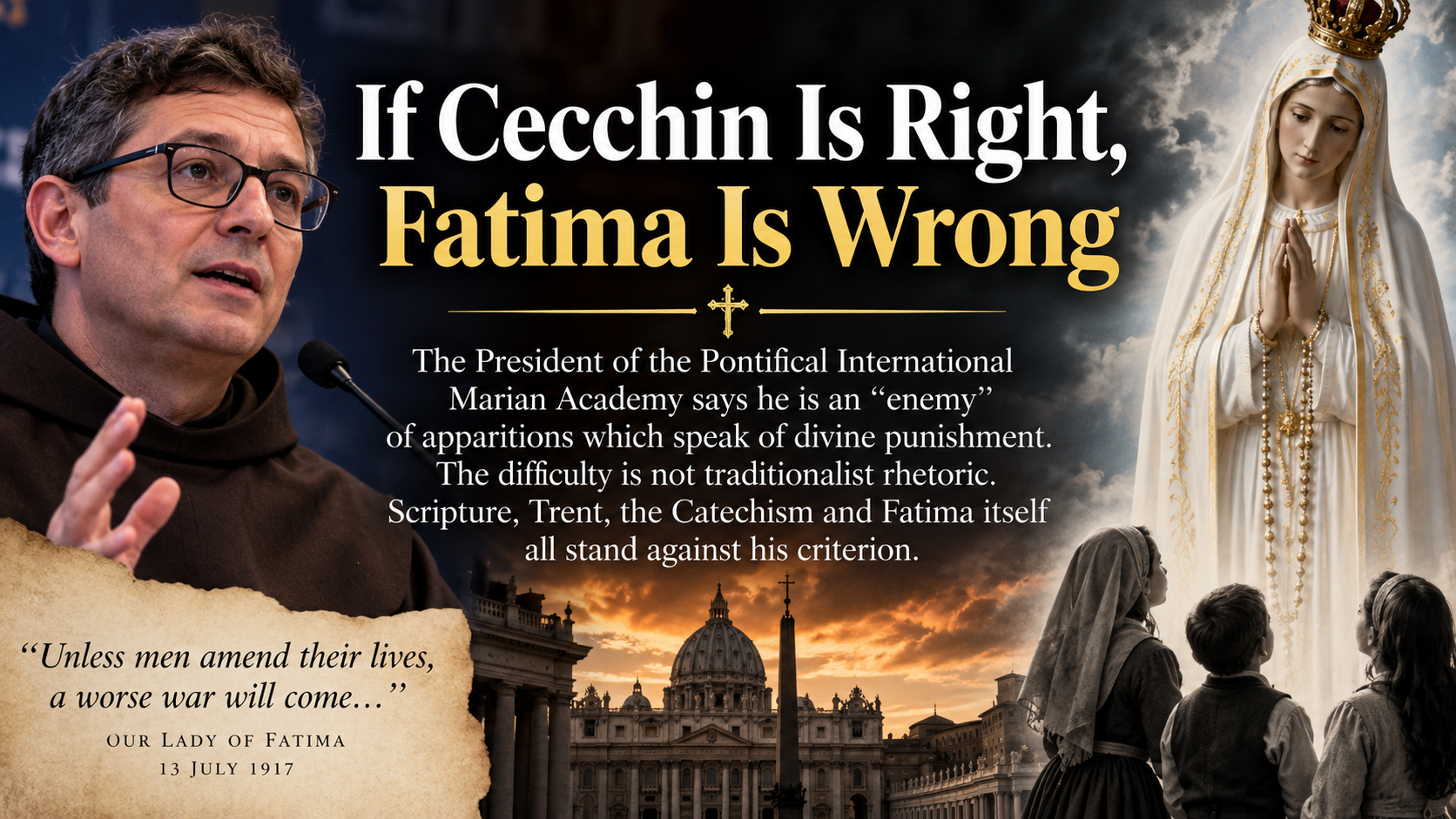
- If Cecchin Is Right, Fatima Is WrongFr Stefano Cecchin, President of the Pontifical International Marian Academy, has declared opposition to apparitions that speak of divine punishment, suggesting they are false. This stance contradicts fundamental Catholic doctrine, including teachings from Scripture, the Catechism, and specifically the Message of Fatima, which warns of divine consequences for sin.
CURRENT EDITION


Today’s Mass Propers
- Today’s Mass: September 05 Saint Lawrence Justinian
 Saint Lawrence Justinian, the first Patriarch of Venice, dedicated his life to the poor and the establishment of monasteries, rejecting noble marriage. Renowned for his humility and pastoral dedication, he emphasised the spiritual integrity of Venice’s safety. He was a precursor to the reforms of the Council of Trent, dying on 8 January 1455.


Leave a Reply