
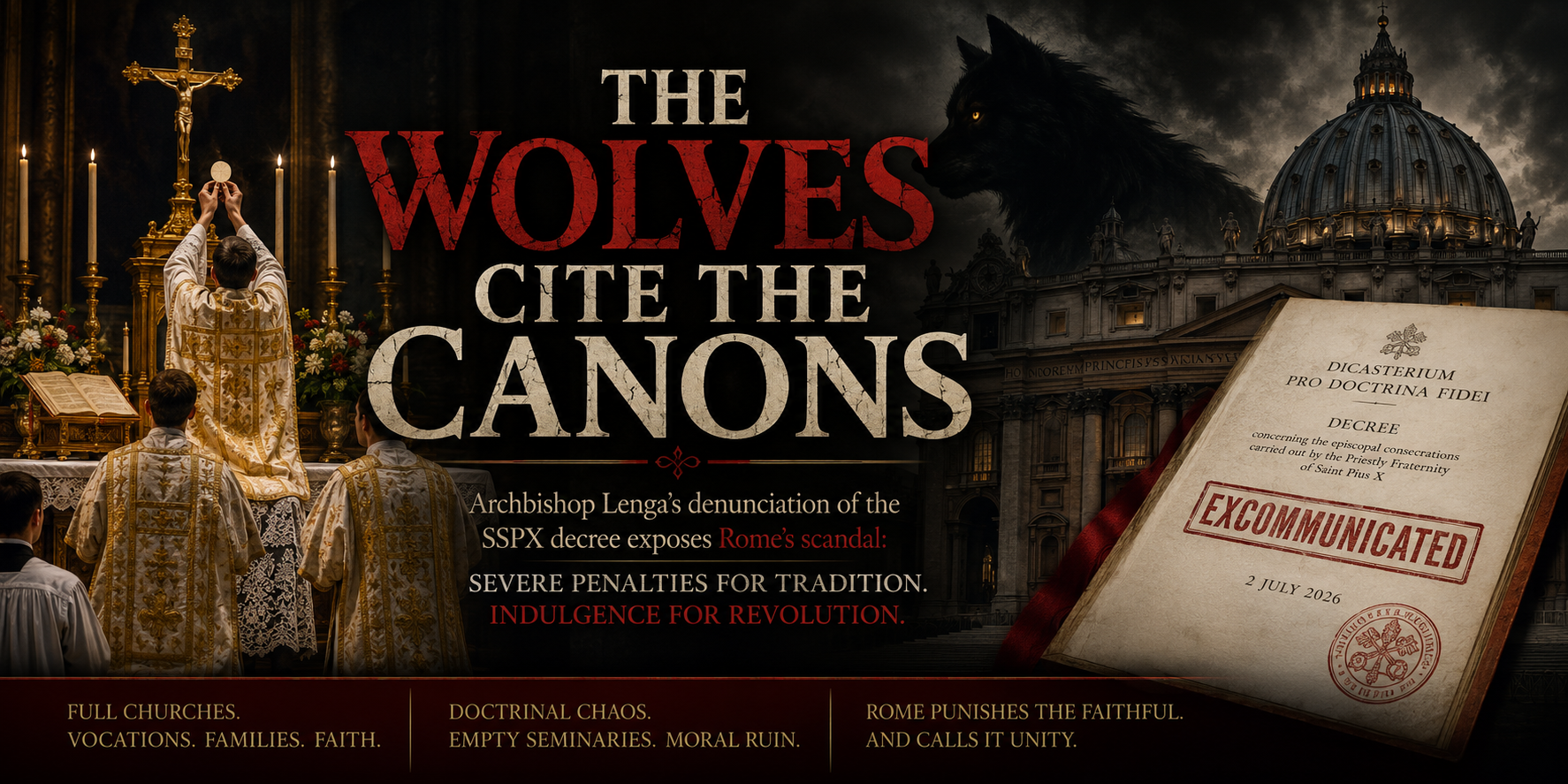
The Wolves Cite the Canons: Archbishop Jan Paweł Lenga’s denunciation of the SSPX decree
Archbishop Jan Paweł Lenga’s denunciation of the SSPX decree exposes the central scandal of the postconciliar Church: Rome now deploys its severest penalties against those who preserve what it habitually refuses to defend.

Archbishop Jan Paweł Lenga has answered the Vatican’s decree against the Society of Saint Pius X with the kind of episcopal plain speaking that has almost disappeared from the Catholic hierarchy. The former Archbishop of Karaganda declared that the document issued by the Dicastery for the Doctrine of the Faith under Cardinal Víctor Manuel Fernández proved “how far the Vatican has departed from Christ and from the faith”. He described a hierarchy that appeals to canonical authority while tolerating the destruction of doctrine, worship and Christian morals, and contrasted its disorder with the prayer, reverence, youth and supernatural seriousness visible at the episcopal consecrations in Écône.¹
The language is fierce. It is also intelligible. Archbishop Lenga did not learn the Faith in a Western episcopal bureaucracy where ecclesiastical advancement commonly rewards caution, accommodation and the skilful concealment of conviction. He was ordained secretly under Soviet persecution, ministered clandestinely and later served the Church in Kazakhstan. He knows what an institution looks like when its official language conceals hostility to the truths it claims to protect. His statement should therefore be read not as an exercise in curial diplomacy, but as the testimony of a churchman who believes that Rome’s present disciplinary priorities have become an indictment of Rome itself.
The immediate occasion was the DDF decree of 2 July 2026. Following the consecration of four bishops at Écône without a pontifical mandate, the Dicastery declared six SSPX bishops excommunicated. Its accompanying explanatory note went substantially further. It treated the Society’s priests as schismatics, subjected them to excommunication, warned that lay faithful who formally adhered to the Society could incur the same penalty, and declared SSPX confessions and marriages invalid. The document therefore moved beyond punishing the bishops directly involved in the consecrations and attempted to impose a comprehensive juridical quarantine upon the Society’s sacramental and ecclesial life.²
Archbishop Lenga’s response goes directly to the moral credibility of that act. “They appeal to canons,” he wrote, “which were written to prevent heresies, to prevent schism—yet these cardinals and bishops themselves are in schism.” His point is not that canon law is irrelevant, nor that episcopal consecration without papal mandate is a trivial matter. It is that law has been invoked selectively by men who appear capable of extraordinary severity towards traditional Catholics while exhibiting almost inexhaustible patience towards those who contradict the Catholic religion from within its own structures.
That contrast is not imaginary. Priests and bishops have publicly challenged Catholic teaching on homosexuality, sexual morality, the male priesthood, the uniqueness of Christ and the necessity of conversion. German and Flemish clergy have devised ceremonies for blessing homosexual couples. Senior ecclesiastics have spoken of revising moral doctrine according to contemporary experience. Catholic institutions have hosted advocates of abortion, gender ideology and sacramental innovations. The President of the Pontifical Academy of Theology has praised John Lennon’s Imagine, a song that invites its hearers to imagine a world without heaven, religion or final judgement. Yet no general decree has declared the clergy participating in these movements schismatic. No explanatory note has pronounced their sacraments invalid. No machinery has been established to require their adherents to submit written recantations to their diocesan bishops.
The traditionalist, by contrast, encounters a hierarchy suddenly animated by the strictest conception of obedience. The very authorities who speak of dialogue, accompaniment, synodality and the primacy of conscience rediscover command, penalty and submission when faced with Catholics attached to the traditional Mass and the doctrinal inheritance that produced it. Ambiguity is pastoral when used to accommodate revolution. Precision becomes indispensable when used to punish resistance.
This is the inversion Archbishop Lenga has identified. Rome no longer appears principally offended by the corruption of the Faith, but by resistance to the ecclesiastical programme through which that corruption has advanced. The SSPX is not punished because it denies the Trinity, the Incarnation, the Real Presence, the sacrificial character of the Mass, the divine institution of the papacy or the moral law. It is punished because it refuses to concede that the postconciliar settlement—including its disputed texts, liturgical revolution, ecumenical orientation and practical consequences—must be received as an unquestionably legitimate development of Catholic tradition.
The distinction matters. A heretic rejects a truth that the Church requires him to believe. The SSPX professes the dogmas of the Catholic Faith and contends that certain conciliar novelties cannot be reconciled with the previous Magisterium. Rome has had more than half a century in which to answer that contention with the clarity that truth deserves. Instead, it has repeatedly demanded acceptance while leaving the underlying doctrinal contradictions unresolved. The Society has asked how religious liberty can be reconciled with the teaching of the nineteenth- and twentieth-century popes; how ecumenical practice can be reconciled with the Church’s claim to be the one ark of salvation; how the new liturgy expresses the propitiatory sacrifice of the Mass with the doctrinal precision of the Roman rite it displaced. The answer has too often been that the Council must be interpreted according to tradition, even while the Magisterium’s own subsequent practice repeatedly confirms the interpretation the Society contests.
The DDF has now replaced the missing theological answer with a penal decree. That is not the triumph of authority. It is the confession of argumentative failure.
The canonical case is no less troubling. Episcopal consecration without a pontifical mandate is an offence specified by ecclesiastical law. Schism, however, is a distinct offence. Canon 751 defines schism as the refusal of submission to the Supreme Pontiff or of communion with those subject to him. The fact that a command of the Pope has been disobeyed does not, by itself, establish that papal authority has been rejected as such. Were every grave act of papal disobedience automatically schismatic, the Church’s own canonical distinction between disobedience and schism would collapse.
The SSPX explicitly professes recognition of Pope Leo XIV, names him in the Canon of the Mass and denies any intention of erecting a rival Church. Rome may argue that the Society’s acts contradict that profession. It may judge its position inconsistent, dangerous or objectively destructive of ecclesiastical order. But a penal decree must demonstrate the offence, including the requisite imputability, rather than simply converting disobedience into schism by assertion. The conclusion cannot be smuggled into the premise by describing the consecrations from the beginning as a “schismatic act”.
The problem becomes still more serious when the DDF passes from the six bishops directly involved to the whole body of SSPX priests. Penal responsibility in Catholic law is personal. It depends upon conduct, knowledge, intention and imputability. A priest does not become guilty of schism merely because he belongs to the same priestly society as a bishop who commits a canonical offence. Nor can hundreds of cases be adjudicated by a general explanatory note as though ordination, membership or continued ministry supplied automatic proof of a schismatic will.
The Vatican’s own subsequent explanations reveal the instability of its position. Vatican News acknowledged that lay imputability could not be presumed automatically and that individual circumstances had to be examined. It further recognised that a Catholic who attends an SSPX chapel for spiritual or liturgical reasons, without rejecting the authority of the Pope or the Magisterium, is not thereby necessarily guilty of schism.³ This is a necessary qualification, but it also concedes the very principle obscured by the decree’s theatrical breadth: association is not adherence, attendance is not schism, and canonical guilt cannot be established by proximity.
Archbishop Lenga therefore speaks with particular force when he contrasts the visible fruits of Écône with the condition of the official structures condemning it. “In the Society,” he wrote, “there is a life of prayer; there are young people, new churches are being built.” He did not claim that flourishing apostolates render every canonical decision correct. He pointed instead to the evangelical absurdity of the spectacle: a hierarchy presiding over collapsing vocations, empty churches, doctrinal illiteracy and moral confusion has chosen to place beyond the pale a society whose seminaries are full, whose families are numerous and whose members believe what Catholics believed before the present crisis began.
Fruitfulness does not prove juridical innocence. But sterility does not establish ecclesiastical authority’s fidelity to its mission. Our Lord instructed His disciples to judge false teachers by their fruits. When the communities most fully accommodated to the postconciliar programme decline, age and disappear, while those preserving traditional worship and doctrine attract families and vocations, the hierarchy ought at least to ask whether its pastoral assumptions have failed. Instead, it punishes the evidence.
Lenga’s image is therefore devastating: “The wolves cite the canons.” Law that should defend the sheep is employed by shepherds who have tolerated their dispersal. Canons written to protect the Faith become instruments for isolating those who insist upon its integrity. The ecclesiastical establishment that cannot clearly condemn the errors of its favoured theologians has found ample clarity with which to condemn the traditional priest.
The Archbishop’s most extreme language must nevertheless be placed within proper Catholic limits. His description of a “false Peter” and his declaration that Pope Leo “no longer represents the Church” go beyond what the crisis requires or Catholic ecclesiology safely permits. A pope who governs unjustly, favours error or abuses ecclesiastical discipline does not therefore cease to be Pope by the private judgement of a bishop, priest or layman. Such a conclusion would make the visibility of the Church dependent upon individual determinations of papal orthodoxy and would answer papal absolutism with an opposite but related error.
Yet this qualification should not be used to evade Lenga’s principal indictment. The central question is not whether every expression in his statement is theologically exact. It is whether the present Roman authorities have behaved as guardians of Catholic faith and law. The decree must be judged by what it says, how it reasons, whom it punishes and what it leaves untouched.
On that question, Archbishop Lenga has named the scandal precisely. Rome has allowed the Faith to be contradicted in universities, seminaries, episcopal conferences, synodal assemblies and Vatican publications, yet has imposed its severest censures upon men whose defining offence is their refusal to accept that contradiction as Catholic development. It has shown greater institutional alarm at illicit consecrations intended to preserve traditional priesthood and sacraments than at the theological revolution that made those consecrations conceivable. It has treated the symptom as the disease and the resistance as the rebellion.
The SSPX crisis did not begin at Écône on 1 July 2026. It began when the Church’s rulers permitted doctrinal contradiction to pass under the name of renewal, destroyed inherited worship in the name of pastoral necessity, and then demanded that Catholics call the resulting rupture continuity. The episcopal consecrations may have been the immediate canonical act. They were not the first cause.
Nor can the crisis be resolved by compelling submission to the very ambiguities from which it arose. Authority will not recover its credibility by widening penalties, multiplying declarations or demanding written professions from frightened laymen. It will recover credibility when Rome once again teaches clearly, judges consistently, punishes heresy at least as readily as it punishes traditionalist disobedience, and acknowledges that commands cannot substitute for arguments.
Archbishop Lenga’s statement is harsh because the contradiction is no longer subtle. A Vatican that speaks gently to the revolutionaries and juridically to the faithful has exposed its priorities. A Dicastery that cannot suppress doctrinal confusion has attempted to suppress those who refuse it. A hierarchy that has made ambiguity its ordinary method has become uncharacteristically precise only in its anathemas.
The wolves cite the canons. But the canons do not cease to belong to the Good Shepherd. They were not given to protect an ecclesiastical faction, preserve a conciliar ideology or punish those who remember what Rome once taught. They exist for the defence of faith, the restoration of justice and the salvation of souls.
Until Rome remembers that, its censures may demonstrate its power. They will not prove its case.
- LifeSiteNews, “Archbishop who considered Francis antipope says SSPX excommunications are invalid”, 9 July 2026.
https://www.lifesitenews.com/news/archbishop-who-considered-francis-antipope-says-sspx-excommunications-are-invalid/ - Dicastery for the Doctrine of the Faith, “Decree” and “Explanatory Note concerning the episcopal consecrations carried out by the Priestly Fraternity of Saint Pius X”, 2 July 2026.
https://www.vaticannews.va/en/vatican-city/news/2026-07/holy-see-decrees-excommunication-lefebrians-consecrations.html - Vatican News, “Lefebvrite priests and lay faithful: Procedure to return to Catholic communion”, 2 July 2026.
https://www.vaticannews.va/en/vatican-city/news/2026-07/fraternity-saint-pius-x-ways-to-repent-return-full-communion.html - Code of Canon Law, canons 18, 1321, 1364, 1387 and 751.
https://www.vatican.va/archive/cod-iuris-canonici/cic_index_en.html - Society of Saint Pius X, “How Does the SSPX Justify the July 1, 2026 Consecrations?”, 12 May 2026.
https://fsspx.news/en/news/how-does-sspx-justify-july-1-2026-consecrations-58945 - Society of Saint Pius X, “Declaration of Catholic Faith”, 14 May 2026.
https://fsspx.news/ - Pontifical Council for Legislative Texts, Explanatory Note concerning adherence to the schism of Archbishop Marcel Lefebvre, 24 August 1996.
https://www.vatican.va/roman_curia/pontifical_councils/intrptxt/documents/rc_pc_intrptxt_doc_19960824_vescovo-lefebvre_it.html
RELATED ARTiCLES


LATEST ARTICLES
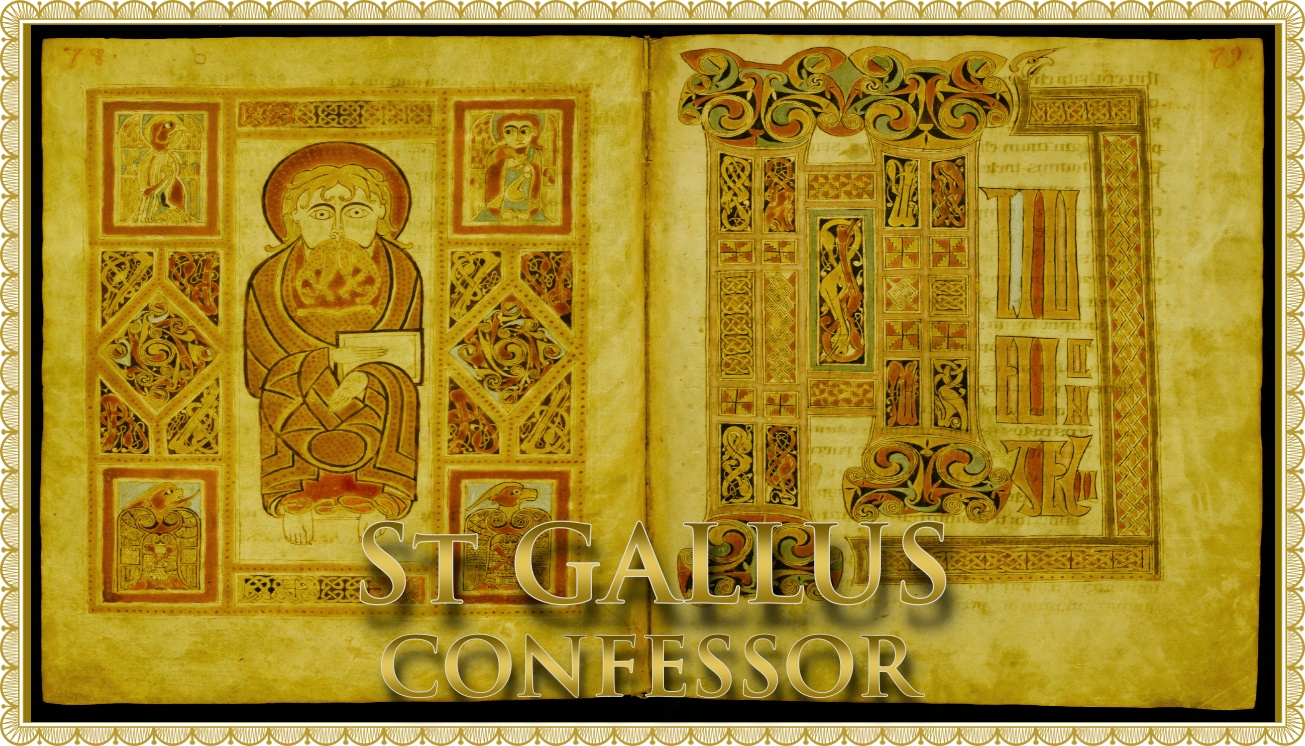
- Today’s Mass: October 17 St Gall, Confessor;Saint Gall, born in Ireland in the sixth century, became a notable confessor after accompanying Saint Columban to France and later Switzerland, where he preached and converted idolaters. Despite his significant contributions, he humbly declined the position of bishop of Constance. He died in 646, leaving a lasting legacy.
- 18.10.26 Nuntiatoria CXXVIII: NON POTEST VERITAS SUBDI POTESTATIThis editorial asserts that truth should not be subjugated to authority, emphasising that legitimate power derives from truth rather than mandates it. It critiques contemporary tendencies in both ecclesiastical and societal contexts where authority prioritises institutional credibility over accountability. Ultimately, it calls for a return to truth as the foundation of authority, urging faithful adherence to moral principles.
- ORDO w/c 18.10.26The liturgical calendar from 18 to 25 October 2026 includes the feast of St Luke the Evangelist, commemorating essential themes of forgiveness and evangelisation. Subsequent days honour St Peter of Alcantara, St John Cantius, St Ursula and St Raphael, culminating in the celebration of Christ the King, affirming His universal sovereignty over all creation.
- THE DEBTOR AT HIS BROTHER’S THROAT: The Twenty-First Sunday after PentecostThe Twenty-First Sunday after Pentecost highlights the danger of receiving divine mercy and failing to extend the same to others, exemplified by the parable of the unforgiving servant. The Church emphasises the need for genuine charity, justice without vengeance, and the importance of faith in guiding interpersonal conduct amidst spiritual struggle.
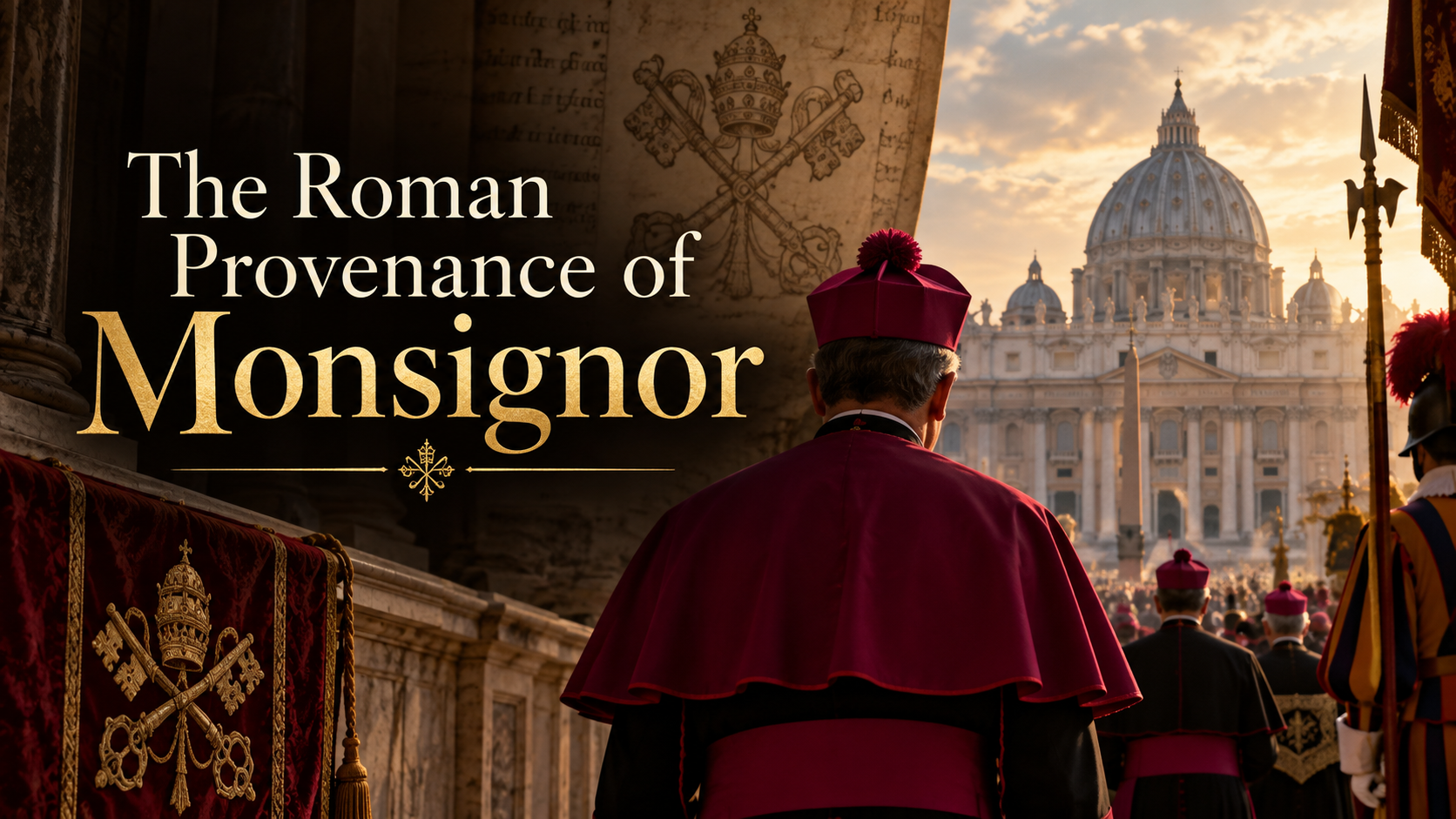
- The Roman Provenance of MonsignorThe title “Monsignor” is often misunderstood as an ecclesiastical rank or honour, whereas it is merely a style of address linked to specific ecclesiastical offices. The distinction between substantive dignity and its verbal expression is crucial. Various regulations historically defined these roles, ensuring accurate representation of ecclesiastical authority and honour.
CURRENT EDITION


Today’s Mass Propers
- Today’s Mass: October 17 St Gall, Confessor;
 Saint Gall, born in Ireland in the sixth century, became a notable confessor after accompanying Saint Columban to France and later Switzerland, where he preached and converted idolaters. Despite his significant contributions, he humbly declined the position of bishop of Constance. He died in 646, leaving a lasting legacy.


Leave a Reply