

Rome’s Treatment of the SSPX Exposes the Fraud of Synodality
The Society of Saint Pius X has spent decades asking Rome for doctrinal discussion before canonical submission. Its treatment reveals that synodality welcomes almost every grievance except the claim that the post-conciliar settlement itself requires judgement and correction.
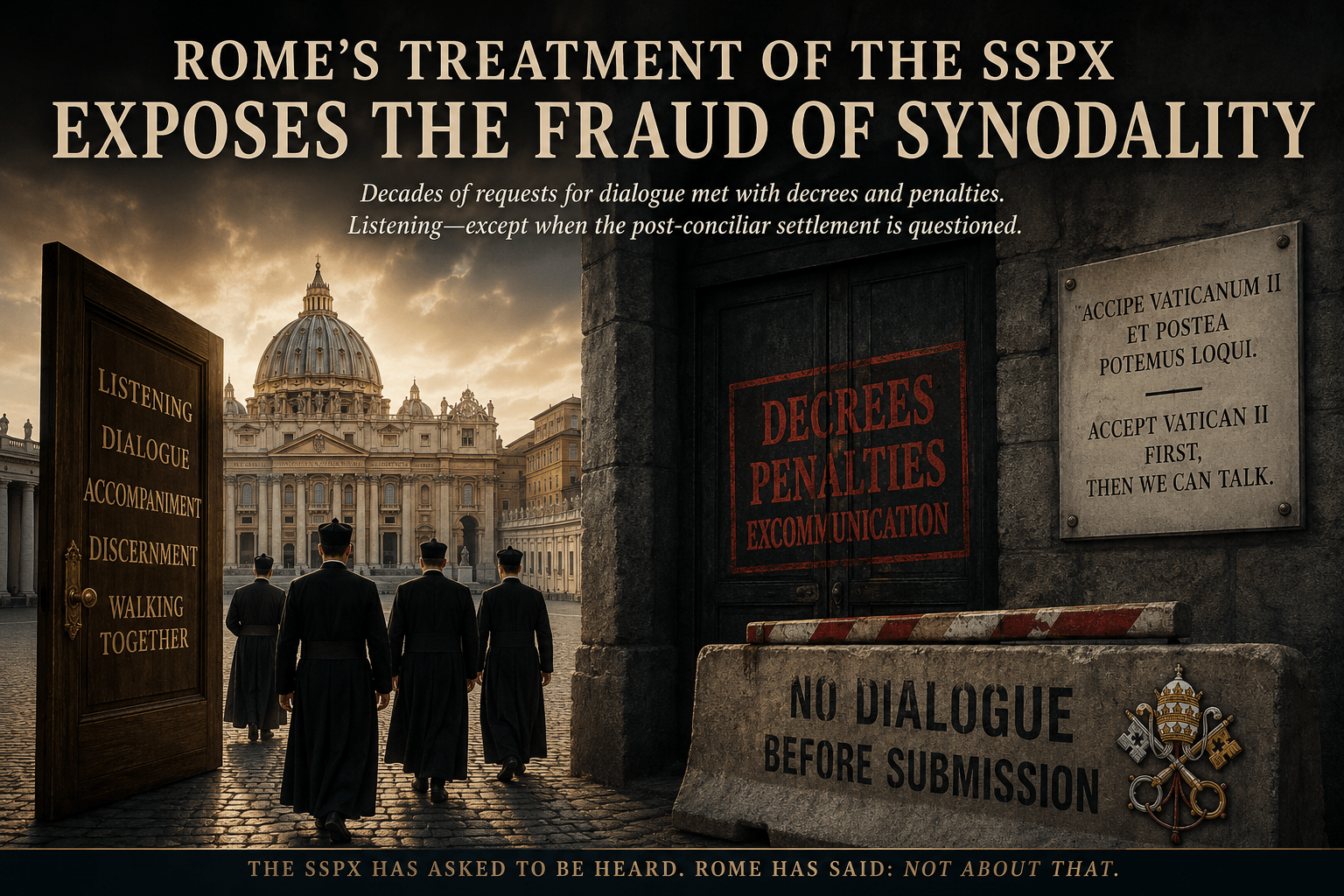
For more than ten years, Catholics have been told that the Church has adopted a new manner of governing herself. Its vocabulary is now unavoidable: listening, accompaniment, discernment, inclusion, encounter and “walking together”. Synodality, according to its advocates, is not another temporary programme from Rome. It is meant to describe an ecclesial conversion in which authority listens before judging and difficult disagreements are endured patiently rather than suppressed administratively.
If that claim is genuine, there is one obvious place where it ought to have been tested.
The Society of Saint Pius X is not a newly assembled pressure group presenting Rome with demands borrowed from the surrounding culture. It is a priestly fraternity whose dispute with the Holy See concerns the Second Vatican Council, the reformed liturgy, religious liberty, ecumenism, collegiality and the relation of the post-conciliar Magisterium to what preceded it. Its seminaries, schools, priories and chapels exist because clergy and faithful concluded that the Catholic inheritance was no longer secure within ordinary ecclesiastical structures.
Some of the Society’s judgements may be disputed. Its prudential decisions are not immune from criticism, and the consecration of bishops without a pontifical mandate is a grave act touching the visible government and unity of the Church. None of that removes the central fact: the SSPX has been asking Rome for precisely what synodality claims to offer every wounded or marginalised constituency in the Church.
It has asked to be heard before being condemned. It has asked that its experience be taken seriously. It has asked Rome to examine how the post-conciliar reforms affected Catholic belief, worship and practice. It has requested sustained theological discussion before an administrative settlement is imposed. It has argued that reconciliation cannot be reduced to signing a canonical agreement while the doctrinal causes of the estrangement remain unresolved.
Rome’s answer, beneath the softer vocabulary, has increasingly been that the Society must accept the post-conciliar settlement before meaningful discussion of that settlement can proceed.
The conversation may begin after the conclusion has been conceded.
That contradiction has become impossible to conceal following the episcopal consecrations at Écône on 1 July 2026. Pope Leo XIV appealed publicly to the Society not to proceed. The consecrations nevertheless took place. The following day, the Dicastery for the Doctrine of the Faith issued a decree against the six bishops involved and warned clergy and faithful against adherence to what it termed the Society’s schism.¹
The canonical issues are serious. Rome possesses authority over episcopal appointments, and no traditional Catholic can treat the papal mandate as though it were a dispensable formality. Necessity cannot be established merely by asserting it, nor does resistance to ecclesiastical misgovernment abolish the constitution of the Church.
Yet this was not a crisis that appeared without warning on 1 July.
The SSPX announced its intention to consecrate bishops on 2 February. Its Superior General, Father Davide Pagliarani, wrote to the Dicastery for the Doctrine of the Faith later that month. The names of the proposed candidates were announced in May. Appeals, declarations and public exchanges followed. Rome had months in which to receive the Superior General, reopen formal doctrinal discussions, propose an approved candidate, provide an interim canonical arrangement or offer some other credible means of securing the continuation of the Society’s apostolate.
Instead, the Pope’s public appeal came at almost the last moment. The penal decree followed the consecrations almost immediately.
One cannot spend years preaching accompaniment and then reduce the prevention of an ecclesial rupture to a belated injunction.
The contrast with the treatment of other forms of dissent is considerable. Bishops, priests and synodal bodies that question Catholic teaching on sexual morality, sacramental discipline or the reservation of priestly ordination to men are commonly treated as participants in an extended ecclesial conversation. Their proposals are contextualised. Their frustration is acknowledged. Their language is examined for possible insights. Their continued place within the process is seldom made dependent upon a prior retraction of everything under dispute.
The SSPX receives another method entirely. Its questions are deemed obstacles to communion because they concern the Council and its implementation. Its reluctance to trust Roman assurances is treated as disobedience without sufficient consideration of the history that produced that distrust. Its demand for doctrinal clarification before canonical absorption is made to appear unreasonable, although the disputed doctrine is the very reason canonical separation arose.
Traditional Catholics are permitted to speak, but only within a narrowing range of conclusions.
Under Benedict XVI, Rome at least recognised that the SSPX dispute could not be resolved as a merely disciplinary problem. Following the remission of the excommunications imposed after the 1988 episcopal consecrations, Benedict wrote to the bishops of the Church in March 2009. He stated plainly that the Society lacked canonical status and that its ministers did not exercise legitimate ministry. He also insisted that the outstanding questions were “essentially doctrinal” and concerned acceptance of the Second Vatican Council and the post-conciliar Magisterium.²
Formal doctrinal discussions followed. They did not bring about reconciliation, but their existence acknowledged the nature of the dispute. The Society was not simply being asked to obey an administrative order. Rome was accepting, at least provisionally, that the relation between Vatican II and the preceding Magisterium required theological examination.
Under Francis, the approach became more practical. The Society remained canonically irregular, but its priests received faculties to hear confessions validly and licitly. Arrangements were also made for marriages involving SSPX faithful, including the delegation of Society priests in certain circumstances.³ These provisions did not resolve the underlying conflict, but they recognised that the faithful attending SSPX chapels could not simply be treated as though they stood wholly outside the Church’s sacramental and pastoral concern.
The policy now appears to have moved from unresolved dialogue and pastoral accommodation towards coercive closure. The doctrinal questions have not been answered. They have instead been subordinated to the demand for canonical conformity.
The proposed route back requires the Society to accept the legitimacy of the post-conciliar reforms, profess adherence to the disputed Magisterium and place itself beneath authorities whose conduct has supplied much of the evidence for its apprehension. Theological discussion may continue afterwards, but only within boundaries already fixed by the act of submission.
That is not discernment. It is the ratification of a settlement.
The treatment of the traditional Roman liturgy supplies the Society with ample reason for caution. When Benedict XVI promulgated Summorum Pontificum in 2007, he declared that the older Roman Missal had never been juridically abrogated and sought to heal a division that had hardened unnecessarily. Francis reversed that policy through Traditionis Custodes, placing severe restrictions upon the ancient rite and presenting the reformed liturgy as the unique expression of the Roman Rite’s lex orandi.
Cardinal Arthur Roche has now stated that Pope Leo XIV will not reverse Traditionis Custodes or return to Summorum Pontificum.⁴ The old Mass remains, in the eyes of the authorities responsible for liturgical discipline, a concession to be controlled and eventually displaced rather than an inherited form of Roman worship possessing an enduring claim upon the Church.
This bears directly upon the SSPX question. The Society is asked to entrust its seminaries, clergy and faithful to a Roman system whose principal liturgical official denies the stability of the very settlement once offered by Benedict XVI. Diocesan priests who relied upon Summorum Pontificum later discovered that its protections could be withdrawn almost overnight. Communities once assured of pastoral generosity have been restricted, displaced or subjected to permissions revocable at episcopal discretion.
Rome asks the Society to trust. Rome’s conduct has repeatedly taught it that such trust may not survive the next pontificate or the next decree.
A genuinely synodal approach would begin there. It would ask why Catholics formed by the older liturgy no longer believe Roman assurances. It would examine the suppression of the traditional Mass, the disruption of seminaries and religious communities, the doctrinal ambiguity that followed the Council, and the enormous collapse in Catholic practice across much of the Western world. It would permit those who lived through that history to speak without first requiring them to declare that the policies responsible were fundamentally sound.
Instead, synodality appears to possess a protected premise: the post-conciliar direction of the Church may be developed, expanded and accelerated, but it may not be judged adversely.
Everything else may be discussed.
The role of women may be reconsidered. Sexual morality may be subjected to renewed “discernment”. The language of the Catechism may be revised. Episcopal conferences may press beyond Roman limits and still be invited to continue the conversation. Ecumenical and interreligious practice may assume forms scarcely imaginable before the Council and be praised as prophetic encounter.
The possibility that the Council’s ambiguities and reforms contributed to the present crisis is treated differently. That conclusion may be entertained only as a pathology to be corrected in those who hold it.
This is why the SSPX has become the control case for synodality. The Society asks whether Rome will employ its proclaimed method when the object of criticism is not an isolated abuse or an incomplete implementation, but the post-conciliar settlement itself. Will authority listen where the testimony offered is unwelcome? Will it accompany Catholics whose desired destination is restoration rather than further development? Will it permit unresolved doctrinal questions to remain open while seeking practical peace?
The answer supplied at Écône was a decree.
Rome may argue that penalties became inevitable after the consecrations. It cannot persuasively argue that the preceding months displayed the patient, imaginative and sustained engagement promised by synodality. Nor can the broader explanatory language be dismissed as a narrow canonical response to the conduct of six bishops. Its warning against the Society as a whole risks collapsing distinctions which the Church’s law and theology require.
Illicit episcopal consecration is not identical to formal schism. Attendance at an SSPX chapel is not of itself formal adherence to schism. A priest ordained by a Society bishop is not proved to have rejected the Roman Pontiff merely by belonging to the Society. A layman who seeks the traditional Mass, sound catechesis and reverent sacraments cannot be assigned the culpability of those who made the decision to proceed at Écône.
Doctrine, canonical status, liceity, validity, personal culpability and formal adherence are distinct questions. They cannot be compressed into a general category of exclusion merely because precision complicates an administrative response.
Such distinctions are particularly necessary because the Society continues to recognise the Roman Pontiff, names him in the Canon of the Mass, professes Catholic dogma concerning the papacy and rejects the sedevacantist conclusion. Its position may be internally strained, and its resistance may at times exceed what others judge defensible. It is nevertheless not the position of a body that has simply founded another Church and abandoned all reference to Rome.
The tragedy is that both sides still profess the necessity of Catholic unity, yet one side is required to prove its desire for unity by abandoning the grounds upon which it believes the Faith has been endangered.
The SSPX has never requested dialogue in the synodal sense of exchanging experiences indefinitely while doctrine remains malleable. It has asked for something older and more serious: a theological judgement according to Tradition. It wants disputed conciliar propositions and post-conciliar reforms examined against the perennial Magisterium, not merely explained by those already committed to defending them.
Rome has found room for almost every modern question except that one.
This exposes synodality’s governing logic. It is not simply a process by which the whole Church seeks truth together. In practice, it determines which disputes remain open, whose wounds count as evidence and which destinations may be reached. Arguments that extend the post-conciliar trajectory become contributions to discernment. Arguments calling that trajectory into question become threats to communion.
The direction is fixed. Only the manner of travelling towards it is described as synodal.
There is a restrained irony in all this. The Society of Saint Pius X has spent nearly forty years asking Rome for what synodality now claims to offer the entire Church: patient conversation about disputed questions before administrative solutions are imposed. Its clergy and faithful have spoken of estrangement, exclusion, mistrust and the loss of their liturgical inheritance. They have described the crisis as they have experienced it and asked Rome to examine the causes.
The response has been that the conversation may proceed once the Society accepts the conclusions it wishes to contest.
Rome says that the Holy Ghost speaks through listening.
The SSPX asks Rome to listen.
Rome replies: not about the Council, not about the new Mass, and not until you submit.
The treatment of the Society has therefore become something larger than a conflict with one priestly fraternity. It is the empirical test of whether synodality remains operative when listening threatens the assumptions of those directing the process.
On that test, the project has failed.
Rome will walk with those who question the Catholic past. It will not walk with those who question the post-conciliar present.
- Cardinal Arthur Roche, interview with The Tablet, published 29 July 2026; contemporary reporting of his statement that Pope Leo XIV would neither change Traditionis Custodes nor return to Summorum Pontificum.
- Dicastery for the Doctrine of the Faith, Decree concerning the episcopal consecrations performed by the Society of Saint Pius X, 2 July 2026.
- Benedict XVI, Letter to the Bishops of the Catholic Church concerning the Remission of the Excommunication of the Four Bishops Consecrated by Archbishop Lefebvre, 10 March 2009.
- Francis, Misericordia et Misera, 20 November 2016, no. 12; Pontifical Commission Ecclesia Dei, letter concerning faculties for marriages of the faithful of the Society of Saint Pius X, 27 March 2017.
RELATED ARTiCLES


LATEST ARTICLES
- Today’s Mass: November 2 All SoulsAll Souls’ Day is observed on 2 November, commemorating the faithful departed. The Church encourages prayers, alms, and Masses of Requiem to aid souls in need of cleansing from sins. Originating in the early Christian practices, it aims to provide spiritual support for the deceased, ensuring their journey towards eternal rest.
- DE PROFUNDIS: THE PRAYER THAT WILL NOT LEAVE THE DEAD BEHINDThe De Profundis serves as a profound prayer for the dying and the deceased, urging honesty in facing sin and reliance on Christ’s mercy. Through its historical context and traditions, it encourages ongoing remembrance of the departed within the family, emphasising the importance of intercession and maintaining a connection with faith.
- EVERY VOICE — EXCEPT THE OLD MASS?Pope Leo XIV has appointed Father Giacomo Costa and Sister Elena Massimi to oversee synodal implementation. Massimi’s prior support for Traditionis Custodes raises concerns about the Church’s authenticity in listening. As synodality takes a more central role in governance, it remains uncertain if traditional Catholics’ voices will be genuinely considered, questioning the credibility of the process.
- THE COUNCIL SAID PRESERVE IT. THEY TORE IT OUT.James Likoudis’s last defence of the liturgical reform highlights a disconnect between Vatican II’s true directives and the significant alterations that followed. The 1965 interim Mass illustrates that the Council’s goals could be achieved without the 1969–70 reconstruction. Official documents document the loss of sacred heritage and misuse of Vatican II’s intentions, raising questions about ecclesiastical responsibilities and the difference between true reform and the abandonment of tradition.
- POLAND: WHO RULES THE RULE OF LAW?Poland’s constitutional crisis has revealed a profound struggle over judicial authority, with competing judges, President Karol Nawrocki, and Prime Minister Donald Tusk each asserting conflicting claims. This situation raises critical questions regarding the independence of the judiciary, the legitimacy of governmental actions, and the implications for national sovereignty versus European Union oversight.
CURRENT EDITION


Today’s Mass Propers
- Today’s Mass: November 2 All Souls
 All Souls’ Day is observed on 2 November, commemorating the faithful departed. The Church encourages prayers, alms, and Masses of Requiem to aid souls in need of cleansing from sins. Originating in the early Christian practices, it aims to provide spiritual support for the deceased, ensuring their journey towards eternal rest.


Leave a Reply