
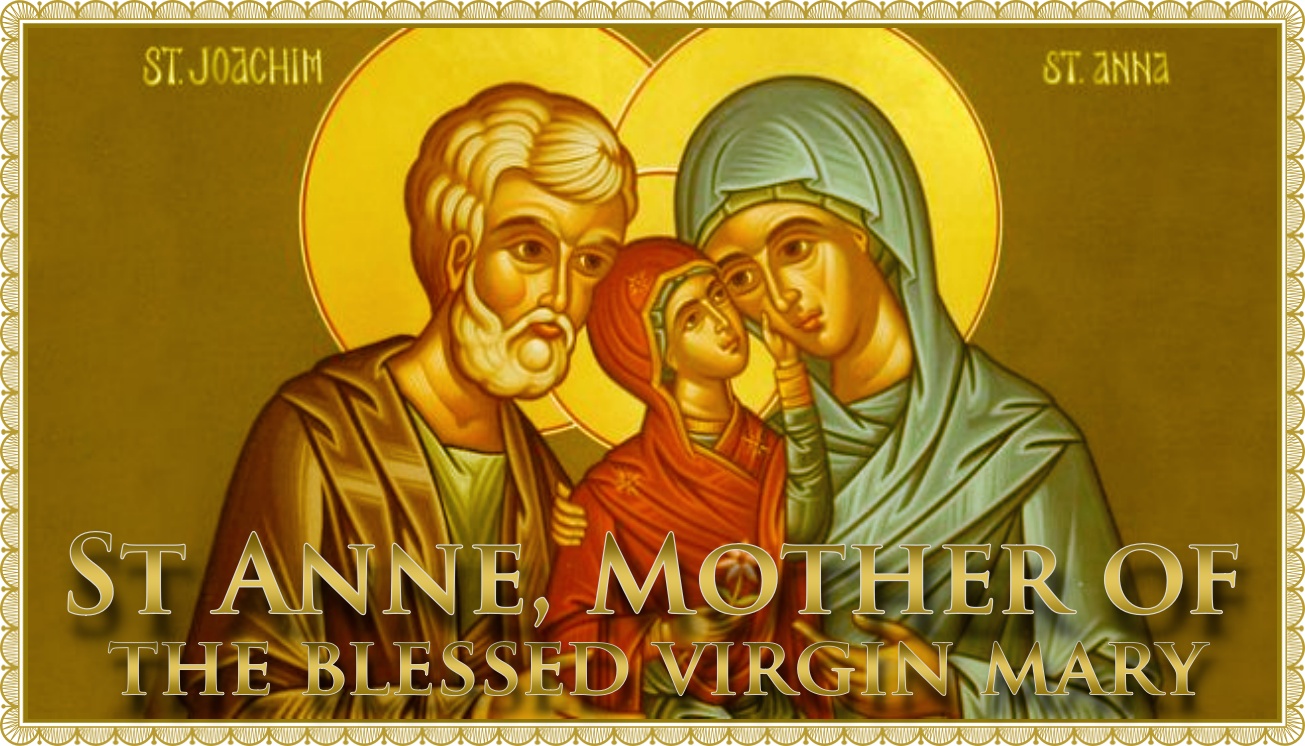
St. Anne/Ninth Sunday after Pentecost
Today we celebrate the feast of St. Anne, as well as commemorating the Ninth Sunday after Pentecost. Tradition gives us the names of St. Anne and St. Joachim as the parents of the Blessed Virgin Mary. Their names are not found in the canonical Gospels, but in a later document called the Protoevangelium of James. This tells of how Mary was born to a hitherto childless couple, Joachim and Anne and how she was subsequently bequeathed to the service of God in the Temple. There are parallels with the story in the Old Testament of the birth of the prophet Samuel to his hitherto childless mother Hannah. The Protoevangelium of James is not part of the canonical New Testament or the canonical Gospels, and so does not have the same authority for Christians. It is more like the later lives of the saints in that it has been accepted as part of the tradition of the Church. Such tradition (however ancient) does not have the same authority as the canonical Scriptures. However, it is on the basis of this tradition that we celebrate the feast of St. Anne today.
Since Christian tradition sees in St. Anne an example of a model wife and mother the lesson today is the famous passage from the Book of Proverbs about the good wife. Today we tend to see the religion of ancient Israel as a patriarchal religion and in one sense this is true. However, there is also an important sense in which it was a matriarchal religion as well, for the vocation of wife and mother was as important as that of the husband and father (indeed in Judaism it is the mother who bears the dowry). While it would be true to say that Christianity has placed more emphasis on the role of celibacy than Judaism, it still affirms the importance of the vocation of the wife and mother. This is why when we celebrate the feasts of holy women who were not virgins we often read this passage from the Book of Proverbs.
This is especially important to note at the present time when the Christian doctrine of marriage is under attack from so many quarters. It is a strange paradox that the Christian Church is attacked both for the exaltation of virginity (which it is said has in the past imprisoned women in the cloister and denigrated female sexuality) but also for speaking of marriage as a specific vocation for women (which it is said has imprisoned them in the home and restricted their opportunity to have a career of their own). It seems that in the eyes of many of its modern critics Christianity cannot win, for it is criticised both for teaching about virginity and also for teaching about marriage. Perhaps it is not Christianity that is confused, but the modern critics themselves. A hundred years ago G. K. Chesterton said that “twenty million young women rose to their feet with the cry “we will not be dictated to” and proceeded to become stenographers”. This is even more pertinent today than it was then, as both women and men are now viewed not as being made in the image of God but as primarily economic units who can be controlled and manipulated for commercial and economic purposes. The reason why governments and commercial agencies hate the married family, as they also hate celibacy, is because people with a specific vocation whether to marriage or to celibacy are more difficult for them to control. It is a basic rule of life that all governments and earthly organisations have as their primary aim the expansion of control. That is why they seek to denigrate people and organisations that they cannot control because they see them as a threat and challenge to their own pride and vanity. The aim is so that those who do not conform to the present zeitgeist can be marked out by the establishment as odd and so subjected to censure, fines and bullying. The truth of the matter is that it is the government themselves, not those who do not conform to their arbitrary diktats, who are odd as they seek to interfere in people’s lives (they interfere because they hate the idea of people outside their control).
Ultimately, our disagreement with our governments over the relation between the human person and the state can be traced back to the contrasting attitudes between the biblical and the pagan view of humanity. In paganism the state was the ultimate authority, whether the city state in Greece or the person of the Emperor in Rome. By contrast, in the Bible since human beings were made in the image of God, governments were seen as a necessary evil rather than the ultimate authority. That is why when the Bible tells the story of the origins of the people of Israel it speaks not of kings and queens and rulers, but of husbands and wives, patriarchs and matriarchs, of Abraham and Sarah, Isaac and Rebecca, Jacob and Rachel (the Israelites later had a monarchy and rulers but they were seen as a necessary evil to preserve the civil peace rather than the ultimate authority). Since they saw their origins and the handing on of their traditions as a matter for families and communities rather than governments they had a much higher view of marriage and the human person than their pagan counterparts.
Our attitude at the present time in the face of the creeping totalitarianism of our governments must be one of passive resistance. There is no point in taking part in riots and demonstrations against the government’s bullying and controlling agenda. Rather we must state politely but firmly that we must obey God rather than men. Consequently we cannot conform to the present zeitgeist whether it attempts to redefine the doctrine of marriage or makes increasingly totalitarian claims for the role of the civil power. The early Christians prayed for the political order that wanted them to worship it and sent them to their martyrdoms.
by the Revd Dr Robert Wilson PhD (Cantab), Old Roman Apostolate UK




Leave a Reply