

When Christ Stops the Procession
MASS Inclína, Dómine
LESSON Galatians 5:25–26; 6:1–10
GOSPEL St Luke 7:11–16
HOMILIST Mt Revd Jerome Lloyd OSJV

In the Name of the Father, and of the Son, and of the Holy Ghost. Amen.
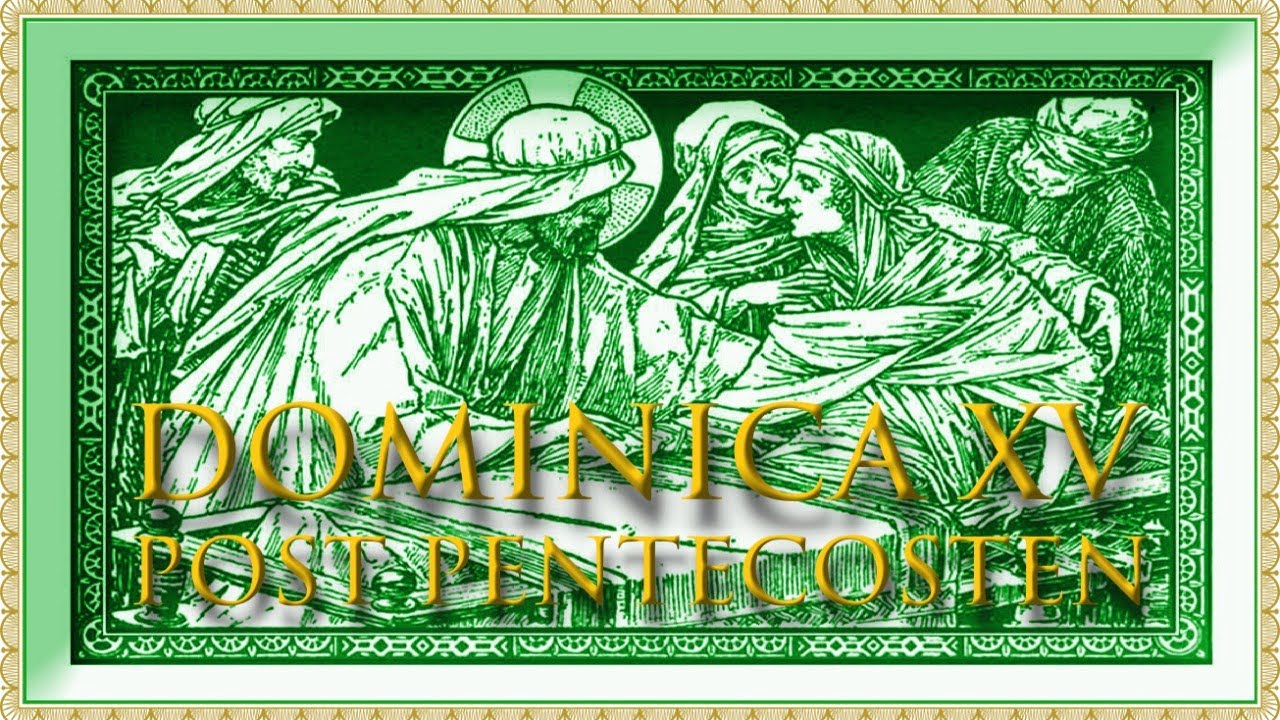
There are two processions in today’s Gospel. One is entering the city of Naim. At its head is Jesus Christ, followed by His disciples and a great multitude. The other is leaving the city. At its head is a dead young man carried upon a bier, followed by his widowed mother and another great multitude. One procession accompanies Life; the other accompanies death. And they meet at the gate of the city.
Everything about the funeral procession says that the matter is finished. The young man is already dead. The mourning has begun. The bier is moving. The grave lies ahead. His mother can weep, the mourners can accompany her, and the bearers can carry him, but none of them can reverse the direction in which the procession is travelling. Then Jesus Christ stands in the road. He sees the widow, has compassion upon her, approaches the bier, touches it, and the bearers stop.
There is something deeply moving in Our Lord’s compassion for this woman. Before Him stands a widowed mother following the body of her only son. And perhaps the Christian heart may reverently see here a foreshadowing of another Mother who will one day stand before the death of her only Son. Mary had already heard Simeon’s prophecy: “Thy own soul a sword shall pierce.” At Calvary she would stand beneath the Cross and watch the Son whom she bore at Bethlehem surrender His life. St Luke does not tell us explicitly that this is why Christ was moved with compassion at Naim, but the likeness is difficult to miss. The Sacred Heart which looks upon this grieving widow already knows the sorrow through which His own Mother will pass.
Yet there is also a mysterious difference. At Naim, Christ says to the widow, “Weep not,” and gives her son back to her. At Calvary, no one prevents Mary’s sorrow. Her Son truly dies. Yet precisely through that Death a far greater procession of death is stopped: the procession of fallen mankind towards eternal death. At Naim Christ restores one widow’s son; at Calvary the Son of Mary dies so that the sons of Adam may rise. The words Noli flere — “Weep not” — are spoken by One who knows both the sorrow of His Mother and the final impotence of death.
Then Our Lord speaks: “Young man, I say to thee, arise.” And the dead man sits up. That is the great message of this Sunday: when Christ stands in the road, what appeared inevitable is no longer inevitable. What human beings could only mourn, Christ can reverse. What seemed to have reached its final conclusion can be interrupted by the Lord of Life.
That is a message Catholics need today. We have watched things disappear which previous generations assumed would always remain. Churches have closed, religious houses have emptied, vocations have declined, Catholic education has weakened, and practices once regarded as elementary Catholic life have been forgotten. The ancient Roman liturgy itself, which nourished centuries of saints, was treated in many places as something to be superseded rather than treasured.
Perhaps even more painful is the fact that generations of Catholics were never properly given what their grandparents received. They were not always taught the Faith clearly. They were not taught the seriousness of mortal sin, the necessity of sanctifying grace, the value of fasting, the spiritual life, Catholic history, or even sometimes the most elementary catechism. Looking at all this, it is easy to become like the mourners at Naim. The procession is already moving. The loss has already occurred. Surely nothing can now be done.
But the Gospel says otherwise. Christ stands in the road.
Christian hope does not consist in pretending that death is life. The young man at Naim really was dead. The widow’s sorrow was justified. The funeral procession was real. Christian hope consists in knowing that death is not stronger than Christ. That distinction matters. We preserve the Faith not because nothing serious has happened, but because something serious has happened. We hand on the traditional Mass because the Mass matters. We teach the Catechism because doctrine matters. We preserve Catholic customs because memory matters. Tradition survives because somebody hands it on.
And here the widow of Naim becomes especially important. The Fathers saw in her an image of Mother Church. She does not abandon her son because he is dead. She remains beside him even when humanly nothing more can be done. There is a lesson here for Catholic parents and grandparents who know the sorrow of children or grandchildren who have drifted from the Faith. They were baptised, made their First Communion, perhaps once served Mass or prayed willingly, and then gradually absorbed the assumptions of the world.
Look at the widow. She cannot raise her son, but Christ can. That is why prayer for the conversion of our families must never cease. St Monica prayed for Augustine for years when there seemed little cause for hope. Yet the son for whom she wept was eventually given back to Mother Church not merely as a penitent but as one of her greatest bishops and Doctors. We do not know what grace is doing in another soul. We do not know what suffering, beauty, friendship, bereavement, a book, a church, a piece of music, or a Mass may become the moment when Christ puts His hand upon the bier. Never assume that someone is too far away. God has His hour.
The same is true of the restoration of Catholic life more broadly. We see today people rediscovering things which earlier generations were told had become obsolete. Young Catholics encounter Gregorian chant and recognise its beauty. Families rediscover fasting, pilgrimage, Ember Days, the Rosary, saints’ days and the old calendar. Young people encounter the traditional Mass without ever having known it in childhood and recognise something sacred, objective and deeply Catholic. Young priests learn Latin. Laymen learn chant. Families rebuild domestic Catholic life from traditions their own parents were never taught.
None of this means that the crisis is over. But it does mean that the bier has stopped in places where nobody expected it to stop. Things which were supposed to disappear have survived. Communities which were expected to decline have produced children and vocations. Books thought forgotten have been republished. Devotions thought obsolete have returned. The procession is not travelling in only one direction.
St Paul therefore gives us exactly the instruction we need: “In doing good, let us not fail. For in due time we shall reap, not failing.” Do not become weary because restoration is slow. Catholic culture is not recovered in a single year or pontificate. Children are not formed by one catechism lesson. Vocations do not appear simply because we lament their absence. The Faith is transmitted through countless ordinary acts of fidelity.
A mother teaches a child his prayers. A father brings his family to Mass. A priest teaches the Catechism without embarrassment. A server learns the responses. A choir learns the proper chant. Someone restores an old devotion. Someone teaches a convert how to use a Missal. Someone encourages a young man to consider the priesthood. Someone continues praying for an adult child who has abandoned the Faith. These things rarely make headlines, but Christianity was never built by headlines. It was built by grace acting through fidelity.
And the Gospel reminds us that the decisive action belongs to Christ. The widow does not raise her son; Christ does. Our duty is therefore neither frantic activism nor passive resignation. It is fidelity. We preserve, teach, pray, sacrifice, build and hand on, and we leave to God the hour in which He commands: “Arise.” We are not asked to control history. We are asked to be faithful within it.
After the Gospel, the liturgy points us to the source by which supernatural life is sustained. At Communion we hear the words of Our Lord: “The bread that I will give is My flesh for the life of the world.” There is the answer to Naim. The Christ who commands the dead to rise gives Himself as food to those whom He has raised. Catholic restoration therefore begins and ends at the altar.
Our preservation of the traditional Mass is not nostalgia for a beautiful ceremony. It is fidelity to the supreme act of Catholic worship received through centuries of organic development. Here Calvary is sacramentally made present. Here Christ the High Priest offers the Sacrifice. Here the Church on earth touches eternity. Here the same Lord who stopped the bier at Naim gives His Flesh “for the life of the world.”
That is why we should leave Mass strengthened rather than discouraged. We have no promise that our age will be easy, nor that every battle will be won in our lifetime. But we possess the promises of Christ. We possess His Sacraments, His doctrine, the example of His saints, the intercession of Our Lady, and the inheritance of Catholic Tradition. Above all, we possess Christ Himself. That is enough to rebuild from.
So when the procession of our age appears to be moving relentlessly towards the grave, remember Naim. Christ is coming from the opposite direction. Death does not tell Him where the road must lead. He tells death where it must stop. The bearers halt. The Lord touches the bier. And the voice which created the heavens speaks: “Young man, I say to thee, arise.”
That is our hope for our families. It is our hope for those who have lost the Faith. It is our hope for Catholic Tradition. It is our hope for the Church. Not optimism. Not nostalgia. Not wishful thinking. Jesus Christ, the Lord of Life.
Therefore do not grow weary. Teach the Faith. Keep the traditions. Raise Catholic families. Pray for vocations. Support faithful priests. Bring children to Mass. Pray for those who have fallen away. Restore what can be restored. Hand on what you received. And when circumstances tempt you to believe that everything is already being carried towards burial, look again towards the gate of Naim.
Christ is standing in the road.
And He still says: “I say to thee, arise.”
In the Name of the Father, and of the Son, and of the Holy Ghost. Amen.
Homilies Archive

Mass Propers


DAILY MASS ONLINE
One of the earliest online apostolates dedicated to the Traditional Latin Mass, Old Roman TV began broadcasting the Holy Sacrifice on the Feast of the Assumption, 15 August 2008. During the COVID-19 pandemic, additional programming — devotions, catechesis, and conferences — was added to support the faithful in prayer and formation.
Support the daily Holy Mass on Old Roman TV by offering a Mass intention — for loved ones, thanksgiving, or the repose of souls. Your intention helps sustain the sacred liturgy and brings grace to those you remember before God’s altar.
SUPPORT THE DAILY MASS ONLINE
Likely the world’s longest-running daily online broadcast of the
Traditional Latin Mass, streaming faithfully since the
Feast of the Assumption 2008.

This apostolate cannot continue without immediate help
Please support us with a contribution toward
chapel rent, sacristy supplies, operating costs, and web-hosting.
Our essential monthly costs reach £1,000.



Leave a Reply