
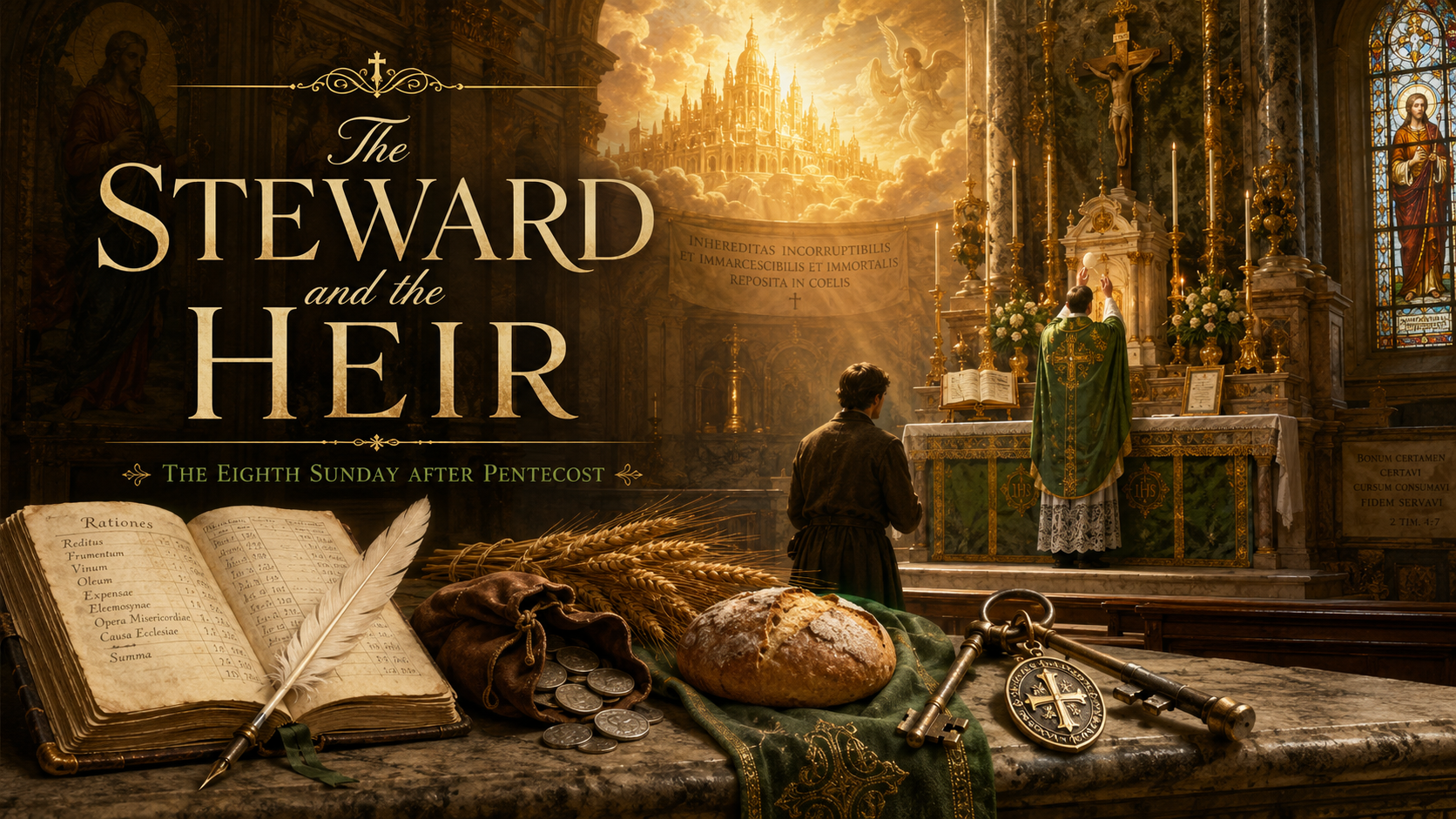
The Steward and the Heir: Grace, Judgment and the Eighth Sunday after Pentecost
The ancient Roman liturgy places divine adoption beside the summons to judgment. We are heirs of God, yet stewards of gifts that remain His; children permitted to cry “Abba, Father,” yet servants who must hear: “Give an account of thy stewardship.”

The Mass of the Eighth Sunday after Pentecost is constructed around an apparent contradiction. In the Epistle, Saint Paul declares that those who are led by the Spirit of God are His sons, heirs of God and joint heirs with Christ. In the Gospel, Our Lord presents a steward whose administration is examined, whose office is withdrawn and whose future depends upon what he does before the account is finally closed.
The contradiction is only apparent. The Christian is both heir and steward because grace does not make him an autonomous proprietor of divine gifts. It makes him a son capable of using them according to the will of his Father. Everything has been entrusted to him: his soul and body, his intellect and will, his time and possessions, his influence and authority, his sufferings and opportunities, the Catholic Faith, the sacred liturgy, the sacraments and every actual grace by which God has prompted him towards the good. Yet none of these things originates in him or exists solely for him. He receives them from God, administers them beneath God’s judgment and must return them to God with increase.
The Christian life is therefore neither anxious servitude nor presumptuous entitlement. We are not slaves cringing before an unknown master, but neither are we spoiled children who may squander the patrimony of grace without consequence. The liturgy teaches something at once more consoling and more severe: we shall be judged by the Father whose children we have been made.
The Introit immediately unites mercy and judgment: “We have received Thy mercy, O God, in the midst of Thy temple: according to Thy name, O God, so also is Thy praise unto the ends of the earth: Thy right hand is full of justice.”¹ Mercy has been received in the Temple, but the hand that bestows mercy remains full of justice. The sanctuary is not an escape from divine judgment. It is the place in which God gives everything necessary to withstand it.
Dom Prosper Guéranger sees in the Temple a figure both of the Church and of the sanctified soul. Jerusalem had received the divine presence, the sacrifices and the promises, yet the magnificence of the Temple did not preserve it when those charged with its stewardship became unfaithful. The Christian soul is a still more intimate sanctuary, consecrated by Baptism and inhabited by the Holy Ghost. It cannot appeal to graces once received while refusing the fidelity for which those graces were given.²
The tragedy is not that God has been ungenerous, but that man dissipates what divine generosity placed in his hands. The sacraments are received without amendment; instructions are heard without obedience; inspirations are postponed until they grow faint; absolution is sought without serious resistance to the occasions of sin; Holy Communion is received while the communicant continues to organise his life around the very attachments from which Christ came to deliver him. Grace is treated not as seed to be cultivated but as a possession that may be stored without fruit.
The Collect exposes the impossibility of such self-sufficiency: “Grant us, we beseech Thee, O Lord, always to think and do such things as are right; that we, who cannot exist without Thee, may be able to live according to Thee.”¹ The Church does not ask merely that God should approve what we have independently decided to do. She asks Him to give the very spirit by which we think rightly and act rightly.
The prayer moves from thought to action, and from existence to supernatural life. We cannot exist without God because He sustains every creature in being; still less can we live according to God without the assistance of grace. Saint Thomas Aquinas distinguishes the natural powers which remain in fallen man from the healing and elevating grace required for meritorious supernatural action. Man may apprehend particular natural truths and perform certain naturally good acts, but he cannot heal himself from sin, love God above all things in the supernatural order, persevere to the end or merit eternal life without grace.³
The Collect therefore contains the entire drama of the Sunday. The steward has misused his freedom because he has acted according to himself rather than according to his master. The son lives only when he permits the Holy Ghost to order his thoughts, desires and deeds according to the Father.
Saint Paul begins the Epistle with a declaration of debt: “Brethren, we are debtors, not to the flesh, to live according to the flesh.” The modern mind imagines freedom as the absence of obligation, but Saint Paul teaches that man is necessarily indebted. The only question is whether he will acknowledge his debt to God or submit himself to the tyranny of fallen appetite.
The “flesh” in this passage does not mean the body considered as evil. Catholic doctrine knows nothing of such contempt for the Creator’s work. The body was created by God, assumed by the Son, sanctified in Baptism, nourished by the Eucharist and destined for resurrection. “The deeds of the flesh” are the disordered movements by which fallen nature seeks created satisfaction against the judgment of reason and the law of God.
Saint John Chrysostom emphasises that the Apostle commands the mortification of the deeds of the body, not the destruction of the body itself. The tyrant to be overthrown is not human nature but sin. The Holy Ghost restores the proper hierarchy of the person: the passions governed by reason, reason enlightened by faith and the whole man subjected to God.⁴
Mortification is therefore not a peripheral devotion for unusually austere souls. Saint Paul makes it a condition of life: “If you live according to the flesh, you shall die: but if by the Spirit you mortify the deeds of the flesh, you shall live.” The language permits no comfortable neutrality. Whatever is not being brought beneath the rule of the Spirit is quietly extending the dominion of the flesh.
Yet this mortification is not performed in the terror of a slave. “You have not received the spirit of bondage again in fear,” the Apostle continues, “but you have received the spirit of adoption of sons, whereby we cry: Abba, Father.” Christian asceticism is filial. The son restrains his passions not because the Father despises him, but because sin is beneath the dignity bestowed upon him. He does not fast, watch, pray, confess and make restitution in order to persuade God to adopt him. He does so because, having been adopted, he must no longer live as a slave.
Saint Thomas explains Saint Paul’s reasoning with scholastic clarity. Those who are ruled by the Spirit are sons of God; the sons of God are heirs of the life of glory; therefore those who are ruled by the Spirit are being led towards the inheritance of glory. The Apostle does not say merely that those who once experienced the Spirit are sons, but that those who are led by Him are sons. Divine adoption is a gift, but the adopted life has a governing principle: the motion of the Holy Ghost.⁵
This destroys the sentimental counterfeit of spiritual childhood. To call God “Father” while resisting His commandments is not filial confidence but presumption. The cry “Abba, Father” is authenticated by a life increasingly governed by the Father’s Spirit. Adoption confers a real dignity, but dignity creates obligation. The greater the inheritance, the more terrible its deliberate dissipation.
The Gradual answers the soul that recognises its weakness: “Be Thou unto me a God, a protector, and a place of refuge, to save me. In Thee, O God, have I hoped: O Lord, let me never be confounded.” The liturgy does not leave man trapped between the power of the flesh and the severity of judgment. God Himself is the refuge from the ruin we have made. The sinner cannot repair his accounts by self-reliance; he must flee to the Master whom he has offended.
The Alleluia then returns to the city and holy mountain of God: “Great is the Lord, and exceedingly to be praised, in the city of our God, in His holy mountain.” The movement is significant. The Introit announced mercy in the Temple; the Gradual begged protection; the Alleluia looks towards the holy city. The liturgy is already directing the mind towards the “everlasting dwellings” of the Gospel.
The parable of the unjust steward is among the most difficult in the New Testament because the steward is plainly dishonest and yet is commended for having acted “wisely.” Our Lord cannot be praising fraud. The eternal Truth does not suddenly suspend the moral law in order to admire a clever falsification of accounts.
Saint Augustine supplies the essential distinction: the steward’s injustice is not proposed for imitation; his foresight is. A bad man may exhibit a natural quality which puts the servants of God to shame. He sees the crisis approaching, accepts that his present arrangement cannot continue and acts decisively to secure his future. The children of light must imitate his urgency without imitating his sin.⁶
Origen, cited in the Catena Aurea, observes that the children of this world are not declared wiser absolutely, but wiser “in their generation.” They understand the objects towards which they have directed themselves. They calculate, sacrifice, labour, wait, cultivate advantageous relationships and endure inconvenience for wealth, influence, pleasure or position. They are foolish regarding eternity but astonishingly purposeful regarding time.
The children of light often reverse this arrangement. They profess belief in judgment but live as though the account will never be required. They profess belief in heaven while devoting their sharpest thought, greatest discipline and strongest emotion to the world. They will rise early for business but not for prayer, study every movement of the market but remain ignorant of the Faith, accept privation for bodily appearance but refuse fasting, travel long distances for entertainment but regard attendance at Mass as burdensome. The worldling’s end is false, but his application to that end rebukes the lethargy of the believer.
“Give an account of thy stewardship,” says the master, “for now thou canst be steward no longer.” Death is the revocation of our administration. At that moment, every earthly distinction between ownership and stewardship will become unmistakable. The body will be surrendered, property divided, offices filled by others, unfinished plans abandoned and accumulated influence rendered powerless. The soul will stand alone with what it has loved and what it has made of the gifts placed temporarily at its disposal.
The judgment will not concern gifts never received. One man will not answer for another’s intelligence, wealth, health, authority or opportunity. He will answer for his own. One will answer for children entrusted to his formation; another for souls entrusted to his pastoral care; another for wealth that could have relieved suffering; another for learning that should have defended truth; another for influence used to flatter error; another for sufferings wasted in resentment instead of offered in union with the Cross.
We shall answer not only for evil committed, but for good omitted. The account will include the correction withheld through cowardice, the apology postponed through pride, the restitution evaded through avarice, the vocation neglected through comfort, the prayer abandoned through distraction and the grace refused because obedience would have required a change of life.
Our Lord then gives the application: “Make unto you friends of the mammon of iniquity; that when you shall fail, they may receive you into everlasting dwellings.” Material riches are not evil in themselves. They are called “mammon of iniquity” because they belong to an order deeply marked by sin, are frequently acquired or distributed unjustly, readily become occasions of avarice and are false when mistaken for man’s true wealth. They promise security but cannot preserve their owner from sickness, betrayal, death or judgment.
Saint Augustine firmly rejects the idea that stolen goods may be purified merely by giving a portion of them to the poor. Justice requires restitution. God is not bribed by alms taken from another man’s property. The unjust possessor must first cease his injustice and, so far as possible, restore what he has taken. Only then may he speak honestly of generosity.⁷
Saint Thomas develops the same principle. Private possession is lawful because the orderly administration of material goods requires responsibility, but their use cannot be morally isolated from the needs of others. Man may possess external things as his own for the purpose of administration; in their use, he must be ready to communicate them to others. Goods superfluous to one man may become due in charity—and, in grave necessity, even in justice—to another.⁸
The Christian does not buy heaven with alms. Eternal life is the gift of grace, merited in Christ and attained through acts made living by charity. Yet almsgiving is one of the principal ways in which temporal goods are converted into eternal fruit. The poor become “friends” because Christ has identified Himself with them and because their prayers accompany their benefactors. Oil and wheat, money and property, food and clothing cannot enter heaven; but charity exercised through them can.
Cornelius a Lapide extends the stewardship beyond money. Every advantage is part of the account: bodily strength, beauty, intelligence, education, authority, reputation, eloquence and time. The miser is not only the man who hoards coins. A man may hoard knowledge by refusing to teach, hoard influence by refusing to defend the innocent, hoard affection by withholding forgiveness or hoard spiritual gifts by treating prayer as a private consolation without allowing it to produce charity.⁹
The Catholic exegetical tradition also applies the parable to the custodians of revelation. The scribes and Pharisees were stewards of the divine word. They did not create the Law, the promises or the sacred rites; they received them for the service of God’s people. Their condemnation lay partly in treating the inheritance as their private domain, burdening others while exempting themselves and obscuring the purpose of what they had been appointed to preserve.
The warning applies with particular force to ecclesiastical authority. A bishop, priest or religious superior is not the proprietor of the Faith, the sacraments or the liturgy. He cannot alter inherited doctrine as though it were an administrative policy, silence inconvenient truths to preserve popularity or deprive the faithful of their spiritual patrimony to demonstrate his power. Authority in the Church is stewardship beneath revelation, not mastery over it.
The same account will be required of parents, teachers, rulers and all who exercise influence over others. Authority is never morally neutral. It either communicates the order received from God or conscripts others into the disorder of the one who holds it. The steward’s gravest fault may not be that he has ruined himself, but that he has wasted goods intended for the entire household.
Dom Guéranger therefore presents the liturgy itself as a providential safeguard when human teachers become negligent. The Church’s traditional worship does not merely illustrate doctrine after the fact. It transmits a rule of belief, disciplines the affections and trains the soul to perceive reality according to God. Its prayers teach dependence upon grace; its ceremonial teaches hierarchy and sacrifice; its calendar orders time around the mysteries of Christ; its silence teaches reverence; its unbroken inheritance rebukes the conceit that the present generation is the proprietor of the Church.²
To transmit such a patrimony faithfully is therefore an act of stewardship. To deform it according to passing ideologies is to expend another’s treasure for purposes the owner never authorised.
Father Gabriel of Saint Mary Magdalen carries the parable into the interior life. The old man and the new man struggle within the baptised. The old man seeks possession, indulgence and independence; the new man receives everything from the Father and returns everything through Christ. The spiritual life advances as the soul ceases to live as though its faculties and consolations belonged to itself.¹⁰
Actual graces must also be administered. God gives a light by which a fault is recognised, a movement towards prayer, an opportunity for sacrifice, a moment in which reconciliation becomes possible. The grace may be obeyed or wasted. Repeated infidelity does not prove that grace was absent; it often proves that grace was resisted until the conscience became less responsive to its prompting.
Saint John of the Cross explains that attachment turns created goods into obstacles, not because creatures are evil, but because the disordered appetite demands from them what only God can give. A thing may be small in itself and yet bind the soul completely if the will refuses to surrender it. The chain need not be heavy if it remains unbroken.¹¹
The unjust steward’s deepest disorder is therefore not simply financial. He acts as though the goods entrusted to him exist for his own gratification. This is the essence of every sinful attachment. The creature is detached from its purpose beneath God and appropriated by the ego. The servant behaves as master; the gift obscures the Giver; stewardship becomes theft.
The Offertory provides the remedy: “Thou wilt save the humble people, O Lord, and wilt humble the eyes of the proud.” Humility is the truth of stewardship. The humble man does not deny the gifts he possesses; he denies that they originate in him or terminate in his glory. He receives them gratefully, uses them obediently and returns them sacrificially.
The Secret makes this movement explicit: “Receive, we beseech Thee, O Lord, the gifts which we bring to Thee from Thine own bounty; that these holy mysteries, by the working of the power of Thy grace, may sanctify our conduct in this present life and bring us to everlasting joys.”¹ Everything offered already belongs to God. Even the power to offer is His gift.
At the altar, the whole doctrine of the Sunday becomes visible. Man brings bread and wine made from the fruits of creation and the labour of human hands. He returns to God what came from God. God then receives the offering and gives back not merely bread and wine but the Body and Blood of His incarnate Son. The economy of grace is not sterile bookkeeping. Whatever is surrendered faithfully to God is taken into the Sacrifice of Christ and restored on a higher plane.
The Communion antiphon answers the hunger from which avarice arises: “Taste and see that the Lord is sweet: blessed is the man that hopeth in Him.” The soul clings desperately to creatures because it has not tasted deeply enough of the Creator. Once God is known as the true good, possessions can be held without servitude, surrendered without despair and used without idolatry.
The Postcommunion completes the Mass by asking that the heavenly mystery may restore both mind and body, “that we may feel the effect of that which we celebrate.”¹ The liturgy does not conclude with a resolution produced by unaided will. It concludes with sacramental restoration. The same man who could not exist without God and could not live according to God without grace has now received the heavenly mystery by which soul and body are repaired.
This final prayer also issues a severe warning against empty ritualism. The Church asks that the effect of the mystery should be experienced in those who perform its worship. Exterior participation that produces no interior conversion is not the intended fruit of the Mass. The communicant who receives the Victim must himself become sacrificial; the recipient of mercy must become merciful; the one incorporated into the obedient Son must no longer organise his life around disobedience.
The Eighth Sunday after Pentecost is therefore not principally a lesson in clever financial management. It is a revelation of the whole Christian condition. We are sons, but sons who must be led. We are heirs, but heirs whose path passes through suffering with Christ. We are stewards, but stewards whose Master supplies the grace by which faithful administration becomes possible. We are debtors, but our debt is owed not to the flesh that enslaves, but to the Spirit who gives life.
The account has not yet closed. That is the mercy hidden within the terror of the Gospel. While life remains, wasted gifts may still be turned towards their proper end. Sins may be confessed, restitution made, scandal repaired, neglected duties resumed, enemies forgiven, the poor assisted, children instructed, truth defended and suffering offered. A soul that has lived according to itself may yet begin to live according to God.
But the time for such prudence is now. The steward acted because he understood that his present office would not continue. The Christian knows more than the steward knew. He knows that death will come, that judgment is certain, that grace has been offered and that an everlasting dwelling has been prepared.
The children of this world should not reach their perishable ends with greater zeal than the children of God seek heaven. The miser counts his money; the ambitious man measures every opportunity; the sensualist arranges his life around pleasure. Let the Christian count his graces, examine his debts and employ what remains of his stewardship for eternity.
Then, when the summons finally comes—“Give an account of thy stewardship”—the soul will not stand before a stranger. It will stand before the Father whose Spirit taught it to cry “Abba,” before the Son with whom it was called to suffer and before the Judge whose mercy it first received in the midst of His Temple.
The office of stewardship will end. The inheritance will not. What was possessed without charity will vanish; what was surrendered in charity will remain. The faithful steward will discover that every gift returned to God has been kept, every sacrifice united to Christ has borne fruit and every act performed beneath the motion of grace has prepared him for the hour when he shall cease to administer the goods of the household and enter, as a son, into the everlasting dwelling of his Father.
¹ Missale Romanum, Dominica VIII post Pentecosten: Introit, Collect, Gradual, Alleluia, Offertory, Secret, Communion and Postcommunion. The complete sequence of the traditional Propers joins mercy in the Temple, dependence upon grace, refuge in God, sacrificial offering, divine sweetness and sacramental restoration.
² Dom Prosper Guéranger, The Liturgical Year, Time after Pentecost, “The Eighth Sunday after Pentecost.”
³ St Thomas Aquinas, Summa Theologiae, I–II, q. 109, aa. 2–10; q. 114, aa. 2–4. Aquinas distinguishes natural human powers from the healing and elevating grace necessary for supernatural life and merit.
⁴ St John Chrysostom, Homilies on the Epistle to the Romans, Homily XIV, on Romans 8:12–17.
⁵ St Thomas Aquinas, Commentary on the Epistle to the Romans, chapter 8, lecture 3, especially the exposition of Romans 8:14–17.
⁶ St Thomas Aquinas, Catena Aurea: Commentary on the Four Gospels, St Luke 16:1–9, collecting the interpretations of St Augustine, Origen, St Ambrose and the other Fathers.
⁷ St Augustine, Sermon 113 [Sermon 63 on the New Testament], on Luke 16:9; see also Exposition on Psalm 49.
⁸ St Thomas Aquinas, Summa Theologiae, II–II, q. 32, especially a. 7; q. 66, a. 2; q. 117, on liberality and the proper use of external goods.
⁹ Cornelius a Lapide, Commentaria in Scripturam Sacram, commentary on Luke 16:1–9; George Leo Haydock, Catholic Bible Commentary, notes on Luke 16:8–9.
¹⁰ Fr Gabriel of Saint Mary Magdalen OCD, Divine Intimacy, meditation for the Eighth Sunday after Pentecost, “The Children of God.”
¹¹ St John of the Cross, The Ascent of Mount Carmel, Book I, chapters 4–12, on disordered appetites and detachment from created things.
related articles


Latest articles
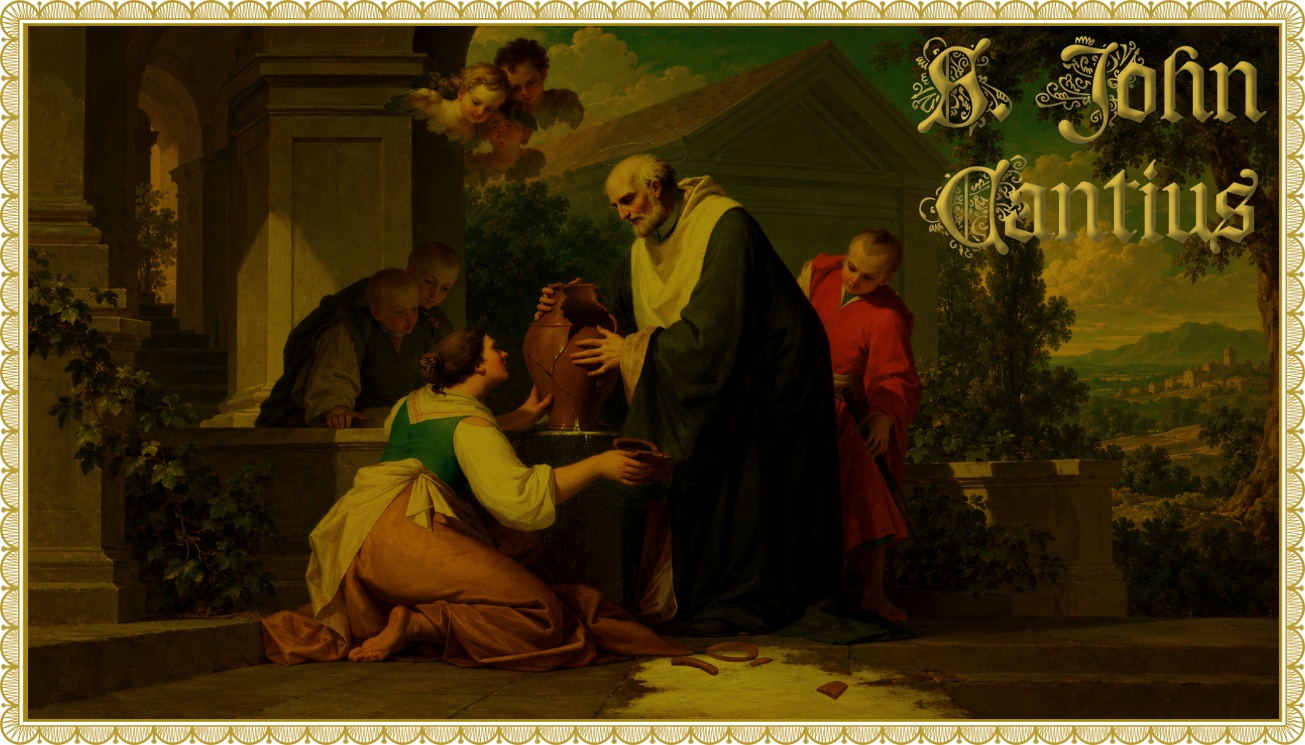
- Today’s homily: St John CantiusThe account of St John of Kenty illustrates true charity, as he prioritised the needs of a poor man over his own comfort, exemplifying how knowledge of faith must translate into actions. His life was marked by humility, generosity, and a dedication to both charitable works and doctrinal integrity, urging a holistic expression of faith.
- Today’s Mass: October 22 St John CantiusSt John of Kenty, originally a humble country lad, succeeded as a theology professor in Kraków but faced opposition that led to his role as a parish priest. Known for his kindness, he lived simply, aiding the poor. After winning his parishioners’ hearts, he returned to teaching, living a life of humility and faith.
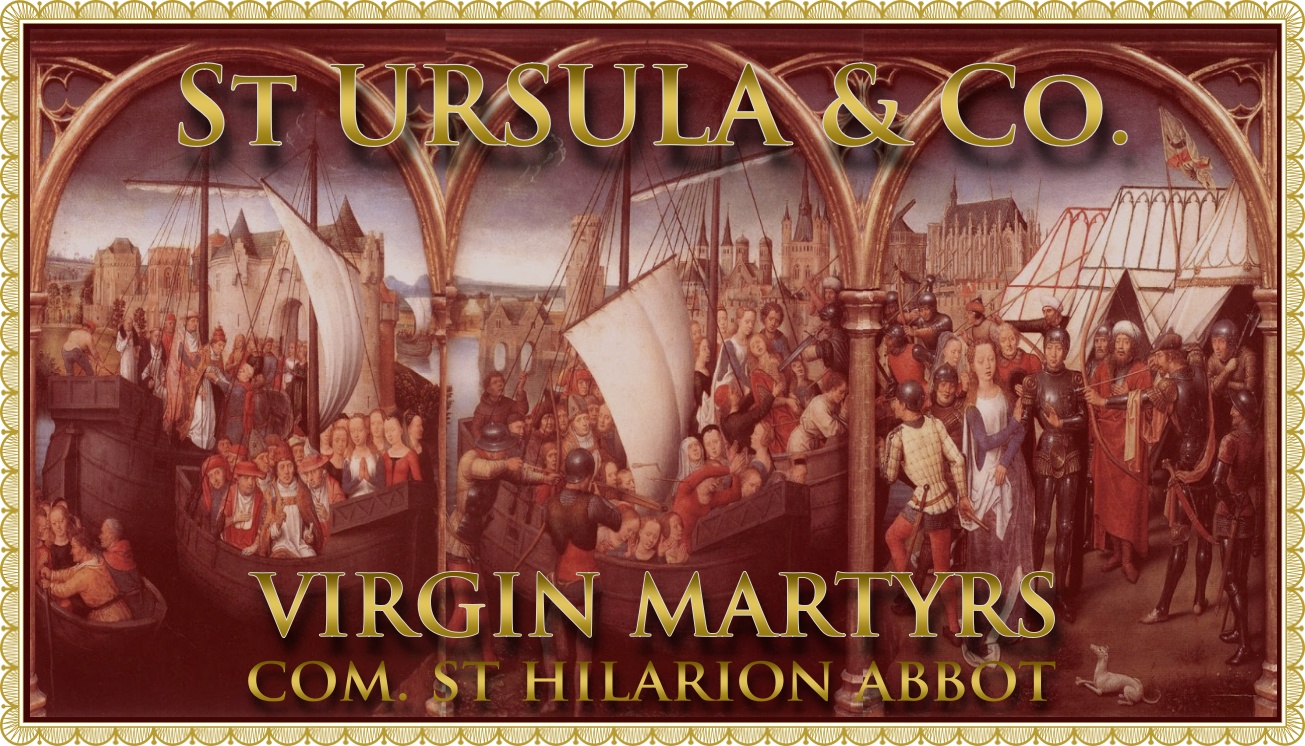
- Today’s Mass: October 21 St Ursula, Virgin Martyr & CompanionsSt Ursula and Companions, Virgins and Martyrs; Commemoration of St Hilarion, Confessor. Though legends concerning Ursula and eleven thousand virgins are historically uncertain, early Christian martyrs were venerated at Cologne. St Hilarion, Palestinian hermit and disciple of St Anthony, embraced severe penance and solitude, dying in 371 aged eighty.
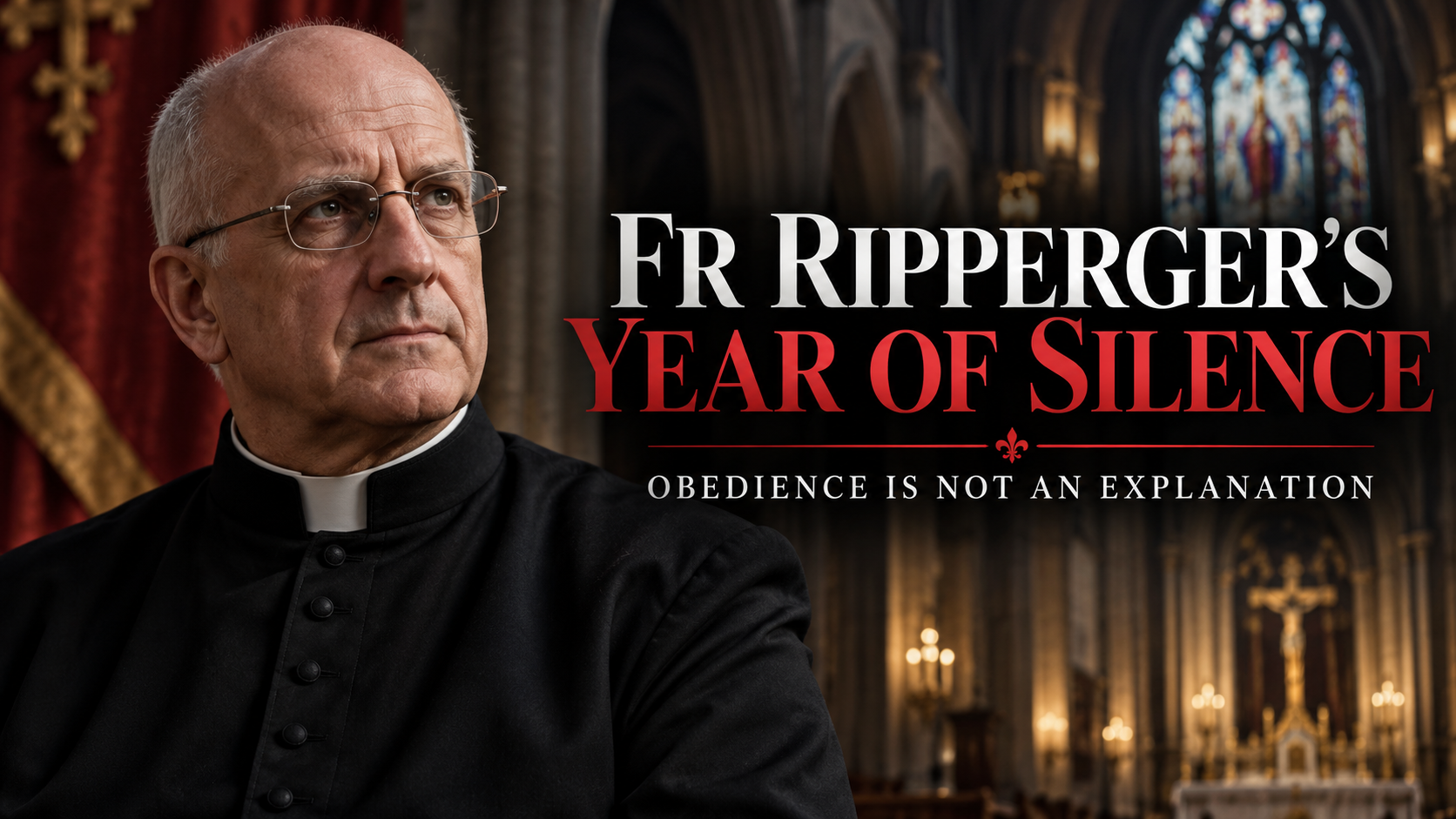
- FR RIPPERGER’S YEAR OF SILENCE: Obedience is not an explanationFr Chad Ripperger has accepted a year-long withdrawal from public speaking as requested by Archbishop Golka of Denver, aimed at focusing on his priestly community. This decision, following the removal of another exorcist, raises concerns about the Church’s balance between discretion and public witness regarding exorcism and supernatural matters.
- Today’s Mass: October 20 Octave Day of St Edward, King & ConfessorEdward the Confessor, England’s last Saxon king, ruled from 1042 until his death in 1066. Born in 1003, he fled to Normandy during Danish rule and returned to take the throne. His reign is debated, seen as both weak and a time of peace. Edward’s legacy includes the establishment of Westminster Abbey, where he is buried.



Leave a Reply