
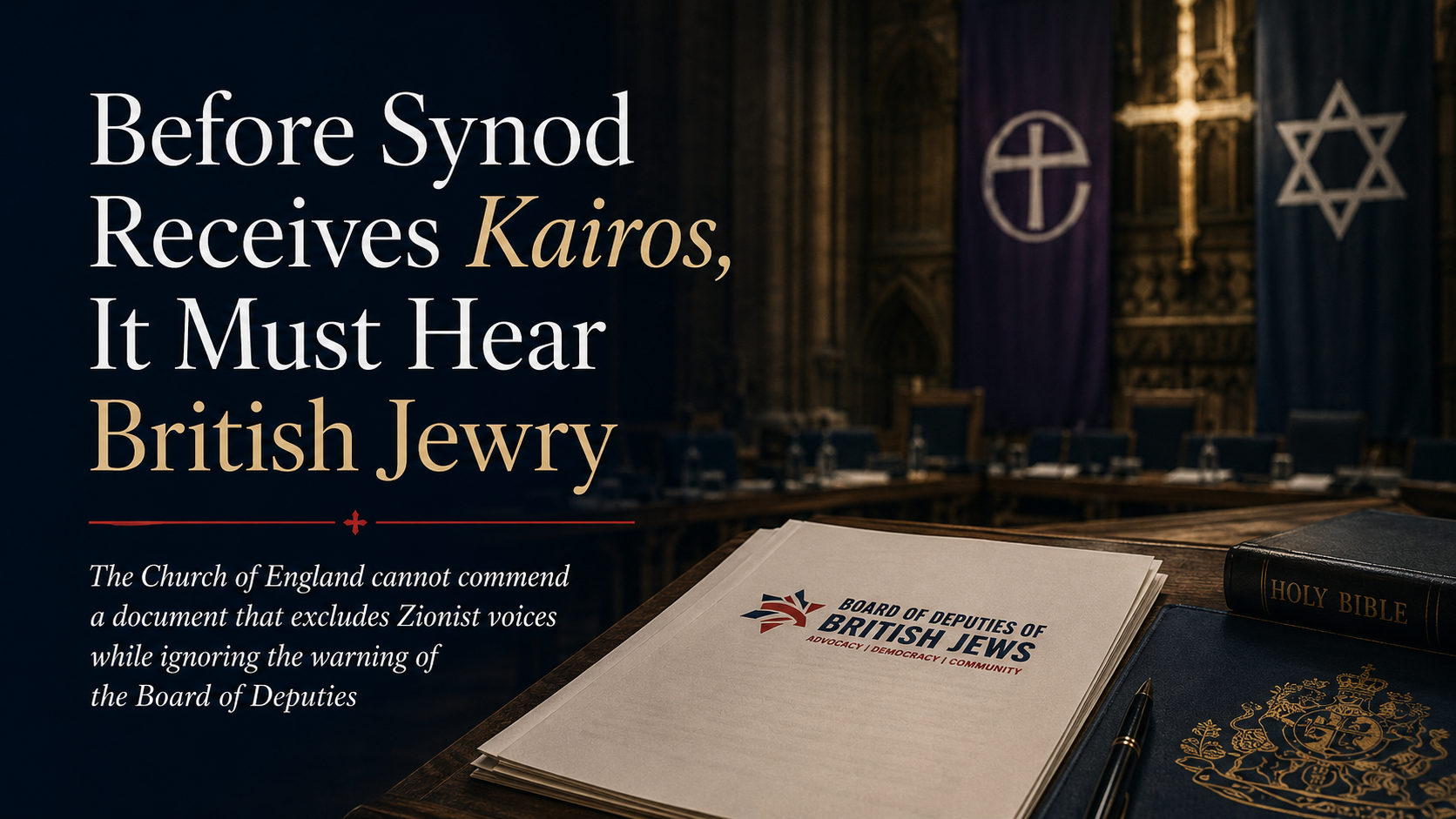
Before Synod Receives Kairos, It Must Hear British Jewry
The Church of England cannot commend a document that excludes Zionist voices while apparently declining to circulate the warning of the Board of Deputies

Tomorrow, 12 July, the General Synod of the Church of England will debate the Carlisle diocesan motion on Kairos Palestine. Much of the motion is unobjectionable and necessary. It laments the deaths of Israelis and Palestinians, rejects antisemitism and anti-Muslim prejudice, prays for peace, supports Palestinian Christians and calls for the protection of human dignity. Yet within these aspirations lies a proposal of much greater consequence: Synod is asked formally to “receive” four Kairos documents, including Kairos Palestine II: A Moment of Truth—Faith in a Time of Genocide, as “heartfelt expressions of the lived experience of Palestinian Christians”, and to encourage the Church of England at every level to engage with them.¹
William Nye, the Secretary General of Synod, insists that members are not being asked to endorse the documents, “only to receive them and to commend them for further study”. Yet the motion also asks the Church’s Faith and Public Life Division to recommend resources through which dioceses and parishes may pray, study, advocate and act.² A document formally received by Synod, commended for study and incorporated into national Church resources has plainly acquired institutional standing. Whatever distinction may be drawn between reception and endorsement, the practical effect is to confer legitimacy, circulation and formative influence.
That is why information circulated to Synod members today is so disturbing. Canon Guy Wilkinson CBE, formerly the Church of England’s national Inter Religious Affairs Adviser and an adviser to Archbishop Rowan Williams, has personally distributed the response of the Board of Deputies of British Jews. He says that he did so because the General Synod office declined to circulate it. Wilkinson’s ministry has included parish, diocesan and national responsibility in multireligious contexts; he helped to establish the Christian Muslim Forum, worked to sustain the Council of Christians and Jews, and was among those responsible for God’s Unfailing Word, the Church of England’s foundational theological statement on Christian-Jewish relations.³
His statement concerning the Synod office must remain precisely attributed unless and until the office explains its decision. There may be some procedural rule governing the circulation of external submissions. But no procedural explanation can alter the substantive absurdity. Synod is being asked to receive a document making sweeping claims about Jews, Zionism, Jewish history and the State of Israel, while the formal response of the principal representative body of British Jewry was apparently not considered suitable for circulation through Synod’s own machinery. The Church proposes to receive the indictment while leaving it to a retired priest to distribute the answer.
That is not discernment. It is an institutional asymmetry masquerading as dialogue.
The Board of Deputies’ briefing is neither an attempt to silence Palestinian Christians nor a demand that Israel be placed beyond moral judgement. It recognises Palestinian suffering, condemns violence by Israelis and Palestinians alike, specifically denounces extremist settler violence, affirms Palestinian national rights and advocates security and peace for both peoples. Its objection is that Kairos II transforms testimony about oppression into a totalising political theology in which Zionism itself becomes the originating sin and Jewish national existence the enduring crime. The Board warns that disseminating this narrative “will do more to perpetuate conflict than make peace”.⁴
The contents of Kairos II justify that alarm. The document does not restrict itself to condemning the Israeli Government, military operations in Gaza, settlement expansion, discrimination, occupation or attacks upon Palestinian civilians. Those matters demand grave and unsparing moral examination. Instead, it declares that the war is “the continuation of the Zionist project to seize all of Palestine, emptied of its Palestinian people”, describes Zionist ideology as a system of apartheid and “arrogant Jewish supremacy”, and calls Israel “a colonial, settler and exclusionary entity” whose establishment depended upon replacing an indigenous population with settlers.⁵
Its treatment of 7 October is formally qualified but morally evasive. Kairos II states that explaining the context does not justify killing or abducting civilians. Yet it immediately absorbs the Hamas atrocities into a narrative of colonial reaction and asks: “How can a colonizer defend itself against those it has colonized and expelled from their land?” Israel’s right to defend its population is thereby denied in principle, not merely criticised in its execution. Hamas’s agency recedes behind the prior guilt assigned to Zionism; murder and abduction become intelligible primarily as consequences of Israel rather than as crimes deliberately chosen by their perpetrators.⁵
Most damagingly for Christian-Jewish relations, Kairos II calls upon churches to “boycott dialogue with Zionist voices” that it considers supportive of occupation, apartheid and genocide.⁵ That qualification must be stated accurately. The document does not explicitly demand the exclusion of every person who calls himself a Zionist. Nevertheless, it defines Zionism so comprehensively and pejoratively that the distinction offers little protection. Jewish voices deemed prophetic are those which confront Zionism; those suspected of sustaining it are to be excluded. The Church is invited to listen to Jews only after determining which Jews have passed an ideological test devised by non-Jews.
Criticism of Israel is not antisemitic merely because it is severe. Governments may commit grave crimes. Armies may act unlawfully. Settlements may be condemned. The displacement, deprivation and deaths of Palestinians cannot be relativised by appeals to Jewish suffering, just as the murder and persecution of Jews cannot be relativised by appeals to Palestinian suffering. Christian moral judgement must name the sins of governments, movements and combatants without collapsing either people into its most culpable representatives.
Kairos II does something more dangerous. It converts a disputed political analysis into an ecclesial criterion of righteousness. Zionism ceases to describe a diverse family of Jewish national movements and becomes a synonym for racism, colonialism, ethnic supremacy and genocide. Jewish interlocutors are then judged according to whether they accept that definition. The result is not dialogue with Jewish historical consciousness but a demand that Jews repudiate a central element in the identity of much of their own community before the Church will recognise them as suitable partners.
The British context makes this approach especially reckless. Research published in 2025 by the Institute for Jewish Policy Research found that 64 per cent of British Jews identified as Zionist and 75 per cent felt emotionally attached to Israel. Yet the same study found that 51 per cent believed Israel’s conduct of the Gaza war conflicted with their Jewish values.⁶ These figures expose the false binary between Zionist attachment and moral criticism of Israel. British Jews may defend Israel’s right to exist while fiercely opposing its Government, settlements, military conduct or treatment of Palestinians.
Boycotting “Zionist voices” would therefore not isolate a handful of extremists. It could exclude much of British Jewry, including Jews who oppose the very policies Kairos II condemns. It would replace dialogue with conditional admission: Jews may be heard when they endorse the Church’s preferred political interpretation of Jewish history, but not when they defend Jewish national self-determination while criticising the state in which it is embodied.
The contradiction with the Church of England’s stated commitments could scarcely be clearer. Its College of Bishops formally adopted the International Holocaust Remembrance Alliance working definition of antisemitism, including its examples, without qualification. That definition distinguishes criticism of Israel from denying Jewish self-determination or describing Israel’s very existence as a racist endeavour. In 2019, God’s Unfailing Word acknowledged that Christian teaching had too often promoted destructive stereotypes of Jews and declared that the Church’s theology should instead provide an antidote to antisemitism.⁷
The Secretary General’s own paper reminds Synod of both commitments and acknowledges that British Jews presently feel particularly vulnerable.² Yet Synod is invited to receive a document that condemns definitions of antisemitism which it associates with Zionist interests, portrays Zionism as a structure of racial supremacy and recommends excluding certain Zionist voices from dialogue. The issue is not that every sentence in Kairos II is antisemitic. It is that its governing categories invite Christians to pronounce upon Jewish identity while discounting the way most British Jews understand their own relationship with Israel.
The Chief Rabbi, Sir Ephraim Mirvis, has described Kairos II as political activism presented in theological dress and warned that it risks undoing decades of careful Christian-Jewish relationship-building. He has not denied Palestinian suffering; neither has the Board of Deputies. Their complaint is that the suffering of one people is being used to construct an account which effaces the history, trauma and national aspirations of another.⁸ Synod need not agree with every Jewish objection, but it cannot honourably claim to pursue understanding while refusing those objections institutional parity with the document under consideration.
Nor does the phrase “lived experience” resolve the problem. Lived experience demands attention; it does not confer infallibility. Palestinian dispossession, occupation, settlement violence, bereavement and fear are lived experiences. So are Jewish memories of exile, pogrom, expulsion, statelessness and genocide. So are the terror of 7 October and the devastation of Gaza. Justice does not require the Church to select one people’s trauma as the controlling explanation of the other’s. It requires the Church to hear truths that resist absorption into a single ideological narrative.
There is a principled course open to Synod. It should distinguish hearing Kairos II from receiving it. The document should not be hidden or prohibited. Synod members should read it fully and critically. Palestinian Christians have every right to testify to their suffering and to challenge churches they believe have abandoned them. But the Church of England is under no obligation to grant ecclesial reception to every political, historical and theological judgement contained in that testimony.
The motion should therefore be amended. Kairos II should be noted as an important but deeply controversial Palestinian Christian statement, not received as a text to be commended throughout the Church. Any educational resources should place it alongside the response of the Board of Deputies, representative Israeli and Palestinian perspectives, and the work of organisations pursuing coexistence. The Church should condemn terrorism, collective punishment, settler violence, antisemitism, anti-Muslim hatred, attacks upon civilians and every denial of legitimate national rights—Jewish or Palestinian—without assigning either people the role of hereditary oppressor or permanent victim.
Canon Wilkinson is correct that the language of reception cannot conceal the significance of Synod’s decision. A Church which has spent decades repenting of Christian anti-Judaism should hesitate before institutionalising a document that prescribes which Jewish voices are worthy of dialogue. A Synod invoking lived experience must not treat Jewish lived experience as an impediment to an account it has already decided to privilege.
The Church of England can stand beside Palestinian Christians without accepting every political judgement they make. It can condemn Israeli injustice without treating Jewish statehood as an original sin. It can hear the Palestinian cry without instructing British Jews that their attachment to Israel disqualifies them from dialogue.
Before Synod receives Kairos, it must hear British Jewry—and hear the Board of Deputies through the same institutional channels, with the same seriousness and the same professed respect that it proposes to extend to everyone else.
¹ General Synod of the Church of England, GS 2451A: Diocesan Synod Motion—Kairos Palestine (London: Archbishops’ Council, July 2026).https://www.churchofengland.org/sites/default/files/2026-07/gs-2451a-dsm-kairos-palestine-v2.pdf
² William Nye, GS 2451B: Kairos Palestine (London: General Synod of the Church of England, May 2026), paras. 1–3, 9.https://www.churchofengland.org/sites/default/files/2026-06/gs-2451b-secretary-general-kairos-palestine.pdf
³ Guy Wilkinson, communication circulated to members of the General Synod, 11 July 2026; Church of England Faith and Order Commission, God’s Unfailing Word: Theological and Practical Perspectives on Christian-Jewish Relations (London: Church House Publishing, 2019).https://www.churchofengland.org/about/building-relationships/interfaith-relations/other-resources
⁴ Board of Deputies of British Jews, A Briefing for Members of the General Synod of the Church of England Regarding the Motion Relating to Kairos Palestine, 10 July 2026.https://bod.org.uk/bod-news/board-publishes-briefing-for-general-synod-members-on-the-kairos-palestine-motion/
⁵ Kairos Palestine, A Moment of Truth: Faith in a Time of Genocide, 14 November 2025, §§1.3, 1.6, 1.22, 3.7–3.8, 3.12 and 4.2.https://kairospalestine.ps/images/Kairos_Palestine_II_English_Final.pdf
⁶ Jonathan Boyd, Two Years after the October 7 Attacks: British Jewish Views on Antisemitism, Israel and Jewish Life (London: Institute for Jewish Policy Research, October 2025).https://www.jpr.org.uk/reports/two-years-after-october-7-attacks-british-jewish-views-antisemitism-israel-and-jewish-life
⁷ Church of England, “Bishops Adopt International Definition of Antisemitism,” 11 September 2018; Faith and Order Commission, God’s Unfailing Word.https://www.churchofengland.org/media/press-releases/bishops-adopt-international-definition-antisemitism
⁸ Simon Rocker, “Chief Rabbi Warns ‘Genocide’ Document Due to Be Discussed by Church of England Synod Will ‘Harm Peace’,” Jewish Chronicle, 7 July 2026.https://www.thejc.com/news/uk/chief-rabbi-warns-genocide-document-due-to-be-discussed-by-church-of-england-synod-will-harm-peace-sdffs81b
RELATED ARTiCLES


LATEST ARTICLES
- Today’s Mass: October 17 St Gall, Confessor;Saint Gall, born in Ireland in the sixth century, became a notable confessor after accompanying Saint Columban to France and later Switzerland, where he preached and converted idolaters. Despite his significant contributions, he humbly declined the position of bishop of Constance. He died in 646, leaving a lasting legacy.
- 18.10.26 Nuntiatoria CXXVIII: NON POTEST VERITAS SUBDI POTESTATIThis editorial asserts that truth should not be subjugated to authority, emphasising that legitimate power derives from truth rather than mandates it. It critiques contemporary tendencies in both ecclesiastical and societal contexts where authority prioritises institutional credibility over accountability. Ultimately, it calls for a return to truth as the foundation of authority, urging faithful adherence to moral principles.
- ORDO w/c 18.10.26The liturgical calendar from 18 to 25 October 2026 includes the feast of St Luke the Evangelist, commemorating essential themes of forgiveness and evangelisation. Subsequent days honour St Peter of Alcantara, St John Cantius, St Ursula and St Raphael, culminating in the celebration of Christ the King, affirming His universal sovereignty over all creation.
- THE DEBTOR AT HIS BROTHER’S THROAT: The Twenty-First Sunday after PentecostThe Twenty-First Sunday after Pentecost highlights the danger of receiving divine mercy and failing to extend the same to others, exemplified by the parable of the unforgiving servant. The Church emphasises the need for genuine charity, justice without vengeance, and the importance of faith in guiding interpersonal conduct amidst spiritual struggle.
- The Roman Provenance of MonsignorThe title “Monsignor” is often misunderstood as an ecclesiastical rank or honour, whereas it is merely a style of address linked to specific ecclesiastical offices. The distinction between substantive dignity and its verbal expression is crucial. Various regulations historically defined these roles, ensuring accurate representation of ecclesiastical authority and honour.
CURRENT EDITION


Today’s Mass Propers
- Today’s Mass: October 17 St Gall, Confessor;
 Saint Gall, born in Ireland in the sixth century, became a notable confessor after accompanying Saint Columban to France and later Switzerland, where he preached and converted idolaters. Despite his significant contributions, he humbly declined the position of bishop of Constance. He died in 646, leaving a lasting legacy.

Leave a Reply