

Dominica XXI post Pentecosten — Festum S. Lucæ Evangelistæ — Sanctissimus Redemptor — Domini Nostri Jesu Christi Regis
ORDO 18–25 OCTOBER 2026
| DIES | DOM 18 | FER II 19 | FER III 20 | FER IV 21 | FER V 22 | FER VI 23 | SAB 24 | DOM 25 |
|---|---|---|---|---|---|---|---|---|
| OFFICIUM | S. Lucæ Evangelistæ; comm. Dom. XXI | S. Petri de Alcantara C. | S. Joannis Cantii C. | Ss. Ursulæ et Sociarum Vv. Mm.; comm. S. Hilarionis Abb. | Feria post Dom. XXI | Sanctissimi Redemptoris | S. Raphaelis Archangeli | D.N.J.C. Regis; comm. Dom. XXII |
| CLASSIS | Duplex II cl. | Duplex | Duplex | Duplex majus (propr.) | Feria / Simplex | Duplex majus (propr.) | Duplex majus | Duplex I cl. |
| COLOR | Rubeus | Albus | Albus | Rubeus | Viridis | Albus | Albus | Albus |
| MISSA | Mihi autem | Justus ut palma | Miseratio hominis | Loquebar | In voluntate tua | Gaudens gaudebo | Benedicite Dominum | Dignus est Agnus |
| ORATIONES | 2a Dom. XXI; pro Propagatione Fidei ubi præscribitur | Unica | Unica | 2a S. Hilarionis Abb. | 2a A cunctis; 3a ad libitum | Unica | Unica | 2a Dom. XXII |
| RUBRICÆ | Gl. Cr. Præf. Apostolorum. IX lectio et Ult. Ev. Dom. | Gl. Præf. communis | Gl. Præf. communis | Gl. Præf. communis | Sine Gl., sine Cr. Præf. communis. Benedicamus Domino | Gl. Cr. Præf. de S. Cruce | Gl. Cr. Præf. communis. I Vesp. Christi Regis | Gl. Cr. Præf. D.N.J.C. Regis. IX lectio et Ult. Ev. Dom. |
| NOTÆ LOCALES | Dies Missionum ubi præscribitur | In quibusdam propriis Angliæ: Octava S. Wilfridi Ep.C. | In quibusdam antiquis propriis Angliæ: Octava S. Eduardi Regis C. | In Calendario Romano universali: S. Hilarion Abb.; comm. Ss. Ursulæ et Soc. Coloniæ Agrippinæ: cultus S. Ursulæ | In quibusdam antiquis propriis: S. Joannis Cantii translatio. Missæ votivæ vel defunctorum ubi licent | In quibusdam propriis diœcesium et religionum: Sanctissimus Redemptor | Festa propria ubi præscribuntur. I Vesperæ D.N.J.C. Regis | Translatio S. Joannis Beverlacensis in propriis antiquis Angliæ impeditur. Renovatio consecrationis Sacratissimo Cordi Jesu |
Abbreviations: Gl. — Gloria; Cr. — Credo; Præf. — Preface; Dom. — Sunday; IX lectio — ninth lesson of Matins; Ult. Ev. — proper Last Gospel; propr. — particular proper.
Sunday, 18 October — St Luke the Evangelist; Commemoration of the Twenty-first Sunday after Pentecost
Duplex II classis — Red — Missa Mihi autem
The feast of St Luke the Evangelist takes precedence over the Twenty-first Sunday after Pentecost. The Mass is Mihi autem, with Gloria, Creed and the Preface of the Apostles. The Sunday is commemorated, its Gospel supplies the ninth lesson at Matins, and its proper Gospel is read as the Last Gospel of Mass. Where prescribed, the prayer for the Propagation of the Faith is added according to the applicable rubrics.
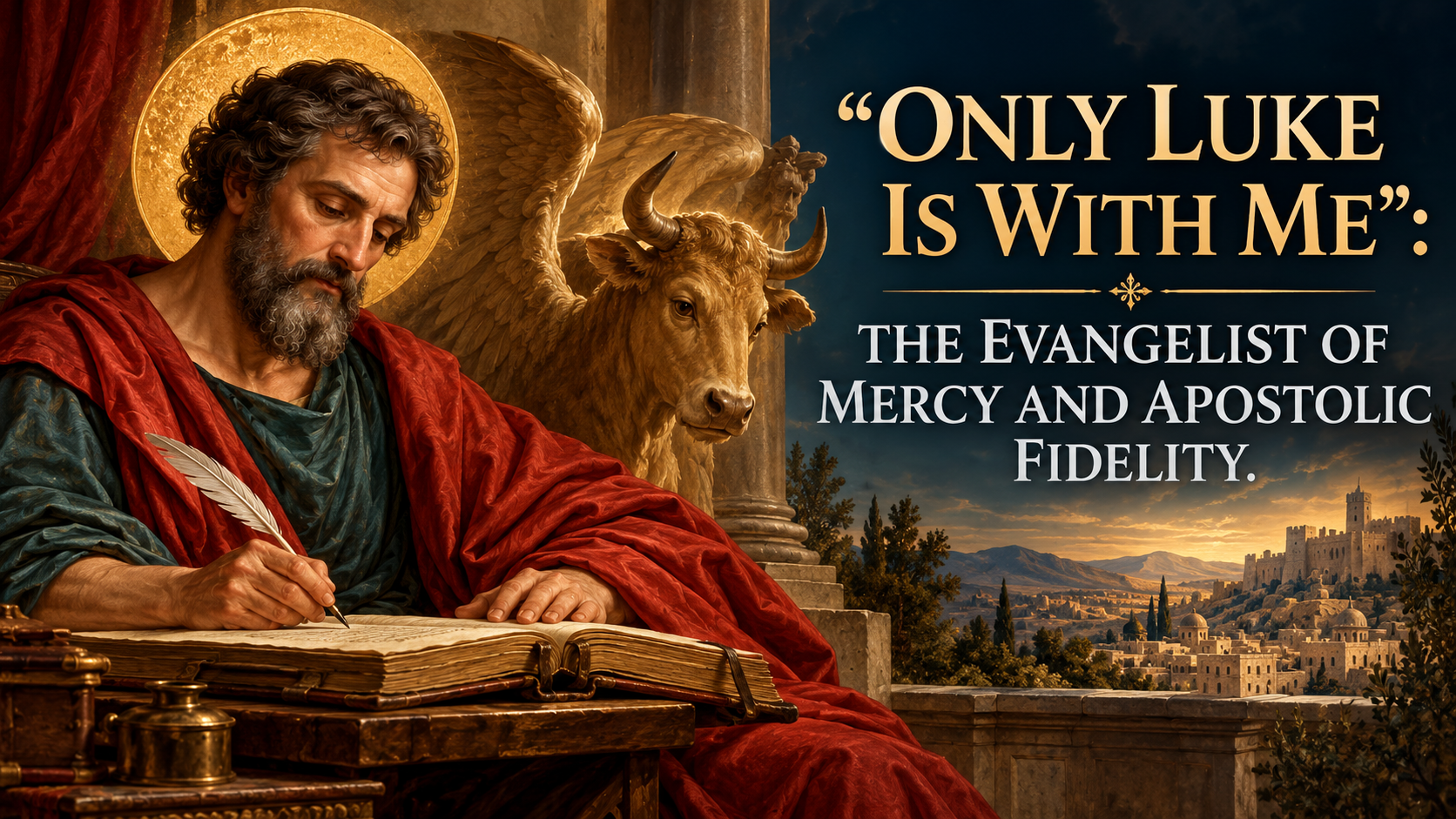
St Luke occupies a particular place among the Evangelists as the traditionally acknowledged author of both the Third Gospel and the Acts of the Apostles. These two books form a continuous account of the saving work of Christ and its extension through the Church. The Gospel begins with the events surrounding the Incarnation, while the Acts concludes with the apostolic mission extending into the heart of the Roman world.
His writings preserve much of the Church’s biblical testimony concerning the Blessed Virgin Mary. The Annunciation, Visitation, Nativity, Presentation and Finding in the Temple belong to his account. So too do the parables of the Good Samaritan and the Prodigal Son, the conversion of Zacchaeus, the encounter with the penitent thief and the appearance of the risen Christ to the disciples on the road to Emmaus.
Luke’s concern for historical particularity is inseparable from his theological purpose. Christianity does not rest upon timeless religious speculation but upon the actual intervention of God in human history. The Word became flesh, lived amongst men, suffered under Pontius Pilate, rose from the dead and commissioned His Apostles to preach the Gospel to every nation.
The occurring Sunday supplies an appropriate moral counterpart. Its Gospel, Matthew 18:23–35, recounts the unforgiving servant, whose own enormous debt is remitted but who refuses to forgive a comparatively insignificant debt owed by another. The parable exposes the contradiction between seeking divine mercy and refusing that same mercy to one’s neighbour.
The extension of the Gospel therefore requires more than the transmission of correct propositions, indispensable though doctrinal truth remains. Those who receive the revelation of divine mercy must themselves be converted by it. Forgiveness does not excuse wrongdoing or abolish justice, but it excludes the deliberate cultivation of hatred and vengeance.
The coincidence with the missionary observances traditionally associated with October is also fitting. St Luke’s Acts of the Apostles depicts a Church whose very nature is missionary. The deposit of faith is received in order to be preserved and proclaimed, not altered according to the tastes of successive generations.
The Sunday thus joins two inseparable duties: fidelity to apostolic revelation and the obligation to carry that revelation to others. Evangelisation requires charity, but charity cannot be separated from truth. The Church serves mankind by proclaiming the Gospel she has received, not by substituting a message of her own invention.
At Second Vespers, the Office remains that of St Luke, with the commemoration of the occurring Sunday according to the older rubrics.
Monday, 19 October — St Peter of Alcantara, Confessor
Duplex — White — Missa Justus ut palma
The Mass of St Peter of Alcantara is Justus ut palma, celebrated in white with Gloria and the Common Preface. No additional commemoration is prescribed in the universal Roman observance.
Born in Spain in 1499, St Peter became one of the most remarkable reformers of Franciscan religious life. His personal austerity was extraordinary, even by the demanding standards of the sixteenth century. He practised severe fasting, prolonged vigils, poverty and recollection, seeking to recover the primitive discipline of the followers of St Francis.
His reform was not a protest against the essential character of religious life but an attempt to restore it where observance had become relaxed. Poverty was to be real, obedience sincere, prayer habitual and detachment from worldly possessions more than a matter of constitutional language.
The saint is also remembered for his spiritual relationship with St Teresa of Jesus. His support proved important during the early difficulties of her Carmelite reform. He recognised the authenticity of her spiritual life and encouraged her to persevere amidst suspicion and opposition.
Yet the significance of St Peter’s asceticism must be understood correctly. Mortification is not an end in itself, nor is extraordinary bodily severity an automatic indication of holiness. The purpose of self-denial is the ordering of the passions, the weakening of disordered attachments and the liberation of the soul for the love of God.
The authentic ascetic tradition therefore refuses two opposing errors: a religion of comfort which regards sacrifice as unnecessary, and a religion of external severity which mistakes hardship for sanctity. Penitence must be animated by charity and governed by prudence.
English historical variation — Octave of St Wilfrid. In certain older English ordines, 19 October is associated with the octave of St Wilfrid, Bishop of York, whose principal feast falls on 12 October. This observance was included as an alternative in the corresponding Nuntiatoria Ordo for 2025.
St Wilfrid possesses a particular significance for the history of Christianity in Sussex. His missionary activity amongst the South Saxons and his association with the early church at Selsey place him amongst the figures through whom the Roman ecclesiastical tradition was established in southern England.
His defence of Roman liturgical and canonical usage reminds the faithful that ecclesiastical unity is not merely institutional. It concerns fidelity to the common faith, sacramental life and discipline of the Church.
The octave must nevertheless be treated as a historical particular observance. It cannot be presumed binding throughout England or automatically introduced into every pre-1955 calendar without the applicable diocesan or religious proper.
Tuesday, 20 October — St John Cantius, Confessor
Duplex — White — Missa Miseratio hominis
St John Cantius, or St John of Kęty, was born in Poland in 1390 and became one of the notable scholars of the University of Kraków. A priest, professor and theologian, he combined intellectual distinction with humility, personal austerity and remarkable generosity towards the poor.
The Mass is Miseratio hominis, celebrated in white with Gloria and the Common Preface.
The saint’s life offers a necessary corrective to the notion that learning and sanctity belong to separate spheres. Theology is not merely the study of religious ideas; its subject is God as He has revealed Himself, and its proper end is the deeper understanding and love of divine truth.
Scholarly ability may serve the Faith, but it can also become an occasion of vanity. The possession of knowledge does not exempt a man from the duties of charity, obedience or humility. Indeed, the greater the intellectual gifts entrusted to him, the more serious is his responsibility to employ them truthfully.
John’s charity was practical. His concern for the poor, his personal generosity and his willingness to undertake difficult pilgrimages formed part of a life in which intellectual achievement never displaced the obligations of Christian discipleship.
His example is particularly relevant to Catholic education. The Church’s schools, colleges and universities cannot fulfil their purpose simply by producing technically competent graduates. They must cultivate intellectual honesty, moral responsibility and a recognition that truth is not manufactured by the human mind.
In Poland, especially in Kraków, the saint remains a distinctive patron of learning and university life. His canonisation by Clement XIII in 1767 confirmed a reputation for sanctity which had endured for centuries.
English historical variation — Octave of St Edward the Confessor. Certain nineteenth-century English Roman ordines assign the octave of St Edward the Confessor to 20 October. In those arrangements the octave may displace St John Cantius, whose celebration is consequently transferred.
This is a documented historical practice, but not a universal rule for every English diocese or every period before 1955. The immediately preceding Nuntiatoria Ordo rightly distinguished between evidence for the historical observance and proof of its application to a particular church.
The octave is therefore retained in the local notes without replacing the universal celebration in the principal entry.
Wednesday, 21 October — St Ursula and her Companions, Virgins and Martyrs; Commemoration of St Hilarion, Abbot
Duplex majus in the historical English proper — Red — Missa Loquebar
The historical English observance of St Ursula and her Companion Martyrs is restored to the principal entry, following the precedent of the October 2025 Nuntiatoria Ordo. In nineteenth-century English Roman ordines the feast appears as a Greater Double, celebrated in red, with the Mass Loquebar and the commemoration of St Hilarion, Abbot.
This arrangement differs from the universal Roman calendar of 1954, in which St Hilarion is the principal Simple feast, celebrated in white, with St Ursula and her Companions commemorated. The distinction is one of legitimate historical calendar usage and must be respected according to the proper applicable to the church concerned.
The cult of St Ursula and her companions is of considerable antiquity, particularly in Cologne, where the tradition of a company of virgin-martyrs became deeply established. Medieval accounts identify Ursula as a British princess who, with her companions, suffered martyrdom rather than surrender her Christian fidelity and chastity.
The developed legend speaks of eleven thousand companions, but the precise number and many narrative details cannot be established with historical certainty. The antiquity of a martyrial cult must be distinguished from the reliability of every later embellishment attached to it.
The essential religious significance of the celebration remains the witness of virginity consecrated to Christ and of fidelity maintained even at the cost of life. The martyrs are honoured not because every element of their legend can be demonstrated, but because their veneration belongs to the Church’s historical remembrance of Christian witness.
Their feast also points towards the supernatural meaning of chastity. Christian purity is not a merely negative refusal of bodily pleasure. It is the proper ordering of human love according to God’s purposes and, in the consecrated state, an undivided offering of the heart to Christ.
The commemoration of St Hilarion introduces a complementary witness. Hilarion, born in Palestine during the fourth century, became a disciple of the ascetical tradition associated with St Anthony of Egypt. His life was described by St Jerome, who presented him as one of the great representatives of early Christian monasticism.
Hilarion sought solitude, prayer and penitence. His withdrawal from the world was not a rejection of mankind, but an effort to pursue God without distraction and to serve the Church through hidden fidelity.
The virgin-martyrs and the hermit thus represent different expressions of the same supernatural allegiance. Their lives testify that the demands of Christ take precedence over personal security, public approval and worldly advantage.
Regional observances. Cologne retains a particular association with St Ursula, while her cult also influenced religious foundations and educational institutions throughout Europe. In the Philippines she is honoured as patroness in various local communities, including Binangonan in Rizal. The rank of any corresponding patronal feast depends upon its authorised proper.
The historical English rank of Greater Double is preserved here, rather than treating the universal Roman arrangement as though it had always displaced the older local observance.
Thursday, 22 October — Feria after the Twenty-first Sunday after Pentecost
Feria / Simplex — Green — Missa In voluntate tua
The ferial Mass is that of the Twenty-first Sunday after Pentecost, In voluntate tua, which was impeded by the celebration of St Luke the Evangelist.
The vestments are green. Neither Gloria nor Creed is said; the Common Preface is appointed, with the additional collects A cunctis and a third ad libitum, according to the older rubrics. The Mass concludes with Benedicamus Domino.
The practice of resuming an impeded Sunday Mass reflects the importance of the temporal cycle in the older Roman liturgy. Although a higher feast may displace the Sunday Office and Mass, the Sunday formularies retain their place in the spiritual instruction of the faithful.
The Epistle, Ephesians 6:10–17, contains St Paul’s exhortation to put on the armour of God. The Christian struggle is not merely against visible opponents, but against the spiritual powers of evil. Truth, justice, faith, salvation and the word of God are described as the equipment necessary for spiritual resistance.
The Gospel, Matthew 18:23–35, presents the unforgiving servant. A man whose enormous debt has been remitted refuses to extend a corresponding mercy to another. His conduct reveals the contradiction between receiving forgiveness and deliberately withholding it.
Our Lord’s conclusion is severe because the matter concerns the sincerity of repentance. The Christian who asks God to forgive his sins must not cultivate an attitude fundamentally opposed to forgiveness.
This does not abolish legitimate authority, discipline or justice. Forgiveness does not require the pretence that wrongdoing has not occurred, nor does it remove the duty to protect others or seek appropriate restitution.
The distinction is between justice properly ordered towards truth and the common good, and vengeance nourished by resentment. The former may be obligatory; the latter corrupts the soul.
The ferial Mass therefore brings together spiritual vigilance and practical charity. The Christian must resist evil without permitting hatred to become the governing principle of his own conduct.
In certain older English arrangements, St John Cantius appears on 22 October following displacement from his usual date by the octave of St Edward. Such a transfer belongs to the particular calendar and does not replace the universal ferial entry except where the historical proper warrants it.
Where the feria is observed, a permitted votive or Requiem Mass may be celebrated according to the applicable rubrics.
Friday, 23 October — The Most Holy Redeemer
Duplex majus in the historical proper — White — Missa Gaudens gaudebo
The feast of the Most Holy Redeemer, Sanctissimi Redemptoris, is restored in accordance with the October 2025 Nuntiatoria Ordo and its documented place in older English liturgical usage.
In the historical proper, the feast is celebrated as a Greater Double, in white, with the Mass Gaudens gaudebo, Gloria, Creed and the Preface of the Holy Cross.
The feast is not entered in the universal Roman calendar of 1954, which treats 23 October as a feria. Its proper celebration nevertheless has substantial historical authority. It was observed by religious congregations devoted to the mystery of Redemption and appeared in particular diocesan calendars, including nineteenth-century English Roman ordines.
The Congregation of the Most Holy Redeemer received particular privileges for its celebration, while Pope Pius VIII assigned the feast to 23 October in Rome by decree of the Sacred Congregation of Rites in 1830. Its occurrence in an approved particular calendar must not be confused with its inclusion in the universal calendar.
The feast directs attention towards the central mystery of Christianity: the Redemption accomplished by the Incarnate Son of God through His Passion, Death and Resurrection.
Christ is the Redeemer not merely because He offers an example of moral goodness, nor simply because His teaching enlightens mankind. He redeems by offering Himself in obedience to the Father, reconciling fallen humanity to God through the sacrifice of the Cross.
The Epistle, Ephesians 1:3–9, proclaims the divine blessings bestowed upon mankind in Christ. St Paul speaks of election, adoption, grace and the forgiveness of sins through the Blood of the Redeemer. The initiative belongs entirely to divine mercy, but the grace received demands a corresponding transformation of life.
The white vestments express the joy of salvation accomplished. The Preface of the Holy Cross directs that joy towards its source, refusing any separation between the glory of Redemption and the sacrifice through which Redemption was won.
The feast also provides a necessary theological foundation for the approaching celebration of Christ the King. Christ possesses universal dominion by right of His divinity and also, in a distinctive manner, by His redemptive conquest. The sovereignty proclaimed on Sunday is inseparable from the saving work celebrated today.
The Church does not proclaim a Redeemer whose mission consists merely in encouraging humanity to discover its own goodness. She proclaims the divine Saviour who delivers mankind from sin, restores grace and opens the way to eternal life.
For those entrusted with the apostolic ministry, this distinction is fundamental. Preaching, sacramental administration and pastoral charity derive their purpose from the Redemption. Without that supernatural end, ecclesiastical activity is reduced to an institution’s contribution to social improvement.
The feast accordingly joins thanksgiving to responsibility. Those redeemed by Christ are called to live as men redeemed, rejecting sin, embracing penance and seeking holiness.
Historical and regional qualification. The celebration belongs to particular diocesan and religious calendars, notably those associated with the Redemptorist and Trinitarian traditions. Its appearance in an older English Ordo is historically established, but it must not be assumed obligatory in every diocese or religious house without reference to its proper.
The later universal calendar assigns St Anthony Mary Claret to this date. That later arrangement is not substituted here for the older feast.
The traditional Friday discipline of abstinence remains relevant according to the ecclesiastical law applicable to the faithful.
Saturday, 24 October — St Raphael the Archangel
Duplex majus — White — Missa Benedicite Dominum
The feast of St Raphael the Archangel is celebrated as a Greater Double, in white, with Gloria, Creed and the Common Preface. The Mass is Benedicite Dominum, recalling the ministry of the holy angels in the divine government of creation.
Raphael’s scriptural witness is preserved in the Book of Tobias. Appearing in human form, he accompanies the younger Tobias upon his journey, protects him amidst danger, directs his marriage to Sara, assists in her deliverance from demonic oppression and provides the means by which the blindness of the elder Tobias is healed.
Only when his mission has been fulfilled does Raphael reveal his true identity. He declares himself one of the seven holy angels who present the prayers of the saints before the glory of God.
The account provides a remarkable illustration of Providence. God governs His creatures not only through the visible order of nature but also through the ministry of spiritual beings whose activity ordinarily remains hidden from human perception.
Raphael’s name, traditionally understood as signifying God heals, is inseparable from his ministry in the sacred narrative. His patronage is therefore invoked especially for travellers, the sick, those seeking a holy marriage and those requiring guidance in difficult circumstances.
The Church’s doctrine of the angels must not be reduced to sentiment or metaphor. Angels are real, personal, spiritual creatures possessing intellect and will. They are neither divine nor independent powers, but servants of the one God.
Their ministry also demonstrates that the Christian understanding of creation is more extensive than what the senses can perceive. The visible world is not the whole of reality, and divine Providence is not limited to those causes accessible to ordinary human investigation.
The feast of Raphael recalls the ministry of spiritual assistance at the very moment when the liturgical year approaches its great proclamation of the sovereignty of Christ.
All the holy angels serve the King whose authority embraces heaven and earth. Their obedience manifests the perfect ordering of created intelligence and will towards God.
At Vespers, the Office turns towards the following day. The First Vespers of Christ the King, a Double of the First Class, take precedence according to the rubrics. The transition is particularly fitting: from contemplation of the heavenly messenger to adoration of the Lord whom the angels worship and obey.
Sunday, 25 October — Our Lord Jesus Christ the King; Commemoration of the Twenty-second Sunday after Pentecost
Duplex I classis — White — Missa Dignus est Agnus
The final Sunday of October is devoted to the Kingship of Our Lord Jesus Christ, instituted by Pope Pius XI in 1925 through the encyclical Quas primas.
The feast is a Double of the First Class. It takes precedence over the Twenty-second Sunday after Pentecost, which is commemorated. The Mass is Dignus est Agnus, in white, with Gloria, Creed and the proper Preface of Christ the King. The occurring Sunday’s Gospel is read as the ninth lesson at Matins and as the proper Last Gospel of Mass.
The original placement of the feast is theologically deliberate. Pius XI ordered that it should be celebrated on the last Sunday of October, immediately before All Saints, so that the Church might proclaim the universal sovereignty of Christ before contemplating His triumph in the blessed of heaven.
The feast arose amidst the increasing secularisation of public life and the widespread claim that religion belonged exclusively to the private sphere. Against this tendency, Pius XI recalled the perennial doctrine that the authority of Christ extends over individuals, families, societies and nations.
Christ’s Kingship is not dependent upon the consent of earthly rulers. His sovereignty belongs to Him by reason of His divinity, through which all things were created, and by His redemptive work, through which fallen humanity has been reconciled to God.
The distinction is essential. The Church does not claim that any particular political system constitutes the Kingdom of Christ, nor does she confuse supernatural authority with the ordinary instruments of temporal administration.
Rather, she teaches that civil society remains subject to the moral law and that political authority cannot legitimately exempt itself from the demands of divine justice.
The Gospel of the feast, John 18:33–37, records Christ’s declaration before Pontius Pilate that His Kingdom is not of this world. The words describe the origin and nature of His authority. They do not imply that His authority has no claim upon the world.
His Kingdom is not established through the ambitions, violence or calculations of earthly rulers. Nevertheless, every ruler remains accountable to the truth and justice of God.
The occurring Twenty-second Sunday after Pentecost offers a fitting complement. In Matthew 22:15–21, Christ commands that what belongs to Caesar be rendered to Caesar and what belongs to God be rendered to God.
The distinction recognises the legitimate existence of civil authority, but it does not establish a sphere of human action beyond divine judgment. Caesar himself is a creature and remains subject to the Creator.
The Preface of Christ the King describes His Kingdom as one of truth and life, holiness and grace, justice, love and peace. These terms provide a theological measure against which the conduct of both individuals and institutions must be judged.
A society may be materially prosperous yet spiritually impoverished if it treats truth as negotiable, justice as a matter of expediency or human dignity as dependent upon political convenience.
The public claims of Christ cannot be maintained through rhetoric alone. His Kingdom must first be acknowledged in the life of the believer through faith, repentance, sacramental fidelity and obedience to His commandments.
For this reason, Pius XI commanded that the consecration of the human race to the Sacred Heart of Jesus should be renewed annually on the feast. The public profession of Christ’s sovereignty is thus joined to the personal act of submission to His merciful love.
The connection with Friday’s historical feast of the Most Holy Redeemer is particularly instructive. The Lord who reigns is the Lord who has redeemed. His authority is neither arbitrary nor detached from His sacrifice. The Cross is the supreme manifestation of the divine love through which mankind is offered salvation.
The feast also anticipates the conclusion of the ecclesiastical year. The Church’s final Sundays direct attention towards judgment, perseverance, the passing of earthly kingdoms and the consummation of all things in Christ.


Leave a Reply