
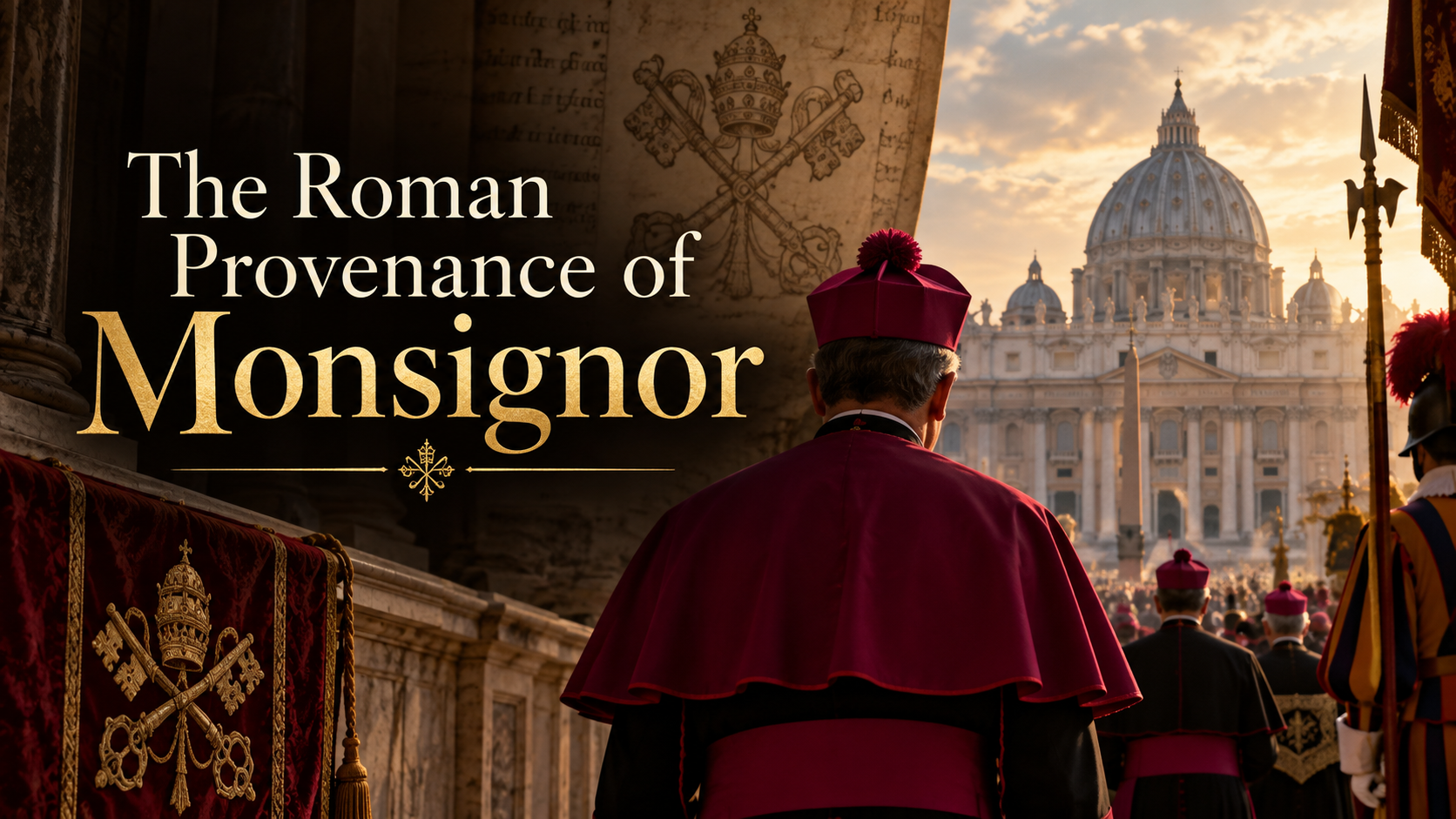
The Papal Court, ecclesiastical styles and honours, and the limits of episcopal jurisdiction
The appellation “Monsignor” is frequently mistaken for an ecclesiastical rank or a papal honour in its own right. Strictly speaking, it is neither. It is a style of address attached to certain recognised ecclesiastical dignities, offices and customary usages. The distinction is essential to understanding its development within the Papal Court, its regulation by successive pontiffs, and the limits of the authority competent to confer the honours with which it has become associated. Its history reveals a fundamental principle of Catholic ecclesiology: the authority to confer a dignity must not be confused with the convention by which its holder is addressed.
An ecclesiastical honour and a style of address are not the same thing. The former is a dignity conferred or recognised by competent authority; the latter is the form of address conventionally or officially employed towards its holder. The distinction may appear elementary, yet nowhere is it more frequently overlooked than in the use of Monsignor. The word has become so familiar in Catholic life that it is often treated as though it designated a separate rank of the priesthood, or constituted a pontifical honour in its own right. Neither understanding is strictly correct. A priest may be appointed a Chaplain of His Holiness and consequently become entitled to the style Monsignor. He has not been appointed to an office called “Monsignor”, nor has the form of address itself conferred a new ecclesiastical dignity. The honour is the chaplaincy; Monsignor is the recognised style by which its recipient may be addressed. This distinction between substantive dignity and its verbal expression is indispensable to any serious account of the title’s history.
The word itself possesses origins considerably older than the ecclesiastical system with which it is now associated. Derived from the French Monseigneur and the Italian Monsignore, meaning essentially “my lord”, it belonged originally to the language of European courts and aristocratic society. Its use within the Roman ecclesiastical establishment is commonly associated with the Avignon Papacy, when French courtly terminology exercised considerable influence upon pontifical ceremonial. Over subsequent centuries, the expression became attached to various categories of ecclesiastics occupying recognised positions within the Roman administration, the Papal Court and the wider system of pontifical honours. Its linguistic origins, however, must be distinguished from the juridical foundations of the offices and dignities to which it became attached. A word may possess a broad etymological meaning while acquiring a much more particular and regulated ecclesiastical application.¹
The distinction becomes clearer when the historical character of the Papal Court is understood. This was not simply an assembly of distinguished priests, but an organised institution possessing recognised offices, ceremonial precedence, administrative functions and gradations of honorary association. Apostolic Protonotaries, domestic prelates, papal chamberlains and various classes of chaplains occupied different places within its constitutional and ceremonial order. Some discharged substantial responsibilities in Rome; others enjoyed honours associated with the pontifical establishment while continuing their ministries elsewhere. Their standing arose from the offices they held or the distinctions conferred upon them, not from the mere employment of a common form of address. Monsignor could express their status, but it was not the juridical source of that status.
This historical qualification immediately disposes of an excessively narrow interpretation. Not every ecclesiastic properly styled Monsignor was necessarily a personal attendant of the Pope or a member of his immediate Household. Particular honours were extended beyond Rome, certain ecclesiastical offices carried recognised privileges, and established linguistic conventions provided additional foundations for the appellation. Yet the existence of these different grounds did not render the underlying distinctions interchangeable. A recognised office, a pontifical honour and a customary episcopal style are different realities, even where the same word is employed to address their holders. The fact that a designation can properly arise from more than one foundation does not mean that it requires no foundation at all.
The legislation of St Pius X provides an exceptionally revealing illustration. His motu proprio Inter multiplices curas, promulgated on 21 February 1905, undertook a comprehensive regulation of Apostolic Protonotaries and other lesser prelates. Its provisions distinguished four classes of protonotaries, carefully differentiated their privileges, and prescribed the circumstances in which particular insignia and forms of ecclesiastical dress might lawfully be employed. Pius X was especially concerned that the unrestricted multiplication or improper assumption of prelatical privileges should not obscure the distinctive dignity of bishops. His regulations were therefore intended to preserve the correspondence between ecclesiastical office, legitimate honour and external ceremonial expression.²
The distinction between a substantive dignity and its outward manifestations permeates the document. Certain protonotarial honours were conferred personally; others arose through membership of particular chapters or tenure of specified offices. Some privileges endured for life, while others ceased when the office to which they belonged was relinquished. The right to employ particular insignia could be restricted to a specific church, diocese or ceremonial occasion. Pius X insisted that these concessions should be interpreted strictly, precisely because a limited privilege could not legitimately be enlarged through assumption or convenience. A dignity was not created by adopting its insignia, any more than an honour was constituted by employing the style associated with it.
Particularly instructive are the provisions concerning titular or honorary Apostolic Protonotaries. Pius X recognised that certain powers of nomination had been delegated to apostolic nuncios and other competent authorities. He also provided that vicars-general and certain other office-holders enjoyed specified protonotarial distinctions during their tenure. Nevertheless, he expressly distinguished these office-based dignities from membership of the Papal Household. Such ecclesiastics did not thereby acquire the honours belonging to the Pope’s domestic prelates. Here the legislation makes several distinctions simultaneously: the possession of a recognised dignity, the means by which it is acquired, the privileges attached to it, and membership of a particular pontifical institution. They could coincide, but they were not identical.³
These historical arrangements must not be projected indiscriminately upon the contemporary Church. The protonotarial privileges and office-based entitlements regulated in 1905 belonged to the disciplinary structure then in force; subsequent legislation substantially altered that structure. Their importance lies in what they reveal about the Roman understanding of ecclesiastical honours. The Church distinguished with considerable exactitude between an office, a personal distinction, a ceremonial privilege and the form of address attaching to one or more of them. The older system was elaborate, but it was not indiscriminate.
The reform of Paul VI made the distinction even more apparent. On 28 March 1968, the motu proprio Pontificalis Domus reorganised the former Papal Court into the modern Papal Household, abolishing numerous historic offices and consolidating the surviving ecclesiastical honours into three principal categories: Apostolic Protonotaries, Prelates of Honour of His Holiness, and Chaplains of His Holiness. These were the designated categories of pontifical distinction; Monsignor was not listed as a fourth category, nor was it constituted as a separate honorary grade. The reform concerned the institutional honours themselves, not the creation of an independent rank bearing that appellation.⁴
This is the pivotal distinction. A Chaplain of His Holiness is entitled to the style Monsignor because he possesses the recognised pontifical dignity. A Prelate of Honour may be styled Monsignor because he possesses that particular honour. An Apostolic Protonotary may likewise receive the form of address according to the provisions applicable to his class. The common appellation does not abolish the distinctions between them. Nor does it place their holders within a single juridical grade called “Monsignors”. The style follows from the underlying status; it does not replace, define or independently constitute it.
The instruction Ut sive sollicite, issued by the Secretariat of State on 31 March 1969, confirms this distinction with exceptional clarity. Its second part separately regulates ecclesiastical titles and insignia. Paragraph 23 recognises that a bishop may be addressed in Italian as Monsignore. Paragraph 25 provides for the style in relation to specified senior prelates and officials, while paragraph 26 extends it to Apostolic Protonotaries supernumerary, Prelates of Honour and Chaplains of His Holiness. These provisions do not establish an independent office of “Monsignor”. They identify the persons whose existing dignity or recognised position warrants the form of address. The Latin instruction employs the word titulus for the style, but that terminological usage must not obscure the juridical distinction between an appellation and the office or honour to which it pertains.⁵
The provision concerning bishops is especially important. In Italian ecclesiastical usage, Monsignore may properly be employed when addressing a bishop, without suggesting that he has received a separate honorary appointment as a papal chaplain or prelate. Similarly, French ecclesiastical convention has long employed Monseigneur for bishops and archbishops. Here the style expresses episcopal dignity through established linguistic usage, rather than a distinct pontifical honour. The bishop’s ecclesiastical standing arises from his episcopal office and sacramental character, not from being called Monsignore. The appellation acknowledges that standing; it neither creates nor enlarges it.
Consequently, three things must be kept separate in any accurate account: the office or dignity actually possessed, the authority by which it is constituted or conferred, and the style used in addressing its holder. A bishop may properly be styled Monsignore without possessing an honorary papal chaplaincy. A Chaplain of His Holiness may properly be styled Monsignor without possessing episcopal Orders or diocesan jurisdiction. A senior Roman official may enjoy a recognised form of address by virtue of office, without that form of address constituting a separate personal honour. The same appellation can therefore have several legitimate foundations, but it does not erase their differences.
Nor should the various foundations be confused with a general liberty to confer the style as though it were itself an honorary dignity. If an ecclesiastical appointment carries an established form of address, the appointee may enjoy that style by virtue of the office legitimately acquired. If the style follows from a recognised pontifical honour, the entitlement rests upon the competent conferral of that honour. If it arises through established linguistic convention, no additional honorary appointment is necessarily involved. But these are all different propositions from claiming that an ecclesiastical superior may independently manufacture a pontifical dignity simply by declaring someone a “Monsignor”. A form of address can acknowledge an existing status; it cannot substitute for the authority required to create that status.
It is here that the question becomes jurisdictional rather than merely ceremonial. Catholic ecclesiology distinguishes the sacramental character conferred by episcopal consecration from the canonical jurisdiction exercised through particular offices. A bishop possesses the fullness of the Sacrament of Holy Orders, but episcopal consecration does not automatically confer ordinary jurisdiction over a diocese or every faculty exercised within the Church. A diocesan bishop, in turn, possesses genuine ordinary, proper and immediate power within the particular Church entrusted to him. Yet that jurisdiction is exercised within the limits established by ecclesiastical law. Canon 381 §1 expressly excludes matters reserved to the supreme or another competent ecclesiastical authority. The possession of episcopal jurisdiction is therefore not equivalent to an unrestricted power to confer every ecclesiastical office, dignity or honour.⁶
The competence to appoint a Chaplain of His Holiness illustrates the distinction. The chaplaincy is a pontifical dignity belonging to the system of honours regulated by the Apostolic See. Its proper conferral requires the authority of the Roman Pontiff or a legitimate faculty deriving from that authority. A diocesan bishop may recommend a priest for the honour, but his ordinary diocesan jurisdiction does not itself empower him to constitute a member of the Pontifical Household. This does not diminish the bishop’s genuine authority over his diocese. It simply recognises that ecclesiastical powers are exercised within their proper competence. To confer an honour belonging to another authority requires a legitimate juridical foundation; the employment of the associated style cannot supply that foundation retrospectively.
Nor should such honorary distinctions be mistaken for sources of sacramental or governing power. A priest appointed Chaplain of His Holiness remains a priest. The honour does not confer episcopal Orders, create diocesan jurisdiction or automatically bestow an administrative office. Similarly, the possession of the style Monsignor cannot itself establish canonical authority. Where a particular office carries jurisdiction, that jurisdiction belongs to the office and is exercised according to law. It does not arise from the form of address employed towards its holder. This is precisely why the distinction between style and honour is more than a matter of correct terminology. Confusing them can lead to the further confusion of ceremonial precedence with ecclesiastical authority.
Pope Francis’s restriction of honorary appointments in January 2014 reinforces the point. New pontifical honours for diocesan priests were ordinarily limited to the dignity of Chaplain of His Holiness, with a minimum age of sixty-five. Previously conferred distinctions were preserved, while established office-based usages and arrangements within the Roman Curia remained unaffected. The measure was widely associated with opposition to clerical careerism, but its canonical significance is equally important. Francis did not abolish or redefine a supposed office of “Monsignor”; he restricted access to the particular pontifical honour which, for newly honoured diocesan priests, would ordinarily provide the entitlement to that style. The object of regulation was the honour, not the word considered in isolation.⁷
This distinction also explains why the history of the Papal Court cannot be reduced to a general history of ecclesiastical courtesy. The Court and subsequently the Papal Household possessed defined offices and honours. Their holders employed particular styles and enjoyed particular privileges according to their status. The styles were part of the ceremonial vocabulary through which those distinctions were acknowledged, but they were not interchangeable with the distinctions themselves. A change in form of address did not necessarily alter an office; the abolition of an office could extinguish the foundation for a particular style; and the preservation of a customary style did not necessarily preserve every historic privilege formerly associated with it. These were separate matters, requiring separate regulation.
The relationship between honour and ecclesiastical dress offers a further illustration. The different classes of lesser prelates historically enjoyed carefully regulated privileges concerning soutanes, choir dress and insignia. Such privileges could accompany particular honours or offices, but they were not identical with either. The right to wear a particular garment did not of itself constitute an appointment to a pontifical dignity. Conversely, the reform of ecclesiastical dress did not necessarily abolish the dignity to which the former vesture had been attached. In Pontificalia insignia, Paul VI appealed to the proper correspondence between ecclesiastical signs and the realities they signify. Whatever judgment may be made concerning the extent of the reforms, the underlying principle is evident: an external sign is intelligible because of the office or dignity it represents, not because it independently creates that office or dignity.⁸
This attention to institutional precision is not an exercise in ceremonial triviality. The Catholic Church possesses a sacramental and hierarchical constitution in which outward signs communicate realities of considerable theological and juridical importance. Episcopal insignia express the dignity and pastoral responsibility of the episcopate. Administrative offices carry specific faculties and obligations. Pontifical honours recognise particular distinctions within an established ecclesiastical order. Styles of address acknowledge these realities according to the conventions and regulations appropriate to them. The integrity of ecclesiastical language depends upon the preservation of the differences between what a person is, what office he holds, what honour he has received, and how he is properly addressed.
These distinctions are equally important to the understanding of papal authority. The recognition that particular honours belong to the competence of the Roman Pontiff does not require an exaggerated or maximalist theory of papal government. The Pope’s power over the universal Church does not extinguish the proper jurisdiction of diocesan bishops, nor does his regulation of honorary titles transform every aspect of ecclesiastical ceremonial into a matter of divine law. Pontifical honours belong to the Church’s mutable discipline. Their categories may be established, modified, restricted or abolished by competent authority. But their reformable character does not make their juridical foundations irrelevant. An honour may be disciplinary rather than divinely instituted and nevertheless remain subject to the authority which is competent to confer it.
The history of Monsignor thus illustrates a principle extending far beyond clerical nomenclature. Ecclesiastical tradition is not preserved simply by perpetuating familiar words, garments or ceremonies. It requires fidelity to the distinctions which gave those forms their meaning. St Pius X’s concern to protect episcopal dignity, Paul VI’s reorganisation of the Papal Household, and Francis’s restriction of honorary appointments differ considerably in their immediate purposes. Yet each presupposes an ordered relationship between authority, office, honour and external expression. The forms may change; the need for that relationship does not.
There is also a necessary spiritual perspective. A priest requires no honorary distinction to possess the sacramental dignity of his vocation. The faithful exercise of the priesthood does not depend upon appointment to the Pontifical Household, and the absence of such an appointment diminishes neither the character conferred by Holy Orders nor the supernatural value of priestly ministry. Ecclesiastical honours may appropriately recognise exceptional service, but they cannot create the sanctity, fidelity or pastoral charity which alone make that service fruitful. They are secondary distinctions within the Church’s visible order, not additional grades of sacramental priesthood.
The confusion surrounding Monsignor arises in considerable part because a single word has become shorthand for several different realities. In ordinary speech, “being made a monsignor” usually means receiving a pontifical honour which entitles the recipient to that style. Such language is understandable as a colloquial abbreviation, but it is not canonically exact. Strictly speaking, the person receives the dignity of Chaplain of His Holiness, Prelate of Honour or Apostolic Protonotary, as applicable; the style follows according to the relevant regulations. Elsewhere, the same word may be used because of episcopal dignity or recognised official usage, without any comparable honorary appointment. To speak accurately of Monsignor therefore requires asking not simply who bears the appellation, but what the appellation denotes in the particular case.
The Roman provenance of the style remains unmistakable in its modern association with pontifical honours, but its history is more nuanced than the assertion that every Monsignor must personally belong to the Pope’s Household. The word has recognised episcopal and official applications beyond that particular setting. Nor is the proper conclusion that every informal employment of the appellation constitutes an unlawful conferral of papal dignity. Ordinary courtesy and institutional claims must be distinguished. The more serious question arises when the style is presented as evidence of an honour, office or privilege which has no competent foundation. An expression of respect is not the same thing as a juridical act, but neither can an expression of respect perform the work of a juridical act.
The distinction should therefore be stated without qualification or ambiguity: the style Monsignor may follow from a legitimate honour, but it is not itself that honour; it may acknowledge an ecclesiastical office, but it does not constitute that office; and its proper employment cannot confer jurisdiction which its bearer does not otherwise possess. The honour, office or recognised usage explains the style. The style does not establish the underlying dignity.
The elaborate ceremonial world of the Papal Court has largely disappeared, and many of its former offices and distinctions survive only in historical scholarship. Yet the ecclesiastical principle illustrated by their regulation remains. Authority must be exercised within its proper competence; dignity must possess a legitimate foundation; and outward forms must correspond to the realities they purport to express. The history of Monsignor is therefore not merely the history of an ecclesiastical appellation. It is a small but illuminating chapter in the Church’s understanding of her own constitutional order.
A pontifical honour is conferred by competent authority. A style of address recognises a dignity already possessed. To confuse the two is to mistake the language of ecclesiastical honour for the authority which gives that honour its existence.
- Paul Maria Baumgarten, “Monsignor”, The Catholic Encyclopedia, vol. 10 (1911).
- St Pius X, Inter multiplices curas, motu proprio, 21 February 1905, introduction and nn. 1–14.
- St Pius X, Inter multiplices curas, nn. 59–76.
- Paul VI, Pontificalis Domus, motu proprio, 28 March 1968, particularly n. 8.
- Secretariat of State, Ut sive sollicite, instruction, 31 March 1969, Acta Apostolicae Sedis, 61 (1969), pp. 334–340, particularly nn. 21–26.
- Code of Canon Law, 1983, canons 375–381.
- ZENIT, “Pope Francis Changes Rules on Use of ‘Monsignor’ Title”, 7 January 2014.
- Paul VI, Pontificalia insignia, motu proprio, 21 June 1968.



Leave a Reply