

A Priest at the Helm: What St Mary’s Must Now Be
Fr Dr Øystein Lund has taken office as Vice-Chancellor of St Mary’s University, Twickenham: a married convert, Catholic priest, biblical scholar and experienced higher-education administrator. His appointment is unusual and potentially very encouraging. But its real significance will not be measured by the novelty of having a priest at the head of the university. It will be measured by whether St Mary’s becomes more confidently, intellectually and institutionally Catholic.

On Monday, 17 August, the Rev. Fr Dr Øystein Lund assumed office as Vice-Chancellor of St Mary’s University, Twickenham. His appointment deserves rather more Catholic attention than it has so far received. St Mary’s is not simply another British university which happens to possess a chapel, a Catholic foundation and an ecclesiastical history. Founded in 1850 by the Catholic Poor Schools Committee to train teachers for the education of poor Catholic children, it continues formally and publicly to describe itself as a Catholic university, rooted in the Catholic intellectual tradition and committed to the mission of the Church in higher education.¹ At a time when the confessional identity of so many institutions founded by the Church has faded into little more than historical memory, the choice of a Catholic priest and theologian as its chief executive is therefore significant.
Fr Lund is an unusual appointment by almost any measure. Born in Norway in 1967, he is a theologian whose principal academic field was the Old Testament. He was formerly a Lutheran minister, but was received into the full communion of the Catholic Church on 13 April 2009. He subsequently became a candidate for priesthood in the Diocese of Oslo, was ordained deacon in St Olav Cathedral in August 2013 and priest there by ✠Bernt Eidsvig on 1 May 2014. He has served as Dean of Studies at St Eystein Seminary, as a diocesan chaplain and student priest, and on academic and financial bodies within the Diocese of Oslo.²
The biographical detail likely to attract most immediate attention is that Fr Lund is married and has children. There is nothing irregular about this. His marriage preceded his reception into the Catholic Church and the Holy See expressly authorised his ordination to the diaconate and priesthood as a married former Lutheran minister.³ It would be equally misleading to portray this either as an infringement of Catholic discipline or as evidence that the Latin Church has somehow abandoned clerical celibacy. The Church has long possessed mechanisms by which married former Protestant ministers may, in particular circumstances and with Roman permission, be ordained as Catholic priests. Fr Lund’s situation belongs to that established exception.
Far more consequential is the breadth of experience he brings to Twickenham. Lund holds a doctorate in theology and spent two decades at the institution now known as MF Norwegian School of Theology, Religion and Society, where his work ranged from Old Testament scholarship to senior academic management. He became Dean of Studies and Pro-Rector for Education, later served as Director of Supervision at NOKUT, Norway’s national quality-assurance agency for higher education, and from 2022 until this summer worked at the Royal Norwegian Embassy in London as Counsellor for Research and Education.⁴ His appointment is therefore not that of a cleric placed in university management principally because he wears a Roman collar. He has spent most of his professional life at the intersection of theology, scholarship, higher-education governance, institutional standards and public service.
That combination could prove particularly valuable because St Mary’s has arrived at an important moment in its history. The university is expanding. Its School of Medicine is preparing to receive students, while the development of a Dubai campus forms part of an increasingly international institutional ambition. Announcing Lund’s appointment, ✠Richard Moth, Chair of the Board of Governors, expressly placed it in the context of this new stage of St Mary’s development, identifying the medical school and Dubai campus among the initiatives intended to broaden the university’s reach. Fr Lund himself spoke of academic excellence, human flourishing and the Church’s tradition of learning, scholarship and enquiry.⁵
All of that is encouraging. But expansion creates a particular danger for Catholic institutions. An institution can grow more quickly than its identity can withstand. New faculties, partnerships, professional accreditations, international campuses, commercial considerations and widening recruitment can transform a university’s reach while progressively weakening the very thing which originally made it distinctive. The result can be an institution which is historically Catholic, ceremonially Catholic and perhaps even pastorally Catholic, but no longer recognisably Catholic in its governing intellectual assumptions.
This is the real test presented by Fr Lund’s appointment. The question is not whether St Mary’s will continue to call itself Catholic. It plainly will. The question is what work the word “Catholic” will actually be permitted to do.
That question is not answered by maintaining a chaplaincy, celebrating Mass, displaying religious imagery or periodically citing St John Henry Newman. Nor is it answered by a vocabulary of “values”, “inclusion”, “human flourishing”, “dialogue”, “community” and “social engagement”. All of those things can express authentically Catholic realities. They can also be found, almost word for word, in the prospectuses and strategic plans of thoroughly secular institutions. A Catholic university requires something more fundamental. Its Catholicism must shape how it understands truth, knowledge, the human person, moral reasoning, freedom, society and the relationship between the disciplines. Catholic identity cannot be merely one activity of the university. It must inform the university’s understanding of what a university is.
The Church is remarkably explicit about this. St John Paul II’s Apostolic Constitution Ex Corde Ecclesiae does not describe Catholic identity as a matter of atmosphere or historical inheritance. A Catholic university is to possess a Christian inspiration not merely among individuals but within the university community as such; it is to reflect upon human knowledge in the light of the Catholic faith; it is to remain faithful to the Christian message as presented by the Church; and it is to serve the People of God and the human family in their pilgrimage towards the transcendent goal which gives meaning to life.⁶
The General Norms of Ex Corde Ecclesiae become more concrete still. Teachers and administrators who are not Catholics are to recognise and respect the university’s distinctive Catholic identity, and John Paul II states plainly that the number of non-Catholic teachers “should not be allowed to constitute a majority” within an institution which “is and must remain Catholic”.⁷ This provision is rarely mentioned in contemporary discussions of Catholic higher education, perhaps because it makes uncomfortable reading in an age which prefers institutional identity to remain aspirational and difficult to measure. Yet there it is. Whatever prudential questions surround its implementation, Rome clearly did not understand the word “Catholic” as a decorative adjective which could remain meaningful irrespective of who teaches, governs and forms the students.
Canon law supplies an equally demanding benchmark. Canon 810 requires those responsible for Catholic universities to ensure that teachers possess not only scientific and pedagogical qualifications but integrity of doctrine and probity of life; the same canon recognises the duty and right of bishops to ensure that Catholic doctrine is faithfully observed. Canon 811 requires provision for theology and, significantly, requires theological questions related to the other disciplines taught by the university to be addressed.⁸ Theology, in other words, is not supposed to exist in splendid isolation as one specialist subject among many. The Catholic intellectual tradition proposes an integration of knowledge in which theology and philosophy help the other disciplines understand their own ultimate questions and limits.
This is precisely where St Mary’s new School of Medicine makes the issue particularly acute. Medicine does not operate in an anthropological vacuum. Abortion, assisted suicide, embryonic experimentation, reproductive technology, the treatment of sex and gender, the moral limits of medical intervention and the definition of human dignity all depend upon prior judgements about what a human being is. St Mary’s has itself presented the ethical vision of its medical school within its Catholic inheritance and explicitly invokes Newman’s conception of interdisciplinary education and formation.⁹ That commitment will become meaningful precisely when Catholic anthropology conflicts with prevailing professional or cultural opinion.
A Catholic medical school which teaches Catholic principles only where those principles coincide with the dominant consensus is not undertaking a particularly difficult task. The test comes where fidelity has a cost. If Catholic teaching concerning the inviolability of innocent human life, the integrity of the human body, the meaning of sexual difference and the proper ends of medicine can be bracketed whenever professional orthodoxy moves in another direction, then “Catholic medical school” risks becoming a description of ownership rather than an account of intellectual identity.
The same applies beyond medicine. What is man? Is the human person something given, or something constructed? Does freedom consist merely in unconstrained choice, or is freedom ordered towards truth and the good? Does the body possess an intelligible meaning which the will must receive rather than invent? Is the family a natural society with claims prior to those of the State? Can moral truths be known by reason? Are there acts which remain intrinsically wrong regardless of motive or social approval? Is human dignity inherent, or does it depend upon autonomy, consciousness, usefulness or consent? These are not sectarian curiosities smuggled into academic life by religious believers. They are among the fundamental questions upon which medicine, law, psychology, politics, education and social policy depend.
A genuinely Catholic university ought to be unusually well equipped to ask them.
It ought also to be unusually resistant to the fragmentation of knowledge which characterises much contemporary higher education. That point has now been made explicitly by Pope Leo XIV. Addressing leaders of the Association of Catholic Colleges and Universities on 3 June, Leo identified the increasing fragmentation of knowledge as one of the central problems facing education. Universities can produce experts who possess enormous quantities of specialised information while lacking any coherent account of the whole. Catholic education, he said, has a particular role in overcoming this division, teaching students not merely to acquire information but to seek truth and the meaning of life. Ultimately, he insisted, the truth sought by Catholic education cannot be separated from “the Truth that is Christ himself”.¹⁰
That is considerably stronger than the generic language sometimes employed about Catholic “values”. Leo’s conception of Catholic education is explicitly Christological. He describes Catholic institutions as places in which the Christian vision should permeate the disciplines and the relationships within the university, and concludes by expressing the hope that students will find within Catholic institutions the “sound doctrine” entrusted to the Church.¹⁰ For the new Vice-Chancellor of St Mary’s, that address could scarcely be more timely.
There is consequently something particularly interesting in Fr Lund’s own biography. He is not simply a Catholic administrator. He is a convert. At some point in his life, having been formed, ordained and ministered within Lutheranism, he judged that truth required him to enter into full communion with the Catholic Church. Conversion of that kind necessarily involves receiving something rather than inventing it. It means recognising that revealed truth places claims upon us which are not generated by our preferences, inherited identities or institutional convenience.
That fact should not be romanticised. Conversion does not automatically determine how a man will govern a university, and it would be unfair to place arguments into Fr Lund’s mouth merely because his biography makes them attractive. His own language about the future of St Mary’s is characteristically contemporary. Speaking to his former institution in Norway, he expressed the desire that St Mary’s remain academically ambitious, socially engaged, international, open and inclusive while continuing to build upon the Catholic foundation which makes it distinctive. He also described theology as the thread running through his professional life and as a discipline demanding analytical precision, historical understanding, philosophical reflection and ethical judgement.¹¹ There is much in that account to welcome.
But the qualifying phrase is the important one: without losing the foundation which makes the institution distinctive.
The challenge now facing Fr Lund is to determine what that means in practice. Catholic identity cannot survive indefinitely as an inherited sentiment. Each generation of an institution must consciously receive it, understand it and transmit it. Once “Catholic” becomes reducible to kindness, inclusivity, social concern, community and an openness to transcendence, the process of secularisation is already substantially complete, because none of those things requires Catholic revelation or Catholic doctrine.
A Catholic university should certainly be welcoming. It should welcome people of other faiths and none. It should encourage vigorous scholarship, intellectual disagreement and genuine academic freedom. Catholic truth has nothing to fear from serious enquiry. But openness and identity are not opposites. Dialogue requires somebody to speak from somewhere. A university which possesses no truths it is prepared to affirm cannot truly enter dialogue; it can only facilitate conversation. The Catholic university brings to that conversation two thousand years of theology, philosophy, jurisprudence, moral reasoning, artistic achievement and reflection upon the human person, all illuminated by Revelation. To conceal that inheritance in order to appear intellectually respectable would not demonstrate openness. It would demonstrate embarrassment.
St Mary’s itself understands at least something of this. Its own account of its Catholic mission says that Catholic universities possess a particular gift arising from their understanding of knowledge and that they have a duty to prevent the separation of faith from reason.¹² That is exactly right. But duties stated on institutional webpages must eventually become decisions: decisions about appointments, curricula, partnerships, ethical policies, research, student formation and what a university is prepared to say when the surrounding culture finds Catholic teaching difficult.
For that reason, Catholics should welcome Fr Lund’s appointment neither naively nor suspiciously. There is no reason to assume failure before he has begun his work, and much in his background suggests reasons for hope. A priest, theologian and convert with serious experience of academic governance may be exceptionally well placed to understand the opportunity before him. But precisely because the appointment is promising, Catholics are entitled to expect something more than competent management.
They should expect St Mary’s to become more unmistakably Catholic.
That does not mean turning the university into a seminary. It means allowing Catholicism to be intellectually consequential. It means ensuring that Newman is read rather than merely quoted; that theology speaks to medicine, education, psychology and politics rather than remaining confined to its own corridor; that the moral teaching of the Church is not treated as an awkward inheritance whenever it conflicts with fashionable opinion; that students encounter serious Catholic philosophy and anthropology; and that the university possesses enough confidence in the truth it has received to risk being unfashionable.
The timing could hardly be more propitious. Leo XIV has now told Catholic university leaders that their task is not simply to prepare students for employment but to cultivate a passion for truth, to overcome the fragmentation of knowledge, to allow the Christian vision to permeate university life and to transmit the doctrine entrusted to the Church.¹⁰ Ex Corde Ecclesiae and canon law provide the institutional standards. St Mary’s possesses the history, resources and Catholic inheritance. Its new Vice-Chancellor possesses theological formation, priestly ordination and substantial experience of higher education.
The ingredients are there.
What happens next will tell us whether “Catholic” at St Mary’s describes its past or governs its future.
Fr Øystein Lund has now taken the helm. The important question is not that a priest is steering.
It is whether St Mary’s remembers where the ship is meant to be going.
¹ St Mary’s University, St Mary’s as a Catholic University — heritage, identity, mission; St Mary’s University, The Founding of St Mary’s.
² Den katolske kirke i Norge, Øystein Lund.
³ Oslo katolske bispedømme, Øystein Lund diakonvies 28. august, 29 July 2013.
⁴ St Mary’s University, St Mary’s Announces Appointment of New Vice-Chancellor, 26 June 2026; MF vitenskapelig høyskole, Fra MF til rektorstilling i London, 29 July 2026.
⁵ St Mary’s University, St Mary’s Announces Appointment of New Vice-Chancellor, 26 June 2026.
⁶ John Paul II, Apostolic Constitution Ex Corde Ecclesiae, 15 August 1990.
⁷ John Paul II, Ex Corde Ecclesiae, General Norms, art. 4 §4.
⁸ Codex Iuris Canonici, cann. 810–812.
⁹ St Mary’s University, School of Medicine Statement of Ethics.
¹⁰ Leo XIV, Address to a Delegation of the Association of Catholic Colleges and Universities, 3 June 2026.
¹¹ MF vitenskapelig høyskole, Fra MF til rektorstilling i London, 29 July 2026.
¹² St Mary’s University, St Mary’s as a Catholic University — heritage, identity, mission.
related articles


Latest articles
- Today’s Mass: October 07 Pope St Mark, ConfessorSt Mark’s brief pontificate teaches that God measures fidelity, not duration or worldly achievement. Christ alone possesses the everlasting priesthood; His servants are stewards of what they have received. With the commemorated martyrs, St Mark reminds us to persevere faithfully, so that when the Lord comes, He finds us “so doing.”
- Omnia autem probate: quod bonum est tenete ~ Prove all things; hold fast that which is good: Spiritual Conference for Nuntiatoria CXXVIThe conference reflects on St Paul’s assertion to “prove all things” in relation to self-judgement and the Church. It explores themes of synodality, ecumenism, and the importance of discernment, emphasising the need for humility in understanding truth and the challenge of maintaining genuine holiness in the midst of contemporary ecclesiastical crises.
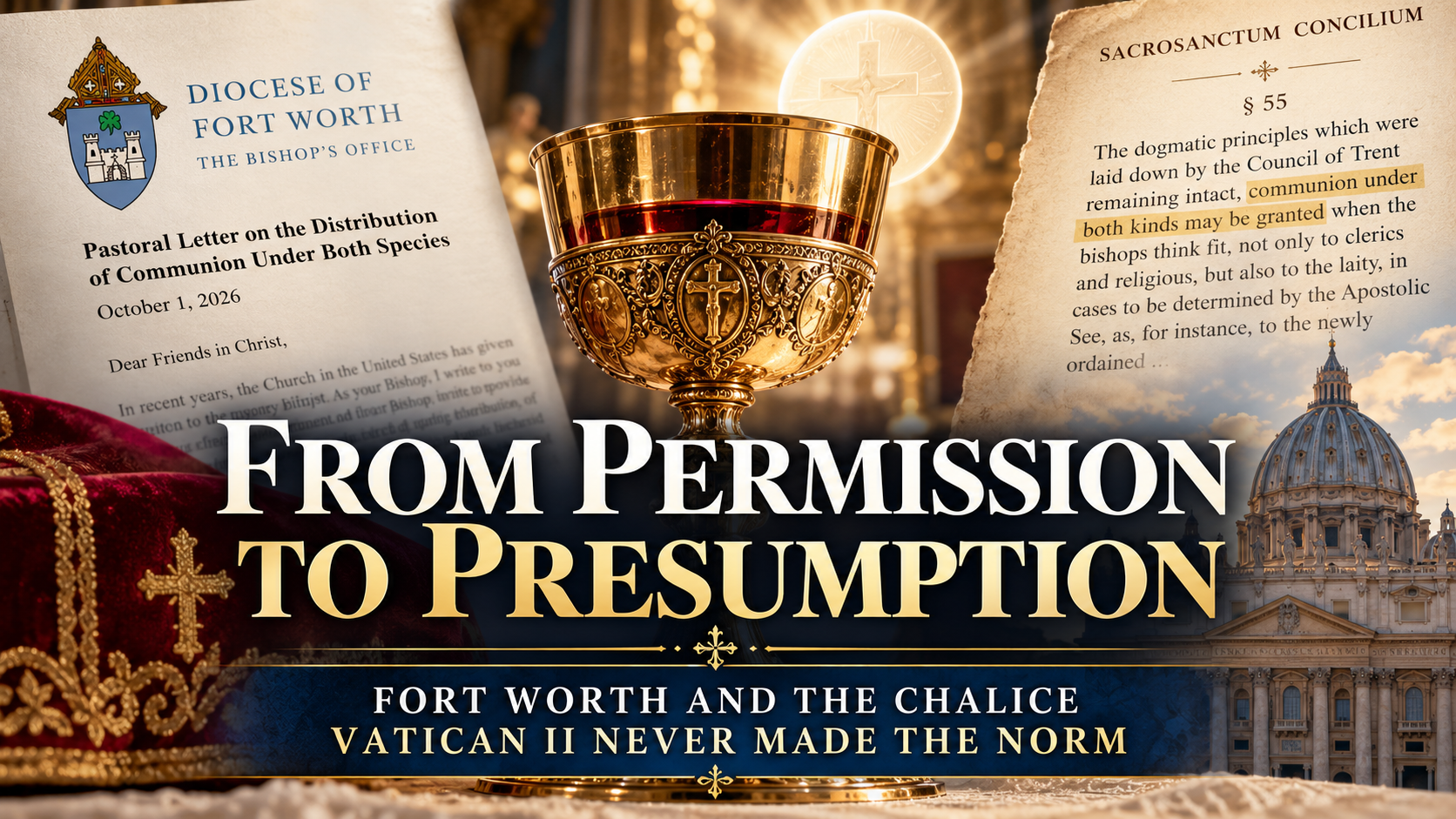
- FROM PERMISSION TO PRESUMPTION: Fort Worth and the Chalice Vatican II never made the NormBishop Michael Olson has implemented strict limitations on the distribution of Communion under both species in the Diocese of Fort Worth, prompting a discussion on the historical evolution of liturgical practices following Vatican II. This decision aims to reaffirm the doctrine of the Eucharist, emphasising that Christ is fully present under either species, while addressing misconceptions surrounding modern practices.
- AUGSBURG 2030: Can Rome commemorate a Confession it once confuted?Pope Leo XIV aims to revitalise the ecumenical spirit of the Augsburg Confession for its 2030 anniversary. However, historical responses from Rome highlight significant doctrinal differences between Catholics and Lutherans. True reconciliation must acknowledge these unresolved issues, as merely celebrating commonality risks glossing over critical theological distinctions that led to the Reformation.
- Today’s homily: St BrunoThe text reflects on Saint Bruno’s journey towards a life of solitude, prayer, and contemplation, emphasising the importance of genuine pursuit of God amidst distractions. It highlights that true spiritual growth requires silence and self-examination, urging believers to reclaim quiet moments for reflection, repentance, and devotion in daily life.



Leave a Reply