
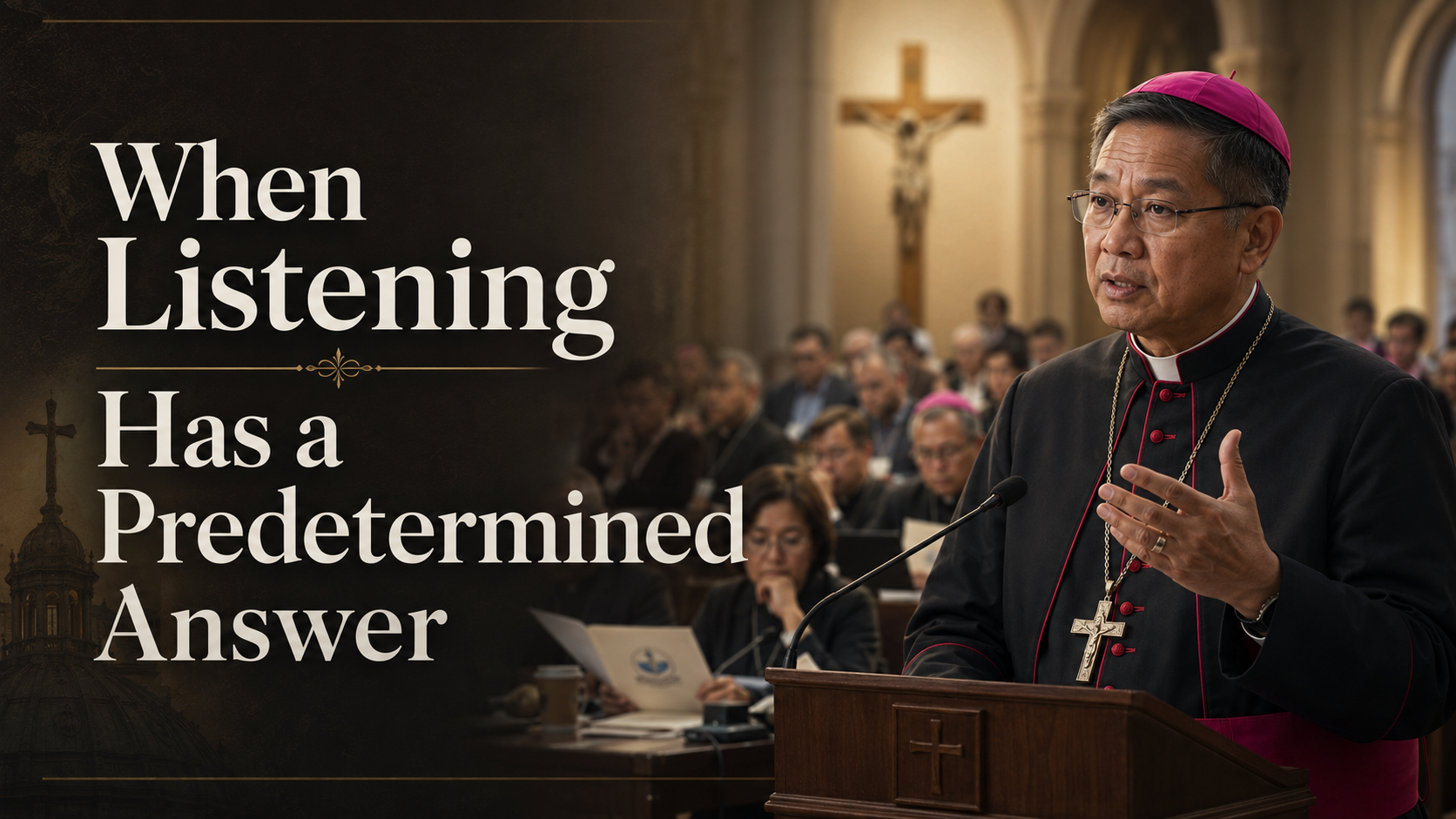
When Listening Has a Predetermined Answer
When Listening Has a Predetermined Answer
Archbishop Gilbert Garcera is right that meetings, reports and assemblies cannot substitute for conversion. But his description of synodality as a permanent “way of life”, involving “shared decision-making” and a “living fidelity” capable of moving beyond a supposed “legacy culture”, exposes the question Nuntiatoria has repeatedly raised throughout the synodal experiment: does the Church listen in order to receive more faithfully what Christ has given her, or in order to discover what she might now become? The distinction is decisive. The Church is receptive before she is deliberative. Revelation, sacramental constitution and apostolic authority precede consultation. A genuinely synodal Church must therefore be capable of hearing an answer she did not invent — especially when that answer is Tradition.

There is much in the address delivered by Archbishop Gilbert Garcera of Lipa, President of the Catholic Bishops’ Conference of the Philippines, at the seventieth annual national assembly of the Pontifical Mission Societies–Philippines in Tacloban City on 19 August with which no Catholic need disagree. Archbishop Garcera warned against imagining that synodality consists merely in consultations, assemblies and documents. “Synodality is not an event. It is not a meeting. It is not merely a document,” he said. “It is a way of life.” He spoke of prayer, conversion, discernment, missionary responsibility, perseverance and parrhesia — courageous, honest and charitable speech.¹
All of these belong naturally to Catholic life. The Church certainly requires continual conversion. Bishops should listen to their priests and people. Ecclesiastical institutions can become bureaucratic, self-protective and more concerned with perpetuating their machinery than converting souls. Lay Catholics are not spectators within the Mystical Body. Through Baptism they receive genuine responsibilities for the Church’s mission, particularly in those spheres of family, work, education, culture and public life which clergy cannot possibly evangelise alone. Nor should anyone defend a style of episcopal government in which consultation is regarded as weakness and pastoral counsel as insubordination.
The difficulty with contemporary synodality has never been that Catholics object to listening. The difficulty is what listening has gradually been made to mean. As Nuntiatoria has documented repeatedly this year, “synodality” has undergone a remarkable semantic expansion. Dialogue becomes participation; participation becomes co-responsibility; co-responsibility becomes shared discernment; shared discernment becomes involvement in decision-making; and what began as a pastoral summons to listen increasingly approaches a theory of ecclesiastical government. This is precisely the development examined in “Synodality for the Initiated: How Collegiality Became Permanent Process”, which traced the movement from occasional consultation towards a permanent ecclesiastical apparatus capable of presenting highly mediated participation as the voice of the People of God.²
The distinction matters because the Catholic Church does not deliberate herself into existence: she receives herself. Her constitution is antecedent to her consultation, her sacraments are antecedent to her committees, her revelation is antecedent to her listening exercises, and her apostolic ministry does not derive authority from the consent of those whom it serves. Before the Church asks what Catholics think, she possesses something which neither bishops nor laity created: a Faith revealed by God, entrusted to the Apostles, handed down in Scripture and Tradition, interpreted authentically by the Magisterium and embodied sacramentally in a visible Church constituted by Christ. The Church is therefore receptive before she is deliberative, and every legitimate form of synodality must remain subordinate to that prior reality.
Once that order is reversed, synodality changes its nature. Instead of consulting about how the Church may more faithfully teach, sanctify and govern according to what she has received, the process begins to suggest that sustained consultation might determine what the Church should henceforth believe, bless, tolerate or become. That is why Archbishop Garcera’s reference to “shared decision-making” requires theological precision. The expression is capable of an entirely orthodox meaning, but not every imaginable meaning. The International Theological Commission’s own 2018 document on synodality carefully distinguishes communal discernment, consultation and cooperation from the decision which belongs to legitimate ecclesiastical authority, summarising the distinction with admirable economy: “Working things out is a synodal task; decision is a ministerial responsibility.”³
The later Synod Instrumentum laboris retained that distinction. Participation can and should inform decisions; consultation cannot simply be ignored; and authority exercising government is not entitled to arbitrary disregard for serious counsel. Yet the responsibility of the bishop, the College of Bishops and the Roman Pontiff to take decisions remains, in the Synod’s own words, “inalienable” because it is rooted in “the hierarchical structure of the Church established by Christ”.⁴ That is not clericalism but Catholic ecclesiology. A bishop is not an ecclesiastical delegate whose jurisdiction rises from the baptised by popular sovereignty. He governs the particular Church entrusted to him because episcopal office belongs to the apostolic constitution of the Church. Lumen Gentium consequently describes bishops as “vicars and ambassadors of Christ”, possessing proper, ordinary and immediate authority in the Churches entrusted to them.⁵ They ought to listen precisely because they must govern well; listening does not relieve them of government.
Here lies one of the central paradoxes Nuntiatoria has identified in contemporary synodality. A programme repeatedly presented as the remedy for clericalism can itself become intensely clericalist in operation. The rhetoric is participation, but the architecture may remain centrally controlled. The faithful are invited to speak, while ecclesiastical professionals select questions, determine vocabulary, synthesise responses, choose representative voices and ultimately decide what the consultation is understood to have revealed. The existence of consultation does not by itself prove that the process is open, still less that its conclusions have arisen organically from the faithful rather than from the machinery directing them.
Nuntiatoria examined the problem directly in “Synodality or Stage Management? Fr James Martin, Study Group 9, and the Manufactured Consensus Crisis.” The concern was not that testimony had been heard, but that curated testimony could be presented as representative ecclesial discernment while contrary testimony disappeared from view. A process does not become genuinely representative simply because some people have been invited to speak. If those managing the process determine who speaks, which experiences are privileged, how contributions are framed and what counts as a legitimate conclusion, consultation can become construction.⁶
The problem appeared again in “Cardinal Zen, Synodality, and the Constitutional Crisis of the Church” and subsequently in “When Process Replaces Judgment: Cardinal Zen’s Warning, the Synodal Consistory, and the Crisis Rome Refuses to Confront.” Cardinal Joseph Zen’s criticism was significant precisely because it came not from an opponent of episcopal consultation but from a bishop and cardinal objecting that managed processes could diminish episcopal disputation and judgement. Nuntiatoria’s point was not that conversation is unnecessary, but that process ceases to serve authority when organising conversation becomes a substitute for reaching the judgements for which authority exists.⁷
That distinction returns with particular force in Archbishop Garcera’s criticism of what he calls a “legacy culture”. He warns against an inward-looking mentality concerned with preserving inherited structures and says that “true fidelity to tradition is never static”, but constitutes a living fidelity capable of responding courageously to new pastoral realities.¹ Properly understood, this too can be entirely Catholic. Tradition is not archaeology. Catholic doctrine develops. Disciplines change. Institutions change. Missionary methods change. The Church encounters questions that previous generations never confronted in their present form and applies perennial truth to circumstances which may indeed be unprecedented. No serious doctrine of Tradition requires Catholics to imagine that the Church ceased living at some favoured date.
But “living Tradition” becomes a dangerous expression when “living” ceases to describe the transmission and organic development of what was received and begins instead to imply its indefinite revisability. Pope Leo XIV supplied an unusually useful corrective in his General Audience of 28 January. Reflecting upon Dei Verbum, he explicitly affirmed that Apostolic Tradition develops in the Church through the assistance of the Holy Ghost. Yet Leo immediately placed that development within the concept of the sacred deposit. Recalling Saint Paul’s command to Timothy — “O Timothy, guard what has been entrusted to you” — the Pope observed that the word “deposit” is juridical in origin and imposes upon the depositary an obligation to preserve the content entrusted to him and transmit it intact.⁸
Tradition develops because the Church enters more profoundly into what she has received; it does not develop because the Church continually replaces what she has received. Development unfolds identity, while mutation destroys it. A living oak differs enormously from the acorn from which it grew, yet everything that develops belongs to the same organism. If an entirely different organism eventually stands where the acorn was planted, the transformation cannot be justified merely by calling it growth. This is why the present edition’s governing maxim is so relevant to the entire synodal question: Accipere, non fingere — to receive, not to invent.
That maxim describes not merely a conservative disposition towards ecclesiastical inheritance but something intrinsic to Christianity itself. The Apostle receives what he delivers. The evangelist transmits what he has witnessed. The bishop receives the Faith he is ordained to guard. The priest receives a sacramental form he does not manufacture. The theologian investigates a Revelation he did not originate. The faithful receive a Gospel whose truth does not depend upon their approval. Christianity begins in reception, and that fact places an absolute theological boundary around consultation.
New pastoral realities may require new pastoral responses, but they cannot generate new revelation. No amount of consultation can make adultery cease to be adultery, no cultural transformation can erase the natural distinction between man and woman, no majority can create sacramental capacity where Christ has not given it, no pastoral necessity can make an intrinsically evil act good, and no listening process can produce authority to contradict what the Church has definitively received. Circumstances may affect how truth is explained, defended and prudently applied, but they do not determine whether it remains true.
The same distinction governs the sensus fidelium, a term now frequently invoked alongside synodality as though consultation itself disclosed the mind of the Church. The International Theological Commission explicitly rejects such an identification. The Church, it says, “is not structured according to the principles of a secular political society”; she receives her constitution from Christ. The sensus fidei therefore cannot simply be equated with public or majority opinion within the Church. The Commission goes further: throughout salvation history, the authentic faith has sometimes been preserved not by majorities but by minorities.⁹ A questionnaire is therefore not Revelation, a majority is not the Magisterium, a listening session is not automatically the sensus fidelium, and consensus is not necessarily Catholicity.
This is precisely why the July Nuntiatoria editorial “When the Faithful Ask Rome to Listen: Sweden, Apostolic Visitation and the Test of Synodality” posed such an uncomfortable question. If ecclesiastical culture is genuinely being reordered around listening, what happens when those asking to be heard are not requesting progressive change but scrutiny of ecclesiastical government? Can listening remain a principle when the testimony becomes inconvenient to those possessing authority? Nuntiatoria argued then that a Church which hears the faithful only when their conclusions accord with institutional expectations will eventually discover that “listening” has ceased to be credible.¹⁰
The same test applies much more widely. If Archbishop Garcera wishes Catholics to practise parrhesia, then traditional Catholics must be free to say that they do not believe the devastation of the Church’s inherited liturgical culture constituted renewal; priests must be able to say that perpetual consultation, restructuring, committees, facilitators, surveys and diocesan strategies can themselves become the self-preserving ecclesiastical “legacy culture” from which the Church needs liberation; Catholic parents must be able to say that pastoral sensitivity cannot require Catholic schools to treat Christian anthropology as one perspective among several; and young Catholics must be able to say without embarrassment that what draws them towards the Church is often precisely what fashionable ecclesiastical management has spent decades treating as an impediment: doctrinal clarity, sacrificial worship, Gregorian chant, Eucharistic adoration, fasting, Confession, the Rosary, traditional religious life, reverence and an unapologetically supernatural understanding of Catholic existence.
If such testimony is to be solicited in the name of synodality, it must then actually be heard. It cannot simply be reclassified as rigidity, nostalgia, fear, ideology or resistance to the Holy Ghost before it has even been considered. Otherwise the contradiction becomes impossible to conceal. Synodality promises decentralisation while exercising control, participation while curating participants, openness while supplying the categories in which experience must be interpreted, and parrhesia while marginalising conclusions which challenge the programme. That is not the abolition of clericalism. It is clericalism with facilitators.
Archbishop Garcera’s warning against the “arrival fallacy” therefore deserves to be turned back upon the synodal project itself. He is right that the Church has not fulfilled her mission merely because consultations have been conducted and documents published. But there is a deeper arrival fallacy: the assumption that synodality itself is somewhere the Church is supposed to arrive. It is not. The Church does not exist in order to become synodal. She exists to worship Almighty God, proclaim Jesus Christ crucified and risen, baptise the nations, forgive sins, sanctify souls, offer the Holy Sacrifice, administer the Sacraments, teach revealed truth, form saints and lead men to eternal life. Structures, episcopal conferences, committees, listening processes and synods themselves are instrumental to those ends; none of them constitutes the end.
Archbishop Garcera says that “mission tells us where we are going; synodality tells us how we journey together.”¹ There is truth in the formulation, but it requires an essential qualification. Christ has already told His Church a very great deal about how she must journey. She travels through the Apostolic Faith, the sacramental economy, the hierarchical constitution He established, the moral law, prayer, penance, supernatural charity, conversion and holiness. These are not propositions waiting to emerge from consultation. They are the realities consultation must receive before it begins.
Nuntiatoria’s sustained criticism of contemporary synodality has therefore never required the absurd claim that bishops should refuse counsel or that the laity should remain silent. “Synodality or Stage Management?” questioned whether consultation could become curated consensus. “Cardinal Zen, Synodality, and the Constitutional Crisis of the Church” questioned whether managed process could displace the responsibility of bishops to teach and judge. “When Process Replaces Judgment” asked whether elaborate procedure had begun to substitute for government itself. “When the Faithful Ask Rome to Listen” tested whether listening survived when the faithful delivered unwelcome testimony. “Synodality for the Initiated” asked whether an apparatus understood chiefly by specialists could plausibly be identified with the ordinary life of the whole People of God.² ⁶ ⁷ ¹⁰ Archbishop Garcera’s address brings those arguments together.
The ultimate test of synodality is therefore not the number of assemblies convened, questionnaires completed or diocesan implementation plans written, nor whether Catholics have acquired the vocabulary of “journeying”, “spaces”, “discernment”, “co-responsibility” and “shared decision-making”. The test is whether the process knows its own limits. A genuinely Catholic synodality knows that Revelation is not on the agenda for amendment, that apostolic authority cannot be reconstructed by participation, that the sensus fidelium witnesses to the Faith received rather than generating another Faith by consensus, that pastoral circumstances must be judged by truth rather than truth being renegotiated in response to pastoral circumstances, and that the Holy Ghost who assists the Church today is not another Spirit from the One who guarded her yesterday.
Everything therefore turns upon one question: when the Church listens, does she listen in order to receive, or in order to invent? If synodality means the whole Church listening more attentively to the Word of God, receiving more faithfully the Apostolic Deposit, discerning more prudently how perennial truth should be applied, allowing pastors to hear their people and the faithful genuinely to assist their pastors, then it can serve Catholic mission well. If it means something else — if accumulated consultation gradually becomes a means by which settled questions are reopened, received structures are made provisional, doctrine is reframed by experience and predetermined reforms acquire the appearance of ecclesial consensus — then calling the process synodal does not make it Catholic.
The Church possesses no mandate to reinvent the inheritance she was founded to transmit. Before she was commissioned to listen to herself, she was commanded to hear Christ; before she was invited to discern the signs of the times, she was entrusted with a Deposit; and before she was taught to “journey together”, she was shown the Way. Before any synodal process could ask what the Church should become, Saint Paul had already given Timothy the principle by which every authentic development, reform and discernment must finally be judged: “Guard what has been entrusted to you.”
That is not the paralysis of a “legacy culture”. It is the condition of Catholic continuity, the necessary boundary of synodality and the difference between a Church which receives the living Tradition of Jesus Christ and an ecclesiastical generation tempted to manufacture something in its own image. Accipere, non fingere: receive, do not invent.
¹ Roy Lagarde, “Archbishop warns against complacency as Church implements synodality,” CBCP News, 19 August 2026.
² Nuntiatoria, “Synodality for the Initiated: How Collegiality Became Permanent Process,” 14 July 2026.
³ International Theological Commission, Synodality in the Life and Mission of the Church, §§68–70, 2 March 2018.
⁴ XVI Ordinary General Assembly of the Synod of Bishops, Instrumentum laboris for the Second Session, §§67–70, 9 July 2024.
⁵ Second Vatican Council, Dogmatic Constitution Lumen Gentium, §27, 21 November 1964.
⁶ Nuntiatoria, “Synodality or Stage Management? Fr James Martin, Study Group 9, and the Manufactured Consensus Crisis,” 15 May 2026.
⁷ Nuntiatoria, “Cardinal Zen, Synodality, and the Constitutional Crisis of the Church,” 22 May 2026; “When Process Replaces Judgment: Cardinal Zen’s Warning, the Synodal Consistory, and the Crisis Rome Refuses to Confront,” 26 June 2026.
⁸ Pope Leo XIV, General Audience, A Single Sacred Deposit: The Relationship between Scripture and Tradition, 28 January 2026.
⁹ International Theological Commission, Sensus Fidei in the Life of the Church, §§106–119, 2014.
¹⁰ Nuntiatoria, “When the Faithful Ask Rome to Listen: Sweden, Apostolic Visitation and the Test of Synodality,” 4 July 2026.
RELATED ARTiCLES


LATEST ARTICLES
- Today’s Mass: October 07 Pope St Mark, ConfessorSt Mark’s brief pontificate teaches that God measures fidelity, not duration or worldly achievement. Christ alone possesses the everlasting priesthood; His servants are stewards of what they have received. With the commemorated martyrs, St Mark reminds us to persevere faithfully, so that when the Lord comes, He finds us “so doing.”
- Omnia autem probate: quod bonum est tenete ~ Prove all things; hold fast that which is good: Spiritual Conference for Nuntiatoria CXXVIThe conference reflects on St Paul’s assertion to “prove all things” in relation to self-judgement and the Church. It explores themes of synodality, ecumenism, and the importance of discernment, emphasising the need for humility in understanding truth and the challenge of maintaining genuine holiness in the midst of contemporary ecclesiastical crises.
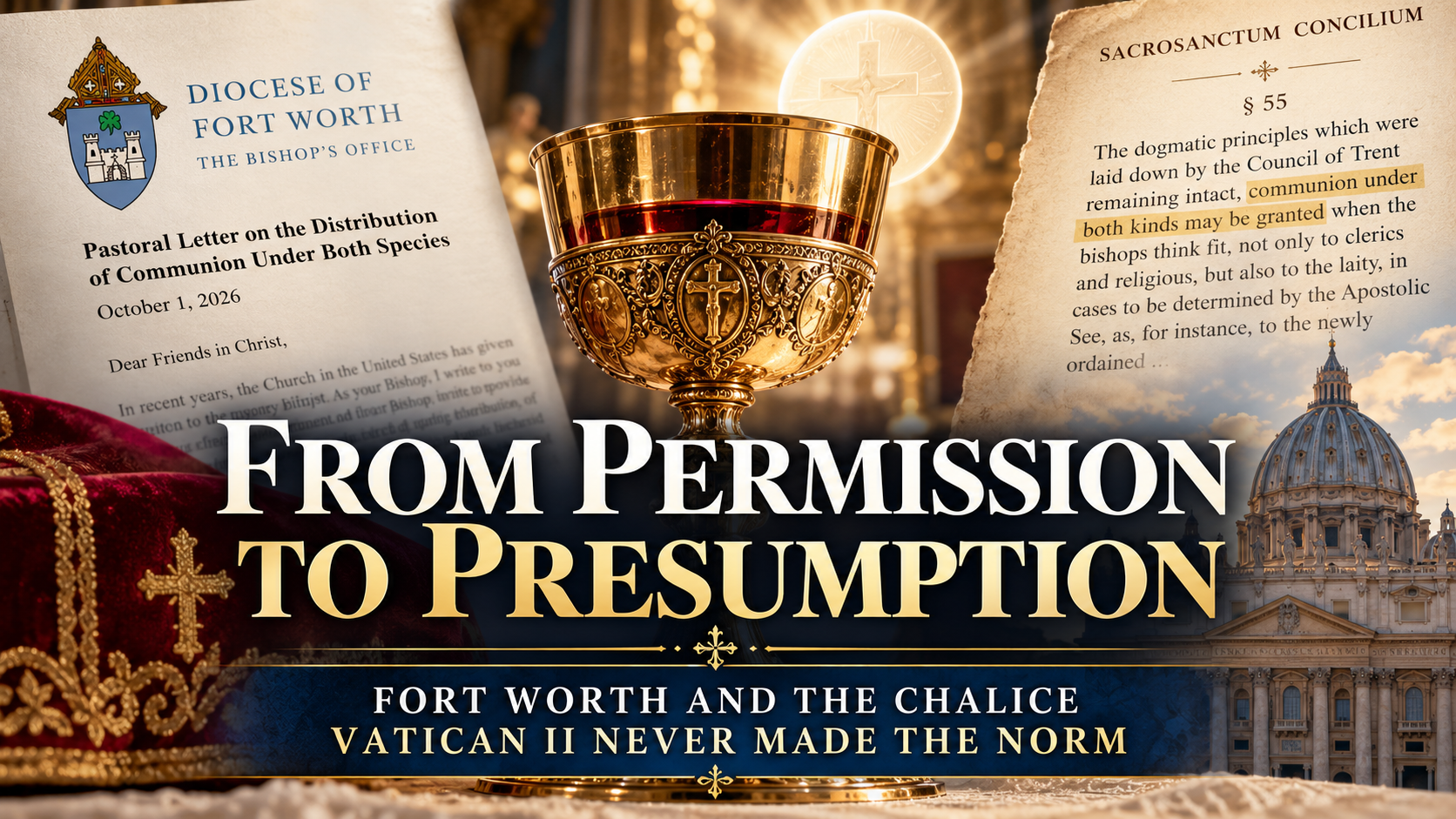
- FROM PERMISSION TO PRESUMPTION: Fort Worth and the Chalice Vatican II never made the NormBishop Michael Olson has implemented strict limitations on the distribution of Communion under both species in the Diocese of Fort Worth, prompting a discussion on the historical evolution of liturgical practices following Vatican II. This decision aims to reaffirm the doctrine of the Eucharist, emphasising that Christ is fully present under either species, while addressing misconceptions surrounding modern practices.
- AUGSBURG 2030: Can Rome commemorate a Confession it once confuted?Pope Leo XIV aims to revitalise the ecumenical spirit of the Augsburg Confession for its 2030 anniversary. However, historical responses from Rome highlight significant doctrinal differences between Catholics and Lutherans. True reconciliation must acknowledge these unresolved issues, as merely celebrating commonality risks glossing over critical theological distinctions that led to the Reformation.
- Today’s homily: St BrunoThe text reflects on Saint Bruno’s journey towards a life of solitude, prayer, and contemplation, emphasising the importance of genuine pursuit of God amidst distractions. It highlights that true spiritual growth requires silence and self-examination, urging believers to reclaim quiet moments for reflection, repentance, and devotion in daily life.
CURRENT EDITION


Today’s Mass Propers
- Today’s Mass: October 07 Pope St Mark, Confessor
 St Mark’s brief pontificate teaches that God measures fidelity, not duration or worldly achievement. Christ alone possesses the everlasting priesthood; His servants are stewards of what they have received. With the commemorated martyrs, St Mark reminds us to persevere faithfully, so that when the Lord comes, He finds us “so doing.”


Leave a Reply