
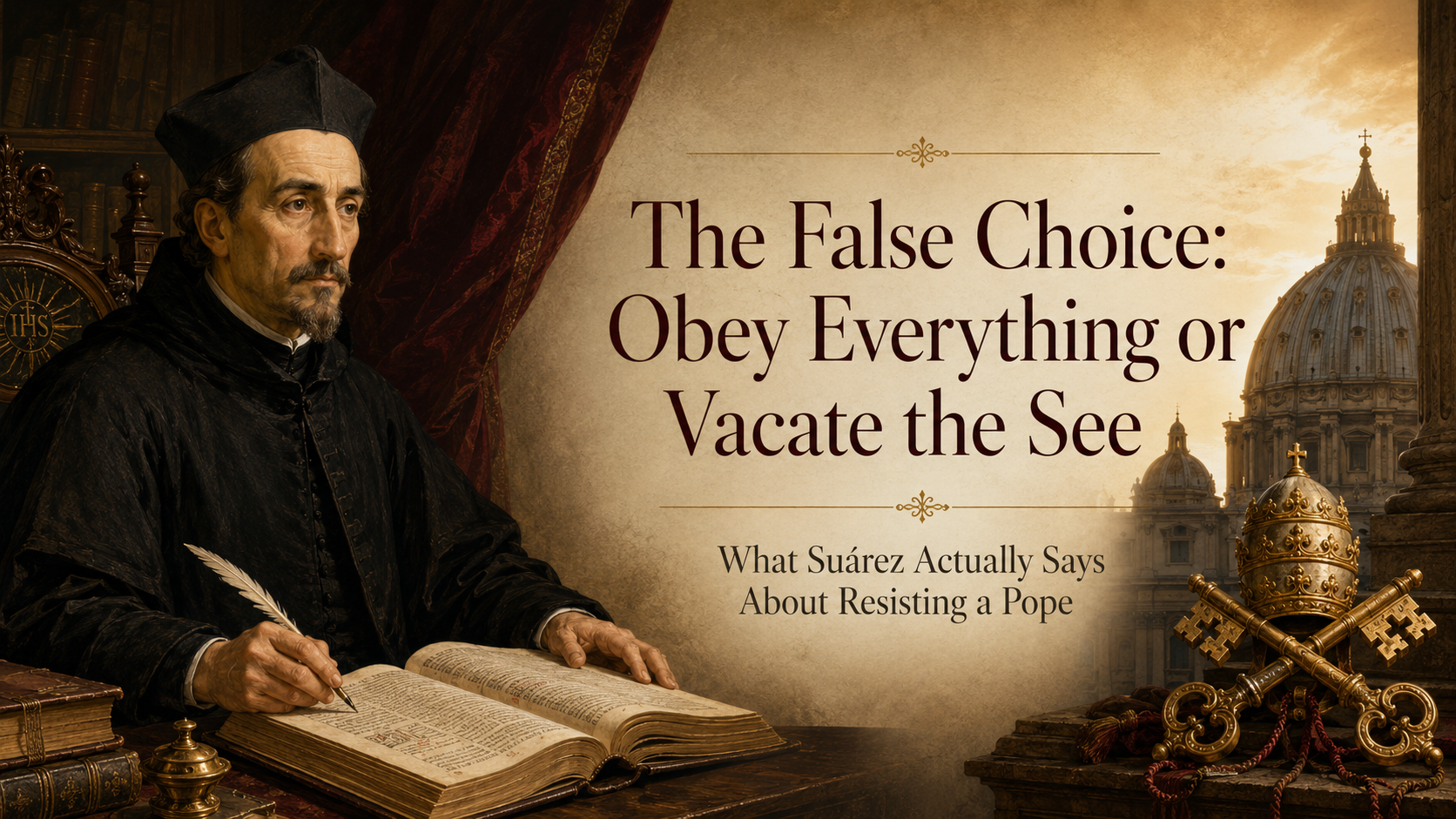
The False Choice: Obey Everything or Vacate the See: What Suárez Actually Says About Resisting a Pope
The WM Review has returned to Francisco Suárez in an attempt to show that the classical theology of resistance gives no support to Catholics who recognise the Roman Pontiff while resisting particular acts judged gravely harmful to the Faith. Yet the argument succeeds only by introducing into Suárez distinctions which he does not himself make, and by presenting Catholics with a choice which the older theology does not impose: either the act of a recognised Pope must be accepted, or the man responsible for it must cease to be recognised as Pope. Suárez offers a more difficult answer. Papal authority is real; subjects possess no jurisdiction over the Pope; yet an abuse of authority can, in exceptional and manifest circumstances, be resisted without the office itself being denied.

There is much to welcome in The WM Review’s determination to go back to the sources. Traditionalist controversy has not always been helped by quotations from Bellarmine, Cajetan or Suárez passing from one polemical work to another until context disappears and a few famous sentences are expected to settle questions their authors never directly considered. Anyone who insists that these theologians be read in full performs a service. But the obligation to respect context cuts both ways. A quotation should not be detached from its setting; neither should a restriction be attached to it which its author does not state. In the present case, The WM Review acknowledges that Suárez permits resistance and then constructs an argument by which the permission is narrowed until it supposedly becomes irrelevant to “recognise and resist”. The difficulty is that the final restriction belongs largely to the commentary, not to Suárez.
The passage itself is remarkably plain. Suárez is considering what remedies remain when a Roman Pontiff behaves wickedly. He has already defended papal supremacy in the strongest terms and denied that subjects possess coercive jurisdiction over the Pope. Yet from this he does not conclude that every exercise of papal will must simply be allowed to take effect. He permits private correction and, where scandal is public, public admonition offered with due reverence and humility. He then considers resistance. If the Pontiff uses unjust physical force, that force may be resisted defensively. If the violence is spiritual — “commanding iniquity, or profaning sacred things, or destroying them” — Suárez says that he may likewise be resisted proportionately by taking measures to prevent such things being carried into execution. He immediately adds the safeguards: the circumstances are rare, the facts must be utterly evident, and the response is defensive rather than punitive.
That distinction is decisive. The Pope remains Pope; the subject remains a subject; no new jurisdiction appears in the person resisting him. Suárez explains that defensive resistance does not require superior authority because it is not an act of punishment. The inferior does not judge the Pope, remove him, usurp his office or establish himself as an alternative source of ecclesiastical authority. He prevents a particular harm from being accomplished. The theological possibility of resistance therefore depends precisely upon separating the office from a particular exercise of the office, and separating defence against an act from jurisdiction over the person who commands it. If one begins by declaring those distinctions impossible, Suárez becomes difficult to explain; if one allows Suárez to speak for himself, they are the architecture of his argument.
That is why the headline conclusion that his “resistance quotes” do not help recognise-and-resist is too sweeping. They certainly do not justify every modern application made in their name. Suárez supplies no licence for habitual suspicion of Rome, no principle by which every papal utterance is submitted to an individual Catholic’s private tribunal, and no warrant for refusing authority whenever obedience becomes inconvenient. His conditions are exacting because resistance is exceptional. But to say that a principle has demanding conditions is not to say that the principle does not exist. Suárez places limits upon resistance because there are circumstances in which resistance is lawful.
The principal means by which The WM Review attempts to remove the contemporary relevance of the passage is its distinction between papal commands and papal laws. Commands, it argues, belong to dominative power and are not guaranteed against error; universal laws belong to legislative power and enjoy the Church’s protection against harmful universal discipline. Therefore a theologian who permits resistance to an unjust command cannot simply be invoked to justify resistance to universal ecclesiastical legislation. There is a genuine theological issue here. Catholic doctrine does not allow universal ecclesiastical discipline to be treated as though the Church could bind the whole faithful to something intrinsically contrary to faith or morals. But it does not follow that Suárez himself makes the particular juridical distinction upon which The WM Review’s dismissal depends.
His language in the disputed passage is concerned primarily with the nature of the harm: wicked things being commanded, sacred things being profaned, sacred things being destroyed. He permits proportionate action to prevent their execution. He does not add that the principle ceases to apply if the command is conveyed through one juridical instrument rather than another. The distinction between a particular precept and a universal law may well affect whether a specific modern appeal to Suárez succeeds; indeed, in some cases it may be decisive. But that argument must be made independently and with precision. It cannot simply be inserted into Suárez and then attributed back to him as though he had said, “Resistance is possible, except whenever the harmful act takes legislative form.” He says no such thing.
There is a wider problem here which Nuntiatoria has addressed repeatedly in examining the post-conciliar settlement. The words “papal authority” do not designate a single undifferentiated category of act. A dogmatic definition, an act of the authentic but non-definitive Magisterium, a universal disciplinary law, a particular decree, a curial instruction, an administrative restriction, an appointment, a permission, an interpretation and a prudential act of government do not all possess the same theological note merely because they can ultimately be traced to Roman authority. This was part of the point made in “Reverence Cannot Rewrite History — Leo XIV and the Unanswered Question of Liturgical Reform.” Vatican II ordered liturgical reform; it did not itself compose every feature of the Missal subsequently promulgated. It permitted wider use of the vernacular while commanding the preservation of Latin; it gave Gregorian chant pride of place; it did not mandate versus populum celebration; it did not itself compose the new Offertory or require the particular practical settlement which followed. One cannot defend sixty years of subsequent ecclesiastical government simply by placing every disputed act under the heading “the Pope legislated” and treating the theological analysis as finished.
The same principle underlay Nuntiatoria’s recent treatment of the SSPX controversy. The issue has never been whether papal authority exists, nor whether a lawful command carries a serious presumption in favour of obedience. The question is whether the mere existence of the command settles every antecedent question concerning necessity, the salvation of souls, the preservation of received sacramental and doctrinal goods, and the moral possibility of compliance. To say that resistance can sometimes be justified is not to say that the resister possesses authority over the superior. That would collapse the very distinction Bellarmine and Suárez preserve. The question is whether a particular command may be resisted while the authority which issued it continues to be recognised. Suárez’s answer, in principle, is plainly yes.
The second strand of The WM Review’s argument is therefore more important. It says, correctly, that Suárez treats heresy differently from other papal abuses. A Pope who is personally wicked does not thereby cease to be Pope; a Pope who becomes a heretic raises the separate question of loss of office. Suárez writes that Christ provided a remedy for such a case, giving the Church the capacity to take cognisance of the crime, declare it, and pronounce the divine deposition following from it. From this The WM Review concludes that those who allege doctrinal heresy should not continue recognising and resisting the Pope but should instead pursue the logic of deposition.
At first sight this appears to close the escape route. In fact it opens the most difficult question of all: who determines that the Pope has become a heretic in the juridically relevant sense, and when does that determination become operative for the Church? Suárez does not say that every Catholic who becomes morally certain of papal heresy is thereby authorised to treat the Apostolic See as vacant. He speaks of the Church taking cognisance of the offence, and elsewhere in the same discussion insists that the Church possesses no coercive authority over the Pontiff while he remains truly Pope unless he has first fallen from the pontificate, including through heresy juridically declared by the Church.
That distinction cannot be brushed aside. Recognising that a proposition is heretical is not the same thing as possessing jurisdiction to make the loss of the papal office a publicly determinative fact for the whole Church. A layman may reason; a priest may reason; a bishop may reason; a theological journal may reason. None becomes by that fact the ecclesiastical authority whose judgement constitutes the juridical order of the Church. The problem is not solved by saying that the Pope automatically loses office and that everyone else merely “recognises” what has already happened, because Suárez himself does not leave the Church without a role in cognisance and declaration. The moment one asks how the alleged loss of office becomes certain and binding for the Church as a visible society, the tidy alternative between obedience and vacancy becomes considerably less tidy.
This bears directly upon the recent Nuntiatoria discussion of the Cassiciacum Thesis and the wider philosophy of authority. A theory may offer an ingenious theological account of why a claimant appears to occupy the Roman See while lacking the formal authority ordinarily attached to it. Yet unless it can explain how that condition is publicly known, by whom it is determined, and how jurisdiction, visibility, apostolic succession and the machinery of papal election continue to operate, the juridical problem has not disappeared. It has merely been moved from one place to another. The same is true here. “He should be deposed” is not an answer to the Catholic who asks what he is bound to do before the Church has established that deposition, especially when the immediate question concerns cooperation with an act believed gravely harmful.
This exposes what is perhaps the deepest weakness in the argument against recognise-and-resist: the alternatives offered are generated by an unexpectedly maximalist view of papal authority. The papal positivist says, in effect, that because a true Pope has done something, the thing must be defensible as an exercise of Catholic authority. The sedevacantist observes an act which he believes cannot possibly be defended and answers that the man responsible therefore cannot truly possess the papal office. Their conclusions are radically opposed, but they can begin from the same exaggerated premise: that possession of the papal office guarantees the rectitude or safety of virtually every significant exercise of papal government. One then saves the act because of the office; the other denies the office because of the act.
The older theology is more discriminating. A Pope may sin, scandalise, govern badly, act imprudently, misuse authority and require correction without the papacy ceasing to exist. Suárez could hardly have written of public admonition, unjust papal violence and the profanation or destruction of sacred things if the mere possession of the office rendered such abuses conceptually impossible. The divine guarantees attached to the Roman See are real and indispensable, but they have objects and limits. Vatican I did not define papal impeccability, nor did it turn every administrative, disciplinary, prudential or non-definitive act into an irreformable exercise of the Magisterium. To defend the papacy by inflating those guarantees beyond what the Church claims for them is not ultramontane fidelity; it risks creating the very argument by which the papacy is subsequently declared absent.
Here Nuntiatoria’s recent motto Accipere, non fingere — to receive, not to invent is particularly apposite. The principle applies to papal authority no less than to doctrine. Catholics receive the Petrine office as Christ instituted it; we do not improve upon it by imagining an authority more absolute than the Church herself teaches. Equally, we receive the Church as a visible juridical society; we do not repair an ecclesiastical crisis by privately assuming powers of determination which Christ did not give us. Tradition constrains both instincts. It forbids us to reduce obedience to papal will, and it forbids us to make private judgement the tribunal which determines whether the Roman See exists.
None of this makes recognise-and-resist easy. Indeed, the strongest objection to the position remains the extraordinary duration of the present crisis. Suárez envisages rare circumstances in which the facts are utterly evident. A condition in which resistance appears necessary across decades, pontificates and whole areas of ecclesiastical life raises grave ecclesiological questions. Traditionalists should not evade them. If resistance becomes the normal rather than exceptional posture of Catholic life, something is profoundly disordered, and merely repeating “Bellarmine permits resistance” is not an adequate account of that disorder. The challenge concerning indefectibility, universal discipline, ordinary papal teaching and ecclesiastical visibility remains real.
But recognising the abnormality does not make the alternative offered by The WM Review logically necessary. The persistence of a crisis cannot confer jurisdiction upon those who do not possess it. Nor can the difficulty of explaining prolonged resistance transform every disputed exercise of papal authority into something which must be obeyed simply because the opposite conclusion would be uncomfortable. Catholic theology is not required to choose between two inadequate simplifications merely because the middle ground is harder to inhabit.
The true contribution of Suárez is precisely that he preserves this difficult ground. He combines an exceptionally strong doctrine of papal supremacy with the admission that a Pope may need correction and, in extreme circumstances, resistance. He denies inferiors coercive jurisdiction while allowing defensive action against harm. He treats heresy as a separate question bearing upon the office itself, yet gives the Church a role in recognising and declaring that condition. These distinctions are not accidental remnants which have to be explained away before his theology becomes coherent. They are how his theology remains coherent.
The WM Review is therefore right about one important thing: traditionalists should stop using Suárez as though a single quotation settled every dispute with Rome. The conditions matter. The character of the papal act matters. The distinction between universal law and particular command matters. The difference between resistance, disobedience, schism and usurpation matters. The gravity and manifest character of the alleged evil matter. Anyone appealing to Suárez assumes the burden of showing that his case actually falls within the principle Suárez describes.
But once all those qualifications are admitted, the article’s conclusion still does not follow. Suárez limits resistance because resistance is possible. He distinguishes resistance from coercion because the two are not the same. He treats heresy separately because loss of office is not simply another form of refusing a harmful command. And he gives the Church a role in the juridical recognition of papal heresy because the theological perception of an individual Catholic does not itself constitute ecclesiastical jurisdiction.
The choice is therefore not “obey everything or vacate the See”. That is the false dilemma. Catholic tradition offers a harder discipline: recognise the authority Christ has established without converting it into absolutism; distinguish carefully among the acts by which that authority is exercised; presume in favour of obedience without pretending that obedience can make evil good; correct with reverence where correction is warranted; resist only where the harm is grave, manifest and the response proportionate; and do not mistake resistance to an act for jurisdiction over the officeholder.
That position will satisfy neither those who want every Roman act vindicated because Rome issued it nor those who want every apparent contradiction resolved by declaring that Rome has ceased to possess authority. It was never intended to satisfy either. It exists because Catholic ecclesiology is more exacting than both.
And on the question actually before us, Suárez is quite clear. A true Pope can, in an exceptional case, be resisted without the resister thereby becoming his judge. The WM Review has not disproved that principle. By publishing the text in full, it has placed the evidence for it before its own readers.
¹ The WM Review, “Suárez’s ‘resistance quotes’ don’t help the ‘recognise and resist movement’ either,” particularly its argument distinguishing commands from universal laws and its conclusion concerning the contemporary application of Suárez.
² Francisco Suárez SJ, Defensio Fidei Catholicae et Apostolicae adversus Anglicanae Sectae Errores, Book IV, chapter VI, on private and public admonition, just defence and resistance to spiritual violence; text reproduced by The WM Review.
³ Suárez’s account of the Roman Pontiff’s exemption from coercive ecclesiastical jurisdiction and the distinction concerning a Pope who has first ceased to hold office through renunciation or heresy juridically declared.
⁴ Suárez on papal heresy, the Church taking cognisance of the crime, declaratory sentence and consequent divine deposition.
⁵ Nuntiatoria, “Reverence Cannot Rewrite History — Leo XIV and the Unanswered Question of Liturgical Reform,” August 2026.
⁶ Nuntiatoria, recent analysis of the Cassiciacum Thesis and the philosophy of authority, August 2026.
⁷ Nuntiatoria, “The SSPX Is Not Really on Trial — The Post-Conciliar Settlement Is,” August 2026.
⁸ Nuntiatoria CXIX, Accipere, non fingere, 16 August 2026.
RELATED ARTiCLES


LATEST ARTICLES
- Omnia autem probate: quod bonum est tenete ~ Prove all things; hold fast that which is good: Spiritual Conference for Nuntiatoria CXXVIThe conference reflects on St Paul’s assertion to “prove all things” in relation to self-judgement and the Church. It explores themes of synodality, ecumenism, and the importance of discernment, emphasising the need for humility in understanding truth and the challenge of maintaining genuine holiness in the midst of contemporary ecclesiastical crises.
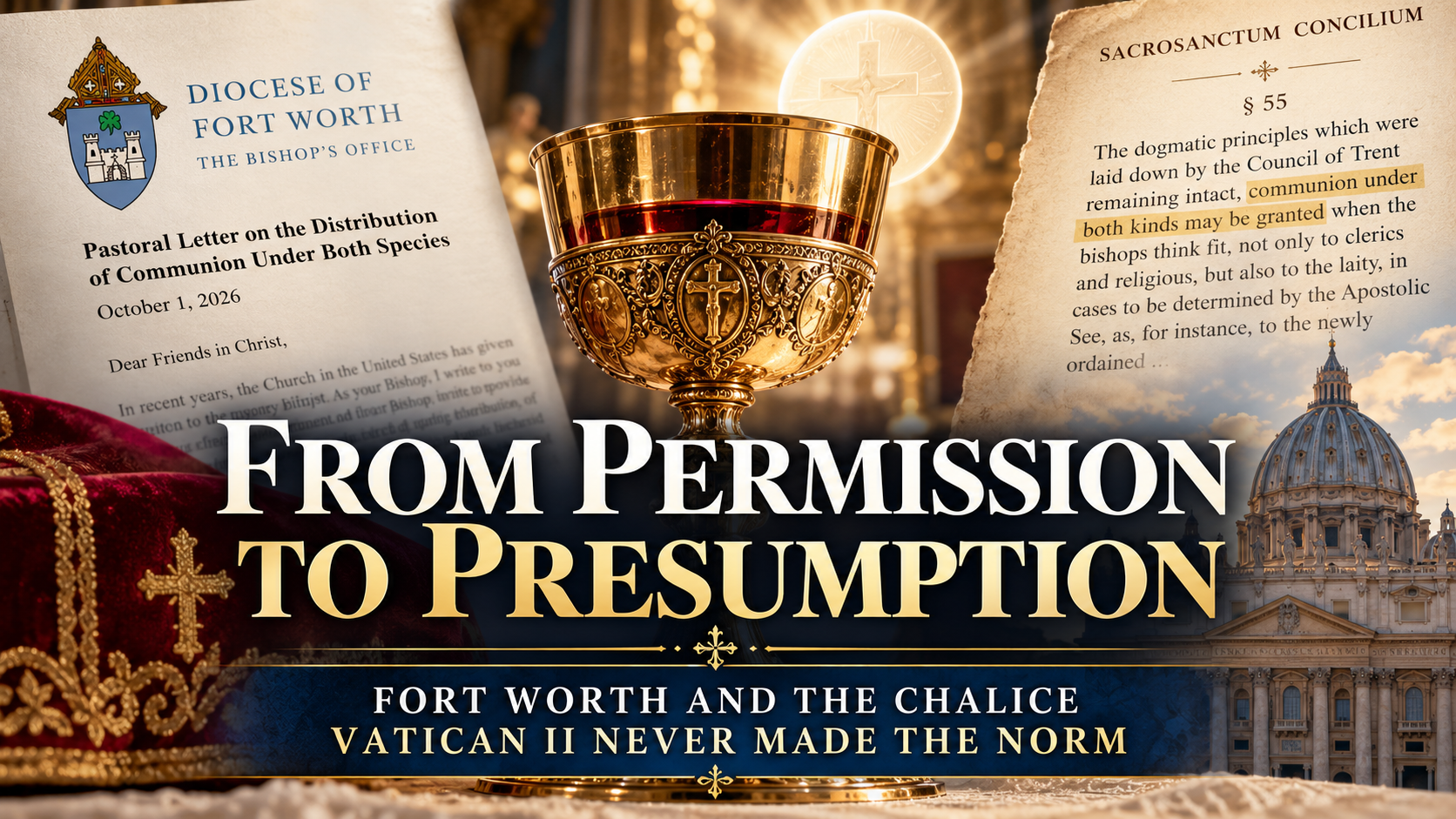
- FROM PERMISSION TO PRESUMPTION: Fort Worth and the Chalice Vatican II never made the NormBishop Michael Olson has implemented strict limitations on the distribution of Communion under both species in the Diocese of Fort Worth, prompting a discussion on the historical evolution of liturgical practices following Vatican II. This decision aims to reaffirm the doctrine of the Eucharist, emphasising that Christ is fully present under either species, while addressing misconceptions surrounding modern practices.
- AUGSBURG 2030: Can Rome commemorate a Confession it once confuted?Pope Leo XIV aims to revitalise the ecumenical spirit of the Augsburg Confession for its 2030 anniversary. However, historical responses from Rome highlight significant doctrinal differences between Catholics and Lutherans. True reconciliation must acknowledge these unresolved issues, as merely celebrating commonality risks glossing over critical theological distinctions that led to the Reformation.
- Today’s homily: St BrunoThe text reflects on Saint Bruno’s journey towards a life of solitude, prayer, and contemplation, emphasising the importance of genuine pursuit of God amidst distractions. It highlights that true spiritual growth requires silence and self-examination, urging believers to reclaim quiet moments for reflection, repentance, and devotion in daily life.
- Today’s Mass: October 06 St Bruno, ConfessorSaint Bruno, born in 1030 in Cologne, founded the Carthusian Order, embracing solitude and prayer. After studying theology and serving as a chancellor, he established a hermitage in the Chartreuse Mountains, combining hermitic and monastic lives. Bruno died on October 6, 1101, leaving a legacy of asceticism and contemplation.
CURRENT EDITION


Today’s Mass Propers
- Today’s Mass: October 06 St Bruno, Confessor
 Saint Bruno, born in 1030 in Cologne, founded the Carthusian Order, embracing solitude and prayer. After studying theology and serving as a chancellor, he established a hermitage in the Chartreuse Mountains, combining hermitic and monastic lives. Bruno died on October 6, 1101, leaving a legacy of asceticism and contemplation.

Leave a Reply