
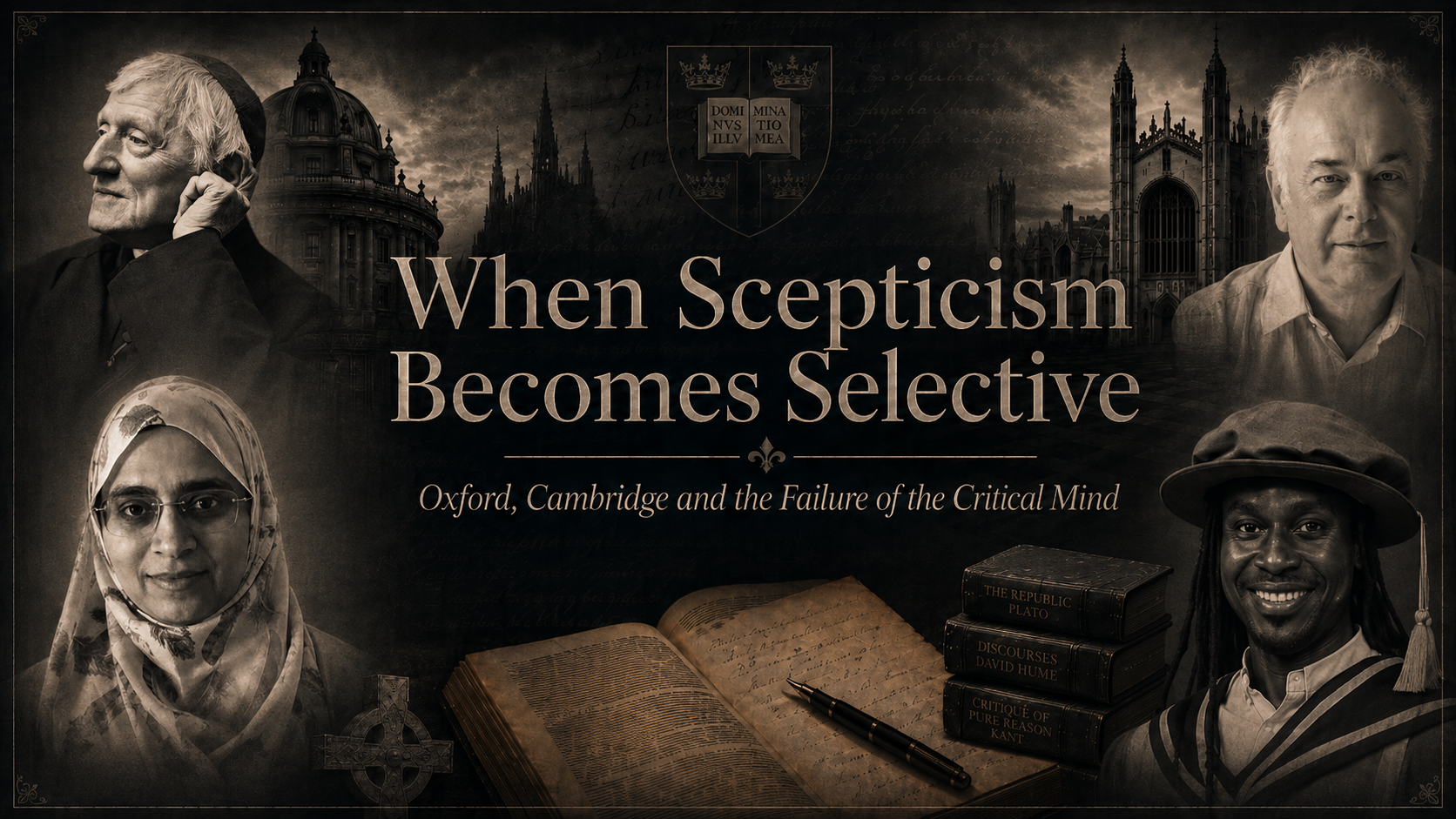
When Scepticism Becomes Selective: Oxford, Cambridge and the Failure of the Critical Mind

Cambridge has spent eight centuries teaching men and women to distinguish an argument from an assertion, evidence from reputation and truth from fashionable opinion. Its present difficulty is that the University increasingly appears less certain that the same standards of scrutiny should be applied to everyone. Three recent controversies, very different in themselves, point towards the same institutional temptation. The questions raised about Professor Jason Arday concern the relationship between academic judgment and an appointment invested with enormous symbolic importance. The earlier writings of Dr Farah Ahmed raise the question whether profoundly anti-Western ideas associated with a minority religion receive the same critical examination routinely applied to Christianity and the Western intellectual inheritance. The employment tribunal won by Professor Neil Wyn Evans exposes something harder still: an institution capable of becoming more concerned with the inconvenient questioner than with the questions he has asked. Taken together, they suggest a problem deeper than any fashionable argument about “wokeism”. It is the replacement of universal scepticism by selective scepticism.
The Jason Arday affair must now be approached with particular care because Arday died suddenly on 14 August, aged forty-one, shortly after resigning from Cambridge. He had denied allegations of plagiarism and dishonesty; the Metropolitan Police said that his death, though unexpected, was not being treated as suspicious, and his family spoke of the immense damage caused by what it described as a campaign of misinformation and harassment.¹ Christian charity excludes triumphalism over a dead man and demands consideration for those who mourn him. It does not, however, require an institution to abandon questions which it had already accepted were sufficiently serious to investigate. Cambridge had begun examining the circumstances surrounding Arday’s appointment and his subsequent time within the Faculty of Education before his death. Those questions now require greater sobriety, not less seriousness.
The institutional question matters precisely because Arday’s appointment was never presented simply as the filling of another professorial chair. When he joined Cambridge in 2023 at the age of thirty-seven he was celebrated as the youngest Black professor in the University’s history, and his extraordinary personal story became inseparable from the public meaning attached to his appointment. None of that demonstrates that Cambridge appointed him because of his race, nor does it establish that academic standards were consciously lowered. Such conclusions would have to be proved rather than insinuated. Yet it would be equally foolish to pretend that symbolic significance can never affect institutional judgment. Once an appointment becomes evidence of the university’s own moral progress, the institution acquires a stake in the story it has told. Criticism of the scholar can then begin to feel like criticism of the principle he has come to represent. The person becomes a symbol; the symbol becomes an institutional asset; and asking whether the original judgment was sound becomes progressively more difficult.²
That is exactly the moment at which a university ought to become suspicious of itself. Universities exist because clever people can be wrong, prestigious authorities can make bad judgments, attractive stories can prove untrue and entire intellectual fashions can rest upon assumptions nobody thought to examine. It would therefore be inadequate for the Cambridge inquiry merely to establish that appointment procedures were formally observed. The more serious questions concern judgment itself. How closely was the scholarship examined? What claims were independently verified? What contrary evidence was available? Were weaknesses explored with the same determination that would have been applied to a candidate whose appointment carried no wider political or representational significance? None of these questions is hostile to racial equality. Quite the reverse. A Black professor has the same right as every other professor to have his achievements taken seriously enough to be judged according to the same standards. To suspend scrutiny because scrutiny might be interpreted as prejudice would not constitute equality. It would turn the scholar into a mascot.
The case of Dr Farah Ahmed reveals the complementary danger. Ahmed, now an Assistant Research Professor in Cambridge’s Faculty of Education, was formerly associated with Hizb ut-Tahrir and contributed to writings first published in 2002 which presented Western education as damaging to Muslim identity, criticised integration and democracy, and objected to parts of the British curriculum on the ground that they imparted concepts and values contrary to Islam. Important qualifications belong beside those facts. Hizb ut-Tahrir was not then a proscribed organisation in Britain; it was proscribed only in January 2024. Ahmed had also long since distanced herself from the organisation, telling the Charity Commission in 2010 that she had ceased involvement several years earlier and did not agree with all of its political views.³ Intellectual honesty requires those qualifications because chronology matters and people are capable of changing their opinions.
But intellectual honesty also requires the arguments themselves to be taken seriously. The issue is not whether Cambridge ought to employ a Muslim scholar who once belonged to a radical organisation. A university which admitted only persons with approved opinions would have solved the problem of intellectual conformity by embracing it. Nor does Ahmed’s earlier association establish what she believes today. The proper question is much simpler: are propositions hostile to Western liberal education examined with the same intellectual severity that Cambridge readily directs towards Christianity and the Western tradition? If a traditional Catholic academic argued that secular education embodied a false anthropology, that democracy cannot make a moral falsehood true by majority vote, that sexual morality is objectively given, that children should be formed according to received truth, and that contradictory religious claims cannot simultaneously be true in the same sense, nobody would suggest that these propositions should be exempted from scrutiny because they constituted an authentic expression of Catholic identity. His assumptions would be examined, his authorities questioned, his understanding of history disputed, his conception of power analysed. Quite right too. He should defend what he believes. The difficulty begins when criticism itself changes character according to the identity of the person whose beliefs are being criticised.
That is selective scepticism. Christianity may be dissected as a system of power while another religion is approached primarily as a protected identity. Western civilisation may be subjected to relentless genealogical suspicion while the assumptions of those who reject it are treated principally as expressions of an alternative cultural experience. A Christian moral judgment can be described as oppressive; an equally stringent judgment originating within a minority community may instead require sensitivity and contextualisation. The progressive academic and the Islamist do not therefore need to be ideological allies. On most fundamental questions they plainly are not. Their conceptions of sex, homosexuality, marriage, women, revelation, authority and society may be almost irreconcilable. The convergence occurs somewhere else: in an intellectual culture which has trained itself to regard the inherited assumptions of the West as proper objects of suspicion while becoming noticeably more cautious about applying the same suspicion to claims associated with minority identities.
The student culture of Oxford and Cambridge helps explain how this asymmetry can acquire considerable visibility without anything resembling a Muslim demographic majority. Oxford’s own 2024–25 figures show that Muslims constitute 5.5 per cent of the student population, compared with 23.5 per cent Christian and 48.5 per cent declaring no religion. The Muslim proportion has nevertheless risen steadily from 4.0 per cent in 2020–21, and Islam is now Oxford’s largest non-Christian religion.⁴ Oxford University Islamic Society, meanwhile, describes itself as one of the University’s largest student societies and claims a membership base exceeding 1,300. That membership figure is not a census of Muslim students and should not be treated as one; membership is broader than religious self-identification. What it demonstrates is something different and important: a relatively small religious minority possesses substantial associational infrastructure and a confident institutional presence.⁵
The importance of organisation becomes clearer when it is compared with the strikingly small electorates which govern prestigious student institutions. Arwa Elrayess won the Oxford Union presidency for Trinity 2026 in an election with 1,528 ballots cast; a later Union election received 1,073 ballots, of which 117 were excluded during verification, while an intervening re-poll attracted only 646.⁶ Cambridge provides an even more striking example. The Cambridge Union says that more than half the University’s student population holds life membership, yet Jack Peters won its Easter 2026 presidency with 182 votes against 92, in what Varsity described as the Union’s largest turnout in recent years.⁷ Cambridge Students’ Union has meanwhile described the Islamic Society as supporting a “strong and rapidly growing community of students”, awarding it Outstanding Contribution to University Life in 2023 after a year of extensive activity which included raising more than £46,000 during its charity week.⁸
None of this establishes Muslim control of either university or of either debating Union, and it would be irresponsible to infer anybody’s religion from a name on a committee list. What the evidence shows is far more ordinary and therefore more useful. Organisation magnifies influence. An institution whose active electorate numbers a few hundred or a thousand can be affected considerably by a cohesive constituency which joins, participates, recruits, campaigns and turns up. That is true of Muslims, socialists, Conservatives, environmentalists, evangelicals, Zionists, pro-Palestinian campaigners and every other organised campus constituency. University-wide population figures tell us how many people there are; they do not tell us who possesses the confidence or organisation to shape student debate. A minority does not need to become a majority before its concerns become culturally conspicuous.
There is consequently little sense in imagining Oxford and Cambridge as universities overwhelmed demographically by Islam. Oxford’s figures show the opposite. The more arresting fact is that Christians there still outnumber Muslims by more than four to one, yet no plausible observer would describe contemporary Oxford as an intellectually Christian institution. That tells us at least as much about Christian retreat as about Muslim confidence. Muslims who organise religiously, maintain communal structures and consider their faith important enough to shape their public lives are behaving like people who believe their religion to be true. The oddity lies rather with the heirs of a Christian civilisation who inherited its colleges, chapels, intellectual traditions and institutions and then learned to regard public confidence in Christianity as faintly embarrassing. If organised Islam sometimes appears more culturally confident than Christianity within institutions built by Christians, one might ask not merely how Islam became so visible, but why Christianity became so reticent.
This is not an argument for treating Islam as intellectually homogeneous. That would commit precisely the failure of discrimination being criticised. Islamic civilisation contains competing theological, philosophical, legal and mystical traditions. The familiar assertion that al-Ghazali simply extinguished Muslim reason is too crude: The Incoherence of the Philosophers is itself an exercise in sustained argument against propositions which al-Ghazali believed the philosophers had failed to demonstrate. Avicenna, Averroes, al-Ghazali, Ibn Khaldun and a twentieth-century Islamist revolutionary programme cannot be collapsed into a single phenomenon called “Islam” merely because doing so makes polemic easier. If we insist that universities distinguish Christianity from Christian nationalism, or Catholic doctrine from the conduct of individual Catholics, intellectual consistency requires equally careful distinctions between Islam, Islamism and the beliefs of particular Muslims.
The deeper issue is therefore not Islam, diversity or even “wokeism” as such. It is intellectual immunity. Modern academic culture has become exceptionally adept at uncovering the contingencies behind inherited claims. Canon, nation, sex, family, morality, religion and tradition are examined in relation to history, class, race, patriarchy, exclusion and power. Some of this inquiry has been genuinely valuable. Institutions do conceal interests; historical narratives do omit inconvenient evidence; received accounts can deserve revision. But the credibility of a critical method depends upon its willingness to turn upon itself. If everything may be interrogated except the assumptions according to which the interrogation is conducted, criticism has ceased to be universal. It has become an orthodoxy disguised as a method.
Allan Bloom saw an earlier stage of the problem in The Closing of the American Mind. His paradox was that an educational culture committed to limitless openness could eventually become remarkably closed. If the highest intellectual virtue consists in refusing to judge between competing conceptions of truth and goodness, the capacity for judgment itself begins to disappear. Yet relativism does not leave a society morally empty for long. Human beings continue to judge, condemn, praise and prohibit. What changes is the source of authority. Thus the university which became suspicious of inherited moral absolutes did not remain permanently sceptical. New certainties arose, accompanied by new taboos, approved vocabularies and hierarchies of innocence and guilt. Orthodoxy did not vanish. It migrated.
That is why contemporary academia can combine radical scepticism with striking moral dogmatism without experiencing the combination as contradictory. One inherited proposition must disclose the interests behind it; another is accepted as the testimony of lived experience. One claim must be deconstructed; another must be affirmed. One identity is treated as possessing power and therefore deserving suspicion; another as lacking power and therefore deserving protection. The question “Is this true?” is gradually preceded by another series of questions: Who said it? What identity does he possess? What effect will this proposition have upon a protected group? Does allowing it advance the institution’s declared commitments? Such questions may sometimes have legitimate relevance. They become destructive when they determine whether the question of truth itself may safely be asked.
The case of Professor Neil Wyn Evans demonstrates how easily that intellectual habit can cross from theory into administration. Evans, an astrophysicist at Cambridge’s Institute of Astronomy, made protected disclosures concerning what he believed to be the treatment of female staff. The Employment Tribunal was explicit that it was not conducting a public inquiry to determine whether the underlying allegations of misogyny and bullying were themselves proved. Its findings about Cambridge’s treatment of Evans were nevertheless severe. Eleven of fourteen alleged detriments were upheld. The tribunal found that Evans had been subjected to a nearly two-year investigation despite allegations against him containing scant particulars and no supporting evidence, while detailed concerns raised by him were dismissed without proper process. It described an “institutional mindset” in which he had come to be regarded as a source of difficulty and reputational risk, and criticised a recurring pattern in which correspondence and decisions nominally belonging to senior figures had effectively been produced by others.⁹
There is almost a parable of the modern university in that finding. An institution exists to inquire. A scholar raises awkward questions. The questions threaten institutional reputation. Gradually the person asking them becomes the problem. That pathology is not uniquely progressive and requires no theory of Muslim influence to explain it. Conservative institutions, corporations, governments and ecclesiastical bodies are perfectly capable of the same vice. It begins whenever preservation of the institution’s preferred account of itself becomes more important than discovering whether that account corresponds with reality. The critical faculty has then ceased to operate precisely where it is most needed: upon oneself.
Cambridge ought to know better because the intellectual inheritance it possesses is older than the fashionable theories now presented as though they invented critical thought. The University traces its origins to 1209. It was already three centuries old at the Reformation.¹⁰ The medieval university did not emerge because Christianity relinquished its hold upon reason; it emerged within Christian civilisation and developed methods of intellectual combat whose rigour remains impressive. The scholastic quaestio and disputatio required propositions to be stated, objections to be heard, distinctions to be made and contrary arguments to be answered. The method of St Thomas Aquinas is almost provocatively confident: videtur quod—“it seems that”—introduces the case against the position which will eventually be defended. The objection comes first because truth does not need to be protected from encountering an objection. One earns the right to answer only after the objection has been heard.
John Henry Newman supplies the indispensable modern development of that tradition. In The Idea of a University, born from his attempt to articulate what a Catholic university ought to be, Newman insists that education is not simply the accumulation of useful information. Its proper object is the cultivation of the intellect itself: a mind trained to see things in relation, to distinguish, compare, analyse and judge. Knowledge possesses a unity because truth possesses a unity. For Newman, therefore, the exclusion of theology from the university is not an act of neutrality. If God exists and theology concerns real knowledge, to exclude it is to mutilate the intellectual whole and consequently distort the other disciplines by pretending that a part of reality does not exist.¹¹ His principle extends beyond the immediate theological controversy. Every university begins to falsify reality when it decides in advance that certain questions, explanations or fields of truth may not enter the intellectual whole. Ideology does precisely what Newman’s university must not do: it begins with the approved conclusion and arranges the fragments of knowledge around it. Liberal education, properly understood, enlarges the mind so that it can encounter the whole, perceive relationships between its parts and judge competing claims without being imprisoned within one fashionable system.
Newman’s point goes deeper still. The educated mind is not simply a well-stocked memory. It has acquired what he calls an enlargement or illumination of the intellect: the ability to apprehend the bearing of one thing upon another and to assign each claim its proper place. That is why a genuinely liberal education produces intellectual discrimination rather than merely information. It teaches a man not simply what to think but how to recognise the relative weight of arguments, how to distinguish what is central from what is incidental, and how to resist being carried away by the immediate prestige of a theory, personality or cause. The selective scepticism of the contemporary university is therefore not merely politically objectionable. In Newman’s terms it represents a failure of education itself, because an intellect trained to scrutinise one class of propositions mercilessly while insulating another from equivalent scrutiny has not been enlarged. It has simply acquired a new set of prejudices.
This is precisely where the Catholic intellectual tradition offers something more robust than either fashionable relativism or religious obscurantism. Catholicism possesses dogmas, but it has never therefore concluded that reason is useless. Leo XIII’s Aeterni Patris called Catholic scholarship back to the example of the Fathers and Doctors who examined the ancient philosophers, preserved what was true in them, corrected what was false and brought philosophical reason into ordered relationship with revelation. The Pope’s point was not that faith should replace thought, but that faith and sound reason cannot finally be enemies because truth cannot contradict truth.¹² Newman and Leo XIII approach the question from different directions but arrive at the same intellectual confidence: truth forms a whole, reason has a genuine vocation within that whole, and revelation does not require the destruction of the intellect which receives it.
That conviction changes the meaning of criticism. If objective truth does not exist, argument ultimately becomes a contest between perspectives, interests and identities, with institutional power deciding which interpretation prevails. But if reality exists independently of our desire that it should be otherwise, then criticism becomes an act of humility. Evidence can defeat us. Facts can embarrass our friends. A hostile witness may be correct. A fashionable theory may be nonsense. A proposition stated by somebody whose politics we detest may be true, while one advanced by somebody whose cause we admire may be false. The scholar does not confer truth upon reality by approving it. He receives what is there and disciplines his judgment accordingly.
This is also why the reaction against ideological academia must not reproduce the same vice in reverse. Jason Arday’s case cannot justify treating Black academics as presumptive diversity appointments. Farah Ahmed’s history cannot justify treating Muslim academics as concealed Islamists. An Islamic Society’s membership cannot be converted automatically into a political bloc, nor can the religion of a debating-union officer be divined from his surname. The answer to identity politics is not counter-identity politics. It is the restoration of standards which do not change according to identity. A poor argument remains poor when made by a white man; a sound argument remains sound when made by a Muslim woman. Plagiarism does not alter its definition according to race. Logic has no ethnicity. Evidence does not acquire or lose weight according to the identity of the person presenting it. Truth possesses no demographic constituency.
Oxford and Cambridge therefore do not suffer from an excess of Muslims, minorities or women. They suffer from an insufficiency of intellectual nerve: too little willingness to subject every claim, from every quarter, to the same uncompromising standard. If Islamism advances propositions about Western society, scrutinise them. If progressive theory explains Western society as an architecture of oppression, scrutinise that too. If a Catholic asserts that liberal secularism rests upon a false conception of man, demand his arguments and scrutinise them. If an institution congratulates itself upon an appointment, an equality programme or a disciplinary process, examine those claims with particular severity because institutions are notoriously poor judges of their own virtue. Nobody should possess a protected proposition.
The irony is that this universalism is much closer to the intellectual inheritance of medieval Christendom than to the contemporary academy’s elaborate vocabulary of inclusion. To discriminate, in its older and necessary intellectual sense, is to distinguish: evidence from assertion, argument from biography, Islam from Islamism, scholarship from reputation, offence from falsehood, compassion from credulity. Newman understood that such discrimination is not an unfortunate by-product of education but one of its achievements. An educated man has not merely learned more things. He has learned how to judge what he knows. Education without this faculty is impossible. The remedy for unjust discrimination is therefore not the abolition of discrimination in the intellectual sense, but its purification: the restoration of judgments based upon what is true rather than upon who has spoken.
There is an older principle for all of this: Accipere, non fingere—to receive, not to invent. Reality precedes the theory constructed about it. Evidence precedes the conclusion. Truth precedes the institution’s need for a convenient narrative. Newman’s insistence upon the unity of knowledge belongs naturally here: reality cannot finally be divided into permitted and forbidden compartments without falsifying the whole. The scholar’s task is not to discover the answer which his political tribe, religious community or university administration requires, but to submit himself to what is there. Sometimes what is there will vindicate the people we admire. Sometimes it will vindicate those we dislike. Sometimes it will show that our suspicions were unjustified. Sometimes it will expose something we would desperately prefer not to know. None of those possibilities changes the obligation.
That is the crisis now confronting Cambridge, and Oxford should recognise it as its own. The issue is not whether these universities contain too many Muslims or too many progressives. It is whether institutions founded upon the disciplined pursuit of truth can still tolerate the application of one intellectual standard to everyone. The test of critical thinking is not how ruthlessly one can dissect the beliefs of an unfashionable opponent. It is whether one will apply the same blade to the ideas, identities, people and institutions one most wants to protect.
Oxford and Cambridge were formed within a civilisation convinced that truth was real and that the human intellect was capable of seeking it. Newman, looking at the university from within that same civilisation, understood that its noblest achievement was a mind sufficiently formed to apprehend truth in its relations and to judge accordingly. These institutions will deserve that inheritance only if they recover the courage which selective scepticism has steadily eroded: the courage to say that propositions can be true or false, arguments strong or weak, evidence sufficient or insufficient, and that neither institutional reputation nor minority status nor fashionable ideology possesses a veto over the question.
A university does not close its mind when it admits people who believe strange or radical things. That is often when university life becomes interesting. It closes its mind when it decides that some of those things may no longer be examined by the standards applied to everything else. The question Oxford and Cambridge must recover is therefore neither complicated nor new.
Is it true?
Everything else follows from having the courage to ask it.
- Reuters, “Jason Arday, ex-Cambridge professor at centre of plagiarism scandal, found dead”, 14 August 2026; reporting the circumstances of his death, the Metropolitan Police statement and his family’s response.
- University of Cambridge, Faculty of Education, announcement of Jason Arday’s appointment, 2023; University of Cambridge, statement of the Vice-Chancellor concerning investigation of the circumstances of his appointment and subsequent time at Cambridge, 12 August 2026.
- The Times, reporting on Farah Ahmed’s contribution to Education and Identity and her former association with Hizb ut-Tahrir, 11 August 2026; Charity Commission investigation concerning the Islamic Shakhsiyah Foundation, 2010; Home Office, proscription of Hizb ut-Tahrir, effective 19 January 2024.
- University of Oxford, Equality, Diversity and Inclusion Report 2024–25, student religion data, Figure 37.
- Oxford University Islamic Society, current institutional information describing its membership base and activities.
- The Oxford Student, reports on the Oxford Union elections for Trinity 2026 and Hilary 2027 and the intervening re-poll, 2025–26.
- Cambridge Union Society, membership information; Varsity, report on the election of Jack Peters as Easter 2026 President of the Cambridge Union.
- Cambridge Students’ Union, Student Awards 2023, “Outstanding Contribution to University Life”, Cambridge University Islamic Society.
- Evans v The Chancellor, Masters and Scholars of the University of Cambridge and Others, Employment Tribunal, Case Nos. 3307960/2023, 3303874/2024 and 3311186/2024, Reserved Judgment, August 2026.
- University of Cambridge, official history of the University, recording the gathering of scholars at Cambridge from 1209.
- John Henry Newman, The Idea of a University, especially Discourses V–VII, on knowledge as its own end, the enlargement of the mind, the relation of the branches of knowledge to one another, and the necessity of theology within the university’s conception of universal knowledge.
- Leo XIII, Aeterni Patris, 4 August 1879.
RELATED ARTiCLES


LATEST ARTICLES
- Veritas non mutatur consensu ~ Truth is not altered by agreement: Spiritual Conference for Nuntiatoria CXXVThe text explores the theme of enduring truth amidst changing societal values, particularly within the Catholic faith. It emphasises that truth remains unchanged irrespective of popular opinion or individual feelings, urging believers to receive and embody divine teachings faithfully. The article concludes with a call to act upon this truth in daily life and relationships.
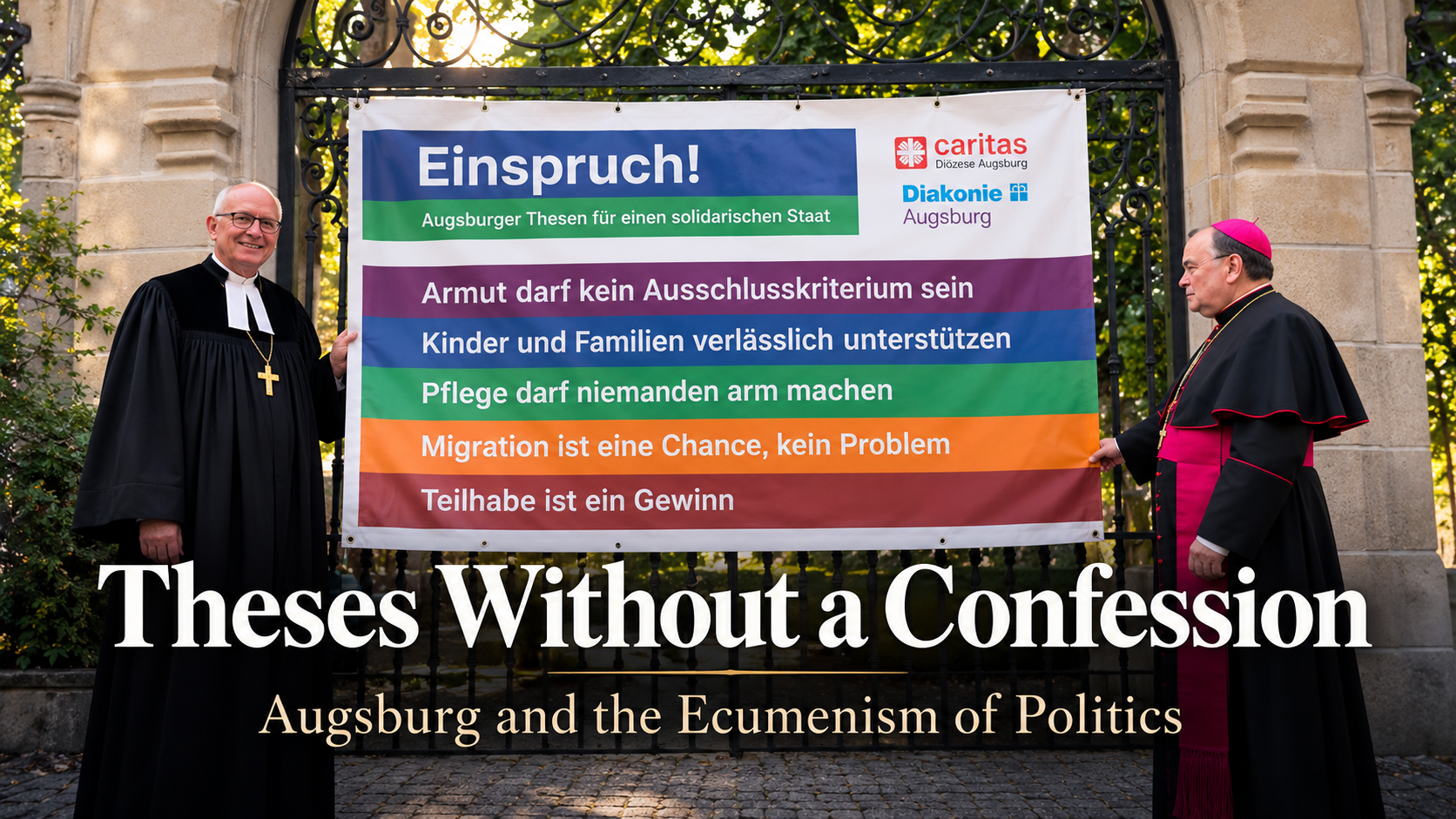
- Theses Without a Confession: Augsburg and the Ecumenism of PoliticsIn Augsburg, Catholic and Lutheran leaders have symbolically reposted theses on social issues like poverty and migration, reflecting Christian social teaching. This event highlights a growing divide where churches confidently address social policies while unresolved doctrinal differences remain. Cooperation on such issues is valuable but should not replace the pursuit of true Christian unity.
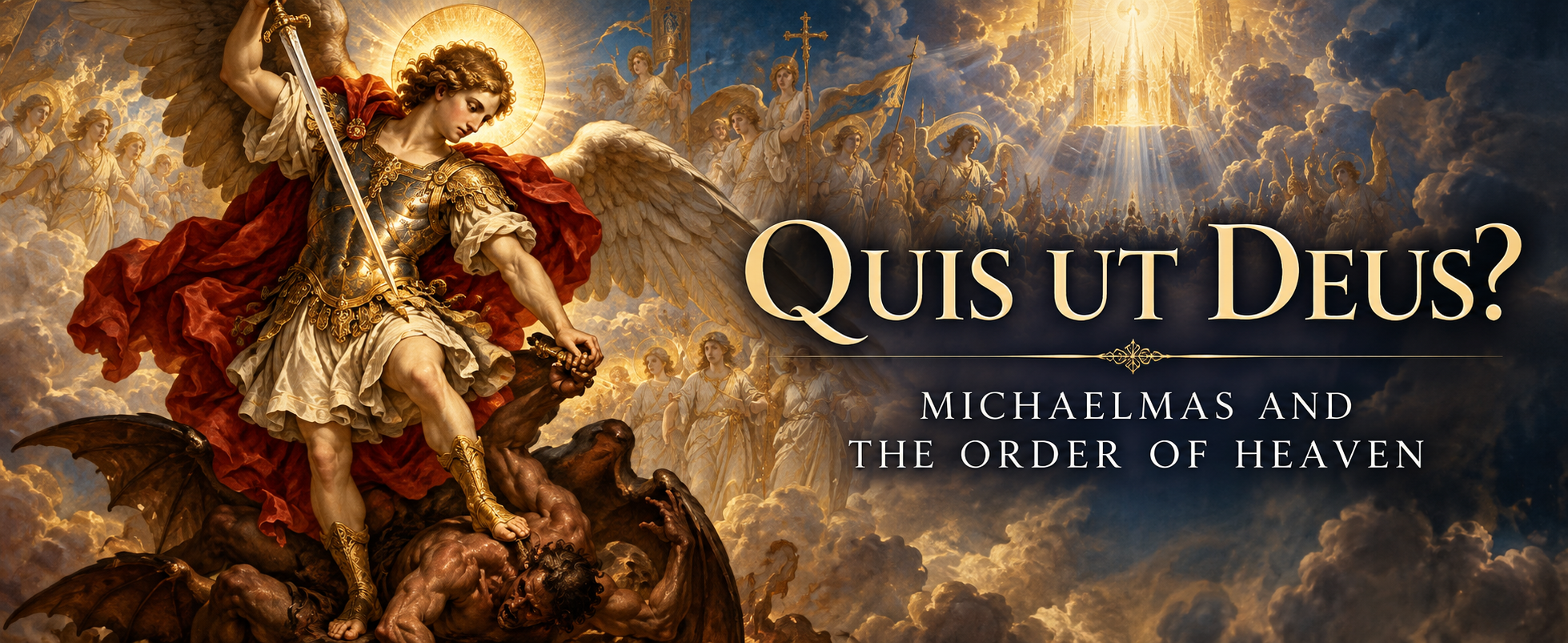
- Quis ut Deus? Michaelmas and the Order of HeavenThe Dedication of Saint Michael, celebrated on 29 September, highlights the Archangel’s role within divine order, illustrating humility and obedience before God. Rooted in ancient Roman traditions, the feast contrasts human pride with the recognition of God’s sovereignty. It underlines the importance of worship that connects earthly life to heavenly realities, centering around God’s presence.
- Today’s homily: The Dedication of S. Michael, ArchangelThe Apostles ask, “Who is greatest in the kingdom of heaven?” Saint Michael’s very name supplies the answer: Quis ut Deus? — “Who is like unto God?” From the angelic rebellion to Daniel’s vision of spiritual warfare, from Christ’s victory over Satan to the Guardian Angels and the worship surrounding the altar, the feast teaches that victory begins with humility, obedience and adoration. The Christian defeats the logic of Lucifer whenever he ceases to enthrone himself and kneels before God.
- Today’s Mass: September 29 Dedication of Saint Michael the ArchangelThe Feast of the Dedication of Saint Michael the Archangel highlights St. Michael’s role as the leader of heavenly armies and protector of the Church. He is revered for defeating evil spirits and is traditionally invoked for defence against sin. The liturgy honours his significant role alongside other angels in spiritual warfare and the protection of believers.
CURRENT EDITION


Today’s Mass Propers
- Today’s Mass: September 29 Dedication of Saint Michael the Archangel
 The Feast of the Dedication of Saint Michael the Archangel highlights St. Michael’s role as the leader of heavenly armies and protector of the Church. He is revered for defeating evil spirits and is traditionally invoked for defence against sin. The liturgy honours his significant role alongside other angels in spiritual warfare and the protection of believers.

Leave a Reply