
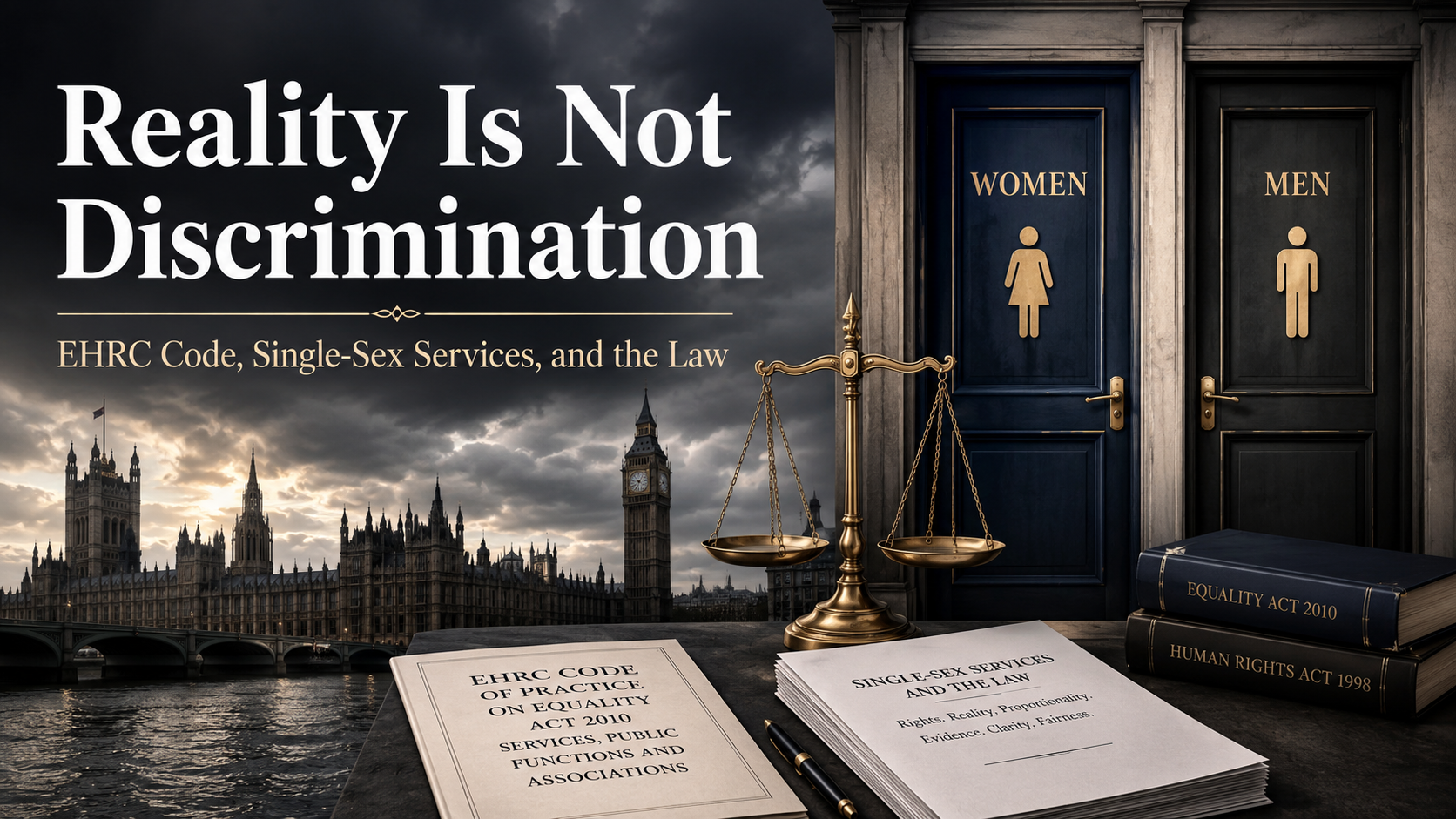
Reality Is Not Discrimination
The Good Law Project’s attack on the new EHRC Code mistakes protection from discrimination for an entitlement to enter opposite-sex spaces—and presents an arguable legal campaign as though it had already prevailed in court.

The Good Law Project has greeted the commencement of the Equality and Human Rights Commission’s revised Code of Practice with the language of emergency. The Code is “discriminatory”, “utterly unworkable in practice” and evidence that the Government is continuing its “attacks on trans human rights”. Service providers are warned that following it may expose them to legal action, while supporters are invited to finance further litigation against the EHRC.¹
That is campaigning, not dispassionate legal analysis. The Good Law Project is entitled to challenge the Code and to argue that particular passages overstate the law. It is entitled to describe the practical consequences as harmful. It is not entitled to obscure the distinction between an organisation’s preferred interpretation of equality and the interpretation of the Equality Act 2010 authoritatively given by the Supreme Court.
The Code comes into force across England, Scotland and Wales on 5 August 2026. It principally concerns services, public functions and associations, rather than the distinct statutory regimes governing employment and education. Its immediate purpose is not to invent a new law but to replace the 2011 Code, which had become seriously outdated after fifteen years of legislation and case law. The commencement order signed by the Equalities Minister does precisely what its title suggests: it brings the revised Code into force.²
The judgment that campaign rhetoric cannot repeal
Every responsible analysis must begin with For Women Scotland Ltd v The Scottish Ministers. In April 2025, five Supreme Court justices unanimously held that the words “sex”, “woman” and “man” in the Equality Act 2010 refer to biological sex. The Court’s conclusion was explicit: those words “mean—and were always intended to mean—biological sex”. It found that the competing interpretation would render important provisions of the Act “incoherent and unworkable”.³
This conclusion applies even where a person holds a Gender Recognition Certificate. Such a certificate continues to have legal effects under the Gender Recognition Act 2004, but it does not change a person’s sex for the purposes of the sex-based provisions of the Equality Act 2010.
The judgment did not declare trans people unprotected. Sex and gender reassignment remain separate protected characteristics. A trans person may bring claims involving gender-reassignment discrimination, indirect discrimination, victimisation and, where the relevant statutory provisions apply, harassment. A trans person may also suffer discrimination because of his or her actual or perceived sex. The Supreme Court stressed that its interpretation “does not remove or diminish” the protections available to trans people.³
The essential distinction is therefore not between people who possess rights and people who do not. It is between different protected characteristics and the legal consequences attaching to each. Protection against gender-reassignment discrimination does not convert a male person into a female person for the purposes of sex discrimination law. Nor does it transform access to every opposite-sex service into an enforceable right.
The Good Law Project’s argument repeatedly collapses that distinction. Exclusion from an opposite-sex service is described as exclusion from public life itself. Recognition of biological sex becomes “segregation”. Provision of an alternative facility becomes the creation of a degrading “third sex”. The statutory protection of women’s privacy is recast as an assault upon trans people.
That framing assumes the very proposition the Supreme Court rejected: that treating a trans woman with dignity requires the law to treat that person as female wherever sex matters.
“Not binding” does not mean legally irrelevant
The Good Law Project emphasises that the Code is “not binding”. In one limited sense this is correct. The Code itself says that it “does not impose legal obligations”. It is not primary or secondary legislation, cannot amend the Equality Act and cannot dictate the outcome of a future case. Only courts and tribunals can provide an authoritative determination of the law.⁴
Yet the campaign’s presentation is materially incomplete. This is a statutory Code prepared under the Equality Act 2006, approved by the Secretary of State, laid before Parliament and brought into force by statutory instrument. Section 15 of the 2006 Act provides that such a Code is admissible in legal proceedings and “shall be taken into account” whenever a relevant provision arises.⁵
A service provider cannot therefore dismiss it as an optional pamphlet. Following the Code will not provide an automatic defence, but it may help demonstrate that an organisation understood the law, identified the relevant interests and reached a proportionate decision. Ignoring it because an activist organisation insists that its own interpretation is superior may carry significant legal risk.
The rhetorical manoeuvre is conspicuous. When the Good Law Project wishes to discredit the Code, it is merely “non-binding” guidance. When it wishes to alarm its readers, the same document becomes an instrument capable of stripping an entire class of people of their civil rights. It cannot sensibly be both legally negligible and socially omnipotent.
Single-sex means single-sex
The Equality Act expressly permits separate and single-sex services. Schedule 3 permits a service to be provided only to one sex when the conditions specified by Parliament are met and the restriction is a “proportionate means of achieving a legitimate aim”. It separately permits proportionate treatment relating to gender reassignment in connection with such services.⁶
These are not loopholes smuggled into the Code by the EHRC. They are statutory provisions enacted by Parliament.
The Code explains their practical effect after For Women Scotland. A service provided to women and trans women, but not to other men, is not a single-sex service under the Equality Act. It is a mixed-sex service from which some male people are excluded. The Code states that such an arrangement is “very likely” to amount to unlawful sex discrimination against those excluded males and may also create discrimination or harassment issues for female users.⁴
This is the point at which much of the campaign rhetoric becomes conceptually evasive. A women-only service is one reserved to members of the female sex. If male people are ordinarily admitted, the service may still be called “women-only” by its provider, but the label no longer describes the service’s legal or material character.
That does not mean that mixed-sex provision is inherently unlawful. The Code expressly recognises mixed-sex services and permits them to operate alongside single-sex services. An organisation may offer private individual facilities, mixed provision, separate sessions or other arrangements appropriate to its premises and users. What it cannot coherently do is operate a mixed-sex service while relying upon statutory exceptions available only to genuinely single-sex provision.
The Good Law Project objects that the Code treats trans people as a “third sex”. It does nothing of the kind. The Equality Act recognises male and female sex, while gender reassignment is a separate protected characteristic. An individual, mixed-sex or supplementary facility does not create a third biological category. It provides a practical means of accommodating different needs without abolishing the distinction between male and female services.
The Code does not order universal exclusion
Nor does the Code impose a universal rule that every trans person must be expelled from both male and female facilities. It requires the provider first to determine what kind of service is being offered, why sex separation is needed and whether the arrangements are proportionate.
Where a person seeks access to a service intended for the opposite sex, the provider should consider whether that person’s needs can be accommodated without compromising the service’s single-sex nature. The Code gives examples including alternative sessions, mixed-sex provision and individual lockable rooms. It also recognises that alternative arrangements may be impossible because of the service’s purpose, physical constraints, the needs of users or disproportionate financial cost.⁴
The Code separately addresses a trans person’s access to the service corresponding to his or her biological sex. Exclusion from that service because of gender reassignment requires its own proportionality assessment. A trans man might, in particular circumstances, be excluded from a female service where his male presentation would reasonably cause distress to vulnerable female users. That conclusion cannot be assumed in every situation; the Code requires a case-by-case assessment.
For essential facilities such as toilets, the Code says it is “very unlikely to be proportionate” to leave a trans person with no service available at all.⁴ That is difficult to reconcile with the Good Law Project’s suggestion that the Code simply instructs organisations to cast trans people out of public life.
The final text also retreats from some of the more troubling implications of earlier proposals. It does not establish routine birth-certificate inspections. It states that enquiries about sex must be objectively justified, proportionate, discreet and respectful of privacy. It says that approaching individuals using incidental facilities such as toilets will ordinarily be neither practical nor appropriate.
The Code also recognises an evidential difficulty which campaigners tend to omit: no British document provides universally reliable proof of biological sex. Passports and driving licences may be altered, while a replacement birth certificate issued after a Gender Recognition Certificate records acquired gender. The Code therefore says that demands for documentary proof will ordinarily be impractical and disproportionate.⁴
There remains a legitimate danger of intrusive questioning and mistaken challenges to women whose appearance does not conform to stereotypes of femininity. The Government’s own equality assessment recognises this. That danger should be addressed through restrained policies, staff training, private handling of genuine concerns and sanctions for harassment. It does not establish that women must surrender single-sex provision because some organisations might administer it badly.
What the High Court actually decided
The Good Law Project’s strongest legal objection concerns the Code’s statement that a service admitting women and trans women while excluding other males is “very likely” to constitute sex discrimination. It relies upon its February 2026 High Court challenge to the EHRC’s earlier interim guidance.
Mr Justice Swift considered the hypothetical example of materially equivalent male and female lavatories. He accepted that there was scope for a strong argument that permitting trans women to use the female lavatory while requiring other males to use the male lavatory might be different treatment without being less favourable treatment. He added the crucial qualification: “the circumstances of the case would be decisive”.⁷
This is a real point. Direct sex discrimination requires not merely different treatment but less favourable treatment. Where two banks of lavatories are materially equal in quality, availability and location, a male claimant excluded from the facility labelled female might struggle to establish the necessary detriment. The Code’s phrase “very likely” may therefore prove too categorical when applied to every conceivable facility.
That does not produce the conclusion claimed by the Good Law Project.
The High Court did not declare trans-inclusive female lavatories lawful in every circumstance. It did not hold that a mixed-sex facility becomes legally single-sex merely because the provider calls it female. It did not quash the EHRC’s guidance. It did not establish that compelled alternative provision is inherently discriminatory.
Mr Justice Swift held that the EHRC’s proposition was “not necessarily wrong”, because the answer would turn upon the relevant facts. He concluded that the interim guidance contained no legal error and dismissed the challenge.⁷
The judgment also rejected the suggestion that the EHRC guidance simply required trans people to use facilities corresponding to their biological sex. The judge called that “not a reasonable reading” and emphasised that the statutory proportionality test remained applicable. He observed that using a unisex rather than a single-sex lavatory would only rarely amount to less favourable treatment and that practical problems with labelling accessible facilities could be addressed by changing their designation.⁷
The Good Law Project may appeal and may ultimately persuade a higher court that the final Code overstates the likelihood of discrimination in a particular category of case. Until then, it should distinguish between a legal argument it continues to advance and a legal proposition already established. Its article does not do so.
There is also a serious distinction between materially equivalent enclosed lavatories and services involving undressing, intimate care, communal sleeping, medical examination, detention, trauma or physical vulnerability. A conclusion concerning private toilet cubicles cannot automatically determine the lawful policy for changing rooms, communal showers, hospital wards, domestic-abuse refuges or residential accommodation.
Equality law requires attention to context precisely because these situations are not interchangeable.
Consultation did occur
The Good Law Project says there was “no proper consultation” with those most likely to be affected. “Proper” is evaluative, and there are grounds on which the process can be criticised. The Code nevertheless followed not one but two formal consultations.
The first ran for thirteen weeks between October 2024 and January 2025. After the Supreme Court judgment required substantial revisions to the provisions concerning sex and gender reassignment, the EHRC conducted a further six-week consultation between May and June 2025, with additional time for Welsh-language submissions.
The second consultation received 51,736 responses. Of these, 41,115 came from individuals, 2,539 from organisations and 396 from legal professionals. More than 29,000 respondents identified gender reassignment as relevant to their answers, more than 31,000 identified sex and more than 10,000 identified disability. The EHRC also met organisations representing trans rights, human rights and women’s rights, as well as parliamentarians from Westminster, Holyrood and the Senedd.⁸
One may question the consultation’s design, the weight given to different responses or the use of a GPT-4.1-based analysis system to assist in categorising an extraordinary volume of material. One may argue that particular objections were inadequately answered. It is nevertheless misleading to leave readers with the impression that affected groups were never consulted.
The parliamentary process deserves stronger criticism. The Code was laid before Parliament for the statutory forty-day scrutiny period, which expired on 9 July. There was no substantive debate and no recorded vote on the instrument. An Early Day Motion seeking its rejection attracted 169 signatures, two of which were later withdrawn.⁹
An instrument touching privacy, dignity, sex, disability, religious observance and access to public services merited proper parliamentary debate. The Government chose legal sufficiency over democratic seriousness. That failure should not be confused with proof that the Code itself contradicts the Equality Act.
Negative consequences are not an admission of illegality
The Government’s equality impact assessment candidly acknowledges possible harms. It identifies risks of involuntary disclosure, conflict over limited accessible facilities, increased scrutiny of gender-nonconforming women, exclusion from both an opposite-sex service and—in exceptional circumstances—a service for one’s own sex, and difficulty in providing alternative facilities where money or space is limited.
It concludes that the likely impact upon the protected characteristic of gender reassignment is negative across the three limbs of the Public Sector Equality Duty.¹⁰ The Good Law Project is entitled to quote and scrutinise that conclusion. It is not entitled to turn it into a governmental confession that the Code is unlawful.
An equality assessment exists because a policy or legal clarification may affect protected groups differently. The same document records positive consequences for the protected characteristic of sex, including clearer access to services that are genuinely sex-based. It also states that accurate guidance can reduce unlawful conduct by helping organisations balance the needs of different users.¹⁰
A women’s refuge may benefit female victims while excluding males. A female sporting category may protect fair competition while restricting male participation. A single-sex changing room may protect privacy while requiring alternative provision for some users. The existence of a disadvantage does not answer the legal question. Parliament expressly adopted tests of legitimate aim and proportionality because rights and interests sometimes conflict.
The Good Law Project’s rhetoric implicitly treats one group’s disadvantage as conclusive while rendering the interests of other groups negotiable. Women’s privacy becomes discomfort. Religious modesty becomes prejudice. A lesbian association’s freedom of association becomes exclusion. The needs of disabled people become a problem to be managed after accessible facilities have been repurposed.
That is not a neutral conception of equality. It is a hierarchy of protected interests disguised as universal compassion.
The real source of the alleged “unworkability”
Implementation will not always be easy. Some buildings lack space for individual facilities. Small charities may lack funds. Employees may fear handling complaints incorrectly. Poorly designed policies may embarrass trans people, encourage challenges based upon appearance or overload toilets intended for disabled users. The Code itself cannot remove every conflict produced by constrained premises and competing needs.
But much of the alleged unworkability arises from policies constructed before the Supreme Court judgment. Institutions were encouraged to believe that a service could remain female-only while routinely admitting males who identified as women. They were told that sex could be replaced by gender identity without legal or practical consequence. When the resulting policies collide with the statutory meaning of sex, reality is blamed for the incoherence produced by its earlier denial.
The humane response is neither indiscriminate exclusion nor the abolition of single-sex boundaries. It is clear policy, proportionate decision-making, private and courteous handling of disputes, adequate alternative provision where reasonably possible, and serious regard for every affected group.
Trans people should not be humiliated, gratuitously exposed or denied essential services. Women should not be required to surrender bodily privacy or sex-based protection. Disabled people should not discover that already inadequate facilities have become the default solution to a conflict created by others. Religious women should not be told that their modesty is merely ideological. Victims of male violence should not be required to accept males into intimate therapeutic or residential settings because an activist organisation considers their boundary discriminatory.
Dignity is not a scarce commodity, but particular spaces necessarily are. Equality law exists to regulate those realities, not to abolish them through vocabulary.
Reality is not an attack
The Good Law Project begins with a legitimate concern: trans people remain vulnerable to hostility, harassment and social exclusion. It ends with an illegitimate conclusion: that any legal recognition of biological sex, or any restriction upon access to an opposite-sex service, is itself an assault upon trans existence.
The revised Code is not beyond criticism. Its “very likely” formulation may be tested in litigation. Its implementation will require care. Parliament should have debated it. The Government must ensure that organisations do not use it as an excuse for humiliation or arbitrary exclusion.
None of this alters the central legal fact. The Equality Act protects sex because sex matters. It protects gender reassignment because trans people also possess enforceable rights. Those protections are distinct, and neither can be interpreted by simply erasing the other.
A mixed-sex service does not become single-sex because its provider changes the sign on the door. An opposite-sex space does not become a civil right because entry is personally desired. An adverse consequence is not automatically unlawful discrimination. A human being’s dignity does not confer authority to redefine the sex of everybody else.
Reality is not discrimination. A boundary is not hatred merely because someone wishes to cross it. Equal treatment does not require the law to declare that males are female, that women’s services need not be for women, or that protecting one group’s privacy is an attack upon another group’s humanity.
¹ Good Law Project, “‘Discriminatory’ and ‘unworkable’ trans guidance to come into force”, 15 July 2026.
² The Equality Act 2010 (Code of Practice on Services, Public Functions and Associations) (Commencement) Order 2026, SI 2026/788, arts 1–2.
³ For Women Scotland Ltd v The Scottish Ministers [2025] UKSC 16, paras 2–3, 248–265.
⁴ Equality and Human Rights Commission, Equality Act 2010: Code of Practice for Services, Public Functions and Associations, 2026, paras 1.5–1.7, 13.130–13.180.
⁵ Equality Act 2006, s.15.
⁶ Equality Act 2010, Schedule 3, Part 7, paras 26–28.
⁷ R (Good Law Project Ltd and others) v Commission for Equality and Human Rights [2026] EWHC 279 (Admin), paras 61–77.
⁸ Equality and Human Rights Commission, Consultation 2 Report: Code of Practice for Services, Public Functions and Associations, 21 May 2026.
⁹ House of Commons, Early Day Motion 240, “Draft Code of Practice on Services, Public Functions and Associations”, 2026–27 Session.
¹⁰ Office for Equality and Opportunity, Equality Impact Assessment: Equality Act 2010 Code of Practice for Services, Public Functions and Associations, July 2026.
RELATED ARTiCLES


LATEST ARTICLES
- 25.10.26 Nuntiatoria CXXIX: CHRISTUS REXThe text discusses the relationship between Christ’s kingship and authority within the Church amidst contemporary challenges. It contrasts ecclesiastical power with genuine faith, emphasising that authority must protect divine truth rather than alter it. The witness of imprisoned priests illustrates the enduring significance of fidelity to Christ over institutional conformity.
- THE DOMESTIC CHURCH: 25 October – 2 November 2026 A Home with Room for Heaven: Preparing for All Saints and All SoulsThe content outlines a week’s plan for traditional Catholic families to prepare for the feasts of All Saints and All Souls. Emphasising daily prayers, remembrance of the deceased, and engagement with children’s activities, it aims to integrate Catholic customs into family life, enriching spiritual practices and fostering a shared faith experience.
- ORDO w/c 25.10.26The text outlines the liturgical calendar for the last week of October and the beginning of November, highlighting key celebrations. Notable events include the Feast of Christ the King, St Evaristus, the Vigil of Saints Simon and Jude, and the Feast of All Saints, emphasising themes of holiness, unity in faith, and the Church’s teachings.
- Christ the King: The Sovereignty of the Crucified RedeemerThe Mass of Christ the King articulates core Catholic beliefs about Jesus’ divine authority, redemptive sacrifice, and the essence of His Kingdom. It emphasises Christ as Prophet, Priest, and King, whose sovereignty is inseparable from His mission of reconciliation, calling the faithful to acknowledge His authority and embrace moral duties rooted in divine truth.
- THE CONSECRATION OF THE HUMAN RACE TO THE SACRED HEART OF JESUSOn 25 October, traditional Catholics will renew the Consecration of the Human Race to the Sacred Heart of Jesus, affirming Christ’s sovereignty over humanity. This act, historically significant, highlights the relationship between divine authority and human responsibility, countering contemporary misunderstandings of faith and moral truth, which increasingly fade from Catholic consciousness.
CURRENT EDITION


Today’s Mass Propers
- Today’s Mass: October 23 Our Holy Redeemer
 The Feast of the Most Holy Redeemer, celebrated on the third Sunday of July or 23 October, originated in Venice in 1576 to give thanks for plague relief. The solemn observance features joyful Mass and prayers, honouring the gift of Redemption through Christ. White vestments symbolise joy and gratitude for divine blessings.



Leave a Reply